
What a Mast Cell Tumor Looks Like on a Dog: A Practical Guide for Spotting Suspicious Lumps

If you’ve found a lump on your dog, the hardest part is usually not touching it — it’s deciding whether it can wait. Mast cell tumors are tricky because they do not have one “classic” look. Some are small, red bumps. Some are soft and under the skin. Some look irritated, swollen, or like a bug bite that never quite settles down.
That uncertainty matters because appearance alone cannot tell you whether a lump is harmless or serious. The goal here is not to diagnose by sight. The goal is to help you recognize when a lump looks suspicious enough to book a veterinary exam rather than keep guessing at home.
What a Mast Cell Tumor Can Look Like on a Dog
A mast cell tumor can show up as a raised bump on the skin or just under it. In some dogs, it looks like a small, well-defined nodule. In others, it looks more like a swollen patch or a lump that blends into the surrounding tissue. They may be solitary or, less commonly, multiple, and they can range from a few millimeters to several centimeters in size.
The color can vary too. Some mast cell tumors are red, irritated, ulcerated, bleeding, bruised, or swollen. Others are not dramatic at all. They may look like a plain skin lump, a hairless bump, or a thickened area of skin that would not immediately alarm most owners.
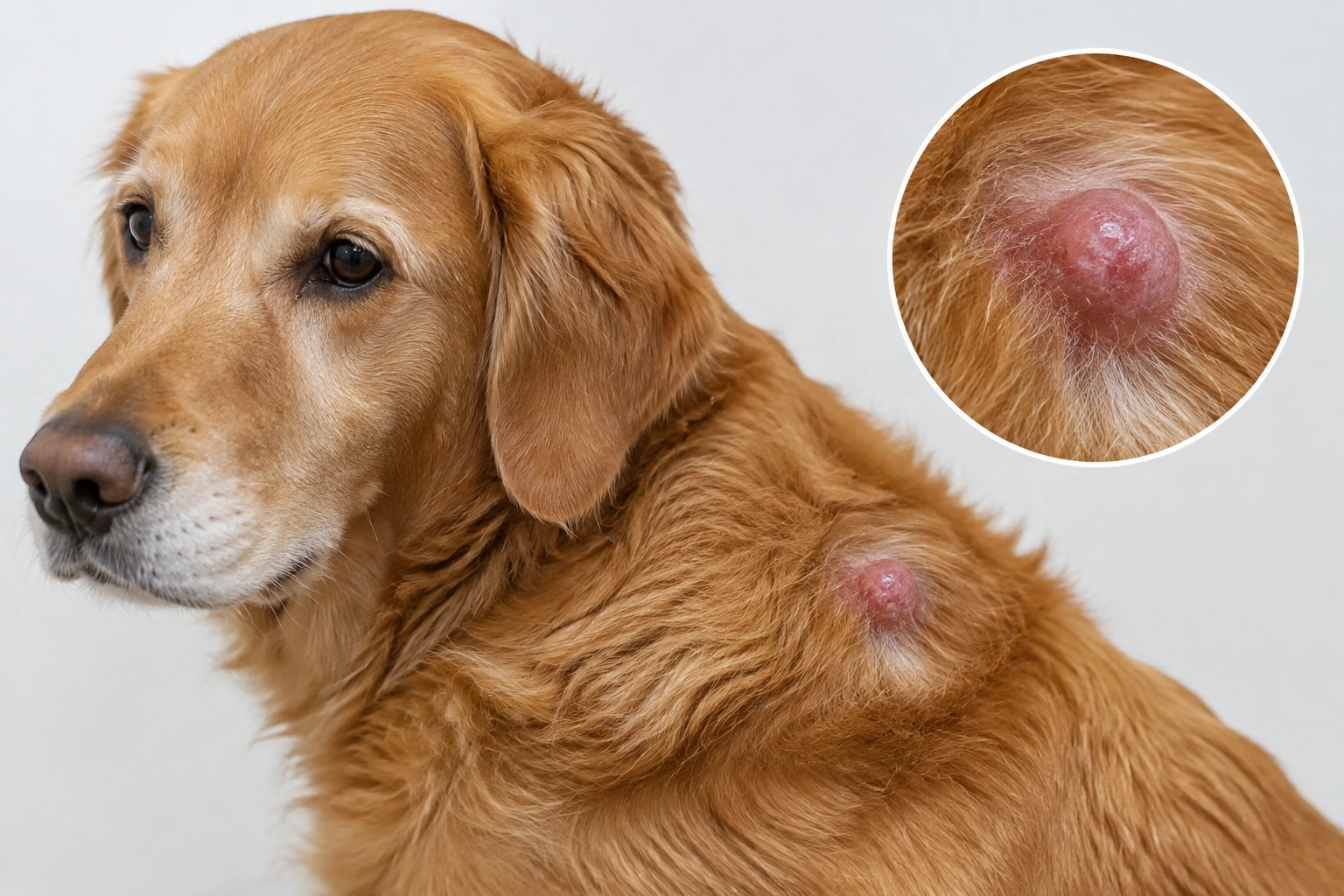
That range is exactly what makes them hard to spot early. A mast cell tumor can look inflamed and obvious, or it can look ordinary enough that someone assumes it is a lipoma, cyst, or wart.
The “ordinary lump” problem
The most misleading mast cell tumors are the ones that do not look obviously sick. A small, smooth, skin-colored bump can seem harmless, especially if your dog is acting normal. But a calm-looking lump is not proof that it is benign.
In practical terms, the visual question is not “Does this look like cancer?” The better question is “Does this lump look different enough from my dog’s usual skin that it should be tested?”
Why Mast Cell Tumors Are Hard to Identify by Sight Alone
A mast cell tumor can mimic many other skin and under-skin masses. It may feel soft or firm. It may be raised or flat. It may be painful, itchy, or not seem to bother the dog at all.
That is why sight alone is unreliable. A lump that looks like a lipoma can still be a mast cell tumor. A red bump that looks like an insect bite can be something more serious. A small wart-like lesion can also be misleading.
This is the main decision point for owners: you cannot safely rule out a mast cell tumor just because it looks mild.
Why “not painful” is not reassuring
Many people assume that a painless lump is less concerning. Sometimes that is true. Often it is not enough information. Mast cell tumors do not have to hurt to matter, and some dogs show almost no discomfort until the mass is irritated or manipulated.
That means a calm-looking lump should still be treated as a “needs testing” problem if it is new, changing, or unusual for your dog.
Common Ways Mast Cell Tumors Change Over Time
One of the most useful clues is not how the lump looks today, but how it behaves over time.
Some mast cell tumors stay the same size for months or years. Others grow quickly over days or weeks. Some even increase and decrease in size, which can make them seem like something temporary such as an allergic reaction or insect bite.
They can also become more obvious after the dog scratches, licks, or bites the area. That self-trauma can make the skin look angrier than the tumor itself would suggest.
Changes that should make you pay closer attention
Watch for:
– a lump that grows quickly
– a bump that seems to shrink and swell
– redness that spreads
– a surface that becomes crusted or ulcerated
– bleeding after minor rubbing or scratching
– a dog repeatedly licking, biting, or scratching the spot
A lump that changes is more concerning than one that has stayed boring and unchanged for a long time. Change is the clue that should move you from observation to veterinary testing.
Where Mast Cell Tumors Commonly Appear on Dogs
Mast cell tumors can occur anywhere on a dog’s body. They are commonly found on the trunk and limbs, but they can also appear on the head, ears, nose, paws, tail, and eyelids.
That wide range matters because the location can affect how noticeable the mass is and how easily it gets irritated. A lump on the leg may get rubbed during movement. A lesion on the eyelid or paw may be more likely to get licked or scratched. A bump on the trunk may be hidden until it changes enough to feel obvious.
Why location matters in real life
A lump in a high-friction area often becomes inflamed faster. That does not prove it is a mast cell tumor, but it does increase the chance that the skin around it will look red, swollen, or traumatized.
If you find a lump in a spot that is hard to see daily, take a photo and measure it. Small changes are easy to miss when you are only going by memory.
What Mast Cell Tumors Can Be Mistaken For
This is where many owners get stuck. Mast cell tumors can look like benign or less urgent skin problems.
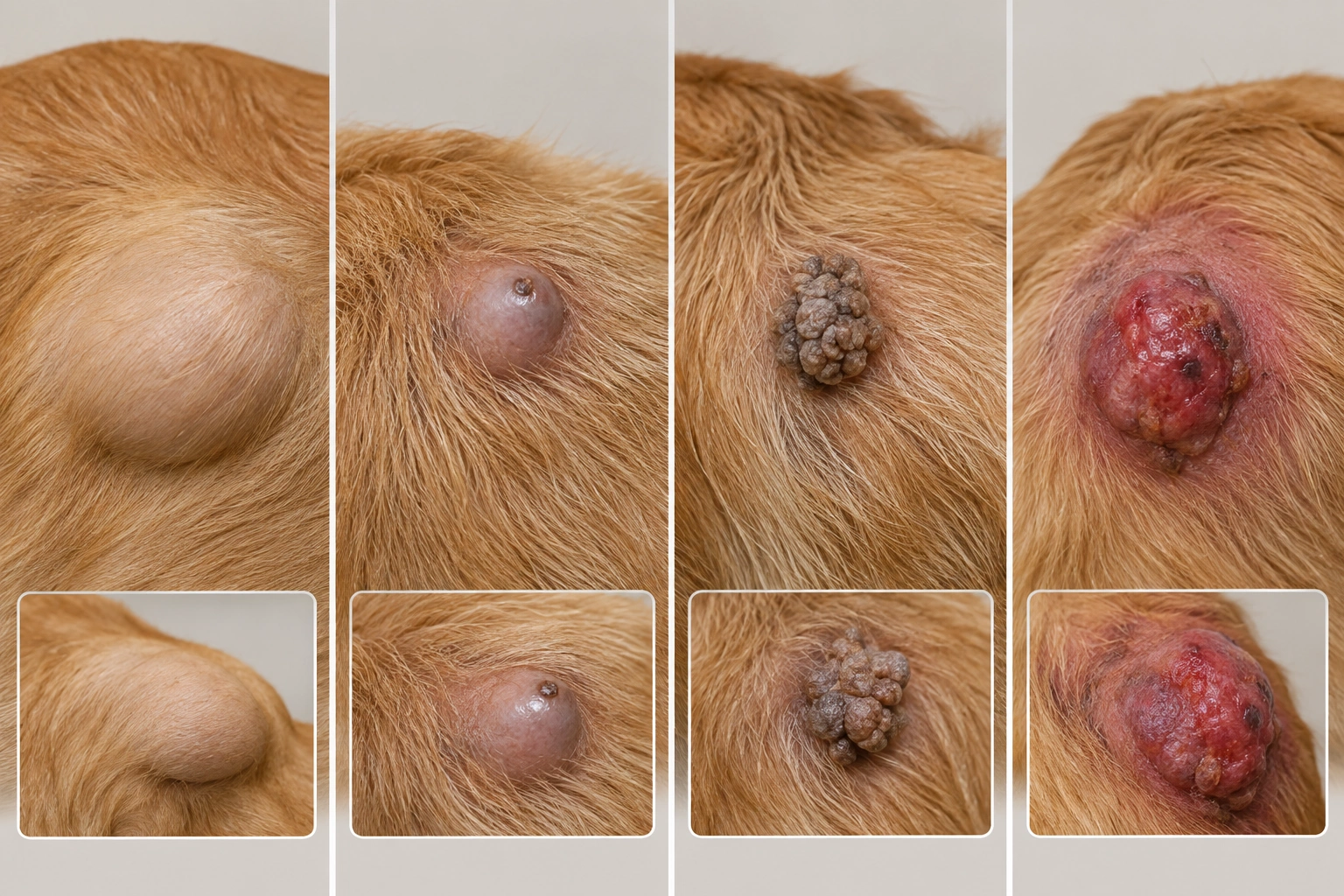
| Lookalike | How it may appear | What tends to differ | Why this matters |
|---|---|---|---|
| Lipoma | Soft, round, usually under the skin | Often feels more movable and less irritated | A soft lump is not automatically harmless |
| Cyst | Smooth bump, sometimes with a pore or thickened feel | May stay stable or drain material | Some cyst-like lumps still need testing |
| Wart or skin tag | Small, raised, sometimes hairless | Often looks more surface-level | A wart-like look does not rule out MCT |
| Insect bite | Red, swollen, itchy bump | May improve quickly | Mast cell tumors can also wax and wane |
| Allergic swelling | Puffy, irritated area | Often more diffuse | A localized mass that keeps returning is concerning |
The most dangerous mistake is assuming that a familiar-looking lump must be familiar in cause. Mast cell tumors can be deceptive.
Lipoma versus mast cell tumor
Lipomas are often soft and movable under the skin. Mast cell tumors can also be soft, especially when they sit in the subcutaneous tissue. That overlap is why “feels like a lipoma” should never be treated as a diagnosis.
If a lump seems like a lipoma but is new, growing, or oddly firm in parts, it deserves a vet exam.
Cyst, wart, or skin tag?
Surface lumps can be misleading too. A small hairless nodule or thickened patch may look like a wart or skin tag. But mast cell tumors can present in those same ways, especially when they are small or not yet very inflamed.
If it is new, changing, or not clearly one of your dog’s long-standing harmless bumps, have it checked.
Which Features Make a Lump More Suspicious
Some features push a lump into the “don’t wait too long” category.
Red flags to take seriously
- rapid growth
- waxing and waning size
- redness or swelling
- ulceration or bleeding
- persistent itchiness
- repeated licking, biting, or scratching
- a lump that seems attached or poorly defined
- a mass that looks different from your dog’s other bumps
If several of these show up together, the odds of “just watch it” go down.
A practical rule for owners
If the lump is new and changing, assume it needs a veterinary exam.
If it is red, ulcerated, or causing your dog to bother it, treat it as more urgent.
If it has been there a long time and is truly unchanged, it still may need testing, but it is less likely to require same-day action unless something changes.
That framework is safer than trying to guess from appearance alone.
When to Schedule a Vet Exam vs Monitor Briefly
A short period of monitoring can make sense when a lump is tiny, unchanged, and your dog is otherwise comfortable. But monitoring should be active, not casual.
Monitor briefly if:
- the lump is very small
- it has not changed
- your dog is not licking or scratching it
- there is no redness, bleeding, or ulceration
- you can measure and photograph it
Book a veterinary exam promptly if:
- the lump is new
- the lump is growing
- the lump seems to come and go
- the skin is red or irritated
- your dog is bothering it
- it bleeds, crusts, or opens
- you are unsure what you are looking at
If you are debating whether to “wait and see,” remember this: mast cell tumors can stay quiet for a while, then change quickly. Waiting only helps if the lump is truly stable.
How Vets Confirm Whether a Lump Is a Mast Cell Tumor
A veterinarian usually starts with a fine needle aspirate, which collects a small sample from the lump for cytology. This is often the first useful test because mast cell tumors frequently have recognizable cells.
In many cases, this simple needle sample can give a strong answer quickly. If the sample is unclear or the mass has unusual features, a biopsy and histopathology may be needed for confirmation. If the fine needle aspirate is positive, your vet may also recommend staging tests or additional biopsy/histopathology depending on the case.
Why testing matters more than guessing
A lump’s appearance can point in the right direction, but it cannot confirm the diagnosis. That is why a “looks like” judgment is not enough. The vet is looking for the actual cell type, not just the surface look of the mass.
For a general overview of how mast cell tumors behave in dogs, the North Carolina State Veterinary Hospital has a helpful summary of the different ways these tumors can appear and change. The American College of Veterinary Surgeons also explains why simple needle aspirates are often the first diagnostic step.
What Not to Do at Home While You Wait
Do not squeeze, pop, lance, or cut into the lump. Do not apply human creams, steroid products, or acne treatments unless your veterinarian specifically tells you to.
That advice is not just about avoiding infection. Mast cell tumors can become more irritated when handled, and scratching or biting can make the skin look worse than it already is. If you keep poking at it, you may also delay a proper diagnosis.
A better home approach
Until your appointment:
– take a clear photo
– measure the lump
– note the date you first noticed it
– watch for changes in size, color, or texture
– prevent chewing or scratching if needed
That gives your vet something useful to work with and keeps the area from being needlessly traumatized.
Key Takeaway: Treat Suspicious Lumps as “Needs Testing,” Not “Needs Guessing”
If a lump looks unusual, changes size, becomes red or itchy, or starts to ulcerate, it should be checked by a veterinarian. Mast cell tumors can look like many different things, including harmless bumps, so appearance alone is not enough to reassure you.
The safest rule is simple: new, changing, or irritated lumps deserve a vet exam, not a home diagnosis. A fine needle aspirate is often the first step, and it is far more reliable than trying to decide by eye.
For a broader picture of how these tumors can present, the VCA Hospitals mast cell tumor guide is another solid reference. If you want a broader look at why some masses can be deceptive, the Morris Animal Foundation offers a useful overview of the many forms these tumors can take.
FAQs
Can you tell if a lump is a mast cell tumor just by looking at it?
Not reliably. Mast cell tumors can look red, swollen, hairless, soft, or almost ordinary. Testing is what confirms it.
Are mast cell tumors hard or soft?
They can be either. Some feel firm and raised; others are soft and ill-defined under the skin.
Can mast cell tumors be itchy?
Yes. Some are itchy, and dogs may scratch, lick, or bite at them, which can make the skin look more inflamed.
Do mast cell tumors change size?
They can. Some stay stable for a long time, while others grow quickly or seem to wax and wane.
What test usually comes first?
A fine needle aspirate is often the first practical test because it can identify mast cells from a small sample.