
How to Break a Dog from Biting Strangers: A Practical Safety and Training Guide

If your dog has snapped, lunged, or bitten at unfamiliar people, treat it as a safety problem first and a training problem second. That order matters. The immediate goal is not to “prove” your dog can handle strangers. It is to prevent another incident while you figure out why the dog is reacting and what level of help you need.
For Border Collies, this can be especially tricky because many are alert, fast to notice movement, and quick to react when they feel pressured. That does not mean the breed is doomed to stranger issues. It does mean you need a plan that respects sensitivity, distance, and control.
Why Dogs Bite Strangers in the First Place
A dog does not usually bite strangers for one single reason. The same outward behavior can come from fear, territorial pressure, reactivity, pain, or over-arousal. If you guess wrong, the fix often fails.
Fear-based biting
A fearful dog is trying to increase distance. You often see backing away, freezing, tucked body posture, whale eye, lip licking, or a growl that says, “Please don’t come closer.” If the person keeps approaching, the dog may snap or bite to make the threat stop.
This pattern is common in dogs with poor socialization, rescue dogs with unknown history, or dogs that have been pushed into greetings too often. For example, a dog that hides behind the owner when guests enter, then snaps if a visitor reaches over its head, is often acting out of fear rather than defiance.
Territorial or barrier-related biting
Some dogs react hardest at the fence, window, front door, or gate. The trigger is not always “a stranger” in general. It is a stranger crossing into the dog’s perceived space. Delivery workers, visitors at the door, and people near a car or yard often bring this out.
A dog that rushes the front window when someone walks up the path, or barks and snaps at the gate when a neighbor stops to chat, is showing a boundary-based pattern. The dog may be calm elsewhere but highly defensive at home.
Reactive or over-aroused biting
Some dogs are not trying to protect space so much as they are too activated to think clearly. They may bark, spin, lunge, and then snap when the arousal peaks. Border Collies can fall into this pattern when they are under-exercised, overstimulated, or repeatedly exposed to trigger-heavy situations without enough control.
In practice, this can look like a dog that does fine until a jogger passes, a child runs by, or several strangers appear at once. The dog is not necessarily fearful of people; it may be reacting to motion, excitement, or the buildup of stress.
Pain or illness-related biting
A dog that suddenly starts biting strangers, especially if the behavior is new or escalating, needs a veterinary check. Pain can make a dog less tolerant of handling, looming, or surprise contact. Neurological or sensory changes can also alter behavior. If the pattern changed quickly, do not assume it is “just training.”
First Priority: Prevent Another Bite Today
The first 24 hours after an incident should be about management, not correction. Your dog needs fewer opportunities to practice the behavior, not more chances to “learn a lesson.”
First-24-hours checklist
Use this as a short-term reset after a bite or near-bite incident:
- Separate the dog from strangers immediately. Use a closed room, gate, crate only if the dog is already relaxed in it, or another secure barrier.
- Restrict access to trigger areas. Block the front door, front yard, fence line, hallway, or any place where the incident happened.
- Pause visitor access. No guests, no “quick introductions,” and no surprise drop-ins.
- Set a temporary management plan. Decide who handles the dog, when the dog moves, where the dog rests, and how strangers will be kept out of reach.
- Avoid rehearsals. No door greetings, no fence patrols, and no sidewalk encounters while the dog is unstable.
- Watch for pain or illness clues. If the behavior is sudden, severe, or out of character, schedule a veterinary check before starting training.
- Document what happened. Note who was there, what triggered the incident, and what the dog did before the bite or lunge.
Put distance between the dog and strangers
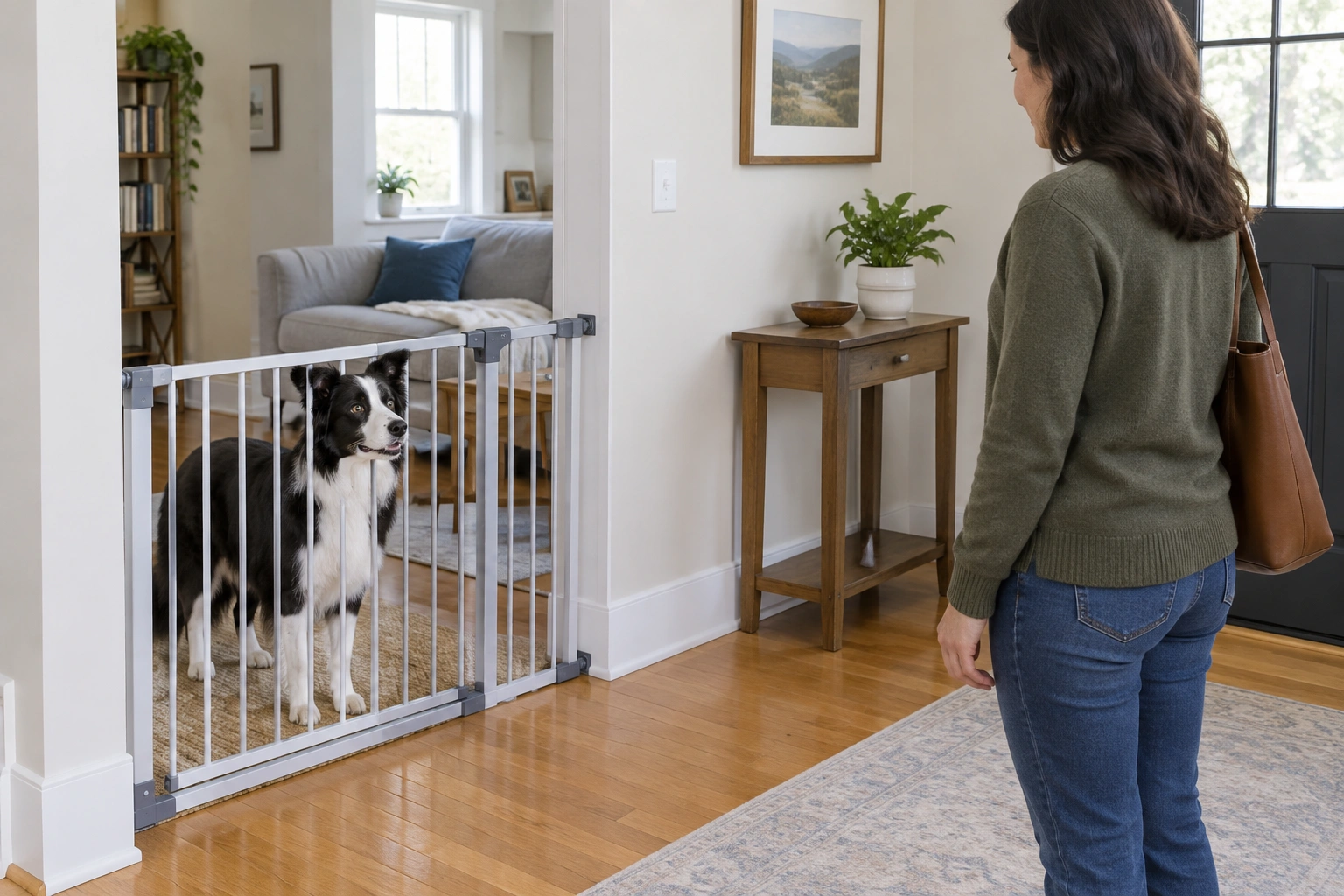
No free access to visitors, door answers, sidewalk greetings, or fence-line interactions while the dog is unstable. Use closed doors, baby gates, crates only if the dog is already calm in them, and leash control when moving through shared spaces.
Stop surprise greetings
Tell family, guests, and neighbors not to approach, reach for, or speak directly to the dog. No bending over the dog. No hand-in-face introductions. No “let the dog get used to me” pressure.
Control the environment before the dog moves
If the dog reacts at the front door, create a routine: dog behind a barrier, visitor enters, dog remains separated until calm. If the dog reacts in the yard, do not let the dog patrol the fence unsupervised. If the dog reacts on walks, avoid crowded routes.
Use management as a training tool, not a punishment
Management is what keeps everyone safe while the behavior plan is underway. It is not “giving in.” It is how you stop rehearsal and lower risk.
For practical guidance on safe dog handling and behavior basics, the ASPCA’s dog behavior resources are a useful starting point, especially if you need a plain-language overview to share with family members.
How to Read Warning Signs Before a Bite
Most bites are preceded by signals. The problem is that people often miss them because the dog is still technically “quiet.”
Watch for these changes:
- freezing or going still
- stiff body posture
- hard staring
- closed mouth after panting
- lip lifting or a brief snarl
- head turning away with the body staying rigid
- backing up while keeping eyes on the person
- low growl, then silence
- sudden pounce or lunge after a pause
A growl is not the failure point. It is useful information. If you punish the warning, you may remove the signal without removing the emotion. That is a bad trade, because then the next warning may be shorter or absent.
Fear-Based vs Territorial vs Reactive Biting: How to Tell the Difference
This comparison helps you choose the right first response.
| Pattern | What it looks like | Likely trigger | Best first response | Escalation level |
|---|---|---|---|---|
| Fear-based | backing away, freezing, growling, snapping if approached | being crowded, reached for, or cornered | increase distance, avoid forced greetings, use counterconditioning | moderate to high if the dog feels trapped |
| Territorial/barrier-based | barking, charging fence or door, snapping at boundary | strangers near home, car, yard, gate | block access, manage sightlines, reduce rehearsal at boundaries | moderate, can become high at entrances |
| Reactive/over-aroused | barking, spinning, lunging, then snapping | fast movement, excitement, repeated trigger exposure | lower arousal, create distance, structured training | moderate, often worsens with chaos |
| Pain-related | sudden change, touch sensitivity, unusual irritability | handling, looming, movement, surprise contact | veterinary evaluation first | high if ignored |
In practice, the simplest way to sort the pattern is to ask: does the dog seem worried, guarding, overexcited, or suddenly uncomfortable? If the dog is trying to make the stranger go away, back up and create space. If the dog is guarding a place, change the environment. If the behavior changed suddenly, rule out pain before you train harder.
Immediate Management Tools: Leash, Distance, Barriers, and Controlled Access
Training cannot work if the dog keeps biting in the middle of practice. Management prevents that.
Leash handling
Use a leash to control movement, but do not use it to drag the dog into contact. Tight leash pressure can increase frustration and make a reactive dog feel trapped. Keep the line loose enough for normal movement but short enough to prevent rushing forward.
Distance thresholds
Your dog needs to stay far enough from strangers that it can notice them without tipping into panic or explosion. That distance is your starting point. If the dog cannot eat, think, or respond to cues, you are too close.
Barriers
Baby gates, closed doors, exercise pens, fences, and parked cars can all buy you time and space. For some dogs, a barrier is the difference between a manageable setup and a bite.
Controlled access
Do not let strangers “test” the dog. Every uncontrolled greeting makes the pattern stronger. Instead, decide in advance who can enter, where they stand, and how long the interaction lasts.
A Border Collie that barks and lunges at delivery workers near the gate may need a no-contact zone at the front of the property, not more exposure.
Should You Use a Muzzle? Fitting, Conditioning, and Public Safety Trade-Offs
If there is any realistic bite risk, a basket muzzle is often the safer choice during training and in public. It is not a sign of failure. It is a safety tool.
Why a basket muzzle
A basket muzzle allows panting and drinking more easily than a tight fabric wrap. That matters because a dog that cannot pant properly can overheat or become more stressed. A properly fitted basket muzzle is generally the better option for behavior work and public safety than improvising with a tool that restricts normal cooling.
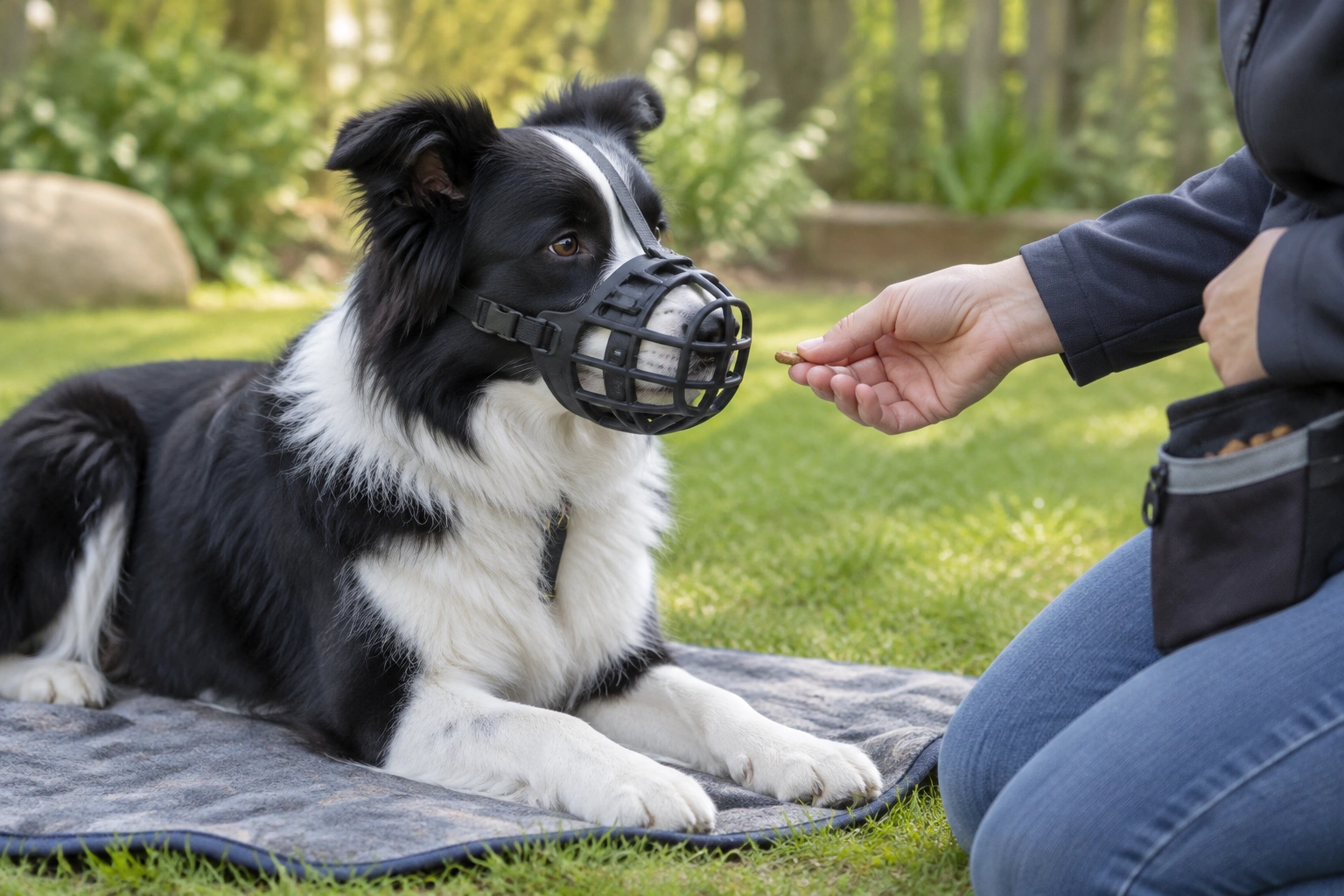
Basic fit criteria
A basket muzzle should be long and wide enough for the dog to open its mouth and pant normally. The dog should be able to drink, take treats, and close and open the mouth without the muzzle pressing into the nose or rubbing the eyes. It should sit securely without sliding into the eyes, twisting, or bouncing around on the face.
Check for these signs of a good fit:
– the dog can pant with the mouth open
– the dog can drink water
– the muzzle does not rub the eyes or sit so close that it touches them
– the dog can accept treats through the front
– the dog cannot easily paw it off or push it into an awkward position
– there are no red marks or rubbing after use
If the muzzle blocks panting, rides up toward the eyes, or causes the dog to panic, it is not the right fit.
The trade-off
The downside is that a muzzle does not solve the behavior. It only reduces the chance of injury while you work on the cause. If the muzzle is used without training, the dog may resist it or become more stressed. So the goal is calm acceptance, not just forced wear.
How to condition it
Let the dog choose to approach the muzzle. Pair the muzzle with food, brief touches, and very short wear periods. Build up slowly. If the dog panics, you moved too fast.
For muzzle basics and humane use, The Kennel Club’s guidance on muzzles offers a solid general reference point for owners who want a welfare-first approach.
Training the Behavior: Desensitization and Counterconditioning for Strangers
This is the core behavior-change framework when the dog is safe enough to train. The idea is simple: strangers predict good things, but only at a distance where the dog can stay calm.
Step 1: Find the threshold
Begin far enough away from the trigger that your dog notices the stranger but does not bark, lunge, freeze, or stare hard. If the dog cannot take food, you are likely too close.
Step 2: Pair the trigger with reinforcement
The instant the stranger appears at a safe distance, feed something your dog values. The stranger is not asking for interaction. The stranger is just part of the background while good things happen.
Step 3: End before the dog tips over
Keep sessions short. A few calm repetitions are better than one long session that ends in barking. If the dog gets stiff or vocal, increase distance and reset.
Step 4: Progress in small steps
Move closer only when the dog stays loose, can eat, and recovers quickly after noticing the person. If the dog regresses, you advanced too fast.
This is where many owners go wrong. They want a social dog, so they push for direct greetings. But the real goal is a dog that can observe strangers without feeling forced to engage.
How to Introduce Strangers Safely
Training the dog is only half the job. The human side of the interaction has to be controlled too.
Tell guests and passersby to follow these rules:
- no staring at the dog
- no reaching over the head
- no leaning in
- no sudden touch
- no direct approach
- no forced petting
- no loud, excited voice
If the dog is ready for contact, let it choose to approach. A side-on posture is usually less threatening than a head-on reach. Keep the first interactions brief and predictable. If the dog chooses to move away, that choice should be respected.
For real-world situations, plan ahead:
– Visitors entering the home: keep the dog behind a barrier until the visitor is seated and the dog is calm.
– Delivery workers: set up a no-contact routine at the door or gate so the dog does not rehearse rushing the boundary.
– Passing people on walks: cross the street, step off the path, or increase distance before the dog tips into barking or lunging.
For Border Collies, calm observation often works better than “making friends” quickly. These dogs tend to do better when they can watch, assess, and decide.
What Not to Do: Punishment, Forced Greetings, and Common Mistakes
Punishing growling, barking, or snapping can make the dog quieter without making it safer. That is the danger. The warning disappears, but the underlying stress remains.
Avoid these mistakes:
- forcing the dog to “say hello” to prove it is fine
- using leash corrections for fear or reactivity
- flooding the dog with too many strangers too soon
- letting people crowd the dog because “he needs socialization”
- ignoring the first signs of tension
- using a muzzle as a substitute for training
Positive reinforcement, distance, and careful exposure are usually the safer starting point for stranger-directed issues.
When Pain, Illness, or Neurological Issues May Be Contributing
A veterinary visit is especially important if:
- the behavior started suddenly
- the dog is older and newly reactive
- the dog seems sore, stiff, or less willing to move
- the dog reacts to touch in new ways
- the biting pattern changed after an injury or illness
- the dog seems confused, disoriented, or unusually sensitive
Do not try to train through pain. If the body is driving the behavior, the dog may not be able to learn well until the medical issue is addressed.
When to See a Veterinarian or Certified Trainer
Some cases can be managed at home. Others should not be handled alone.
Get a veterinarian involved first if:
- the behavior started suddenly
- the dog may be in pain
- the dog is older and the change is new
- the dog seems physically uncomfortable, stiff, or sensitive to touch
- the aggression is severe or escalating quickly
A veterinary exam helps rule out pain, illness, or neurological causes before you invest in training.
Get a veterinary behaviorist if:
- the bites are severe or repeated
- the dog is unpredictable
- the behavior is tied to anxiety, fear, or possible medical issues
- the case is complicated enough that behavior and medication may need to be considered together
A certified trainer may be appropriate if:
- the dog is medically cleared
- the triggers are clear and manageable
- the behavior is not severe enough to require medical behavior support
- you need help with setup, timing, counterconditioning, and desensitization
Home management may be enough if:
- the dog has not bitten, only warned
- the triggers are clear and avoidable
- the dog can stay calm at a safe distance
- you can reliably control visitors, doors, and walks
Get professional help if:
- the dog has already bitten
- the behavior is escalating
- the dog cannot recover after seeing strangers
- the dog is unpredictable around children or guests
- you cannot safely manage the dog in daily life
A certified trainer with behavior experience can help with setup, timing, and desensitization. A veterinary behaviorist is the better choice when the case is severe, complicated, or possibly tied to anxiety, pain, or another medical factor.
If the Dog Has Already Bitten Someone
After a bite, the immediate priorities are medical care, separation, and documentation.
Get the person medical attention if needed, even for wounds that seem minor. Clean the area properly and follow local public health guidance. Then document what happened: who was present, what triggered the incident, where it happened, and what the dog did before the bite.
Also tighten management immediately. That may mean no visitors, no off-leash time around people, and muzzle use when the dog must be moved in public. Depending on where you live, there may be reporting or liability considerations. This is not the moment to “wait and see” if it happens again.
Long-Term Outlook: What Improvement Usually Looks Like
For many dogs, success does not mean loving strangers. It means staying under threshold, recovering faster, and no longer biting when managed well.
That often looks like this:
- the dog notices a stranger and stays loose
- the dog can eat in the presence of people
- the dog no longer explodes at every doorway or fence line
- the dog needs less distance over time
- guests can be managed without incident
Relapse is possible, especially if you rush exposure or let management slide. The safest mindset is not “problem solved forever.” It is “we have a system that keeps the dog and other people safe while the dog learns a better pattern.”
If you want the short version, here it is: stop the rehearsals, identify the trigger pattern, use distance and barriers, condition a muzzle if there is real bite risk, and train at a pace the dog can actually handle. That is the path that gives you the best chance of changing the behavior without making it worse.
FAQ
Why is my dog biting strangers all of a sudden?
A sudden change can point to pain, illness, injury, or a new stressor. A veterinary exam is a good first step before behavior training.
Should I use a muzzle on my dog in public?
If there is a real bite risk, a properly fitted basket muzzle can improve safety while you work on the behavior. It should allow panting and drinking.
Can a trainer fix stranger-directed biting?
A certified trainer can help with management and training if the dog is medically cleared and the behavior is not severe. If the case is serious, unpredictable, or possibly pain-related, a veterinary behaviorist is the better fit.
How do I stop dog biting strangers right now?
Separate the dog from strangers, block access to trigger areas, stop greetings, and set up a short-term management plan before starting training.