
How to Stop Resource Guarding with Other Dogs: A Practical Guide for Safer Multi-Dog Homes

Resource guarding between dogs is one of those problems that can look small right up until it isn’t. A dog that stiffens over a bowl, blocks another dog from a toy, or snaps when a second dog approaches the sofa is giving you useful information early. The goal is not to “win” those moments. The goal is to stop the rehearsal, keep everyone safe, and then change the emotional response underneath the behavior.
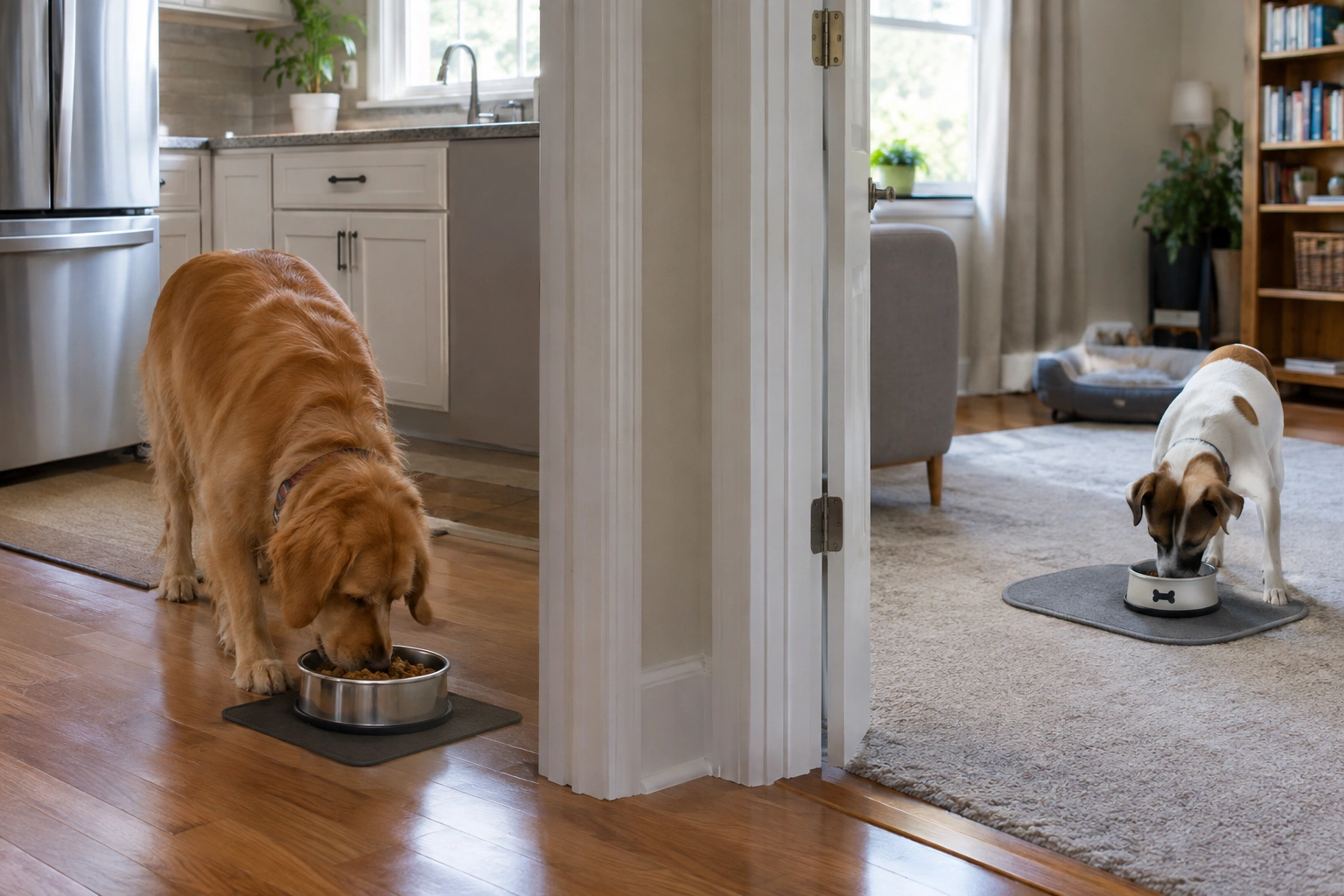
In multi-dog homes, the fastest progress usually comes from two things working together: strong management and carefully planned training. Management prevents fights now. Training changes what your dog expects when another dog appears near something valuable.
If you live with a Border Collie, that matters even more. Border Collies can be highly observant and quick to learn patterns, which is an advantage when you’re teaching calm behavior, but it also means they can become very efficient at rehearsing a guarding habit if the household setup keeps creating the same conflict.
What to Do Right Now
If a guarding incident just happened, focus on safety first:
- Separate the dogs immediately with a door, gate, crate, or leash.
- Remove all high-value items: bowls, chews, bones, toys, dropped food, and favorite resting items.
- Give each dog a different space to settle in.
- Write down what happened: the item, location, which dog approached, what body language you saw, and whether there was a snap, lunge, bite, or redirect.
- Do not retest the setup “to see if they’re okay now.”
- If there was a bite, redirected aggression, or you cannot separate the dogs safely, stop home experimentation and contact a qualified professional.
What Resource Guarding Looks Like Between Dogs
Resource guarding is any behavior a dog uses to keep another dog away from something valuable. The “resource” might be food, a chew, a toy, a bed, a doorway, the couch, a favorite human, or even a resting spot in a hallway.
Normal preference is one thing: a dog may choose to move away, keep eating, or hold onto a toy without any tension. Problem guarding starts when the dog is repeatedly stiff, staring, freezing, hovering, blocking, growling, snapping, lunging, or fighting in order to control access. Once other dogs begin backing off because they feel unsafe, the behavior is no longer just a preference. It is shaping the whole household.
A useful threshold for concern is this: if the dog can stay loose and recover quickly when another dog is nearby, you may be dealing with a manageable early-stage issue. If the dog is already tense, guarding multiple items, escalating fast, or making other dogs avoid shared spaces, that is a problem that needs immediate management and likely professional help.
Food guarding vs toy guarding vs space guarding
Food guarding is often the easiest to spot because the setup is obvious: bowls, chews, dropped food, or scavenged items. Toy guarding can be just as serious, especially when one dog wants to patrol the toy pile or keep another dog from approaching a favorite fetch item. Space guarding is more subtle; a dog may defend a bed, couch, hallway, crate, or doorway. Owner guarding happens when a dog blocks another dog from approaching a person, especially during petting, lap time, or attention.
The risk is not always identical, but the pattern matters more than the category. A dog that guards a chew on the couch today may guard the food bowl tomorrow and the human’s lap next week.
Why Dogs Guard Resources from Other Dogs
Most guarding is not about being “dominant” in the casual sense people often mean. It usually comes from a mix of perceived value, insecurity, and learning history. If a dog has learned that other dogs get close and things disappear, guarding becomes a strategy that works.
Pain and illness can also change the picture. A dog with dental pain, joint pain, gastrointestinal discomfort, or another health issue may become less tolerant of competition. If guarding appeared suddenly or got worse fast, that is a reason to involve a veterinarian.
Trigger stacking matters too. A dog may tolerate one dog near a bowl in a quiet kitchen, but not after a noisy walk, a visit from guests, a missed nap, or a high-arousal play session. The more loaded the situation, the lower the dog’s threshold.
Humane World for Animals notes that new situations can bring out guarding tendencies and recommends enough toys, beds, treats, and food for all dogs, plus a neutral environment when a new dog visits. That is the right mindset: reduce pressure before it becomes a conflict. Humane World for Animals
Early Warning Signs Before a Growl or Bite
Watch for the sequence before the growl, not just the growl itself.
Common early signs include:
- freezing or going very still
- hard staring at the other dog
- hovering over the item
- eating faster or gulping
- standing over a bowl or toy
- body blocking
- lip lifting
- low head carriage over the resource
- whale eye or tension around the muzzle
- a sudden increase in speed or intensity near the item
A dog does not need to show every sign. One or two can be enough to tell you the threshold is too close. If you wait for the growl, you are already late for prevention.
What to Do Immediately to Prevent a Fight
The first job is to stop the dog from practicing the behavior. That means no more “let’s see what happens” setups.
Make a list of the exact triggers in your home: bowls, bones, stuffed toys, couch time, doorway congestion, sleeping spots, dropped food, or human attention. Then remove access, change the environment, or separate the dogs before those triggers appear.
Practical management options include:
- feeding in separate rooms
- using baby gates or closed doors
- crate feeding if the dog is comfortable in the crate
- removing high-value toys and chews when dogs are together
- supervising closely any time a valued item is out
- separating dogs during rest periods if beds or sofas cause tension
Patricia McConnell’s guidance on dog-to-dog guarding is useful here: keep the dogs far enough apart that the guarding dog does not show guarding behavior, then only move closer gradually once happy anticipation appears. She also notes that gates or tethering can be used during that process, and she does not punish guarding. That is the right order: safety first, behavior change second. Patricia McConnell on dog-to-dog resource guarding
How to Manage Food, Toys, Chews, Beds, People, and Outdoor Spaces in a Multi-Dog Home
Management is not a backup plan. It is the foundation.
Deaf Dogs Rock recommends making a list of items, spaces, and situations likely to provoke guarding, then removing access or changing the environment. That may mean removing treasured toys, restricting access to certain rooms or furniture, and confining dogs separately during feeding times. Deaf Dogs Rock on multiple-dog households
Food bowls
Food is usually the easiest trigger to manage and one of the most dangerous to ignore. If there is any history of guarding, feed separately. That can mean different rooms, closed doors, or barriers that prevent approach.
Toys
Toys are best treated as controlled resources, not background clutter. If toys trigger guarding, put them away unless you are actively supervising or using them for training. A toy pile on the floor is an invitation for one dog to patrol it.
Chews and bones
Chews are high-value for many dogs because they last longer and feel more “worth defending.” Give them only when dogs are separated. If a chew is likely to create tension, do not leave it out to see whether the dogs can “work it out.”
Beds and resting spots
Beds and couches can become guarded because they are comfortable, elevated, or close to the humans. If a dog blocks others from approaching a bed or sofa, remove the competition by controlling access. Sometimes that means separate resting zones. Sometimes it means a dog loses access to the couch for a while because the couch is no longer a neutral space.
People
Owner guarding deserves the same seriousness as object guarding. If one dog stiffens, wedges in, or growls when another dog approaches you, stop rewarding that setup. Use barriers or separate attention time until the dogs can share space without pressure. If needed, give attention in turns: one dog on a mat behind a gate while the other gets petting, then switch.
Shared outdoor spaces and walks
Guarding does not stop at the back door. In shared yards, watch for dropped food, chewed sticks, fallen fruit, or scavenged trash. On walks, keep dogs from rushing to the same object and do not let one dog “own” found items. If a dog picks up something valuable outdoors, calmly create distance and use a leash or barrier to prevent another dog from approaching. When in doubt, avoid the area until you can manage it safely.
Humane World for Animals recommends enough resources for all dogs. In practice, that means not just “one of everything.” It means enough of the right things, in the right places, so no dog has to compete. Humane World for Animals
Feeding Multiple Dogs Safely
If you are deciding between co-feeding and separated feeding, the safer choice is usually separation. Some dogs can eat near each other without trouble, but that is not the same as being a wise household policy. If there is any history of guarding, do not use shared bowls or close feeding as a test.
A practical feeding setup looks like this:
- Put each dog in a separate room, crate, or gated area.
- Deliver the bowls without dogs crowding the doorway.
- Remove bowls before the dogs are released if one dog tends to hover or rush the others.
- Keep the routine consistent so no dog has to guess when competition will happen.
If you have a Border Collie that eats quickly and then patrols the other dogs, the separation is not optional. It is part of preventing rehearsal.
For families that want a general reference on guarding behavior, the AKC’s resource guarding guidance is a useful starting point for recognizing the behavior and understanding why early management matters. AKC resource guarding overview
Training the Dog to Stay Calm Around Other Dogs Near Valued Items
Once management is in place, training can begin. The safest behavior-change work usually uses desensitization and counterconditioning. In plain language, that means exposing the dog to a version of the trigger that is far enough away to stay under threshold, then pairing the presence of the other dog with something the guarding dog likes.
The key is distance. If the guarding dog is already tense, you are too close. If the dog can see the other dog and remain relaxed or expect good things, you are in the right zone.
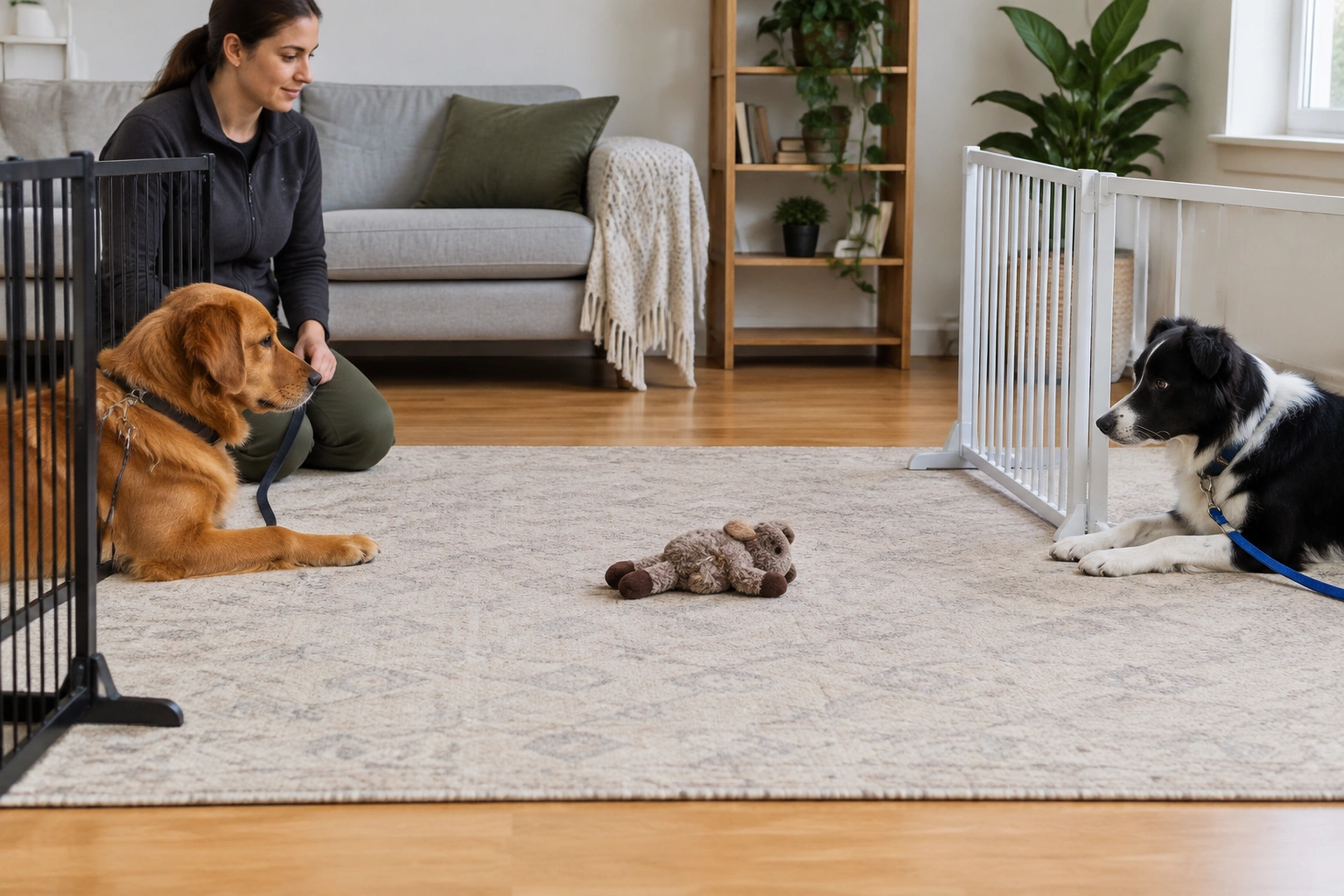
A concrete example for a multi-dog household:
- Put Dog A on a leash behind a gate or at the far end of a room, about 20 feet from Dog B’s closed bowl or chew area.
- Keep the session short, about 1 to 2 minutes at first.
- The moment Dog A sees Dog B near the resource, feed Dog A a few high-value treats one at a time.
- Stop the session if Dog A freezes, stares hard, closes its mouth, leans forward, or stops taking treats.
- If Dog A stays loose and happily eats, repeat for a few short reps over several days before trying a slightly shorter distance, such as 15 feet.
That gradual approach is what keeps the dog from rehearsing the guarding response. It also teaches a new pattern: other dogs near resources predict good things, not loss.
One practical trade-off: training around the resource can help, but only if the dog is under threshold. If the dog is already guarding hard, management does more good than pushing the training closer. For many households, the smartest plan is months of separation while the emotional response is changed in tiny steps.
What Not to Do: Punishment, Forced Sharing, and Testing the Dog
Punishing a growl may stop the warning, but it does not solve the problem. It often makes the dog less willing to warn next time. That increases risk, not safety.
Avoid these mistakes:
- taking items away by force
- scolding the dog for guarding
- making the dogs “work it out”
- feeding too close together to see if they are fine now
- repeatedly reaching in to test whether the dog will object
- using confrontational corrections when the dog is already aroused
One source on dog-to-dog guarding specifically says not to punish resource guarding “not with a look or a word or anything.” That may sound strict, but the logic is sound: punishment can add fear and pressure to an already loaded situation. Patricia McConnell on dog-to-dog resource guarding
If you need to take something away, trade up instead of grabbing. Offer a better item, then remove the original once the dog has willingly released it. That keeps trust intact and lowers the chance of escalation.
When Home Management Is Not Enough
Some cases are manageable at home. Others are not.
You should move to professional help sooner if:
- the guarding is escalating
- there has already been a bite or repeated bites
- the dog redirects onto another dog or person
- the dogs cannot be safely separated with doors, gates, crates, or leashes
- the dog guards multiple categories of resources
- the dog cannot relax even at a distance
- the behavior seems unpredictable
- the household cannot reliably separate dogs
If the problem is mild and the household can control access, management plus careful training may be enough. If the dog is already making fast, hard decisions around resources, DIY work can be too risky.
When to See a Veterinarian or Certified Trainer
If the behavior appeared suddenly, got worse quickly, or seems tied to pain, see a veterinarian first. Pain changes tolerance, and you do not want to train over an untreated medical issue.
If the main problem is behavior, look for a certified professional dog trainer who uses evidence-based methods and has experience with resource guarding. If the guarding is severe, involves bites, or is tangled with fear, anxiety, or medical concerns, a veterinary behaviorist is the better fit.
A useful rule: if you are not sure whether the dog is safe to work around the trigger, that is already a reason to get help. Safety decisions are not where you want to improvise.
Border Collie Considerations: Intensity, Sensitivity, and Prevention
Border Collies often notice small changes before owners do. That can be helpful because you may catch early tension sooner. It can also make guarding look sharper, faster, or more patterned if the dog has learned that controlling access works.
With a Border Collie, be especially careful about:
- fast repetition of training sessions
- over-arousing games around toys
- giving access to shared spaces before the dog is ready
- assuming “smart” means “safe without management”
Practical management examples help a lot with this breed. For example, a Border Collie that patrols toys may need toys stored out of sight except during supervised play. A dog that guards the hallway may need baby gates so it cannot rehearse blocking traffic. A dog that gets amped up by fetch may do better with short, one-dog play sessions and then a calm rest area behind a gate. If the dog guards the couch, the couch may need to be off-limits for a while instead of being used as a training test.
The breed’s sensitivity is an asset when you use calm, clear structure. It is a liability when the home environment keeps creating pressure. In practice, Border Collies usually do best with predictable routines, separated high-value items, and training that rewards relaxation rather than intensity.
A Simple Decision Rule for Owners
If you remember only one thing, make it this:
- If the dogs are tense, separate them.
- If the item is high-value, control access.
- If the behavior is escalating, do not test it.
- If you cannot keep everyone safe, bring in a professional.
That is how you stop resource guarding from becoming the household’s default pattern.
FAQ
Is resource guarding normal between dogs?
Some preference for valuable things is normal. Repeated tension, blocking, growling, snapping, lunging, or fighting is not something to shrug off.
Should I feed my dogs separately?
If there is any guarding history, yes. Separate feeding is the safer default.
Can I fix resource guarding without a trainer?
Mild cases may improve with good management and careful training. If there has been a bite, escalation, repeated lunging, or unpredictability, get professional help.
Should I take toys away completely?
If toys trigger guarding, remove them when dogs are together and reintroduce them only under supervision.
Will punishment stop guarding?
It may stop the warning, but it can make the dog less safe by removing the warning signals. Management and reinforcement-based training are the safer path.
How do I know if it might be pain-related?
If the guarding started suddenly, got worse fast, or comes with other behavior changes, a veterinary exam is the right next step.
Can Border Collies be more prone to guarding?
I would not overstate breed prediction, but Border Collies are often intense and sensitive enough that poor management can make guarding patterns develop quickly.
How long does it take to improve?
That varies. The honest answer is that progress depends on how well you prevent rehearsal, how close the dog is to threshold, and whether there is an underlying medical or emotional issue. There are no safe guarantees.
Should I use a muzzle?
A muzzle can be appropriate in some situations, but only if it is properly fitted and the dog is calmly acclimated to it first. It is a management tool, not a shortcut.
Can dogs share beds or couches again?
Sometimes, but only after the conflict pattern has changed and the dogs can be around the space without tension. In many homes, separate resting spots remain the cleaner long-term solution.
What if my dog guards items on walks?
If your dog guards found items outdoors, manage the environment by avoiding those areas, using a leash to prevent access, and working with a professional on a safe plan.