
How Long Can You Leave a Dog Alone Safely? A Border Collie Owner’s Guide

If you want the short answer, here it is: most healthy adult dogs can usually handle being alone for part of a workday, but the safe limit depends on the individual dog, not just the clock. For many adult dogs, 4 to 6 hours is a practical baseline. Some dogs can adapt to 8 hours or a little more if they have enough space, are comfortable being alone, and have no toilet or anxiety issues. Puppies need much shorter stretches. Senior dogs may seem fine for longer because they sleep more, but age-related bathroom needs and mobility issues can shorten the safe window.
For Border Collies, I’d be more cautious than I would be with a lower-energy breed. A Border Collie may tolerate alone time physically, but that is not the same as coping well. If the dog is under-exercised, under-stimulated, or prone to anxiety, a long stretch alone can quickly turn into barking, chewing, pacing, or stress-related habits that are hard to unwind.
Quick Answer: How Long Is It Okay to Leave a Dog Alone?
Here’s the practical version I use when helping owners make day-to-day decisions:
| Dog type | Realistic alone-time baseline | What usually changes the limit |
|---|---|---|
| Young puppy | 1 to 3 hours, often less at first | Toilet training, supervision, confidence |
| Older puppy / adolescent | 3 to 4 hours | Bladder control, training, boredom tolerance |
| Healthy adult dog | 4 to 6 hours for many dogs | Exercise, routine, temperament, anxiety risk |
| Calm, well-settled adult | Sometimes 8 hours | Home setup, bathroom access, enrichment |
| Senior dog | Often 4 to 6 hours, sometimes less | Mobility, bladder control, discomfort, medication needs |
| Border Collie | Often 4 to 6 hours if well prepared | Energy level, mental stimulation, separation tolerance |
That table is a starting point, not a promise. A dog that can technically hold it for eight hours may still be miserable by hour three. A dog that is calm for six hours one week may struggle the next if the routine changes, exercise drops, or the dog is recovering from illness.
A useful rule is this: the safe limit is the shortest of three things — bladder capacity, emotional coping, and physical safety. If any one of those is weak, the whole setup needs adjusting.
Can a puppy be left alone for 4, 6, or 8 hours?
4 hours: Sometimes yes for an older, well-settled puppy, but often too long for a young puppy.
6 hours: Usually no for a young puppy; it may be possible only for an older puppy that has been gradually trained and can reliably hold its bladder.
8 hours: No for most puppies. That is generally too long for a puppy’s bathroom needs, training stage, and emotional comfort.
A simple age-based rule of thumb:
– Very young puppies: plan for breaks every 1 to 3 hours, sometimes even more often.
– Older puppies / adolescents: may handle 3 to 4 hours if they are progressing well.
– Adult dogs: often do best in the 4 to 6 hour range.
– Border Collie puppies: tend to need even more structure, more supervision, and shorter absences than many owners expect.
What Changes the Safe Alone-Time Limit?
The number of hours matters less than the dog in front of you. When I’m judging whether a dog can stay home alone, I look at five things.
1. Age and life stage
Puppies have tiny bladders, immature impulse control, and very little ability to self-soothe. They also learn from repetition, so a bad setup can teach them to panic, soil the house, or rehearse destructive habits.
Adult dogs usually have the best balance of bladder control and emotional stability. Seniors are mixed: some sleep comfortably for long stretches, but others need more bathroom breaks, medication timing, or help getting up and down.
2. Breed energy, especially in Border Collies
Border Collies are not just active; they are often mentally intense. They notice patterns, anticipate routines, and get bored quickly if their day has no job in it. That does not mean every Border Collie needs constant supervision, but it does mean they often need more preparation before alone time than a more laid-back breed.
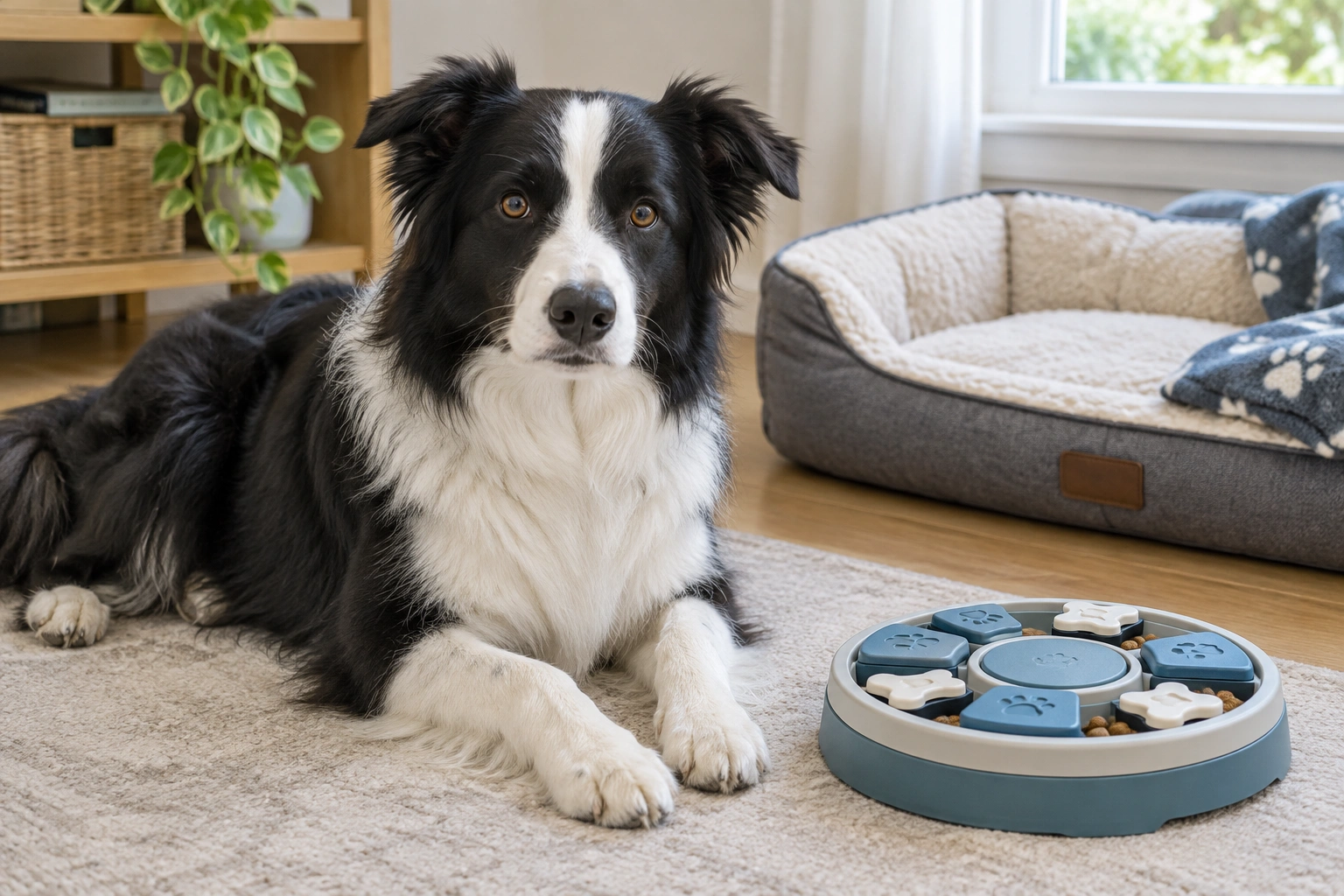
A tired Border Collie is not the same as a fulfilled Border Collie. Physical exercise helps, but mental work matters just as much. A sniff walk, short training session, or food puzzle can reduce frustration far more effectively than simply letting the dog run around the yard for ten minutes.
3. Training history
A dog that has practiced being alone in small, calm steps usually handles absences better than one that only experiences solitude when the owner suddenly disappears for half a day.
Training also matters because it teaches the dog what “settling” looks like. A dog that knows how to lie down, relax, and wait for the next event is less likely to turn every absence into a problem.
4. Bathroom needs and access to water
If your dog cannot comfortably hold a bladder for the time you’re gone, that time is too long. Water access matters too, especially in warm weather or for dogs on dry food, medication, or with health conditions that increase thirst.
For most dogs, the issue is not whether they can survive without a break. The issue is whether they can stay comfortable, clean, and calm.
5. Stress tolerance and personality
Some dogs are naturally independent. Others are people-oriented to the point that being alone feels wrong to them. A dog may be perfectly healthy and still not cope well with long absences.
The warning sign is not always panic. Sometimes it looks like subtle restlessness: pacing, window-watching, whining at the door, or refusing to settle even when nothing obvious is “wrong.”
How Long Is Too Long for a Border Collie?
For a Border Collie, I would treat 4 to 6 hours as a sensible working target for most situations, assuming the dog is adult, healthy, and has been trained to tolerate solitude. Some Border Collies can manage longer stretches, and some need less. The difference comes down to preparation and temperament.
A Border Collie that has had a long morning walk, a little training, and a food puzzle may handle a workday absence far better than a dog that has not had much to do. But if the dog is still bouncing off the walls after exercise, the problem is not “not enough tiring out.” It may be a need for more structured mental work, a calmer routine, or a different alone-time setup.
Border Collies can also become welfare concerns faster than many owners expect. A dog that barks for hours, chews door frames, scratches at exits, or is frantic every time you leave is likely telling you the current arrangement is too much.
If your Border Collie is regularly alone for long workdays, I’d be looking hard at the trade-offs. Saving money by skipping help may cost you in destroyed items, stress, or a dog that learns to dread your departures. A midday dog walker, a trusted neighbor, or a shorter schedule may be the better long-term solution.
For general background on separation-related issues, the Blue Cross guidance on dogs being left alone is a useful reference point, especially because it ties alone time to the dog’s age, breed, and coping ability.
Puppy vs. Adult vs. Senior Dog Alone-Time Limits
Puppies: short, supervised, and built up gradually
Puppies should not be expected to handle long stretches alone. Their toilet needs are frequent, their attention span is short, and they are still learning that the world is safe.
A 10-week-old puppy should not be treated like a small adult dog. Even a “good” puppy can get overwhelmed, soil the house, or develop a habit of crying because the setup asked too much too soon.
If you work long hours, a puppy usually needs one of these:
– a midday break from a person,
– a dog walker,
– a family member or neighbor,
– or a very carefully managed schedule that avoids long absences.
Adult dogs: the most flexible stage
Adult dogs are the easiest group to generalize about, but even here, the range is wide. Many healthy adults do fine with 4 to 6 hours alone. Some can manage a full workday if they are settled, exercised, and have enough room to move comfortably. Still, “can manage” is not the same as “thrives.”
The question I’d ask is simple: does the dog come home relaxed, or does it come home desperate to explode with energy, relieve itself, or cling to you because the day was too empty?
Senior dogs: often quieter, but not automatically easier
Older dogs may sleep more, which can make them seem like easy candidates for longer alone time. Sometimes that is true. But senior dogs often have less bladder control, more stiffness, and more need for predictable comfort.
A senior dog that used to handle six hours may start struggling with four. That’s not a training failure. It’s a cue to reassess the routine.
Signs Your Dog Is Not Coping Well When Left Alone
A dog does not need to destroy the house to be struggling. Some of the clearest signs are also the easiest to dismiss.
Watch for:
– barking or whining that goes on after the initial departure
– pacing, spinning, or repeated window/door checking
– chewing furniture, trim, blinds, or crate bars
– house soiling despite being otherwise housetrained
– drooling, panting, or trembling when alone
– scratching at exits or trying to escape
– refusing food left for enrichment
– frantic greeting when you return, as if the dog has been on alert the entire time
The timing matters. A dog that barks for a minute and then settles is not the same as a dog that remains distressed for hours. If you can, use a camera for a few days. Owners are often surprised by what their dog actually does after the front door closes.
A second useful distinction: boredom and anxiety can look similar, but they are not identical. A bored dog may chew socks and nap between bursts. An anxious dog often looks unable to settle at all.
Crate Training vs. Free-Roaming: Which Is Better for Alone Time?
This is not a moral question; it’s a management question.
Crate training
A crate can be helpful when the dog is already crate-trained, relaxed in the crate, and the absence is short enough that confinement does not become the main problem. It can also prevent destructive mistakes and keep a young dog safe for brief periods.
It is not a good choice if the dog panics in the crate, has a history of fighting confinement, or is being left for too long. In practical terms, a crate is best for short stretches, not as an all-day solution. If the dog will be confined for much of the workday, or if the dog still needs frequent toilet breaks, crating is usually not appropriate.
Free-roaming
Free-roaming gives the dog more room to move, stretch, and settle. For the right dog, that is less stressful than a crate. But it also creates more opportunities for trouble: chewing, counter surfing, window damage, and access to unsafe items.
Free-roaming works best when the dog is already calm, the home is dog-proofed, and the dog has a history of making good choices when unsupervised.
Which should you choose?
Use the crate if:
– the dog is crate-trained and relaxed in it,
– the absence is relatively short,
– and containment is safer than freedom.
Use free-roaming if:
– the dog is trustworthy in the home,
– the space is safe,
– and the dog seems more settled with room to move.
If you are unsure, the dog’s behavior will usually tell you. A dog that scratches, vocalizes, or fights confinement may need a different setup, not more crate time.
Dog Walker vs. Daycare vs. Home Alone: What Should You Choose?
A simple decision guide:
- Home alone works best for an adult dog that is calm, housetrained, and comfortable with the planned absence.
- Dog walker is often the best choice for puppies, seniors, and dogs who mainly need a potty break, a short walk, or a little human contact during a workday.
- Dog daycare makes more sense for social, energetic dogs that do well around other dogs and benefit from a more active day.
- Do not leave the dog alone for the full stretch if it is a young puppy, a dog with separation anxiety, or a dog that is already showing stress signals.
A quick rule of thumb:
– Up to about 4 hours: many adult dogs can manage; puppies usually need help.
– Around 6 hours: many adult dogs still do okay, but puppies, seniors, and Border Collies may need a break or more structure.
– Around 8 hours: this is where many dogs start needing support, even if they could physically last that long. It is especially risky for puppies and for dogs that are bored, anxious, or high-energy.
How to Increase Alone Time Gradually
The cleanest way to build tolerance is to make the training boring and predictable.
For adult dogs, a simple progression looks like this:
1. Leave for a few seconds and return before the dog becomes worried.
2. Repeat until that feels routine.
3. Increase to one minute, then a few minutes, then longer stretches.
4. Mix in ordinary departures so the dog does not learn that every coat means a crisis.
5. Practice at different times of day, not just when the dog is already sleepy.
For puppies, keep the steps smaller and the jumps more conservative:
1. Step out briefly and come back in before the puppy gets upset.
2. Build from seconds to very short minutes.
3. Add successful toilet breaks before and after longer practice.
4. Increase duration only when the puppy is consistently calm and can handle the current step.
5. Expect setbacks after exciting days, poor sleep, or routine changes.
The key is to stay below the dog’s stress threshold. If you keep pushing until the dog barks or panics, you are rehearsing the wrong response.
A practical example: if your Border Collie can stay calm for 15 minutes, do not jump to two hours the next day. Build in small, successful steps. That is slower, but it is far more reliable.
How to Make Longer Absences Easier
If a dog must be alone for several hours, improve the setup rather than hoping the dog “gets used to it.”
Use exercise with purpose
A walk that includes sniffing and exploring is often more useful than a hard sprint. Sniffing lowers arousal and gives the dog real information to process.
Add mental work before you leave
Puzzle feeders, scatter feeding, short training sessions, and chew-safe enrichment can help a dog settle after you go. For Border Collies, this is often the difference between “okay” and “restless.”
Give a bathroom break when needed
If the absence is near the dog’s limit, a midday potty break can prevent accidents and reduce stress. This is especially useful for puppies, seniors, and dogs with medical issues.
Consider a dog walker or daycare
A dog walker is usually the more practical choice if the main issue is toilet relief and a little human contact. Daycare makes more sense if the dog is social, energetic, and benefits from structured activity.
The trade-off is simple: home alone is cheaper and quieter; outside help costs more but can protect welfare and reduce problem behavior. If you are weighing a nine-hour workday, that extra expense may be the difference between a manageable routine and a dog that spends the day frustrated.
When Leaving a Dog Alone Becomes a Welfare Issue
There is a point where this stops being a convenience question and becomes an animal welfare question.
You are likely past that point if:
– the dog regularly soils the house because the absence is too long,
– the dog cannot settle and remains distressed for much of the time,
– the dog injures itself trying to escape,
– or the dog’s daily routine leaves no realistic way to meet basic needs.
The same applies if the dog is being crated for long stretches without enough breaks. Even if the dog is quiet, long confinement can be a welfare concern if it removes the chance to move, toilet, and decompress.
When to See a Veterinarian or Certified Trainer
If your dog suddenly starts struggling with alone time, do not assume it is purely behavioral. Pain, illness, age-related changes, and cognitive decline can all affect how a dog copes when left.
Talk to a veterinarian or certified trainer if:
– the problem appeared suddenly,
– the dog is house soiling after being reliable,
– there is new pacing, panting, or vocalizing,
– the dog seems unable to settle even after exercise,
– or the dog shows panic every time you prepare to leave.
That is especially important for Border Collies, because their intensity can hide discomfort for a while. A dog that looks “busy” may actually be stressed.
For a broader veterinary perspective on alone-time limits, Purina’s guidance on leaving dogs alone is consistent with the idea that adult dogs are often best left alone for only a few consecutive hours, while puppy needs are much shorter.
A Practical Decision Rule for Owners
If you want a quick way to judge your own situation, use this:
- Puppy: plan for short absences only, and arrange help if you’ll be gone much more than a couple of hours.
- Adult dog: 4 to 6 hours is a sensible baseline for many dogs.
- Senior dog: reassess often; comfort and bathroom needs may shorten the limit.
- Border Collie: assume the dog needs more exercise, more mental work, and more gradual training than an average low-energy breed.
If the dog is calm, trained, and physically comfortable, the schedule may work. If the dog is bored, stressed, or repeatedly struggling, the schedule is too long — even if it looks normal on paper.
The best home-alone setup is the one your dog can genuinely handle, not the one that merely fits the calendar.
FAQ
Can I leave my puppy alone while I work?
Usually not for a full workday. Young puppies need frequent bathroom breaks, supervision, and gradual training.
Is 8 hours too long for a dog to be alone?
For many dogs, yes, especially puppies, seniors, anxious dogs, and high-energy breeds like Border Collies. Some adult dogs can physically manage it, but that does not mean it is ideal.
Should I crate my dog when I leave?
Only if the dog is crate-trained, comfortable in the crate, and the time alone is short enough that confinement is reasonable. If the dog panics in the crate or needs long absences, use another setup.
What is better for a Border Collie: a dog walker or daycare?
It depends on the dog. A dog walker is often better for potty breaks and a calmer routine. Daycare may suit a social, energetic Border Collie that enjoys group activity.