
How to Relieve Dog Itching Safely: Practical Steps That Actually Help

If your dog is scratching, licking, chewing, or rubbing nonstop, the goal is not just to calm the itch for an hour. You want to reduce the discomfort safely, avoid making the skin worse, and figure out whether the cause is something simple like dry skin or something that needs veterinary treatment.
First-hour checklist if your dog is itching hard
1. Stop licking/chewing with a cone or other vet-approved barrier.
2. Check for fleas, flea dirt, burrs, or anything stuck in the coat.
3. Rinse paws, belly, and legs with lukewarm water if your dog was outside.
4. Dry the coat well and keep your dog from scratching the same spot.
5. If the skin is raw, smelly, wet, or painful, call the vet rather than trying more home remedies.
That matters because “itchy” is not a diagnosis. Fleas, mites, allergies, yeast, bacterial infection, hot spots, and dry skin can all look similar at first. The right response depends on where the itch is happening, what the skin looks like, and whether there are other signs such as odor, redness, hair loss, or head shaking.
For Border Collie owners, this comes up often after long walks in grass, muddy grooming sessions, or seasonal flare-ups. These dogs are active, outdoors a lot, and often exposed to pollen, burrs, tall grass, and parasites. The good news is that there are a few safe first steps you can take right away while you sort out the cause.
Quick way to narrow down the cause
Use the pattern, not just the scratching. A dog that is itchy all over is pointing you in a different direction from a dog that only chews one paw or shakes one ear.
| Likely cause | Common clues | Best first move | When to see a vet |
|---|---|---|---|
| Fleas or other parasites | Itch around base of tail, hindquarters, belly; flea dirt; sudden biting after outdoor exposure | Check coat closely, start or confirm flea prevention, wash bedding | If itching continues, skin looks infected, or you cannot find the cause |
| Environmental allergies | Seasonal pattern, paws licking, belly/face/ears involved, flare-ups after grass or pollen exposure | Rinse paws, bathe with gentle dog shampoo, discuss allergy management with vet | If recurring, severe, or affecting ears/skin repeatedly |
| Dry skin | Flaking, dull coat, mild generalized itch, worse in winter or dry indoor air | Oatmeal bath, moisturizing shampoo, skin-supportive grooming | If cracking, redness, odor, or no improvement |
| Yeast or bacterial infection | Odor, greasy skin, redness, crusts, discharge, darkened skin | Veterinary exam for targeted treatment | Usually needs vet care rather than home care |
| Hot spot | One angry, wet, red area from licking or scratching | Prevent licking immediately and call vet | Same day if spreading or painful |
| Mites or other skin parasites | Persistent itch, hair loss, crusting, ear issues, intense paw or face rubbing | Vet exam and skin scrape | Promptly, because treatment depends on the parasite |
A few extra location clues can help you self-triage more confidently:
- Base of tail and rump: fleas are a common suspect, especially if the itch starts suddenly.
- Paws, belly, armpits, face, and ears: environmental allergies are often higher on the list.
- Between the toes or around the nails: think grass irritation, yeast, allergies, or something stuck in the paw.
- Ear canals or one ear only: ear infection, ear mites, or trapped moisture are more likely.
- One wet, red, painful patch: a hot spot is more likely than simple dry skin.
- Greasy odor, crusts, or darkened skin folds: infection becomes more likely.
The most useful question is: is this a whole-body itch, or is it focused in one place? Whole-body itch often suggests allergies or parasites. Localized itch often means a hot spot, ear problem, paw irritation, or a small infection.
What to do right now for safe short-term relief
[Image: Dog licking paws after outdoor walk]
The first goal is to reduce self-trauma. Dogs can turn mild irritation into raw skin in a few hours by licking, chewing, and scratching.
Here is the safest short-term plan:
-
Stop the damage first.
If your dog is chewing one spot hard, use an Elizabethan collar or another vet-approved barrier. This is not just about comfort; it prevents a simple itch from becoming a hot spot or open wound. -
Rinse off possible irritants.
If your dog has been in tall grass, mud, pollen, or road dust, rinse the paws, belly, and legs with lukewarm water. A quick rinse can remove the trigger without stripping the skin the way repeated bathing can.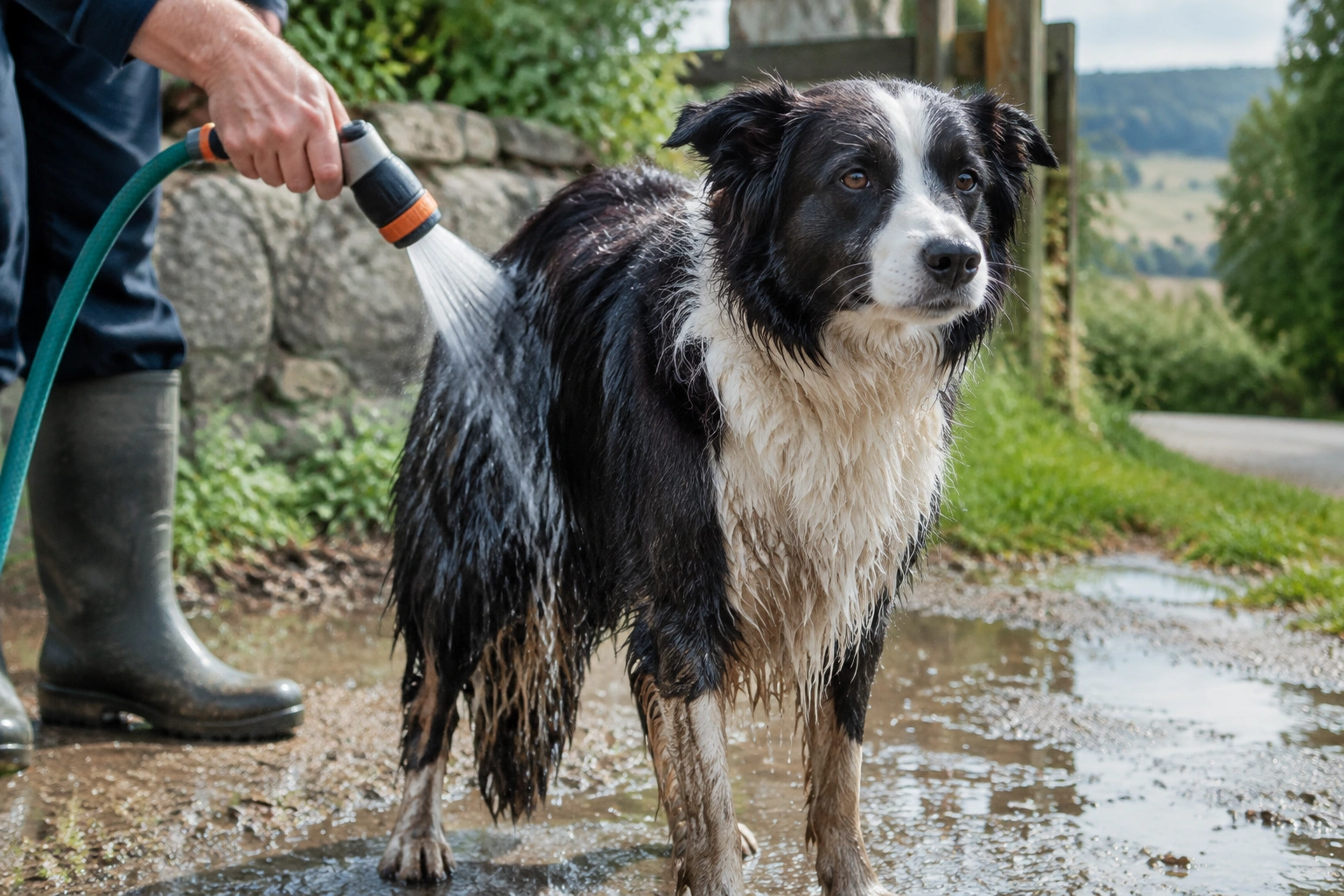
A gentle rinse can remove pollen and debris. -
Use a gentle oatmeal bath if the skin is broadly itchy and not open.
Oatmeal baths are widely used for itchy dogs because they are soothing and help hold moisture against the skin. Keep the water lukewarm, not hot, and avoid scrubbing. If the skin is raw, bleeding, or very painful, skip the bath and call the vet. -
Keep the coat dry and clean after outdoor time.
For Border Collies especially, a damp undercoat can keep pollen, dirt, and debris against the skin. Dry the coat well after wet walks or rainy runs. -
Use one change at a time.
If you switch shampoo, diet, supplements, and flea products all at once, you will not know what helped or what made things worse.
If the dog is actively miserable but the skin is not obviously infected, the simplest order of operations for the first 24 hours is: stop licking, rinse off irritants, use a gentle oatmeal bath if the skin is intact, and watch for infection signs. If the itch is still intense after that, or keeps returning, the cause probably needs more than home care.
A useful rule: if the dog is calmer after a rinse or bath but starts scratching again within a day or two, the underlying cause is probably still active. Relief that fades that quickly usually means you have only reduced the irritation, not solved it.
When to treat for fleas or other parasites
Fleas are easy to miss. You do not always see live fleas, especially on a thick-coated dog or after grooming. Flea dirt, which looks like tiny black specks near the skin, can be a clue.
Treat for fleas early if you notice any of these:
- Itching focused around the base of the tail, back legs, belly, or groin
- Sudden scratching after outdoor time
- Flea dirt or tiny moving specks in the coat
- Other pets in the home are itchy
- Your dog has inconsistent flea prevention
This is one area where waiting can backfire. Even a single flea bite can trigger a lot of scratching in a sensitive dog. In fact, some dogs react strongly to only a few bites, which is why flea allergy dermatitis can look much worse than an ordinary flea infestation. With simple flea infestation, you may mainly see fleas or flea dirt and generalized itch. With flea allergy dermatitis, the itch can be intense, especially around the rump, tail base, thighs, and belly, even if you do not see many fleas.
If fleas are plausible, consistent flea prevention is usually more useful than trying random soothing products.
The trade-off is simple: flea treatment may feel like “extra” if you do not see obvious fleas, but ignoring parasites can keep the itch going for weeks. If you are unsure, a veterinarian can check the skin and help you decide whether parasites are likely enough to treat.
For broader parasite concerns such as mites, a vet exam matters more. Mites and some other parasites need a skin scrape or similar test so treatment matches the cause.
How to soothe dry skin without overbathing
Dry skin usually looks and feels different from infection. You may see light flaking, a dull coat, and generalized mild itching rather than intense odor, discharge, or greasy skin.
The temptation is to bathe more and more. That can help in the short term, but too much bathing can strip natural oils and make the skin barrier weaker.
A practical approach is:
- Use a dog-specific moisturizing or oatmeal shampoo
- Bathe as often as your veterinarian recommends for your dog’s specific skin issue
- Keep baths brief and lukewarm
- Rinse thoroughly so no product residue stays on the coat
- Dry well, especially in dense-coated dogs
If your home air is dry, especially in winter with indoor heating, moisturizing support can help. Some moisturizing shampoos may be useful for dry skin, but coconut oil or aloe should be used cautiously and only with veterinary guidance, since dogs may lick them and irritated skin can react unpredictably.
For many dogs, the best result comes from combining bathing with skin support rather than relying on one product. That might mean a gentle shampoo plus a vet-approved omega-3 supplement if your veterinarian thinks it fits the case. PetMD notes that vets may recommend baths, omega-3 fatty acid supplements, or antihistamines as part of allergy or itch management.
Allergy-related itching: what helps and what usually takes time
Allergies are one of the most frustrating causes because the itch often returns unless the trigger is managed. Environmental allergies often show up seasonally or after exposure to grass, pollen, or dust. Food allergies can also cause itching, but they usually need a structured diet trial rather than guesswork.
Clues that point toward allergies include:
- Recurrent paw licking
- Face rubbing
- Belly itching
- Ear problems that come and go
- Seasonal flare-ups
- Itching that seems worse after walks or time outside
Here is the practical part: allergy relief often has two layers.
Short-term comfort
– Bathing to remove allergens from coat and paws
– Vet-guided medications when needed
– Preventing licking and chewing
Long-term control
– Immunotherapy in some cases
– Omega-3 supplementation when recommended by your vet
– Prescription diets if food allergy is suspected
– Environmental management, such as wiping paws after walks
PetMD notes that environmental allergy treatment can involve prescription medication such as Zenrelia, and that veterinarians may also recommend baths, immunotherapy, omega-3 fatty acid supplements, or antihistamines. That is a useful reminder that severe itching often needs more than home care alone.
If the itch is recurring every spring or after certain outings, do not keep treating it like a one-off skin irritation. That pattern is often the clue that helps your vet narrow the cause.
When licking, paw chewing, or head shaking points to a specific problem
The behavior tells you where to look.
Paw licking or chewing
Often points to:
– Environmental allergies
– Grass or burr irritation
– Yeast between the toes
– Foreign material stuck in the paw
– Mites or skin irritation
Check between the toes, around the nails, and the pads. If the skin is red, moist, or smells yeasty, that is no longer simple dryness.
Head shaking or ear scratching
Often points to:
– Ear infection
– Ear mites
– Allergies affecting the ears
– Water trapped in the ear after swimming or bathing
Do not keep cleaning deep in the ear canal at home if the dog is painful or the ear smells bad. That is a good time for a vet exam.
One hot spot or one angry patch
That usually means the dog has found a very specific area to obsess over. Hot spots often start with licking or scratching and then snowball fast. These need the licking stopped immediately and the skin assessed, because they can worsen quickly.
What not to use on an itchy dog
This is where owners can accidentally make things worse.
Avoid:
– Human anti-itch creams unless your veterinarian specifically says they are safe
– Hydrocortisone cream, zinc oxide ointments, and antibiotic ointments unless your vet says they are appropriate
– Benadryl or other human allergy medicines unless your vet gives the dose
– Essential oils
– Alcohol-based products
– Any remedy on open wounds, near eyes, or inside ears unless directed by a vet
– Thick greasy products if your dog will lick them heavily
Even some home remedies that are discussed online should be used conservatively. Baking soda paste is one example. Canine Journal describes a paste made from equal parts baking soda and water, applied to itchy areas for around 15 minutes and then rinsed. That may be reasonable for small, intact skin areas, but I would not use it on raw skin, and I would stop if the skin looks more irritated afterward.
Apple cider vinegar sprays, herbal tea baths, and random “natural” mixes are more questionable. They may sting, dry the skin, or simply do nothing useful. If a product is not clearly dog-safe, skip it.
The safest rule is simple: if the skin is broken, inflamed, or the dog is likely to lick it, the risk goes up fast.
When itching suggests infection or a hot spot
Infection changes the decision. Once you see infection signs, home soothing alone is usually not enough.
Watch for:
– Bad odor
– Oily or greasy skin
– Pus or discharge
– Crusts or scabs that keep returning
– Redness spreading beyond one area
– Swelling
– Hair loss
– Pain when touched
– Skin that looks wet, sticky, or “angry”
Yeast and bacterial infections often need targeted veterinary treatment. The same goes for a hot spot that is expanding or very painful.
If your dog is scratching one area until it is raw, do not wait for it to “settle down.” The skin barrier is already failing, and the longer it stays open, the harder it is to heal.
Border Collie-specific factors that can worsen itching
Border Collies are not uniquely prone to every skin problem, but their lifestyle can stack the odds against them.
Common triggers include:
– Long exposure to grass, weeds, and pollen
– Mud and moisture trapped in a dense coat
– Frequent outdoor exercise
– Burrs or plant debris caught in feathering and coat
– Seasonal changes that dry out the skin or increase allergens
Because these dogs are active and often outdoors, a quick post-walk check matters more than many owners realize. Run your hands through the coat, check the paws, and look under the collar, around the belly, and behind the ears. That small habit catches burrs, flea dirt, and irritated skin before the dog spends the evening chewing at it.
When home care is no longer enough and a vet visit is needed
[Image: Skin redness odor discharge crusting hair loss]
Make the appointment sooner rather than later if any of these are true:
- Itching is severe or worsening
- There is odor, discharge, swelling, or bleeding
- Your dog has hair loss or crusting
- The ears are involved
- The dog is lethargic or seems painful
- Home care has not helped within a few days
- The problem keeps returning
- You suspect fleas but cannot get it under control
- Multiple pets are itchy
A vet may recommend a skin scrape, ear exam, or other tests to identify parasites, infection, or allergy patterns. That is often the fastest way to stop guessing.
This is also where prescription care can outperform home remedies. Depending on the cause, a veterinarian may recommend medicated shampoo, prescription anti-itch medication, flea prevention, antihistamines, omega-3 support, immunotherapy, or a prescription diet trial.
Veterinary treatment options and how they differ from home remedies
Home care is best for mild, short-lived irritation or for supporting a dog while you wait for diagnosis. Veterinary treatment is better when the cause is persistent, infectious, or severe.
Here is the practical difference:
- Home remedies: useful for rinse-off relief, dry skin support, and preventing self-trauma
- OTC products: sometimes helpful, but not always enough and not always safe for every dog
- Prescription treatment: more targeted when the cause is allergies, infection, parasites, or ongoing inflammation
A few examples make the difference clearer:
- Medicated shampoo may be chosen for yeast overgrowth, bacterial skin infection, or heavy skin debris.
- Antiparasitics are used when fleas, mites, or other parasites are suspected or confirmed.
- Antibiotics may be needed for bacterial infection.
- Antifungals may be used when yeast or fungal issues are part of the problem.
- Allergy medications may help when the itch is driven by environmental allergies or chronic inflammation.
Compared with OTC anti-itch products, prescription options are usually more targeted. Some over-the-counter shampoos, wipes, or sprays may help mild irritation, but they can also be ineffective if the cause is infection, parasites, or a true allergy flare. That is why a product that seems “stronger” is not always the right choice; the right diagnosis matters more than the label.
Practical prevention plan to reduce repeat itching
Once the current flare settles, prevention is mostly about consistency.
Use this maintenance plan:
– Keep flea prevention current
– Rinse paws and belly after heavy grass or pollen exposure
– Brush regularly to remove debris and check the skin
– Bathe only as often as the skin needs, not by habit
– Watch for seasonal patterns and record when flare-ups happen
– Ask your vet about long-term support if the itch keeps coming back
If you keep notes on when the itching starts, where it shows up, and what the skin looks like, you will usually spot a pattern faster than you expect. That pattern is often what leads to the right treatment.
If you are washing bedding, blankets, or grooming tools during a flare, it is reasonable to keep them separate from human laundry until you know whether the cause could be contagious, such as certain parasites or infections. That does not mean every itchy dog is contagious, but it is a cautious step while you wait for a vet’s opinion.
FAQs
Can I give my dog human allergy medicine for itching?
Only with veterinary guidance. Some antihistamines may be used in dogs, but the right drug and dose depend on the dog’s size, health, and other medications.
Is an oatmeal bath safe for all itchy dogs?
It is generally one of the gentler options for intact, irritated skin. Skip it if the skin is open, bleeding, or very painful, and stop if the itching worsens.
How long should I try home care before calling the vet?
If the itching is mild and improves quickly, you can monitor it for a short period. If it is severe, recurring, or not clearly better within a few days, schedule a vet visit.
Why does my dog keep licking its paws?
Paw licking can come from allergies, grass irritation, yeast, mites, or a foreign object. If the paws are red, smelly, or swollen, it needs an exam.
Could itching be contagious?
Some causes can be contagious, especially certain parasites or infections. If multiple pets are itchy, or if the skin looks infected, have a veterinarian check it.
The fastest path is usually the calmest one: stop the scratching, look for clues, and treat the cause instead of chasing the symptom.