
How to Teach a Dog to Speak on Cue Without Creating a Barking Problem

Teaching a dog to “speak” is a useful little trick when it’s done with structure. Done badly, it can turn into a dog that barks more at doors, toys, food, and attention. The difference is not the word “speak” itself. It’s how carefully you build the behavior, how fast you reward, and whether you also teach a clear “quiet” cue.
For Border Collie owners, this matters even more. Many Border Collies are quick learners, highly alert, and eager to repeat behaviors that earn reinforcement. That makes them excellent candidates for controlled cue training, but it also means sloppy bark training can escalate fast.
Below is the practical version: how to get the first bark, how to name it, how to keep it under control, and when to pause if your dog is getting too worked up.
What “Speak” Actually Means
In training, “speak” means a controlled bark on cue. Not random barking. Not barking at every sound outside. Not demanding attention with noise. Ideally, it’s one bark or a short, clearly defined bark response that you can ask for and then stop.
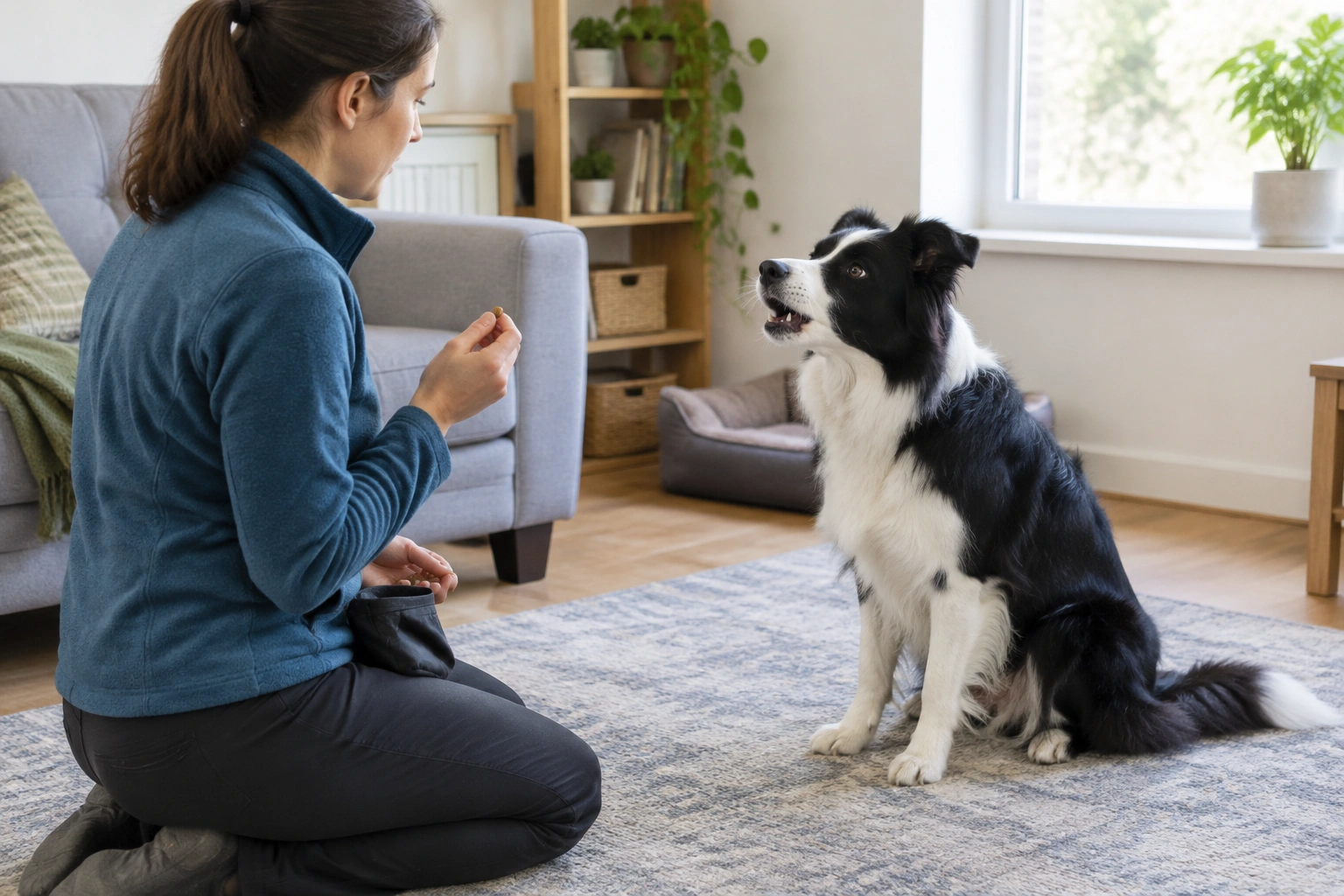
That distinction matters because barking is self-reinforcing for many dogs. Once the sound starts, the dog often becomes more aroused, and arousal makes repetition more likely. If you reward every bark without boundaries, you can accidentally train a habit you’ll later need to undo.
A useful speak cue gives you three things:
- a fun trick for training sessions
- a way to channel vocal dogs into a predictable behavior
- a foundation for teaching “quiet” afterward
It should not become an excuse to encourage nuisance barking at the door or window.
Is Your Dog a Good Candidate for Speak Training?
Some dogs learn this quickly. Others need more groundwork first.
Good candidates
Dogs that already bark sometimes, especially in play or excitement, often learn speak faster. Many Border Collies fit here. They notice patterns quickly, and if barking has ever worked for them, the behavior is already in their repertoire.
Dogs that may need a slower approach
If your dog is shy, anxious, or rarely vocal, don’t force the issue with a highly exciting trigger. Some dogs will respond with stress signals, avoidance, whining, or freezing instead of a clean bark. In those cases, you may need to build confidence and reward simpler communication first.
Dogs that already bark too much
If your dog is already a nuisance barker, teaching speak is not usually the first project. Teach calmness and quiet behavior first, or work on barking control alongside speak from the beginning. Otherwise, you may increase the very behavior you’re trying to manage.
A simple decision rule: if your dog can settle, take treats calmly, and recover quickly from mild excitement, speak training is usually manageable. If your dog escalates fast, vocalizes from anxiety, or struggles to disengage, keep the session very short or get help.
Choose Your Training Path: Capture, Trigger, or Shape
There are three common ways to get the first bark.
| Method | Best for | Trade-off |
|---|---|---|
| Capture | Dogs that bark naturally | Slower, but often calmer and cleaner |
| Trigger | Dogs that need help offering the first bark | Faster to get a bark, but can create too much arousal |
| Shape | Dogs that whine, murmur, or almost bark | More precise, but requires better timing and patience |
For most pet owners, the best order is capture first, then a mild trigger if needed, then shaping only if your dog is vocal but not quite barking cleanly. That keeps the training calmer and lowers the chance of overdoing excitement.
Capture
Capture means waiting for your dog to bark on their own, then marking and rewarding it. This is often the cleanest route if your dog already barks during play, at a knock, or when excited. You’re not creating the behavior from scratch; you’re simply putting it on cue.
Trigger
A trigger is anything that naturally prompts a bark. Verified training guidance includes holding a toy above the dog’s head, using a doorbell sound, or knocking on a surface or door. The point is not to frustrate the dog for long periods. It’s to create a brief situation where barking happens, so you can mark it and build from there. AKC Pet Insurance describes this approach in its speak training guide: how to teach your dog to speak.
Shape
Shaping means rewarding small steps toward the bark. This can help if your dog gives a little vocalization first, such as a grunt, huff, or whine. The downside is that shaping takes more skill. If your timing is late, you may reward the wrong sound.
If you’re unsure, use capture first. If your dog never offers a bark, use a mild trigger. If your dog is vocal but messy, shape toward a cleaner bark.
Clicker, Marker Word, or Both?
You do not need a clicker to teach speak, but a marker can make the exact moment easier to identify.
Clicker
A clicker gives very precise timing. That matters because the bark is brief, and you want to mark the exact behavior you want repeated. A clicker is especially useful if you struggle to say “yes” at the right instant.
Marker word
A marker word like “yes” is simpler. You always have it with you, and some owners find it easier to use naturally during home training.
Both
You can use both in a broader training program, but for this trick, one marker is usually enough. Switching between tools too often can muddy the picture for the dog.
If your timing is sharp and you want simplicity, use a marker word. If your timing tends to lag, a clicker may help.
Step-by-Step: How to Teach the First Bark
Keep the first session short and low-pressure.
1) Set up the dog for success
Choose a quiet room with few distractions. Have treats ready before you begin. Use a reward your dog actually wants, not dry kibble if your dog ignores it in excitement.
2) Elicit one bark
Use a mild trigger your dog already finds meaningful: a toy held slightly out of reach, a door knock, or a doorbell sound. You want a bark, not a frenzy.
3) Mark the bark
The instant your dog barks, mark it with your clicker or marker word.
4) Reward immediately
Follow the marker with a treat. The goal is to reinforce the single bark, not the full burst of noise that may follow if you wait too long.
5) Reset
After the treat, pause. Let your dog settle before asking again. If the dog starts barking repeatedly, you’ve probably moved too fast.
A good first session may only produce a handful of clean repetitions. That’s enough.
Add the Verbal Cue and Hand Signal
Do not name the behavior before the dog is actually doing it. First, get the bark. Then add the cue while the bark is happening. Best Friends recommends teaching the behavior first and then giving the cue while the dog performs it.
Use one consistent word: “speak.” Say it just before or as the bark starts, then mark and reward.
Once the verbal cue is reliable, you can add a hand signal. The AKC describes a common hand signal as an open hand, palm facing the dog, with the fingers repeatedly closing against the thumb. You can see that approach in the AKC’s guidance on training your dog to speak.
At first, the hand signal should support the cue, not replace it. Over time, you can fade the trigger so the cue controls the behavior, not the knock, toy, or doorbell.
How to Reward Speak Without Creating Excessive Barking
This is the part that keeps the trick useful.
Reward the bark you asked for, then create a pause before the next repetition. If you feed too quickly after multiple barks, you can accidentally reinforce barking chains instead of a single cueable behavior.
Use these rules:
- reward one clear bark, not a barking burst
- pause between repetitions
- end the session if barking becomes frantic
- do not keep “testing” the dog once they’re overstimulated
A Border Collie may learn the pattern very fast, which is helpful and risky at the same time. Fast learners can also become noisy pattern collectors. Keep your criteria tight.
Teach Quiet at the Same Time
Speak training is much safer when paired with a quiet cue.
The ASPCA’s barking guidance recommends allowing a few barks, then saying “Quiet” calmly, avoiding shouting, and rewarding the dog when it comes away and remains beside you. You can read that guidance here: ASPCA barking advice.
That does not mean you must use exactly the same setup in every home. It does mean the dog should learn that barking is not the end of the conversation. Quiet is part of the picture.
A practical mini-protocol:
- ask for speak and reward one bark
- say “quiet” once the dog has barked
- if the dog barks once more, wait briefly, then reward the first pause
- if the dog barks repeatedly, stop the session and reset later with an easier trigger
If your dog cannot settle after speak, shorten the session and make the trigger less exciting.
Troubleshooting: Quiet Dogs, Whining, Alert Barking, and Overexcited Dogs
If your dog won’t bark
Use a stronger but still safe trigger. Some dogs need a little social pressure, a toy they can’t quite reach, or a sound they already react to. If the dog is truly silent, don’t keep waiting forever. End the session and try again later.
If your dog whines instead of barking
Rewarding a whine usually gives you more whining. If you are shaping, wait for a clearer bark-like sound before marking. If the dog only whines, ignore the whine and reset; then make the trigger slightly more motivating without turning it into a frustration test.
If your dog alert-barks at every sound
Do not confuse alert barking with the speak cue. If your dog barks at the window, do not reward that bark unless you specifically asked for speak. You want a bark that happens because you cued it, not because the dog saw a person outside. If the dog is already reacting to the environment, work in a quieter room and keep the trigger controlled.
If your dog gets too excited
Stop sooner than you think you need to. Two or three good repetitions may be enough for one session. If the dog starts bouncing, barking repeatedly, or losing focus, you’ve gone past the learning point.
How Long It Takes, How Often to Practice, and When to Stop
There is no honest universal timeline here. Some dogs offer a bark in the first session. Others need multiple short sessions before they understand that barking, not jumping or staring, earns the reward.
For practical training, keep sessions short. A few minutes is often enough for this trick, especially with energetic dogs. One training article notes that the process can involve a lot of waiting, which is another reason not to turn one session into a long grind.
Stop when you see any of these signs:
- barking becomes frantic
- the dog stops taking treats cleanly
- the dog starts offering unrelated behaviors
- the dog cannot settle after a repetition
Short, successful sessions beat long, messy ones.
Advanced Decision Rules for Border Collies and Other High-Drive Dogs
Border Collies often learn speak quickly, but they also need stricter boundaries.
Use a calmer trigger than you think you need. A highly exciting toy game can work, but it can also push the dog into noisy repetition. For a dog that already lives in a high state of alertness, a mild door knock or a brief toy pause may be enough.
Also, keep your reinforcement criteria narrow:
– one bark earns the reward
– repeated barking does not
– quiet earns reinforcement too
That combination turns the trick into an exercise in control, not just noise production. For Border Collies, that is the real win.
If your dog is already showing reactivity, fear, or persistent barking in daily life, this is where a qualified trainer or behavior professional can help. The RSPCA notes that training classes can help, especially for more advanced methods such as clicker training, and that qualified behaviorists or training instructors can help with behavioral issues. See their guidance on dog training support.
Common Mistakes That Turn Speak Into a Barking Problem
The biggest mistakes are usually simple:
- rewarding every bark instead of one controlled bark
- using a trigger that is too exciting
- skipping the quiet cue
- continuing after the dog is overstimulated
- confusing whining or alert barking with the behavior you wanted
- changing the cue word from session to session
Most problems come from reinforcing too much noise too often. If you keep the reward tied to a clear, single bark and also reward calm afterward, the trick stays useful.
When to See a Veterinarian or Certified Trainer
If your dog’s barking changes suddenly, becomes extreme, or seems tied to fear, anxiety, or reactivity, get professional help. A barking issue can be behavioral, but a sudden change can also reflect discomfort or another underlying problem.
See a veterinarian if the vocalization is unusual for your dog or comes with other changes in behavior. See a certified trainer or behavior professional if your dog is struggling to settle, escalating during sessions, or already has a barking habit you cannot manage cleanly.
The goal is not just to get a bark on cue. It’s to keep the dog understandable, calm, and easy to live with.
FAQ
How do you teach a dog to speak on cue?
Start by getting a single bark with a mild trigger, mark it the instant it happens, and reward it. Then add the word “speak” as the bark becomes predictable.
Should I teach quiet at the same time?
Yes. Pairing speak with quiet helps prevent the dog from turning the trick into repeated barking.
What if my dog barks too much after learning speak?
Reduce the excitement of your trigger, reward only one bark, and end the session as soon as barking becomes repetitive.
How long does it take to teach speak?
It varies. Some dogs get it quickly, while others need several short sessions. Keep practice brief and stop before the dog gets overexcited.