
What Does Intact Mean for Dogs? A Practical Guide for Border Collie Owners

If you’re reading dog records, adoption notes, or breeder information, intact simply means a dog has not been spayed or neutered. In plain English, the dog still has the reproductive organs and hormones that would normally be removed in a sterilization surgery.
That matters more than the word sounds like it should. An intact dog is not automatically healthier, harder to train, or intended for breeding. It just means the dog is still biologically able to reproduce. For Border Collie owners, that has real-life consequences: heat cycles, roaming risk, accidental mating, boarding restrictions, and some health trade-offs that deserve an honest look.
If you’re trying to decide whether to keep your Border Collie intact, the useful question is not “Is intact good or bad?” It’s “Can I manage the practical consequences well enough for this dog’s sex, age, lifestyle, and health history?”
What “Intact” Means for Dogs
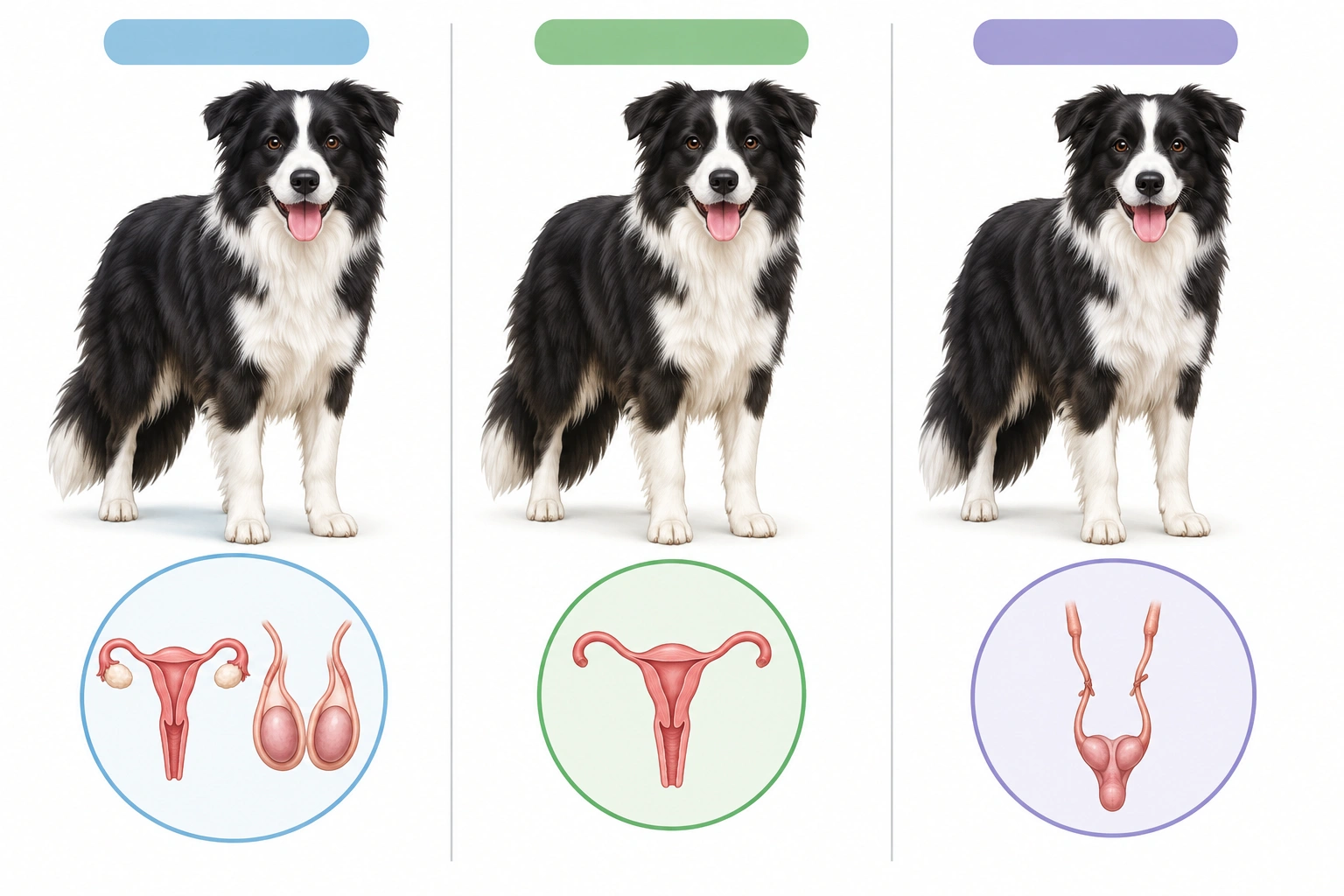
An intact dog has not had its reproductive organs removed. For a male, that means the testicles are still present. For a female, that means the ovaries and uterus are still in place.
You may also see similar terms:
- Unaltered: usually means the same thing as intact
- Whole: informal, but commonly used
- Not spayed: used for females
- Not neutered: used for males
The key point is simple: intact = not surgically sterilized.
That also means the dog still has sex hormones. Those hormones influence reproduction, and in some dogs they also affect behavior, body condition, and certain health risks. The effect is not the same for every dog, which is why broad generalizations often fail owners.
Intact vs. Spayed, Neutered, and Unaltered
People often use these terms loosely, but they do not all mean exactly the same thing.
| Term | Usually means | Applies to | Practical meaning |
|---|---|---|---|
| Intact | Not sterilized | Male or female | Dog can reproduce |
| Unaltered | Same as intact | Male or female | Dog has reproductive organs/hormones |
| Neutered | Male dog sterilized | Male | Testicles removed; cannot father puppies |
| Spayed | Female dog sterilized | Female | Ovaries, usually uterus too, removed; cannot become pregnant |
One useful detail: “Intact” is the cleanest general term when you do not want to specify sex. “Unneutered” gets used in conversation, but it’s not the standard veterinary term.
The practical difference is not just vocabulary. A spayed female does not go into heat. A neutered male does not produce sperm and is less driven by female scent signals. An intact dog of either sex can still contribute to accidental breeding if management slips.
General veterinary guidance often frames spay-neuter as the surgical removal of reproductive organs, and it also notes that keeping a dog intact may avoid surgery- and anesthesia-related risks. You can read that overview on the AKC’s intact dog guidance.
What Changes in Intact Male Dogs vs. Intact Female Dogs
The sex of the dog changes the management job.
An intact male still has testicles and can father puppies, while an intact female has ovaries and a uterus and can go into heat and become pregnant.
Intact male dogs
An intact male still has testicles and can father puppies. In everyday life, that often means he may show more interest in female dogs in heat, and some males become more likely to:
- roam or try to escape fencing
- mark with urine
- mount other dogs
- become harder to settle around a nearby female in heat
That does not mean every intact male becomes a problem dog. It does mean the owner has to be more alert to triggers that pull the dog out of normal routines.
Intact female dogs
An intact female has ovaries and a uterus and will go through heat cycles. During heat, she may attract males from a surprising distance, and she can become pregnant if mating occurs.
Typical management issues include:
- vaginal discharge
- swelling of the vulva
- extra attention from male dogs
- the need for strict separation from intact males
The biggest difference is simple: an intact female has a time-based risk window, while an intact male has a year-round breeding risk if he gets access to a female in heat.
Behavior: What Intact Status Can and Cannot Change
This is where owners often overestimate what hormones do.
Intact status can influence some behaviors, but it does not determine whether a dog is trainable, polite, or manageable. Training, early habits, environment, and the individual dog still matter a great deal.
Behaviors that may be affected
Some intact dogs may show more:
- mating interest
- roaming
- marking
- mounting
- frustration around females in heat
These behaviors are often most obvious when the dog is exposed to strong reproductive cues. A male Border Collie that is calm in the house may still become laser-focused if a nearby female is in heat.
Behaviors that are not solved by sterilization alone
Sterilizing a dog does not automatically fix:
- reactivity
- fearfulness
- poor leash manners
- separation distress
- lack of impulse control
- underexercised, undertrained behavior
That matters for Border Collies because they are a sharp, high-drive breed. An intact Border Collie still needs structure, recall work, leash manners, and a clear daily routine. A neutered or spayed Border Collie still needs exactly the same foundation.
A useful rule: if a behavior happens in many contexts, it is probably a training or management issue first, not an intact-status issue alone.
Health and Reproductive Risks of Keeping a Dog Intact
There are trade-offs either way.
Keeping a dog intact preserves reproductive capability and avoids surgery, but it also leaves the dog exposed to reproductive risks and breeding-related management problems. Veterinary guidance often notes that neutering has been associated with increased risk of certain issues, including endocrine issues, urinary incontinence, orthopedic disorders, soft tissue injuries, and some cancers. That does not mean sterilization is always wrong; it means the decision should be individualized.
For Border Collies specifically, that individualized conversation matters because the best timing can depend on growth, activity level, and overall health as well as breeding plans. A veterinarian can help you weigh whether the practical benefits of waiting are worth the added management demands.
Risks that matter for intact dogs
For intact females:
- pregnancy risk
- false alarms around heat timing
- pyometra risk later in life, which is a serious uterine infection
- accidental mating if supervision slips
For intact males:
- testicular health concerns, including the possibility of testicular tumors later in life
- prostate-related issues as they age
- breeding-related injuries or conflict if they get into fights over a female in heat
For both sexes:
- accidental litters
- management stress
- possible escape attempts
- restrictions at some daycare, boarding, or group-play facilities
The humane society guidance on living with an intact female dog also emphasizes that living with an intact dog can present challenges, and that overpopulation remains an animal welfare concern. That is the practical backdrop to every intact decision: even if your dog is healthy and well-behaved, the risk of an accidental litter is still real.
Preventing Accidental Mating and Handling Heat Cycles
If you keep a dog intact, management has to be deliberate. Hope is not a plan.
For intact females
During heat, assume the dog can attract males faster than you expect. Use:
- constant supervision outdoors
- leash walks only
- secure fencing
- separation from intact males
- double-checking doors, gates, and crates
Do not rely on a backyard fence alone if neighboring dogs can dig, jump, or push through weak points. A female in heat can trigger intense interest from nearby males, and that attention can turn into a fence-line problem quickly.
For intact males
The management priority is preventing access to females in heat. That means:
- no loose outdoor time in unfenced areas
- no unsupervised visits with unknown dogs
- caution at parks, trails, and social events where a female in heat may be present
- immediate separation if a nearby female enters heat
If your intact male suddenly becomes harder to call away or fixates on scent trails, treat that as a management signal, not a training failure. He is telling you the environment has become more difficult.
In multi-dog homes
If you have both sexes in the same home and one dog is intact, plan ahead before heat begins. Separation should be physical, not just verbal. Different rooms, closed doors, crates, baby gates, and scheduled potty breaks are often necessary.
A practical test: if you would not trust the dog alone with a tempting food item, do not trust them alone with breeding access.
Border Collie-Specific Considerations
Border Collies are intelligent, active, and quick to learn patterns. That can make intact management easier in one way and harder in another.
Why they can be easier
A well-trained Border Collie often responds well to routines, boundaries, and clear cues. If you have already built a strong recall, crate routine, and house structure, those habits help a lot.
Why they can be harder
Border Collies also notice everything. A female in heat nearby, a loose dog across the fence, or a new scent on a trail can become a major distraction. Their speed and problem-solving ability mean they may exploit a weak gate or an open door faster than a less driven breed.
Timing matters
Border Collies mature physically and behaviorally at different rates. Some owners want to delay sterilization to discuss growth or joint considerations with their veterinarian. Others prioritize population control and simpler management. There is no universal timeline that fits every Border Collie, which is why the vet conversation matters.
If you are deciding on timing, think in terms of risk you can manage now versus risk you want to avoid long-term.
When Keeping a Dog Intact Makes Sense—and When It Doesn’t
Keeping a dog intact can make sense when:
- the dog is being kept for responsible breeding
- the owner can provide strict supervision
- the dog’s environment is low-risk for accidental mating
- a veterinarian has weighed in on timing and health considerations
It usually makes less sense when:
- the dog will spend time around many unfamiliar dogs
- the household cannot reliably separate dogs during heat
- the owner wants the simplest possible management
- the dog is likely to visit group boarding or daycare that restricts intact dogs
This is where trade-offs become practical. Intact status preserves the option to breed, but it also asks more of the owner every day. Sterilization removes breeding ability, but it may reduce some management problems while introducing surgical and hormone-related considerations that deserve discussion with a vet.
The right decision is not about ideology. It is about the dog in front of you.
When to See a Veterinarian or Certified Trainer
Talk to your veterinarian if:
- you are unsure whether your Border Collie is old enough for spay/neuter
- your intact female may be in heat
- your intact male is showing roaming, marking, or fixation on other dogs
- you have a multi-dog home and need a separation plan
- your dog has a health issue that could affect surgical timing
- you are considering breeding and want to understand health screening and responsibility first
A certified trainer can help if intact status is amplifying management problems, especially leash frustration, reactivity, or boundary-breaking around other dogs. Training will not prevent pregnancy, but it can make an intact dog much easier to live with.
Frequently Asked Questions
Is intact the same as unspayed or unneutered?
Yes in practical terms. “Intact” means the dog has not been sterilized. “Unspayed” usually refers to a female, and “unneutered” usually refers to a male.
Can an intact dog still be well trained?
Absolutely. Intact status does not prevent good training. It may just mean you need tighter management around other dogs, especially if a female is in heat nearby.
Does being intact make a dog aggressive?
Not automatically. Some intact dogs show more hormone-driven behaviors, but aggression is not determined by intact status alone. Training, socialization, genetics, and environment still matter.
How do I know if my female dog is in heat?
Common signs include vulvar swelling, discharge, and increased attention from male dogs. If you are unsure, call your veterinarian rather than guessing.
Should I spay or neuter my Border Collie?
There is no one-size-fits-all answer. The best timing depends on your dog’s sex, age, health, lifestyle, and whether you are managing for breeding or companionship. Your veterinarian should help you weigh the trade-offs.
Do daycare and boarding centers accept intact dogs?
Some do, some do not. Many facilities with group play have restrictions for intact dogs, especially males or females in heat. Ask before you book.
Can an intact dog live safely with other dogs?
Yes, but only with good management. The biggest risk is accidental mating, so physical separation and supervision matter more than good intentions.
The term intact is simple, but the decision behind it is not. For a Border Collie, the real question is whether you can manage reproduction risk, behavior triggers, and daily logistics well enough to make intact status a workable choice.