
Why Is There a Bump on My Dog’s Back? A Practical Guide to What It Could Be

Finding a bump on your dog’s back is unsettling because it sits in that awkward middle ground: common enough to be harmless, serious enough that you should not ignore it. The useful question is not just “what is it?” but “how worried should I be right now?”
In practice, bumps on a dog’s back often turn out to be something relatively ordinary, such as a lipoma, cyst, insect bite reaction, or a localized swelling after irritation or minor trauma. But appearance alone cannot reliably tell you whether a lump is benign or concerning. A soft lump can still deserve a vet visit, and a painless one can still be important.
For Border Collie owners especially, this matters because these dogs are active, lean, and often handled a lot during grooming, training, and exercise. That makes it easier to notice a new bump — but also easier to keep checking it, pressing it, or worrying about it. The goal here is simple: help you decide what the bump most likely is, what signs raise concern, and when it is time to book a veterinary exam.
What a bump on your dog’s back could be
A bump on the back can come from the skin, the tissue under the skin, or deeper structures. Some are fluid-filled, some are fatty, some are inflammatory, and some are tumors. That sounds broad because it is broad. The same “bump” description can cover very different problems.
The most common possibilities include:
- Lipoma: a soft fatty lump under the skin
- Cyst: a fluid- or material-filled sac, often from a blocked gland or hair follicle
- Abscess: a pocket of infection, often warm and painful
- Insect bite or sting reaction: sudden swelling, sometimes itchy or tender
- Wart or skin growth: a small raised mass on or in the skin
- Swelling from trauma: bruising, a hematoma, or localized inflammation
- Tumor: benign or malignant, including skin or soft tissue masses
A useful rule of thumb is this: if the bump appeared suddenly, changed quickly, or seems irritated, think inflammation, bite reaction, infection, or injury first. If it has been there a while and feels soft and movable, a fatty lump becomes more likely. But none of those clues confirm the diagnosis on their own.
PetMD notes that lumps, bumps, and cysts can arise from hair follicles and may form anywhere on a dog’s body, but they are more common on the back, tail, and legs of adult dogs. That is one reason the back is a common place to notice these problems in the first place. You can read more from PetMD’s overview of dog lumps and cysts.
The most common causes and how they usually feel
The quickest way to sort through a bump is to compare how it feels and behaves. You are not trying to diagnose it at home. You are trying to decide whether it behaves like a lower-risk lump or a more concerning one.
Lipoma: soft, movable, usually not painful
Lipomas are fatty masses under the skin. They are commonly described as soft and movable, and they usually do not hurt when touched. If you gently slide the skin over the lump and it seems to move with the skin rather than feel anchored in place, a lipoma is one possibility.
That said, “feels like a lipoma” is not the same as “is a lipoma.” Some tumors and cysts can feel deceptively soft early on, and some lipomas sit in awkward locations that make them feel less obvious.
Cyst: round, under-the-skin lump that may become inflamed
Sebaceous cysts are commonly seen in dogs and are formed when the sebaceous gland overproduces fluid, creating a lump underneath the skin. Banfield notes that heat, redness, or discharge may indicate an infected cyst that needs veterinary care. Greencross Vets similarly notes that these cysts are often found on the back and torso and can contain a creamy grey or white substance.
A cyst may sit quietly for a while, then become irritated if it ruptures, gets scratched, or becomes infected. If the bump changes from calm to red and sore, the problem may no longer be the cyst itself but the inflammation around it.
Do not squeeze it. Greencross Vets specifically advises against squeezing these cysts at home because that can lead to irritation and infection. That is one of those cases where “doing something” is more likely to make the bump worse than better.
Abscess: warm, tender, often linked to infection
Abscesses are usually caused by infection. They often feel tender, warm, and swollen. If your dog flinches when you touch the area, or the skin feels hotter than the surrounding skin, infection becomes more likely.
Abscesses can develop after a bite, puncture, scratch, or other break in the skin. Sometimes the original wound is tiny and easy to miss. If a bump showed up after rough play, a scuffle, or a lot of scratching, an abscess or localized swelling should stay on your radar.
Insect bite or sting: sudden swelling and irritation
A bite or sting reaction often appears suddenly and may be itchy, puffy, or mildly painful. Some reactions settle down on their own, but they can also become more inflamed if the dog keeps licking or rubbing the area.
A key difference from a more fixed lump is timing. If the bump was not there yesterday and now it is obvious, that points more toward a reaction or injury than a slow-growing mass.
Wart or skin growth: small, raised, surface-level
Warts and similar skin growths are often raised and may look rough, cauliflower-like, or attached to the skin surface. Some are harmless, but a new skin growth still deserves a vet’s look if it is growing, bleeding, or changing color.
Tumor: hard, fixed, or fast-growing masses can be concerning
Tumors are not automatically cancerous, but they need respect. Oakhurst Veterinary Center notes that tumors can be malignant and may feel hard, fixed, or fast-growing. That matters because a lump that seems attached to deeper tissue is harder to dismiss as simple swelling.
A mast cell tumor, for example, can vary a lot in appearance and feel, which is exactly why visual guessing is unreliable. A lump that looks small and ordinary can still need testing.
How to judge the bump by feel and behavior
A good home check is calm, brief, and hands-off. You are looking for patterns, not trying to press for answers.
Use these four questions
-
How big is it?
Compare it to a pea, grape, or walnut and note the approximate size. The National Canine Cancer Foundation references a guideline approach suggesting that a lump, bump, or lesion the size of a pea or larger and present for a period of time should prompt further testing. -
Is it soft or firm?
Soft and squishy leans one way; firm or rock-like leans another. Firm does not automatically mean cancer, but it raises the need for a vet exam. -
Does it move?
A movable lump is often less worrying than one that seems anchored. If it feels fixed, attached, or deep, that is more concerning. -
Does your dog react when you touch it?
Pain, flinching, licking, or guarding the area suggests irritation, infection, or injury.
Also watch the skin on top
Look for:
– redness
– heat
– discharge
– bleeding
– ulceration
– hair loss over the lump
– scabbing or a central pore
Palmetto Veterinary Specialist notes that a lump on a dog’s skin that bleeds is a warning sign that should not be ignored. Bleeding does not automatically mean cancer, but it does mean the lump has crossed into “needs attention” territory.
Watch the timeline
The timeline often tells you more than the shape. A lump that has stayed the same size for months is different from one that doubled in a week. Rapid growth is one of the clearest reasons to stop watching and start booking a vet visit.
ImpriMed also points out that lumps and bumps can be easy to miss because they may be small or in areas you do not often touch. That is why it helps to run your hands over your dog during grooming or after baths, when the coat is flat and the skin is easier to feel.
Signs the bump is probably less urgent versus signs it needs prompt vet care
This is the decision point most owners want. The cleanest way to think about it is to separate monitorable bumps from promptly checkable bumps.
More reasonable to monitor at home for now
Home monitoring is more reasonable when the bump is:
– small
– soft
– movable
– not painful
– not red or warm
– not leaking
– not growing
– not affecting your dog’s behavior
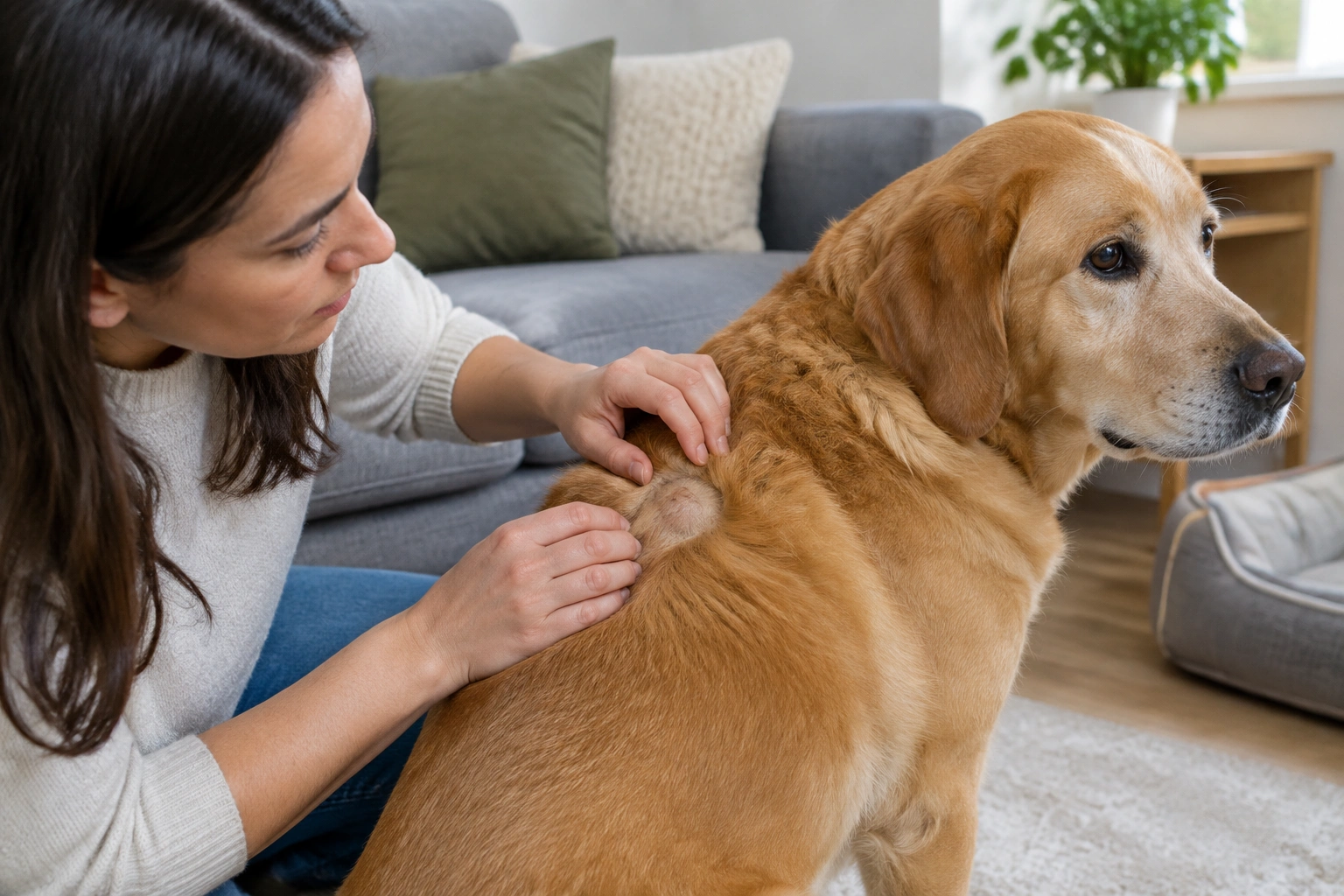
A stable, soft lump that has not changed for a while may still need a routine exam, but it is less likely to be an emergency.
Book a veterinary appointment soon if the bump is:
- new and unexplained
- getting larger
- firm or fixed
- painful or itchy
- red, warm, or inflamed
- leaking fluid or blood
- ulcerated or scabbed
- causing your dog to lick, scratch, or avoid pressure
- making your dog seem off, tired, or uncomfortable
Fountain Valley Emergency Pet Hospital notes that pet lumps and bumps can be caused by age, infections or inflammation, trauma, or cancerous growths. The practical takeaway is that the cause matters less than the pattern: if it is changing, irritated, or affecting your dog, it deserves attention.
Seek prompt care rather than waiting if your dog also seems unwell
A bump plus any of these signs should move you toward faster veterinary care:
– lethargy
– reduced appetite
– feverish behavior
– obvious pain
– sudden swelling
– drainage with a bad smell
– trouble lying down comfortably
A skin lump is one thing. A skin lump plus systemic symptoms is a different problem.
Why a painless or soft lump is not always harmless
This is where owners often get misled. A painless bump can still be important, and a painful bump can still be something relatively minor.
A lipoma is often painless, but some tumors are painless too. A cyst may feel harmless until it becomes infected. A mast cell tumor can sometimes look like an ordinary skin lump. On the other hand, an abscess may be painful but treatable once identified.
So do not let “my dog doesn’t seem bothered” become the only reason to ignore a lump. Dogs hide discomfort well, and they adapt quickly. A lump that is not bothering them today may still deserve diagnosis if it is new, growing, or uncertain.
What not to do at home
This section is short because the rule is simple: do not try to fix the bump yourself.
Do not:
– squeeze it
– pop it
– lance it
– cut into it
– apply human creams without veterinary advice
– give human pain relievers
– keep pressing on a sore area to “see what happens”
The biggest risk is not just infection. It is also that you may make the tissue more inflamed, rupture a cyst, or delay proper diagnosis. If the bump is already irritated, rough handling can turn a manageable problem into a mess.
If your dog resists touch, give the area a break. Reduce grooming pressure over it, avoid rough rubbing, and keep the dog from scratching or biting at it.
What a veterinarian may do to find out what it is
Most of the time, the vet starts with a physical exam: palpating the lump, measuring it, checking the skin, and often feeling nearby lymph nodes before deciding whether testing is needed. From there, the next step is often a fine needle aspirate, which removes a small sample of cells for examination.
That matters because many lumps cannot be identified reliably just by looking. A fatty lump, cyst, inflammatory mass, and tumor can overlap in feel and appearance. A fine needle aspirate is often the quickest way to narrow things down.
If the sample is unclear or the lump looks suspicious, your vet may recommend a biopsy. In some cases, imaging may be helpful if the mass seems deeper than the skin. Depending on what the lump looks and feels like, your vet may also suggest short-term monitoring before sampling if it appears low risk and has not changed.
This is the main reason not to assume you can “watch and wait” forever. If the lump is not clearly harmless, testing is usually the shortest path to clarity.
For a broader reference on how vets approach lumps and bumps, VCA Hospitals’ pet health resources are a useful starting point.
How to monitor a stable bump at home if your vet says it is reasonable
If your veterinarian says the bump can be watched for now, make the monitoring structured. Casual memory is unreliable.
Track:
– size
– shape
– color
– firmness
– whether it moves
– whether it is painful
– whether it leaks
– whether your dog scratches, licks, or avoids it
A simple phone photo once a week can help, especially if you place a coin beside the lump for scale. That gives you a visual record instead of relying on guesswork.
Recheck sooner if:
– it gets bigger
– it changes texture
– the skin becomes red or warm
– it starts draining
– your dog becomes sensitive to touch
– your dog’s behavior changes
If the bump is stable for weeks or months but still unexplained, a routine veterinary exam is still worthwhile. Stability lowers urgency, but it does not automatically solve the question.
When to see a veterinarian or certified trainer
For a bump on your dog’s back, the “trainer” part is usually not the issue unless handling the area is affecting behavior or grooming tolerance. The medical side is the priority.
See a veterinarian promptly if the bump is:
– rapidly growing
– hard or fixed
– painful
– hot or red
– draining
– bleeding
– ulcerated
– associated with lethargy or appetite changes
Also book an exam if:
– you do not know what it is
– it has been there a while and never got assessed
– your dog keeps bothering it
– it is in a place where a harness, brush, or bed pressure irritates it
If your Border Collie is normally tolerant but suddenly resists being brushed or patted over one spot, treat that as a clue, not a behavior problem. Pain often shows up as avoidance before it shows up as obvious limping or whining.
FAQ
Should I wait and see if the bump goes away on its own?
If the bump is small, soft, movable, and unchanged, short-term monitoring may be reasonable. But if it is growing, painful, red, bleeding, or fixed, do not wait.
Can I squeeze a cyst on my dog’s back?
No. Squeezing can irritate the area, rupture the cyst, and increase the risk of infection.
Is a soft lump always harmless?
No. Soft lumps are often less concerning, but some tumors and inflamed masses can also feel soft.
When should I worry most about a dog lump?
Worry more when a lump is fast-growing, firm, fixed, painful, red, warm, draining, or causing your dog to act differently.
The bottom line
A bump on your dog’s back could be something simple, like a lipoma, cyst, or bite reaction. It could also be an abscess, wart, swollen tissue after trauma, or a tumor. The most useful clues are not just what it looks like, but whether it is soft or firm, movable or fixed, painful or painless, and stable or changing.
If it is small, soft, movable, and unchanged, monitoring may be reasonable. If it is growing, red, warm, painful, draining, hard, or fixed, book a veterinary exam. And if you are tempted to squeeze it, pop it, or treat it with something from your bathroom cabinet, stop there. That usually creates more problems than it solves.