
Why Your Dog’s Eyes Are Goopy: Causes, Warning Signs, and What to Do

If you’ve caught yourself asking, “Why does my dog have goopy eyes?” the short answer is that eye discharge can be harmless, irritating, or a sign of a real eye problem. The trick is not just noticing the goop, but reading the pattern around it.
A small amount of crust after sleep is often normal. But thick discharge, a sudden change in color, redness, squinting, pawing at the eye, or one eye that looks different from the other deserves closer attention. In Border Collies, that can matter because active dogs may pick up debris more easily during outdoor exercise and play.
This guide will help you sort normal from concerning, clean mild discharge safely, and decide when to call the vet.
Why Dogs Get Goopy Eyes
Dog eyes make tears all the time. Those tears normally drain through small ducts at the inner corner of each eye. A little residue can collect there from dried tears, oil, mucus, dead cells, and dust. That is why many dogs wake up with a bit of crust, especially after a long nap. PetMD explains that this morning goop is often perfectly normal.
It helps to separate that harmless sleep crust from discharge that seems to be building, changing, or coming with other symptoms. Mild morning crust that wipes away easily is different from discharge that keeps returning during the day, gets thicker, or comes with redness or discomfort.
When eye discharge is more than that, the usual causes fall into a few buckets:
Normal tear drainage and sleep crust
This is the mildest version. The discharge is usually small in amount, easy to wipe away, and not paired with obvious discomfort. If it shows up mostly after sleep and then disappears, that points more toward normal drainage than disease.
Irritation from dust, wind, or debris
A dog that has been out in tall grass, brush, sand, or dusty conditions may get temporary eye irritation. One eye is often involved if something actually got into the eye. If both eyes are watery and mildly irritated, the trigger is more likely environmental.
Allergies
Pollen, dust, and other allergens can inflame the conjunctiva and eyelids, which can lead to goopy eyes from allergies. Seasonal patterns matter here. If the discharge comes with sneezing, itchy skin, or watery eyes on both sides, allergies move higher on the list. The AKC’s eye health guidance is also worth reviewing if you want a broader view of common dog eye issues.
Infection or conjunctivitis
When discharge turns yellow or green, becomes thicker, or starts to smell, infection becomes more likely. Conjunctivitis is one common presentation, but it is a sign, not a final diagnosis. A dog can look “just a little goopy” and still have a problem that needs treatment.
Dry eye
Dry eye, also called keratoconjunctivitis sicca or KCS, is a common cause of thick, sticky discharge. With too few tears, the eye loses its normal wash-and-protect system, so mucus builds up and the eye becomes red and inflamed. This is one reason you should not assume all thick discharge is “just allergies.”
Foreign body or injury
A grass seed, piece of dirt, scratch, or other irritation can trigger tearing, blinking, and discharge. This is especially important if only one eye is affected or if your dog suddenly starts pawing at the face.
Blocked tear ducts or underlying eye disease
If tears can’t drain normally, they may overflow and leave crusty residue. Persistent discharge can also be related to eyelid or facial conformation, or to tear-duct anatomy that does not drain well. Other eye conditions can also change how the eye looks and feels. Veterinary guidance from CAMPLA notes that foreign objects, allergies, eye infections, and underlying health issues are all common causes of goopy eyes in pets.
What Eye Discharge Looks Like When It’s Normal vs Concerning
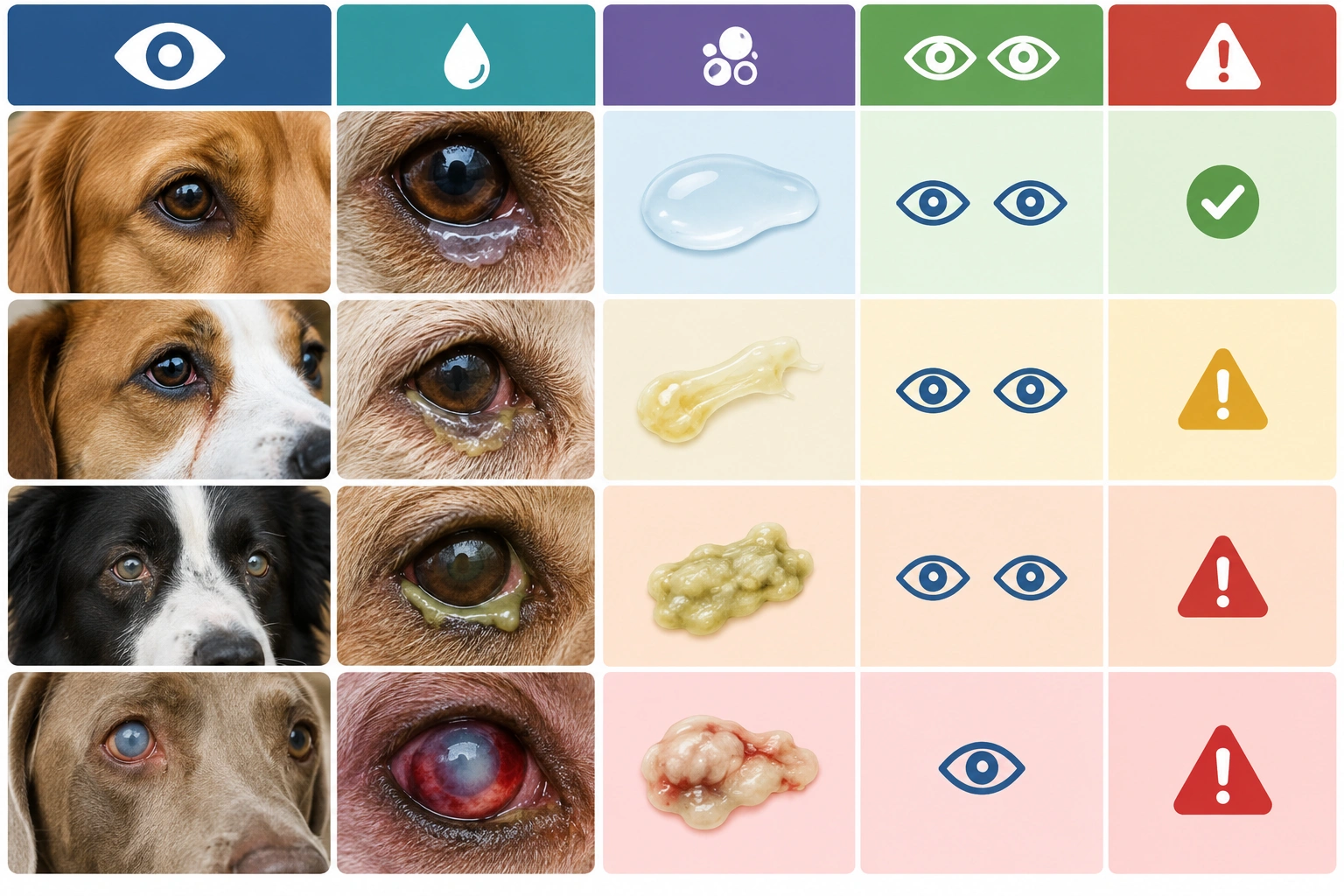
The discharge itself gives useful clues, but it should never be read in isolation. Color, thickness, amount, timing, and the dog’s comfort level all matter. Color alone is not diagnostic: a yellowish tint does not automatically mean infection, and a pale discharge can still be a sign of dry eye or irritation. Pain, redness, squinting, and swelling matter more than color by itself.
| What you see | More likely meaning | What to do |
|---|---|---|
| Small amount of clear or slightly reddish-brown crust after sleep | Often normal tear drainage | Wipe gently and monitor |
| Thin, watery discharge in both eyes | Mild irritation or allergies | Watch for other allergy signs |
| White or pale discharge | Can be mild irritation or dry eye | Monitor closely; call vet if persistent |
| Yellow or green discharge | More concerning for infection or significant inflammation | Book a vet visit soon |
| Thick, sticky, mucoid discharge | Dry eye, irritation, or infection | Needs closer attention |
| Bad smell, redness, swelling, or pain with discharge | More serious eye problem | Vet visit promptly |
A useful rule: the more the discharge changes away from clear and light, the more cautious you should be. York Veterinary Hospital notes that a little morning crust can be normal, while green discharge is more likely to suggest infection or significant inflammation.
The other major clue is whether the amount stays steady or keeps increasing. If your dog has the same tiny bit of crust every morning, that is different from a dog whose eye goop is getting heavier, thicker, or more frequent over a few days. Maddie’s Fund flags discharge that persists more than a few days, increases, or changes from clear and liquid to yellowish or green and mucoid as concerning.
Use the Symptom Pattern to Narrow the Cause
The pattern around the discharge often matters more than the goop itself.
One eye versus both eyes
If only one eye is affected, think first about a foreign body, scratch, blocked tear duct, or local injury. Something mechanical is more likely when the problem is one-sided.
If both eyes are involved, allergies, environmental irritation, or a systemic issue become more likely. That does not rule out infection, but it changes the odds.
Watery versus thick
Watery discharge often fits irritation or allergies. Thick, sticky, or ropey discharge raises concern for dry eye, infection, or more significant inflammation.
Redness, squinting, or pawing
These are not minor details. Red eyes, swollen eyelids, excessive blinking, squinting, keeping the eye closed, pawing at the face, or light sensitivity all suggest discomfort. Companion Animal Clinic lists those signs as reasons to worry about eye discharge.
Pain or vision changes
If your dog seems painful, avoids bright light, bumps into things, or looks unable to see normally, treat that as urgent. Certain eye problems, including corneal ulcers and glaucoma, can threaten vision if they are not addressed promptly.
When Goopy Eyes Are More Likely Allergies, Infection, or Something Stuck
This is the decision point many owners struggle with.
Allergy pattern
Allergy-related discharge is often:
– in both eyes
– watery or mildly mucoid
– paired with sneezing, itchy skin, or seasonal flare-ups
– uncomfortable, but not usually severely painful
A dog may rub the face a little, but intense squinting is less typical for simple allergies.
Infection pattern
Infection is more likely when discharge becomes:
– yellow or green
– thicker and stickier
– accompanied by redness or swelling
– persistent rather than brief
If the eye is clearly inflamed, the discharge is changing, or the dog seems bothered, infection moves up the list.
Something stuck or a scratch
A foreign body or corneal scratch often causes:
– one eye only
– sudden onset
– squinting or repeated blinking
– pawing at the eye
– tearing that seems excessive for the amount of discharge
This is the pattern that makes me most cautious. A dog can seem “just irritated” and still have a corneal problem underneath.
Safe At-Home Cleaning and Monitoring
If the discharge is mild, clear, and your dog is otherwise comfortable, gentle home care is reasonable.
What to use
Use sterile saline or a clean, warm compress. The goal is to soften and lift away crust, not to scrub the eye clean.
How to clean it
- Wash your hands.
- Soak a clean gauze pad or soft cloth in sterile saline or warm water.
- Hold it against the crust for a few seconds to loosen it.
- Wipe gently outward, away from the eye.
- Use a fresh pad for the other eye if both are affected.
Do not dig at the corner of the eye or try to scrape off hard crust with a fingernail. If it does not wipe away easily, stop and let it soften more.
What to watch over the next 24 to 48 hours
Monitor whether:
– the discharge is fading or returning
– one eye becomes redder than the other
– your dog starts squinting, blinking, or pawing
– the discharge changes color
– the eye looks cloudy or swollen
If things are improving and your dog is acting normal, that supports a minor irritation. If symptoms worsen instead of settling, it is time to call the vet.
What Not to Do With a Dog’s Goopy Eyes
Some well-meant fixes can make the problem worse.
Do not use human eye drops unless your veterinarian specifically tells you to. Human products can be wrong for the cause, and steroid-containing drops are especially risky if there is a corneal ulcer or infection.
Do not use leftover pet medication from another issue. Eye problems look similar from the outside, but they do not all need the same treatment.
Do not rub the eye hard or repeatedly wipe it with dry tissue. That adds friction and can irritate the surface further.
Do not try to remove something that looks embedded in the eye. If there is a scratch, a foreign body, or a corneal ulcer, rough handling can worsen the injury.
When Eye Goop Needs a Vet Visit Right Away
Some signs should move you from home monitoring to prompt veterinary care.
Normal home monitoring
This is reasonable if:
– discharge is small, clear, and mostly after sleep
– both eyes look comfortable
– there is no redness, squinting, pawing, or swelling
– your dog is acting normal
– the issue improves after gentle cleaning
Same-day vet visit
Call your vet the same day if:
– discharge is yellow, green, thick, or worsening
– it keeps coming back for more than a few days
– one eye is clearly worse than the other
– redness or swelling is present
– you suspect allergies, dry eye, or a foreign body but cannot be sure
Emergency care
Go now or seek emergency care if:
– the eye is painful
– your dog is squinting or holding it closed
– the eye looks cloudy, dull, or visibly injured
– there is trauma
– your dog may be losing vision
– discharge is heavy and the eye is very red or swollen
A corneal ulcer, severe infection, glaucoma, or another painful eye problem can escalate quickly. Hill’s Pet notes that eye discharge can range from mild allergies to serious conditions like glaucoma that can cause blindness. That is why pain and vision changes are never “wait and see” symptoms.
What the Veterinarian May Check and Treat
A vet will usually start with a close eye exam and the dog’s history: when it started, whether it is one eye or both, and whether the discharge has changed.
In a typical workup, the veterinarian may look at the eyelids, lashes, and tear drainage area, then examine the cornea and the inside of the eye with a light and magnification. Common tests may include:
– a fluorescein stain to check for corneal ulcers
– a Schirmer tear test to evaluate tear production and help rule out dry eye
– a careful look for debris, scratches, or inflammation
These tests are used because different causes can look similar from the outside. A stain helps show whether the cornea has an ulcer or scratch, and a tear test helps determine whether the eye is producing enough tears to stay healthy.
ToeGrips notes that a vet may use a Schirmer tear test to rule out dry eye and fluorescein stain to look for corneal ulcers before tentatively diagnosing allergic eye disease.
Sedation is not always needed, but it may be used if a dog is very painful, anxious, or difficult to examine safely. Many dogs can be examined awake, especially for basic staining and tear testing.
Treatment depends on the cause:
– allergies may need environmental management and vet-prescribed treatment
– infection may need prescribed eye medication
– dry eye often needs long-term management to support tear production and eye comfort
– a foreign body or injury may need removal, pain control, and follow-up checks
Follow-up depends on the diagnosis. Some dogs improve quickly after treatment starts, while others need rechecks to make sure the eye is healing and that the medication is working as expected. The important point is that the treatment should match the cause. That is why guessing based on discharge color alone is not enough.
Border Collie Considerations
Border Collies are not known for a single unique eye-discharge problem, but their lifestyle matters. They are active, fast, and often work or play in grass, dust, wind, and brush. That raises the odds of irritation or a foreign body.
A Border Collie with recurring discharge should not be dismissed as “just sensitive eyes,” especially if the problem keeps returning in the same eye. Recurring irritation can hide dry eye, a blocked tear duct, or a subtle corneal issue.
If your Border Collie also has squinting, redness, or changes in how the eye looks, get it checked rather than waiting for it to settle on its own.
Practical Decision Guide: Monitor, Book a Visit, or Seek Urgent Care
Use this simple framework.
Monitor at home
Reasonable if:
– discharge is small, clear, and mostly after sleep
– both eyes look comfortable
– there is no redness, squinting, pawing, or swelling
– your dog is acting normal
– the issue improves after gentle cleaning
Book a vet visit soon
Do this if:
– discharge is yellow, green, thick, or worsening
– it keeps coming back for more than a few days
– one eye is clearly worse than the other
– redness or swelling is present
– you suspect allergies, dry eye, or a foreign body but cannot be sure
Seek urgent care
Go now or as soon as possible if:
– the eye is painful
– your dog is squinting or holding it closed
– the eye looks cloudy, dull, or visibly injured
– there is trauma
– your dog may be losing vision
– discharge is heavy and the eye is very red or swollen
The safest rule is simple: if the eye looks uncomfortable, treat it as more than cosmetic. Mild morning crust can be normal. Pain, cloudiness, and worsening discharge are not things to watch for too long.
Frequently Asked Questions
Is clear eye discharge normal in dogs?
A small amount can be normal, especially after sleep. If it stays mild and your dog is comfortable, it is usually less concerning than colored or thick discharge.
What does yellow or green eye goop mean?
Yellow or green discharge is more suspicious for infection or significant inflammation. It should not be brushed off, especially if the eye is red or your dog is squinting.
Can allergies cause goopy eyes?
Yes. Allergies can inflame the conjunctiva and eyelids, leading to watery or mildly sticky discharge, often in both eyes.
Should I use human eye drops on my dog?
No, not unless your veterinarian specifically tells you to. The wrong drop can make some eye problems worse.
When should I worry enough to call the vet?
Call if the discharge lasts more than a few days, gets thicker or more colored, or comes with redness, swelling, squinting, pawing, pain, cloudiness, or vision changes.
Can I clean my dog’s eyes at home?
Yes, if the discharge is mild. Use sterile saline or a warm compress and wipe gently. Stop if the eye seems painful or the discharge keeps returning.
Could this be a foreign body?
Yes, especially if only one eye is affected and your dog is suddenly blinking, squinting, or pawing at it. That pattern deserves a vet exam.
Why do Border Collies seem to get eye issues after running outside?
They spend a lot of time in grass, wind, dust, and brush, which can increase the chance of irritation or debris getting into the eye. Recurring problems should be checked rather than assumed to be minor.