

Quick Answer
For many social, active Border Collies, an Australian Shepherd is one of the strongest companion matches because both breeds enjoy training, movement, and mentally engaging activities. However, individual temperament matters more than breed alone, so choose a dog with compatible energy, play style, and social skills. The Border Collie’s working temperament should guide the match.
What makes a strong match?
- Similar energy: The second dog should enjoy an active routine without constantly overwhelming your Border Collie.
- Compatible play: Look for similar preferences for chasing, running, wrestling, or calmer parallel play.
- Good social skills: A dog that reads signals and respects breaks is usually easier to live with.
- Stable temperament: Confidence without pushiness often suits the Border Collie’s sensitive nature.
- Manageable drive: Two intense working dogs can be wonderful, but they also double your training workload.
Good breeds to consider
- Australian Shepherd: Excellent for an active, training-focused household.
- Labrador Retriever: A social, playful choice for many dog-friendly Border Collies.
- Golden Retriever: Often suits Collies that prefer friendly, less intense interactions.
- Another Border Collie: A natural match when both dogs have compatible personalities.
Choosing a friend for a Border Collie is more complicated than matching two energetic breeds. These intelligent working sheepdogs notice movement, pressure, body language, and changes in routine faster than many owners expect.
I look at the individual dogs first and the breed label second. This guide explains the breeds I’d consider, the matches I’d avoid, and how I’d introduce a second dog safely.
In This Guide
- What makes a good companion for a Border Collie?
- Which dog breeds are the best matches?
- Is another Border Collie the best choice?
- Does age or sex matter when choosing a second dog?
- How should you introduce a new dog?
- What makes a poor companion match?
- Can two active dogs meet each other’s needs?
- Frequently asked questions
- Final takeaway
What Makes a Good Companion for a Border Collie?
The best companion is a dog that can share your Border Collie’s lifestyle without creating constant competition or stress. Energy level matters, but emotional stability and communication matter just as much.
A good Border Collie companion dog is a socially compatible dog whose activity level, play style, boundaries, and ability to settle fit the resident Collie’s temperament.
Match energy, but don’t chase maximum intensity
PetMD notes that young Border Collies may need around one to two hours of daily exercise, along with mental stimulation. That doesn’t mean their housemate must be equally intense every minute.
A dog that enjoys hikes, fetch, training, and outdoor play can work well. A companion that also knows how to switch off indoors is even better.
- High-energy Collie: Consider an Australian Shepherd, another Border Collie, or another athletic dog.
- Moderate Collie: A Labrador or Golden Retriever may provide active play without matching every herding behavior.
- Senior Collie: Look for a mature, respectful dog rather than a relentless puppy.
Pay attention to play style
Border Collies often enjoy movement-based games. Chasing and fast directional changes can be more appealing than heavy body wrestling.
Some dogs love crashing into playmates. That style can make a sensitive Collie uncomfortable even when both dogs have similar exercise needs.
Choose emotional compatibility
I’ve learned to value a dog that can hear “enough” from another dog. A companion should notice turning away, freezing, hiding, or attempts to leave.
Breed gives you useful tendencies, not guarantees. The AKC also emphasizes that temperament varies considerably between individuals within the same breed.
Section Takeaway: Match the dog in front of you, not just the breed description. Similar energy helps, but compatible communication and an ability to settle matter more.
Which Dog Breeds Are the Best Matches for a Border Collie?
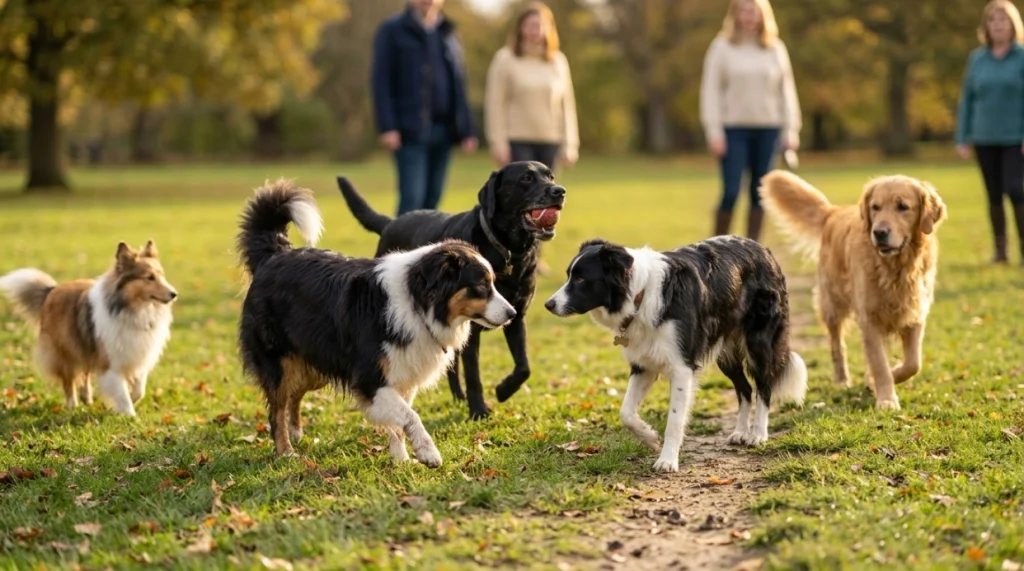
An Australian Shepherd is one of my first breeds to consider for an active Border Collie. Labs, Goldens, Shelties, and another Border Collie can also work well in the right household.
| Breed | Typical Size | Why It Can Work | Main Watch-Out |
|---|---|---|---|
| Australian Shepherd | 40–65 lb | Athletic, intelligent, trainable, and work-oriented | Two intense herding dogs can increase arousal |
| Border Collie | Medium-sized; roughly 18–22 inches tall | Similar communication, stamina, and interest in training | May double herding, chasing, or obsessive habits |
| Labrador Retriever | 55–80 lb | Active, social, playful, and often comfortable around dogs | Young Labs may play more physically than some Collies like |
| Golden Retriever | 55–75 lb | Active yet typically sociable and affectionate | Size and exuberance can overwhelm a timid Collie |
| Shetland Sheepdog | 13–16 inches tall | Athletic, intelligent, trainable, and familiar with herding-style activity | Can add more barking and movement sensitivity |
Australian Shepherd
The Australian Shepherd, or Aussie, is the closest all-around match for many active households. The AKC describes Australian Shepherds as intelligent, work-driven, energetic dogs that thrive with activity.
The combination can be excellent for agility, hiking, obedience, trick training, and structured outdoor adventures. Both dogs need individual training, though.
Labrador Retriever
A Lab can balance a Border Collie’s intensity with a more openly social style. Labradors are energetic enough for active homes and commonly enjoy fetch, swimming, and outdoor exercise.
I especially like this possibility for a Collie that enjoys dogs but doesn’t need another herder watching every movement. Choose carefully if your Collie dislikes rough contact.
Golden Retriever
A Golden Retriever can offer plenty of physical activity without duplicating as much herding intensity. Goldens are commonly social, affectionate, trainable, and active.
This pairing often makes sense for owners wanting two trainable dogs with somewhat different working styles.
Shetland Sheepdog
A Sheltie is smaller but still intelligent and athletic. The breed can suit a Border Collie that enjoys quick movement without heavy wrestling.
Both are herding breeds, so chasing movement and barking may need management.
Section Takeaway: Australian Shepherds often provide the closest lifestyle match, while Labs and Goldens can add a more socially relaxed balance. Another Border Collie can work beautifully when the individual temperaments genuinely fit.
Is Another Border Collie the Best Choice?
Another Border Collie can be an excellent companion, but sharing a breed doesn’t guarantee compatibility. Two Collies may understand each other’s play beautifully, or magnify each other’s difficult habits.
Advantages of two Border Collies
- Similar stamina: Both may enjoy long walks, training, and dog sports.
- Similar play: Many prefer chase and movement-based games.
- Shared training style: Reward-based training often works smoothly with both dogs.
- Similar routines: Exercise and mental enrichment can overlap.
Potential problems
- Competitive arousal: One dog chasing a ball can trigger the other.
- Motion fixation: Dogs may stalk or herd each other instead of relaxing.
- Resource conflict: Toys, resting places, food, and owner attention can become valuable resources.
- Copied habits: Barking, fence running, or reactivity can spread through social learning.
I wouldn’t choose a second Border Collie simply to tire out the first. A second dog creates another intelligent animal whose needs must be met separately.
Think of shared play as a bonus. It isn’t a replacement for training, enrichment, or time with you.
Does Age or Sex Matter When Choosing a Second Dog?
Age and sex can influence household dynamics, but temperament remains the deciding factor. A mature, socially skilled dog is often easier to match than an unknown adolescent.
Adult plus adult
Matching adults gives you more information about energy, confidence, resource guarding, and dog-to-dog manners. Their mature personalities are easier to evaluate.
Adult plus puppy
A stable adult Border Collie may tolerate a puppy well. Still, puppies ignore boundaries, bite during play, and interrupt rest.
Don’t expect the resident dog to raise the puppy for you. Provide separate naps, training sessions, and one-to-one attention.
Senior plus puppy
This combination deserves extra caution. A senior dog may want companionship without wanting a puppy climbing on its face every hour.
Vet note: If your Border Collie has pain, reduced mobility, sensory changes, or another medical condition, ask your veterinarian whether adding an energetic dog is appropriate.
What about male versus female?
Some professionals and breeders find opposite-sex pairings easier in certain households. However, sex alone can’t predict whether two dogs will live peacefully.
The AKC’s guidance on getting a second dog also recommends considering age, energy level, household capacity, and the resident dog’s training before adding another dog.
How Should You Introduce a New Dog to a Border Collie?
Start on neutral ground and keep the first interaction calm. The goal isn’t immediate play; it’s helping both dogs feel safe while gathering information about their behavior.
1. Begin with a parallel walk
Have one handler per dog. Walk in the same direction with enough distance for both dogs to stay relaxed.
Gradually reduce distance if their bodies remain loose. Don’t force a nose-to-nose greeting.
2. Look for comfortable body language
- Positive signs: Loose movement, curved approaches, sniffing, soft faces, and easy disengagement.
- Concern signs: Freezing, prolonged staring, repeated hiding, stiff posture, or relentless pursuit.
- Excellent sign: The dogs can notice each other and then calmly move on.
3. Keep the first home session simple
Put away high-value bones and favorite toys before the new dog enters. Competition is easier to prevent than repair.
The VCA guidance on introducing a new dog to a family dog also recommends considering personality, activity level, resources, and neutral introductions.
4. Give each dog its own resources
- Separate food bowls and feeding areas
- Separate beds or crates
- More than one water station when practical
- Individual training time
- Individual walks or outings
- Protected quiet time
5. Build the relationship slowly
Don’t measure success by how quickly they wrestle. Peaceful coexistence is the first goal.
I’ve seen calm dogs become genuine playmates after they were given time to understand each other’s rules. Rushing removes that choice.
Section Takeaway: Use neutral introductions, reward calm behavior, manage valuable resources, and let the relationship develop gradually. Dogs that can comfortably disengage from each other are often easier housemates than dogs locked into nonstop play.
What Makes a Poor Companion Match for a Border Collie?
A poor match is usually about conflicting personalities rather than a specific breed. I would be cautious with any dog that repeatedly overwhelms, frightens, or frustrates the resident Border Collie.
- Large energy mismatch: One dog constantly demands play while the other wants rest.
- Conflicting play styles: Heavy wrestling can distress a dog that prefers chase games.
- Poor impulse control: Constant stealing, body slamming, mounting, or pestering creates tension.
- Strong resource guarding: Conflict over food, toys, beds, or people requires careful management.
- Severe dog reactivity: A second dog isn’t a treatment for fear or aggression.
- Two highly motion-sensitive dogs: They may trigger repeated chasing, barking, or fence-running.
If your Border Collie already struggles around dogs, solve that problem before adding one. Another dog can increase stress instead of providing companionship.
A qualified trainer or veterinary behavior professional can help evaluate difficult cases. Safety comes before the idea of giving your Collie a friend.
Can Two Active Dogs Meet Each Other’s Exercise Needs?
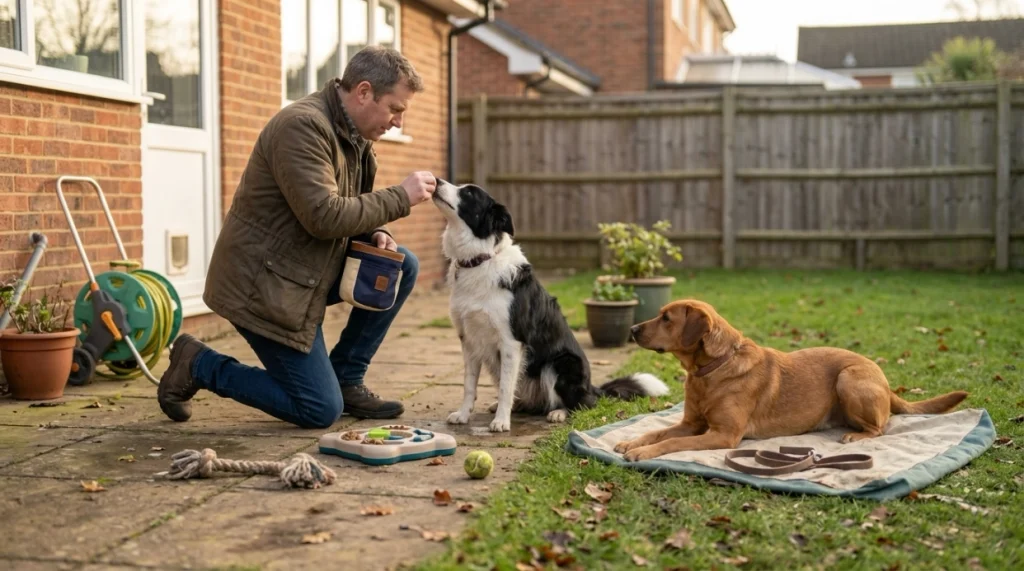
No. Dogs can enrich each other’s lives, but they shouldn’t become each other’s entire exercise or enrichment program.
A Border Collie still needs structured interaction with you. Training uses the dog’s brain in ways backyard chasing doesn’t.
According to PetMD’s Border Collie breed guidance, the breed needs substantial physical exercise and mental stimulation. Positive training, interactive games, herding, agility, and similar activities can all provide useful outlets.
A balanced two-dog routine might include
- Morning: 30–45 minute walk, run, or structured outdoor activity.
- Training: Two separate 5–10 minute sessions for each dog.
- Shared play: Supervised play when both dogs remain relaxed.
- Mental work: Food puzzles, scent games, trick training, or obedience.
- Quiet time: Several periods where both dogs settle independently.
- Individual time: Regular outings with only one dog.
A Border Collie’s traditional herding instinct includes sensitivity to movement and an intense visual focus sometimes called eye. That working heritage is one reason mental work matters alongside physical exercise.
The same principle applies to rough-coated and smooth-coated Border Collies. Coat type changes grooming needs more than the dog’s fundamental requirement for thoughtful training and engagement.
Frequently Asked Questions
Do Border Collies like having another dog?
Many Border Collies enjoy living with another dog, especially when both dogs have compatible play styles and good social skills. Others prefer more personal space. Evaluate your Collie’s real behavior around dogs rather than assuming the breed needs a canine companion.
Is an Australian Shepherd a good companion for a Border Collie?
Yes, an Australian Shepherd can be an excellent match for an active, social Border Collie. Both breeds are intelligent, athletic herders that enjoy training and mental work. The downside is that two high-drive dogs require significant daily management and exercise.
Are Labradors good with Border Collies?
They can be. Labradors are active, playful, trainable dogs, and many are socially comfortable with other dogs. Choose an individual whose play isn’t too physical for your Collie, especially if the Border Collie is sensitive or reserved.
Should I get a puppy for my adult Border Collie?
A puppy can work well when the adult dog is patient and dog-social. Your Border Collie should still have places to rest without being bothered. Don’t expect the older dog to exercise, entertain, or train the puppy for you.
Is a male or female companion better?
There is no universal rule. Opposite-sex combinations are sometimes recommended, but individual temperament, age, social history, and resource behavior are more useful predictors. Meet candidate dogs several times whenever possible before deciding.
Will a second dog stop my Border Collie from being bored?
Not reliably. Two dogs may play together, but Border Collies still need exercise, training, human interaction, and mental challenges. A bored Border Collie can even teach a new dog undesirable habits, giving you two dogs with the same problem.
What if my Border Collie doesn’t like other dogs?
Don’t add a companion simply because you think your Collie should have one. Some dogs are happier without a canine housemate. If your dog shows fear, aggression, or intense reactivity, speak with a qualified behavior professional before considering another dog.
Choosing the Right Companion for Your Border Collie
If I had to start a breed shortlist in 2026, I’d look first at an Australian Shepherd, another compatible Border Collie, a Labrador Retriever, or a Golden Retriever. A Sheltie is also worth considering when a smaller herding companion suits the household.
But I wouldn’t select any of them from the breed name alone. Meet the individual dog and watch how the pair communicate.
Look for loose body language, respectful play, comfortable breaks, and an ability to relax near each other. Those signs tell you far more than whether two breeds appear compatible on paper.
Choose for long-term household harmony, not instant excitement. The right companion should make life richer for both dogs without replacing the training, exercise, and relationship each still needs from you.
