
How Often Do German Shepherds Go Into Heat? A Practical Guide for Owners

If you own an intact female German Shepherd, the short answer is this: most go into heat about every 6 to 8 months, which is roughly twice a year. Some cycle a little more often, some less often, and the first few heats are often less predictable than adult cycles.
That variation matters. A German Shepherd that usually follows a fairly steady pattern can still have a cycle that comes early, late, or looks different from the last one. Large-breed dogs are often less tidy on the calendar than people expect, so the goal is not to memorize one perfect schedule. The goal is to know what is normal for your dog, what signs mean she is entering heat, and when the pattern stops looking healthy.
If you are trying to prevent pregnancy, timing matters more than most owners realize. A dog is not fertile for the entire time she is bleeding, and some of the highest-risk days happen when the signs are still subtle.
Quick Answer: How Often German Shepherds Go Into Heat
Most female German Shepherds go into heat about every 6 to 8 months. That is the practical rule of thumb to keep in mind, but it is not a law.
A few things can shift the timing:
- age, especially the first couple of cycles
- individual reproductive rhythm
- overall health
- whether the dog is intact and cycling normally
- sometimes stress, illness, or hormonal issues
The American Kennel Club notes that most dogs go into heat about every seven months, while some breeds cycle only once a year. German Shepherds usually fall somewhere in the middle, but they are not as clockwork-regular as many owners hope. AKC’s guide to dog heat cycles is a useful general reference if you want a broader comparison across breeds.
What that means in real life
If your German Shepherd had a heat in January, seeing the next one around July or August would be normal. If she is a young dog and the timing is a bit off, that can still be normal too. What matters is the pattern over time, not one single cycle.
IMAGE 1 PLACEHOLDER
What a Normal German Shepherd Heat Cycle Looks Like
A heat cycle is not one flat phase. It moves through four stages:
| Stage | What is happening | Common signs | Fertility risk |
|---|---|---|---|
| Proestrus | The body is preparing for heat | Swollen vulva, bloody discharge, male dogs interested, but she usually will not accept mating yet | Low to moderate |
| Estrus | The fertile phase | Discharge often lightens, tail flagging, more receptivity to males | Highest |
| Diestrus | Fertility has ended and the body moves out of heat | Interest in males drops, discharge tapers off | Low |
| Anestrus | Resting phase between cycles | No heat signs | None |
That structure helps you avoid one of the most common mistakes: assuming that bleeding means the dog is fertile for the whole cycle. It does not.
A German Shepherd can show heat signs before she is ready to mate, then become more fertile later even as the discharge changes. That is why owners who wait for “obvious” signs sometimes miss the highest-risk window.
The fertile window usually falls during estrus, often after the first few days of bleeding and once behavioral signs shift from “not interested” to “receptive.” Exact timing varies because dogs do not all ovulate on the same schedule, and visible signs can overlap or lag behind hormone changes. In practical terms, the safest approach is to treat the dog as potentially fertile as soon as heat signs begin.
For a plain-language breakdown of the stages, VCA Hospitals’ explanation of the canine estrous cycle is a solid veterinary reference.
Why the stages matter
If you know where your dog is in the cycle, you can make better decisions about:
- whether she can still get pregnant
- how strict supervision needs to be
- whether a change in behavior is normal
- whether the cycle is following a healthy pattern
How Long a German Shepherd Stays in Heat
A German Shepherd heat cycle usually lasts about 2 to 3 weeks. That is the overall cycle length, not just the fertile part.
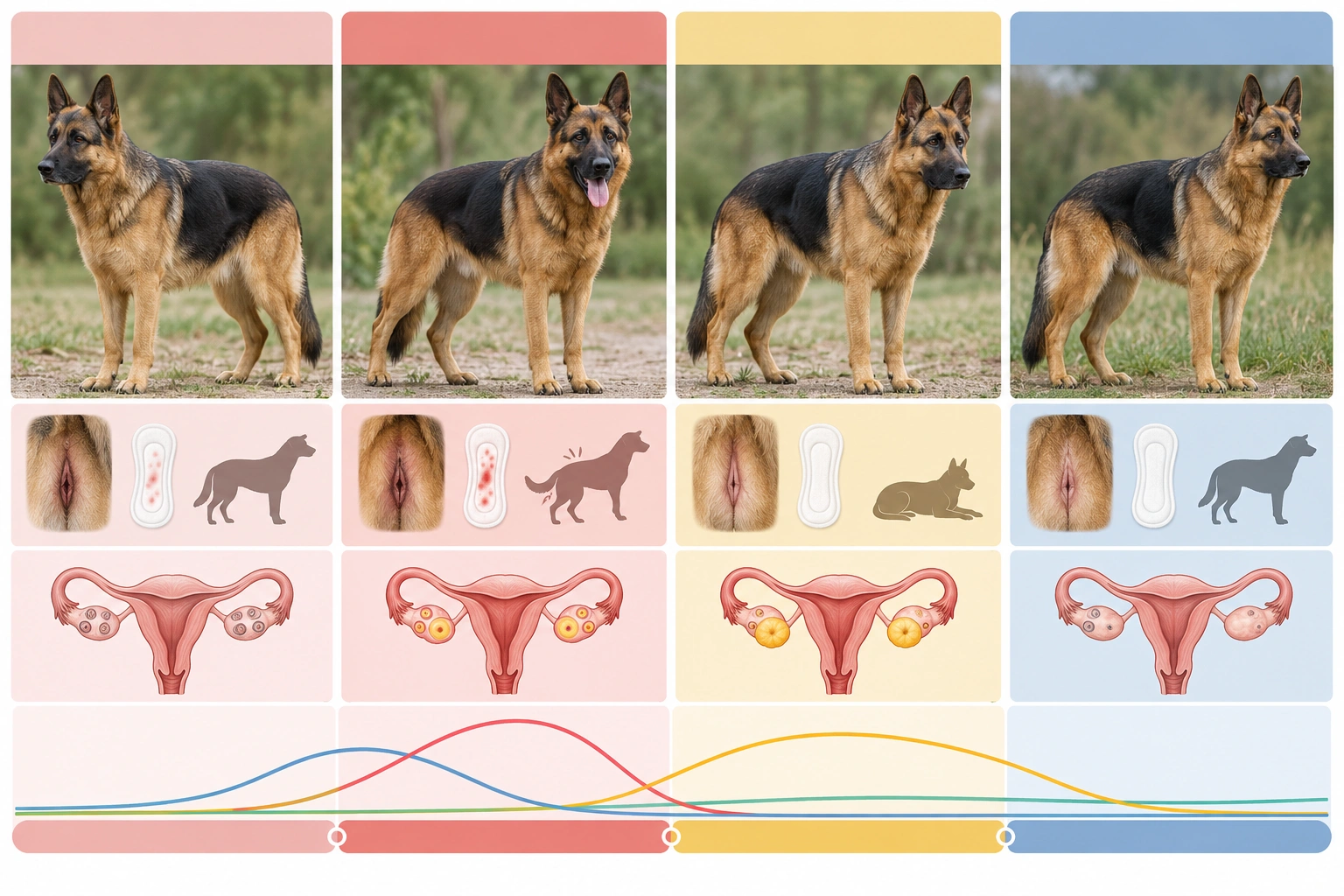
The part owners notice most often is the visible heat period: swelling, discharge, and behavior changes. But even within those 2 to 3 weeks, fertility is not constant. The fertile window is usually during estrus, not the entire time the dog is bleeding.
What is normal timing within the cycle?
A typical cycle can look like this:
- Days 1 to 7 or so: early heat signs, swelling, bloody discharge
- Middle of the cycle: the fertile window often begins
- Later part of the cycle: interest in males fades, discharge lessens, signs settle
That is only a general pattern. Some dogs bleed lightly for a shorter time. Others show more obvious discharge. The amount of blood does not tell you how fertile she is.
When duration becomes a concern
Call your veterinarian if:
- bleeding goes on much longer than expected
- discharge becomes foul-smelling
- your dog seems painful, weak, or unwell
- the cycle seems to drag on without resolving
A heat cycle that does not settle when it should deserves attention, especially if the discharge changes color or smell.
Signs Your German Shepherd Is Entering Heat
The earliest signs are often behavioral, not just physical. Owners sometimes miss them because they are subtle at first.
Common signs include:
- swollen vulva
- bloody or pink-tinged discharge
- licking the rear more often
- frequent urination
- increased interest from male dogs
- clinginess or restlessness
- tail held differently, sometimes tucked more or moved to one side
- changes in appetite or mood
Some dogs become more affectionate. Others become more independent or distracted. A few seem almost normal except for the swelling and discharge. That range is normal.
A practical way to spot heat early
If your German Shepherd suddenly starts urinating more often on walks and male dogs are paying unusual attention to her, treat that as a possible heat start even if the bleeding is still light or not obvious yet. That is the point where owners should tighten supervision immediately.
When She Is Fertile and Can Get Pregnant
The highest pregnancy risk happens during estrus, not necessarily the moment you first notice bleeding.
That is the part many owners get wrong. They see discharge and assume they have time. Sometimes they do. Sometimes they do not. Because the fertile window can overlap with changing discharge and behavior, it is safer to act as though pregnancy is possible from the moment heat signs begin.
Decision rule for owners
If you do not want puppies, use this rule:
The moment you see heat signs, treat your dog as if she can get pregnant.
That means:
- no off-leash time outside
- no unsupervised yard access
- no contact with intact males
- no “just a quick hello” greetings with unfamiliar dogs
A female in heat can attract males from surprising distances, and a brief escape can be enough to create a problem you cannot undo.
What’s Normal vs. What’s Irregular in German Shepherd Heat Cycles
A little variation is normal. A pattern that keeps changing without explanation is not.
Usually normal
These patterns can still fit a healthy cycle:
- first heat a bit earlier or later than expected
- one cycle that is slightly longer or shorter than the last one
- a first few cycles that seem irregular
- bleeding that is lighter or heavier than another dog’s
- timing that varies by a few weeks from cycle to cycle
More concerning
These patterns deserve a vet conversation:
- no heat for much longer than your dog’s usual interval
- heats happening unusually close together
- bleeding that seems prolonged
- discharge that smells bad or looks abnormal
- repeated cycles that are hard to predict
- signs of pain, lethargy, or illness along with heat changes
In practical terms, “too frequent” means cycles that are coming back far sooner than your dog’s normal pattern, and “too long” means a heat that does not resolve when it usually would. Abnormal discharge, a bad smell, or a dog that seems sick is not just a cycle issue — it is a reason to call the vet.
AKC notes that the first heat can be irregular, and that senior dogs do not go through menopause the way humans do, though cycles may become less prominent with age. That means older dogs can still cycle, but a major change in pattern should not be brushed off as “just age.” Read more from AKC.
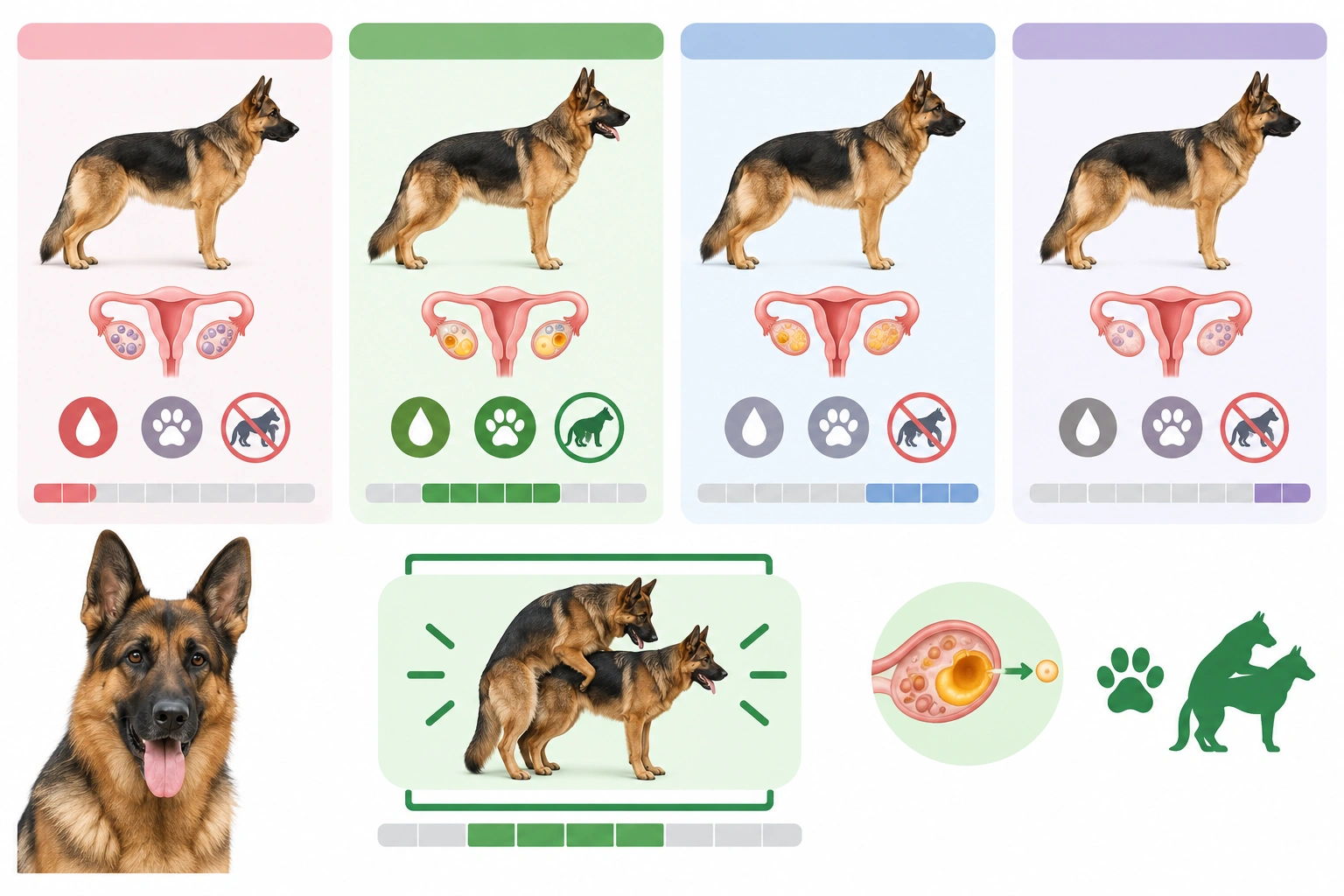
IMAGE 2 PLACEHOLDER
Why a German Shepherd’s Heat Cycle May Be Early, Late, or Missed
There are several reasons a cycle may not arrive exactly when expected.
Age and development
A first heat often comes later in large breeds than in small dogs. In many dogs, the first heat may arrive somewhere around 6 to 12 months, but for larger dogs it can be later. Some German Shepherds do not show a first heat until closer to 8 to 18 months, and occasionally later.
That is one reason owners of young German Shepherds should not assume a puppy is “too young” to become pregnant. She may still be capable of cycling before she looks fully grown.
Individual variation
Some dogs simply run on a different internal schedule. If your dog has always cycled every 7 months and then one cycle stretches to 8, that may not mean anything is wrong.
Health and reproductive issues
A missed or very irregular cycle can also point to:
- pregnancy
- hormonal imbalance
- illness
- reproductive tract problems
- stress or body condition changes
If the cycle changes suddenly and stays changed, the safest move is to ask a vet rather than guess.
How to Manage a German Shepherd in Heat at Home
The management goal is simple: prevent mating and reduce stress for everyone in the house.
Use physical control, not hope
A fence is not enough by itself. A determined dog may jump, dig, or slip through a gate. During heat, use a leash for outdoor breaks even if your yard is normally secure.
Keep her separated from intact males
If you live with an intact male dog, separation has to be real, not casual. That means different spaces, closed doors, and no shared unsupervised time.
Change the routine temporarily
A heat cycle is not the time for loose routines. Short, controlled walks are safer than long off-leash outings. If you travel with your dog, be extra careful around parking lots, dog-friendly stores, and trails where off-leash dogs might appear.
Expect more attention from other dogs
Other dogs may react strongly to a female in heat. Even normally calm male dogs can become fixated. Avoid situations where you have to manage close dog-to-dog contact.
Practical cleanup
Use washable bedding or protective covers in resting areas. Some owners use dog diapers for indoor management, but they are not a substitute for supervision and do not prevent pregnancy.
When to See a Veterinarian or Certified Trainer
For a heat-cycle issue, the veterinarian is the professional you need. A certified trainer can help with management routines, but not with reproductive concerns.
See your vet if you notice:
- bleeding that goes on too long
- a foul smell from the discharge
- thick, green, or pus-like discharge
- obvious pain
- marked lethargy
- refusal to eat for more than a short period
- a cycle that is very late, very frequent, or missing without explanation
- signs you might be dealing with illness rather than a normal heat
If your dog escapes during heat and has contact with an intact male, call your vet quickly. Pregnancy prevention options may be time-sensitive, so the sooner you call, the better your vet can advise you.
Spaying, Future Heat Cycles, and Long-Term Decision-Making
Spaying removes future heat cycles and eliminates the risk of accidental pregnancy, which is a major practical benefit for many households. It also means you no longer have to manage the cycle every few months.
The timing should be discussed with your veterinarian based on your dog’s age, current health, and overall lifestyle. In some German Shepherds, the conversation may also include breed-related orthopedic considerations, but that should be guided by your vet rather than a one-size-fits-all rule.
A simple way to think about the choice
Choose the path that best matches your household’s ability to manage risk:
- Keep her intact if you are prepared for close supervision, strict separation from males, and cycle tracking.
- Consider spaying if preventing pregnancy and avoiding repeated heat management would significantly reduce stress or risk in your home.
If you keep your dog intact, tracking each cycle on a calendar is worth doing. The pattern tells you what is normal for her, and it makes it easier to notice when something changes.
FAQ: German Shepherd Heat Cycles
How often do German Shepherds usually go into heat?
Most go into heat about every 6 to 8 months, though some vary from that average.
At what age do German Shepherds have their first heat?
Many have their first heat around 6 to 12 months, but larger dogs may start later.
How long does a heat cycle last?
Usually about 2 to 3 weeks, though the exact timing can vary.
Can a German Shepherd get pregnant the first time she is in heat?
Yes. A first heat can still result in pregnancy.
Is bleeding the whole time she is fertile?
No. Bleeding can happen before, during, and after the fertile window.
Is it normal for the first heat to be irregular?
Yes. The first cycle is often less predictable than later ones.
When should I worry about the cycle?
Worry if the timing changes sharply, bleeding lasts too long, discharge smells bad, or your dog seems sick or painful.
Do older female dogs stop going into heat?
They do not go through menopause like humans do, though cycles may become less obvious with age.
What is false pregnancy, and is it related to heat?
False pregnancy can happen after a heat cycle and may cause nesting, clinginess, appetite changes, or even milk production. Those signs can look confusing, but they are not the same as being in active heat. If you are unsure which one you are seeing, your vet can help sort it out.
The Bottom Line
A German Shepherd usually goes into heat about twice a year, or roughly every 6 to 8 months. The first few cycles may be irregular, and the fertile window is not the same thing as the whole heat period. If you track the pattern, watch for the early signs, and manage her carefully from day one, you can prevent most of the problems owners worry about. When in doubt, treat heat signs as a pregnancy risk and call your veterinarian if the cycle looks abnormal.