
What Makes a Dog a Dog? The Biological and Behavioral Traits That Define Dogs

A dog is not just a “tame wolf,” and it is not defined by breed, size, or how fluffy it looks. What makes a dog a dog is the combination of domestication, shared canine genetics, and a set of social behaviors that evolved around living with people. In scientific terms, the domestic dog is Canis lupus familiaris, a domesticated mammal in the family Canidae and the order Carnivora. Britannica describes dogs as a subspecies of the gray wolf, which is a useful starting point—but for owners, the more practical answer is this: dogs are the canids that were shaped to live near humans and fit into human households.
In plain language, being a dog is not just genetics or just behavior. It is both, plus domestication: dogs inherit canid instincts, but domestication and breed development shape how those instincts show up in daily life.
That matters because once you understand the “dog-ness” of dogs, behavior becomes easier to interpret. A Border Collie’s herding drive, a Labrador’s enthusiasm for people, and a Chihuahua’s alertness may look very different on the surface, but all of them sit on top of the same basic domestic dog blueprint: social bonding, communication, adaptability, and a strong response to human environments.
Dogs in the Canid Family: Where They Fit Among Wolves, Coyotes, and Others
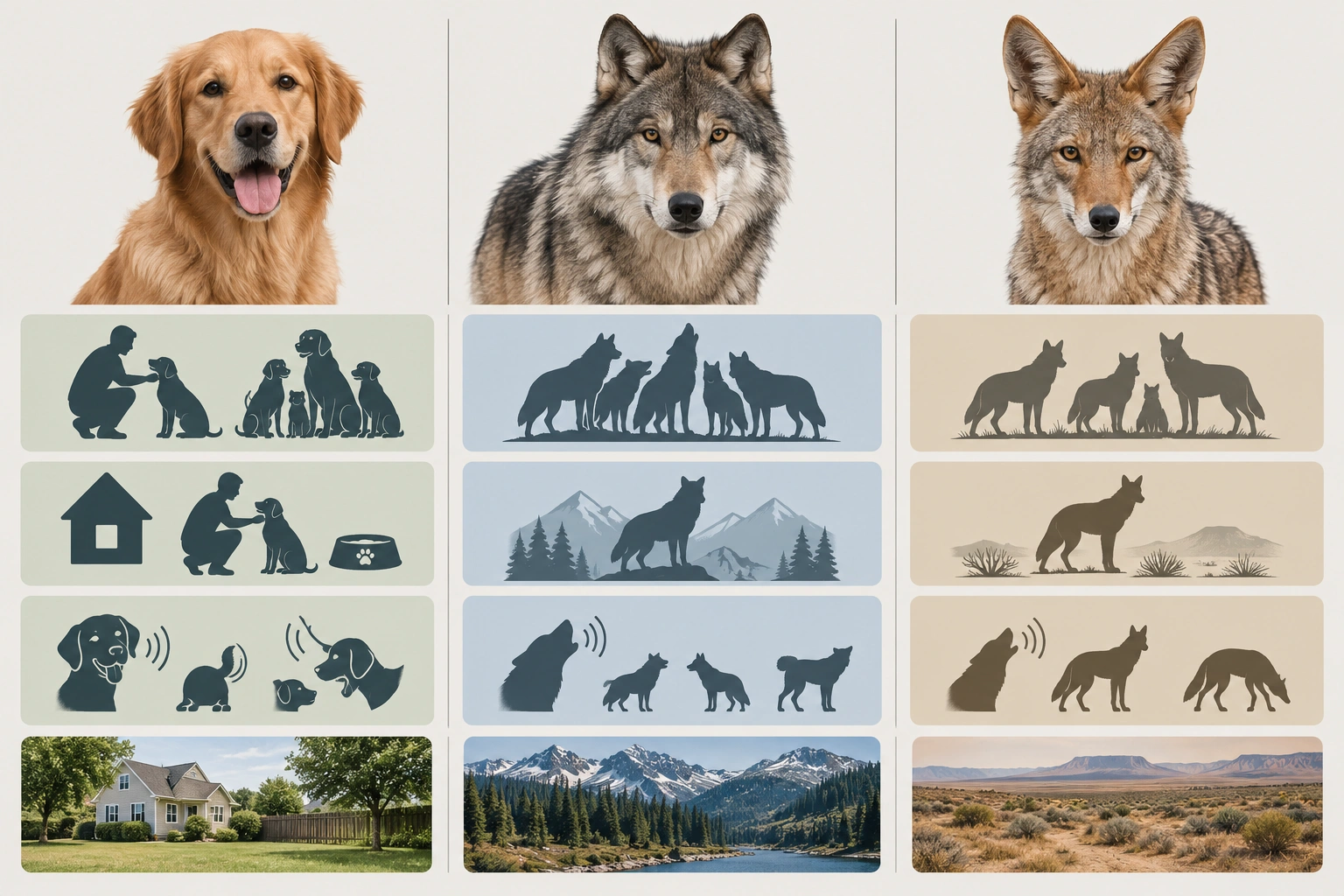
Dogs belong to the canid family, which includes wolves, coyotes, foxes, and jackals. That family resemblance explains why dogs can share some instincts with wild canids, but it does not make them interchangeable. A dog is a domesticated canid; a wolf is a wild canid. That difference is not cosmetic. It changes how the animal develops, how it relates to people, and how it survives.
A practical way to think about it is this:
- Wolves are built for life without human support.
- Coyotes are highly adaptable wild survivors, usually cautious around people.
- Dogs are adapted to human environments, human routines, and human communication.
That is why a pet dog may seek eye contact, follow you room to room, or relax into household life in ways that would typically be unusual for a wolf or coyote. The comparison is useful, but only if you keep the categories straight. A domestic dog is not “half-wild.” It is a different behavioral package shaped by domestication.
| Trait | Dog | Wolf | Coyote |
|---|---|---|---|
| Relationship with humans | Generally social and cooperative in human settings | Usually avoidant and self-reliant | Usually cautious and distance-seeking |
| Development | Raised and shaped around people | Raised in wild family groups | Raised in wild conditions |
| Communication style | Often includes human-directed signals and responsiveness to gestures | Communication is mainly tuned to other wolves | Communication is mainly tuned to survival and caution |
| Dependence on humans | Often high in pet settings | None | None |
| Typical role in human life | Companion, worker, family member | Wild predator | Wild opportunist |
If you want a quick internal reference for the difference between wild and domestic animal behavior, the ASPCA’s general dog care guidance is a useful reminder that dogs are managed as companion animals, not as miniature wildlife.
From Wolf to Dog: What Domestication Changed
Domestication did not simply “tame” wolves. Over time, it selected for animals that could live near people, tolerate human presence, and benefit from human food and protection. That process likely favored reduced fear, greater social flexibility, and a stronger tendency to approach rather than avoid humans.
A useful way to picture the shift is this: a wild canid’s survival depends on caution and distance; a dog’s survival in human company depends on cooperation and social readout. In simplified terms, animals that were more comfortable around people may have done better in the environments where domestication developed, and later human breeding intensified those traits for specific jobs.
That is why dogs often do things that make them feel almost “designed” for human life:
- They look to people for cues.
- They can learn routines quickly.
- They often seek social contact rather than avoiding it.
- They adjust their behavior to household patterns.
This is also why dogs are so varied in appearance yet so similar in core behavior. Dogs developed into many breed lines over time, but the domestic framework underneath is still the same.
The Core Traits Most Dogs Share
If you strip away breed differences, most dogs share a few species-level traits that matter every day in the home.
1. Social bonding
Dogs are built to form attachments. That does not mean every dog is clingy, but it does mean most dogs are socially oriented animals. They usually want some combination of contact, predictability, and reassurance from familiar people.
2. Play
Play is not a side note. It is a major part of how dogs practice movement, social rules, and self-control. A young dog who play-bows, grabs, chases, and pauses is doing normal dog development, not just “being silly.”
3. Curiosity
Dogs investigate. They sniff, watch, follow movement, and test new things. Curiosity is one reason dogs adapt so well to human homes—and also why management matters. A curious dog can find trouble fast.
4. Communication
Dogs are constantly signaling with posture, facial tension, tail carriage, vocalization, and scent. Owners who learn to read those signals usually have fewer misunderstandings.
5. Environmental dependence
Most pet dogs are not built to live as solitary wild animals. They rely on human-provided food, shelter, boundaries, and social structure. That dependence is not weakness; it is part of what domestication produced.
A Border Collie owner will recognize this immediately: the dog’s work drive is real, but so is the dog’s need for structure and interaction. The breed expresses the species-wide dog pattern in a more intense, task-focused form.
How Dogs Communicate: Body Language, Vocalization, and Scent
Dogs do not communicate with one signal at a time. They send layered messages. That is why reading behavior in context matters.
Body language
A loose body, soft eyes, and a wiggly approach usually suggest comfort or friendliness. A stiff body, closed mouth, hard stare, and weight shifted forward may signal tension. A tucked tail does not always mean fear, but it often means the dog is uncomfortable or uncertain.
A few everyday signals are especially useful for owners to watch:
- Ears: ears held forward can suggest interest or alertness, while ears pinned back often go with worry, uncertainty, or appeasement.
- Mouth tension: a relaxed, open mouth is often different from a tight, closed mouth or lips pulled back and tense.
- Gaze: soft blinking and brief glances are usually less intense than a hard, fixed stare.
- Freezing or stiffening: when a dog suddenly stops moving, becomes rigid, or slows down noticeably, that can be an early warning sign that it is uncomfortable.
Vocalization
Barking, whining, growling, and yelping all carry information. Growling is especially important because it is often a warning, not a “bad attitude.” Dogs that are punished for warning signals may stop warning and go straight to more serious behavior. That is one reason it is smarter to treat growling as communication first.
Scent
A dog’s nose is a major source of information. Scent helps dogs identify individuals, assess territory, and gather social information. This is one reason sniffing is not wasted time. It is how dogs read their world.
Dogs also communicate with humans in ways that are especially important in daily life. Many dogs follow pointing gestures, look back and forth between a person and an object, or check a person’s face for direction. That gesture- and gaze-following ability is a big part of why dogs fit so well into human households.
The practical takeaway: if you want to understand your dog, watch the whole picture. A wagging tail alone does not tell you the dog is happy. A dog can wag and still be tense. Look at the body, face, ears, mouth, and context together.
Dogs vs. Wolves: Similar Ancestry, Different Behavioral Systems
Dogs and wolves share ancestry, but they are not behaving from the same playbook.
Wolves develop in tightly coordinated family groups where survival depends on hunting, caution, and group cohesion. Dogs, by contrast, were shaped to fit into human social systems. That means dogs often show:
- more tolerance for human handling,
- more interest in human gestures,
- more flexibility in household life,
- and more variation in social style across breeds.
A wolf pup and a dog puppy may both be playful and curious, but their developmental paths diverge quickly. A dog puppy is selected, directly or indirectly, for comfort around people. A wolf pup is not.
This is why “wolf-like” is not a useful standard for pet behavior. A pet dog that is more reserved, more social, or more dependent on human feedback is not failing to be natural. It is expressing domestication.
Dogs vs. Coyotes and Other Wild Canids
Coyotes are a good comparison because they show how a wild canid can be highly adaptable without becoming domestic. Coyotes can live near human settlements, but they usually keep their distance and remain behaviorally committed to independence.
That difference helps explain why a dog may:
- seek contact rather than avoid it,
- settle into human routines,
- accept handling and training,
- and look to people for direction.
Coyotes, wolves, and dogs may all be canids, but dogs were uniquely domesticated for life inside human households. That distinction matters when owners expect a dog to behave like a wild animal “should” or, just as often, expect a wild-animal response from a pet dog. Neither expectation is useful.
Breed Differences: What Changes and What Does Not
Breed changes expression, not species identity.
A Border Collie is still a dog. So is a Labrador. So is a Chihuahua. What changes is how the dog’s core instincts are channeled.
What breeds can change
- intensity of prey drive
- tendency to herd, retrieve, guard, or chase
- sociability with strangers
- energy level and work style
- sensitivity to movement, noise, or handling
What breeds do not change
- the need for social bonding
- the use of body language
- the reliance on domestication-shaped communication
- the basic canine drive to investigate, play, and adapt
This is where many owners get confused. They see breed differences and assume they are looking at different kinds of animals. They are not. A Border Collie’s herding behavior is a breed-specific expression of broader canine chase and control tendencies. The dog is still operating as a dog; the breed has simply sharpened the channel.
If you are choosing a dog, the AVMA’s guidance on selecting a pet dog is worth reading because unfulfilled expectations are a major reason dogs are given up. That is often what happens when people choose based on appearance instead of behavior.
Instinct, Training, and Individual Temperament: How to Interpret Behavior
This is the decision framework I use when assessing a dog’s behavior:
1. Is it normal dog instinct?
Examples: sniffing, chasing movement, guarding resources, barking at novelty, social following, play bows.
2. Is it breed tendency?
Examples: herding in Border Collies, retrieving in retrievers, scent focus in hounds, alertness in some toy breeds.
3. Is it learned behavior?
Examples: jumping for attention, counter surfing, pulling on leash, reacting because the behavior has been rewarded before.
4. Is it individual temperament?
Some dogs are bold, some are cautious, some are highly social, and some are more reserved. Temperament shapes how instincts show up.
5. Is it a problem?
If behavior is intense, escalating, or unsafe, it may need professional help.
This framework keeps you from making two common mistakes: blaming everything on training, or blaming everything on instinct. A dog that chases moving objects may be showing normal instinct. A dog that cannot disengage, cannot settle, or becomes distressed may need more structured intervention than simple management.
Common Misconceptions About Dog Nature
“Dogs are just tame wolves.”
No. Dogs were shaped by domestication into a separate behavioral system. Wild ancestry matters, but it does not explain everything.
“Breed differences mean different kinds of animals.”
No. Breed differences are real, but they sit inside the same domestic dog framework.
“Natural means safe or desirable.”
Also no. A behavior can be natural and still be a problem in a home. Chasing, guarding, barking, and digging are all natural in some contexts. That does not mean they should be left unmanaged.
“If a dog is friendly, it must be well-trained.”
Not necessarily. Friendliness is not the same thing as training. A dog may be socially bold yet have poor impulse control.
“If a dog is reserved, something is wrong.”
Not always. Some dogs are simply more cautious or less socially forward. The question is whether the dog is coping well, not whether it matches a stereotype.
When to See a Veterinarian or Certified Trainer
Seek help if your dog’s behavior changes suddenly, becomes more intense, or starts affecting safety and quality of life. That includes persistent aggression, panic, compulsive behavior, severe reactivity, or a sudden loss of social interest.
A veterinarian can rule out medical contributors, and a qualified trainer or behavior professional can help you sort out instinct, learning, and management. The earlier you address a serious behavior pattern, the easier it usually is to improve.
Practical Takeaway: What This Means for Reading Your Own Dog
Once you understand what makes a dog a dog, you stop expecting a pet to behave like a wolf, a robot, or a human child. You begin reading the dog as a domesticated social animal with real instincts, real communication, and real breed tendencies.
That changes everyday ownership in three useful ways:
-
You interpret behavior more accurately.
Sniffing, barking, herding, shadowing, and play all make more sense when you see them as part of canine nature. -
You choose better expectations.
A Border Collie will not be content with a low-stimulation life, and a toy breed is not “small by accident.” Breed matters, but only within the dog framework. -
You respond earlier to problems.
When you know the difference between instinct and distress, you can act before a small issue becomes a bigger one.
Dogs are not just animals we live with. They are a species shaped to live with us. That is what makes a dog a dog.
FAQ
Are dogs defined by genetics, domestication, or behavior?
By all three. Genetics gives dogs their canid foundation, domestication shapes how they live with people, and behavior shows how those traits appear in daily life.
Are all dog breeds the same species?
Yes. Dog breeds are different expressions of the same species-level dog behavior and instincts, even when they vary a lot in size, coat, energy, or work style.
How are dogs different from wolves?
Dogs are domesticated and generally more responsive to human cues and household life. Wolves are wild animals whose behavior is shaped for survival in natural packs.
Can dogs understand human gestures?
Many dogs can follow human pointing, gaze, and other cues. That sensitivity to human signals is one reason dogs work so well as companion animals.
What is one early sign that a dog is uncomfortable?
Freezing or stiffening is often an early warning sign. Other clues include a tight mouth, pinned ears, a hard stare, and a rigid body.
Do breed traits override normal dog instincts?
No. Breed traits influence how instincts are expressed, but all dogs still share the same basic canine instincts and communication patterns.
What should I do if my dog’s behavior changes suddenly?
Contact a veterinarian first to rule out medical causes, then consider a qualified trainer or behavior professional if needed.