
When Do Dachshunds Go Into Heat? A Practical Guide for Owners

If you have a female Dachshund, the first thing to know is this: most Dachshunds go into heat for the first time somewhere between about 6 and 14 months old, with many starting around 6 to 7 months. That said, dogs do not read the same schedule. A first heat a little earlier or later can still be normal, especially if your Dachshund is still maturing.
The more useful rule is to watch for the pattern, not just the date. A Dachshund in heat usually shows a swollen vulva, spotting or bleeding, extra licking, behavioral changes, and attention from male dogs. The whole heat episode commonly lasts 2 to 4 weeks, and many Dachshunds cycle about every 6 to 8 months after they settle into a more regular pattern.
If you want the short version: a young Dachshund around 6–14 months old is in the normal first-heat window, and any heat signs mean you should manage her as potentially fertile right away.
Quick answer: the first heat window for Dachshunds
A female Dachshund may have her first heat as early as 6 months, and some do not start until closer to 12 months or even later. Breed-specific guides commonly place the first heat in the 6 to 14 month range, with many owners noticing it around 6 or 7 months.
In practice, the safe assumption is simple:
- Under 6 months: heat is less likely, but not impossible
- 6 to 14 months: first heat is very plausible
- Much later than that: worth a vet check if she has not cycled
The reason this matters is that the first heat can look messy and uneven. Owners often expect a neat, obvious start and stop. Instead, the cycle can begin with small changes: a little swelling, light spotting, extra licking, or male dogs suddenly becoming interested.
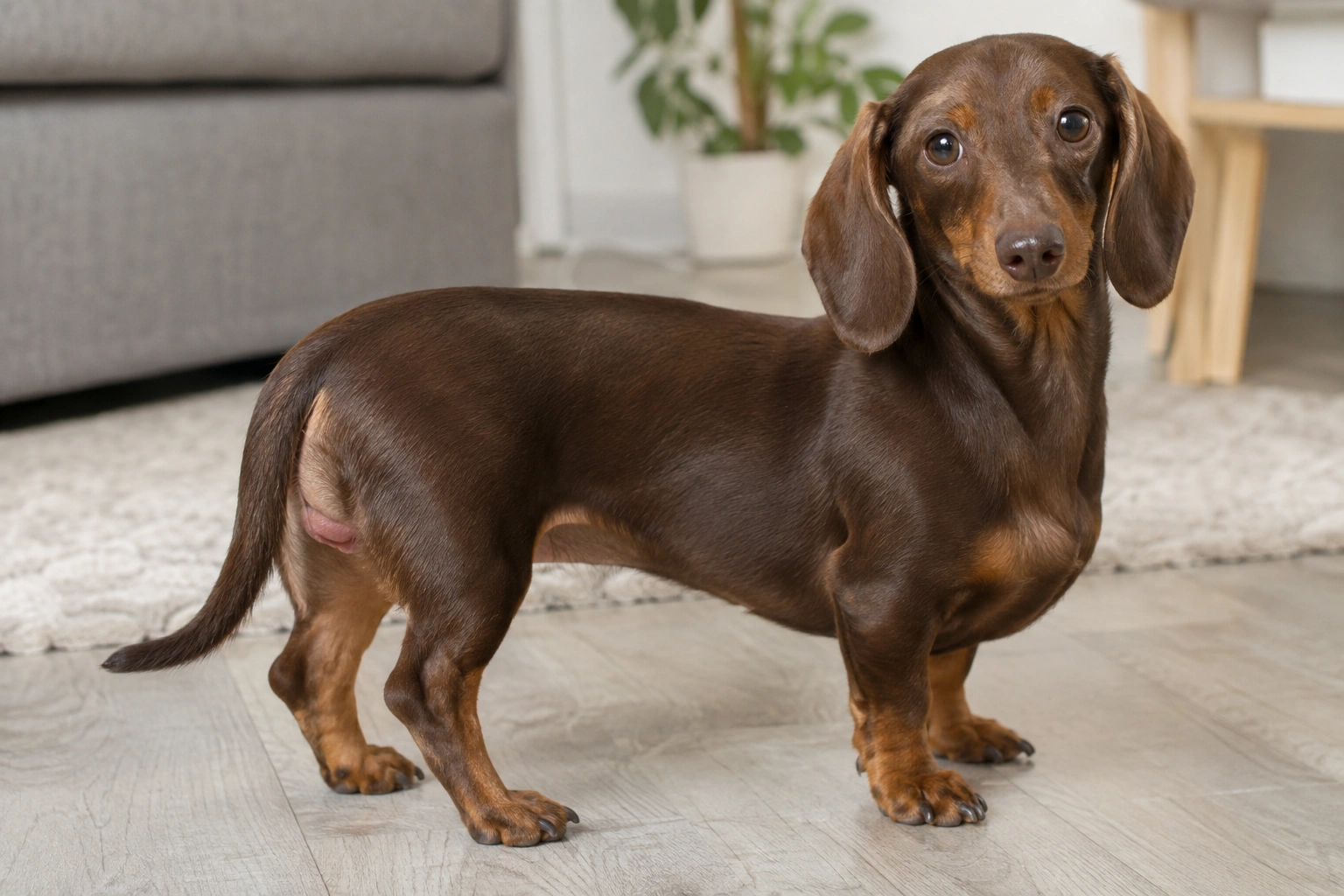
How the Dachshund heat cycle works
A heat cycle is not one single phase. It has stages, and that is why owners sometimes misread what is happening.
Proestrus: the visible beginning
This is the stage most people notice first. The vulva swells, and you may see bleeding or discharge. Your dog may lick the area more often, seem clingier, or act slightly off routine. Male dogs may show interest, but she usually is not yet ready to mate.
This stage can be confusing because the visible signs start before the fertile window does. That means bleeding is a warning sign, not a sign that the fertile period has already passed.
Estrus: the fertile window
Estrus is the phase when the female is receptive to mating. Fertility does not start and stop exactly when the bleeding does. Ovulation and the fertile window can begin after bleeding starts and can continue after visible spotting becomes lighter or stops.
If you are trying to prevent pregnancy, assume the dog may become fertile before the bleeding fully stops and may still be fertile even after the discharge lightens. In other words, visible bleeding is not the same thing as the fertile window.
For a clear general reference on canine heat cycles, the AKC’s guide to dogs in heat is useful because it explains why timing varies so much from dog to dog.
After heat: the quiet phase
Once the cycle ends, signs fade. Swelling reduces, discharge stops, and behavior usually returns to normal. But the body does not always snap back on a perfect schedule, especially after the first heat.
Signs your Dachshund is in heat
Most owners notice a combination of physical and behavioral changes. The pattern matters more than any single sign.
Physical signs
Look for:
- Swollen vulva
- Spotting or bleeding
- More frequent licking of the rear
- A change in discharge over time, often from redder spotting to lighter discharge
The bleeding can be light enough that you only notice it on bedding or floors. Some dogs are tidy enough that the signs are subtle until the swelling becomes obvious.
Behavioral signs
You may also see:
- Restlessness
- Clinginess
- Mood changes
- More frequent urination
- Flirtatious behavior toward male dogs
- “Flagging,” where the tail shifts to one side when touched or when a male is nearby
Not every Dachshund becomes dramatic. Some are mildly needy; others are cranky or distracted. A dog that suddenly seems “different” in several small ways is often more telling than one big symptom.
What owners often miss
The most common mistake is assuming the cycle is over because the bleeding slows down. That is not a safe conclusion. A dog can still be in the fertile part of the cycle after visible discharge decreases.
A first heat can also be very light or easy to miss entirely. Some Dachshunds show only mild swelling, tiny spots of blood, or mostly behavioral changes. If you suspect a cycle but never saw obvious bleeding, treat it as possible heat and monitor closely.
How long a Dachshund stays in heat and how often it repeats
Most Dachshund heat cycles last about 2 to 4 weeks. That is a broad window because the first cycle can be less predictable than later ones.
After that, many Dachshunds come into heat about twice a year, or roughly every 6 to 8 months. Some dogs are a little more regular than others.
First heat versus later heats
The first heat is often the least predictable. It may be:
- shorter or longer than expected
- lighter in discharge
- harder to recognize at first
- irregular in timing
Later cycles are usually easier to predict once the dog settles into her own rhythm. If you keep a simple calendar record, you will usually spot the pattern after one or two cycles.
A practical way to track it
Write down:
- the first day you notice swelling or bleeding
- when the discharge changes
- when the signs fully stop
- any behavior changes you notice
That record helps you decide whether the next cycle is normal or whether the timing has drifted enough to mention to your vet.
What is normal in a first heat versus later cycles
The first heat is the one most likely to make owners nervous, because it often does not look textbook.
| Situation | Usually normal? | What it can look like | What to do |
|---|---|---|---|
| First heat around 6–14 months | Yes | Mild spotting, swelling, inconsistent behavior | Track dates and manage as fertile |
| First heat a bit earlier or later | Sometimes | Dog seems healthy but timing is unusual | Ask your vet if timing feels off |
| Later heats every 6–8 months | Common | More predictable signs and timing | Continue routine tracking |
| Bleeding stops but cycle may continue | Yes | Less visible discharge, male interest may remain | Keep separation from intact males |
| Very late first heat or no heat for a long time | Needs attention | No cycle signs well beyond expected range | Contact a veterinarian |
The main decision rule is this: normal variation is common, but a very late first heat, repeated missed cycles, or odd symptoms deserve a vet conversation.
How to prevent accidental pregnancy during heat
If your Dachshund is in heat, treat her as if pregnancy is possible unless a veterinarian has told you otherwise. That means tightening control immediately, not after you see stronger signs.
Separation is the real protection
The most effective step is simple: keep her away from intact male dogs. That includes:
- dogs in your home
- dogs at a friend’s house
- fenced yards where a male could reach her
- off-leash parks
- casual greetings on walks
Even a brief lapse in supervision can be enough.
Why diapers are not enough
Dog diapers help with mess, but they do not prevent mating. They can make owners feel more secure than they should. Use them for cleanliness, not as birth control.
The safest routine during heat
For the full cycle:
- leash walks only
- no off-leash time in public
- supervised bathroom breaks
- closed doors and secure gates at home
- no unsupervised yard time if intact males might enter
If you live with an intact male, separation should be physical, not just “keeping an eye on them.” Use separate rooms, crates, or barriers that cannot be pushed through or jumped over.
Home care, hygiene, and containment during heat
A calm home plan makes the cycle easier for everyone.
Useful hygiene tools
- washable dog diapers
- extra bedding or washable covers
- enzymatic cleaner for floors or fabric
- baby wipes or pet-safe wipes for light cleanup
- a laundry routine that handles stained items quickly
What actually helps day to day
Put washable covers on furniture if your dog is allowed on the couch. Keep a small cleanup kit in one place so you are not scrambling when spotting appears. If she sleeps in a bed, use a washable blanket underneath her regular bedding.
A diaper can be useful indoors, but do not leave one on for long periods without checking and changing it. Moisture and friction can irritate the skin.
Containment without false confidence
The goal is not just cleanliness. It is also reducing the chance of a mistake. A neatly diapered dog can still become pregnant if she gets near a male. Hygiene tools help you manage the mess; supervision prevents the bigger problem.
When a late, irregular, or concerning cycle needs a vet
Some variation is normal. Some is not.
Call your veterinarian if:
- your Dachshund has not had a first heat by about 18 months of age
- her cycle timing is wildly inconsistent from one heat to the next
- bleeding is heavy, prolonged, or foul-smelling
- discharge looks unusual
- she seems painful, weak, or unusually lethargic
- she stops eating or drinking normally
- you notice fever, vomiting, or a sudden change in behavior
The biggest red flag is not just timing. It is timing plus abnormal symptoms. A dog that seems unwell should not be written off as “just in heat.”
For a broader veterinary perspective on reproductive timing and heat signs, the ASPCA’s guidance on dog spaying and heat cycles is a helpful starting point for owners who want a practical overview before calling their clinic.
Spaying before versus after the first heat
This is one of the most common decisions owners face.
Spaying before the first heat
Pros:
– removes the risk of accidental pregnancy
– avoids managing a heat cycle at home
– simplifies life in multi-dog households
Trade-off:
– you will not see how her adult cycle would have developed
– the best timing can vary by individual dog, so discuss it with your veterinarian
Spaying after the first heat
Pros:
– lets the dog go through one natural cycle
– may help owners who are still deciding on long-term breeding plans
Trade-off:
– you must manage at least one full heat cycle carefully
– the risk of accidental pregnancy is real during every fertile window
For owners who are not planning to breed, the practical question is often not “What is theoretically ideal?” but “Which option fits my household’s ability to prevent mistakes?” If your home includes intact males or frequent visitors with intact males, earlier spaying may be the simpler path to safety and peace of mind.
A simple decision framework for owners
Use this quick check:
-
Is she in the normal first-heat age range?
If yes, treat the signs as a real heat cycle. -
Are there physical signs plus behavior changes?
If yes, manage her as fertile. -
Can you guarantee separation from intact males?
If not, tighten the setup immediately. -
Does the cycle look unusually late, heavy, painful, or foul-smelling?
If yes, call the vet. -
Are you still deciding about spaying?
Base that decision on your household’s ability to manage risk, not just convenience.
When to see a veterinarian or certified trainer
This topic is mostly about health, but behavior during heat can also strain a household. If your Dachshund becomes anxious, highly vocal, escape-prone, or impossible to settle, a certified trainer can help you manage the environment safely while the cycle passes.
See a veterinarian promptly if the timing is abnormal or the symptoms do not look like a typical heat cycle. That is especially true for a very late first heat, a sudden change in discharge, or signs of illness.
FAQs
How old are Dachshunds when they first go into heat?
Many Dachshunds first go into heat between 6 and 14 months old, with a lot of dogs starting around 6 to 7 months.
How long does a Dachshund stay in heat?
A heat cycle commonly lasts 2 to 4 weeks.
How often do Dachshunds go into heat?
Many go into heat about twice a year, or roughly every 6 to 8 months.
Can my Dachshund get pregnant after the bleeding stops?
Yes. Bleeding slowing down does not guarantee the fertile window is over.
Is it normal if my Dachshund’s first heat is late?
Some variation is normal, but if she has not had a first heat by about 18 months, it is a good idea to check with a veterinarian.
Should I use diapers during heat?
Diapers can help with cleanup, but they do not prevent pregnancy.
Is spaying before the first heat better?
It can be simpler for owners who want to avoid heat management and accidental pregnancy, but the best timing should be decided with your veterinarian.
If you track the cycle, manage separation carefully, and treat the first heat as potentially fertile from the start, you will avoid most of the common mistakes owners make. That is the practical core of it.