
What a Stroke Looks Like in a Dog: Signs Owners Should Not Ignore

A dog stroke rarely looks like the dramatic “one side of the face droops” picture people expect from humans. In dogs, the first signs are often more practical and more confusing: sudden wobbling, a head tilt, circling, falling to one side, abnormal eye movements, or a dog that suddenly seems disoriented and “not themselves.”
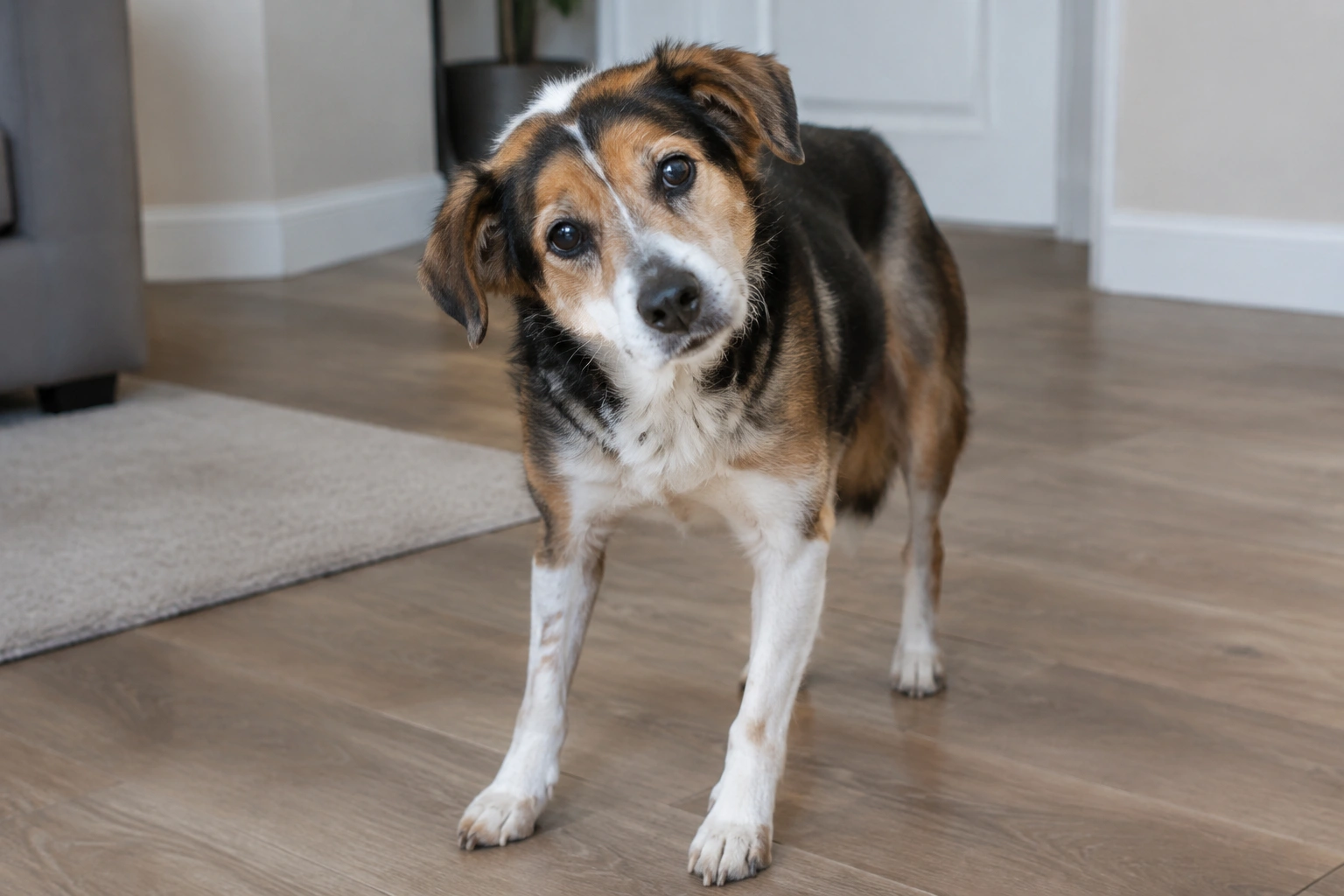
That matters because those same signs can also come from other emergencies. Vestibular disease, an inner ear problem, seizures, toxin exposure, fainting, and low blood sugar can all create a sudden neurological-looking picture. You cannot confirm the cause at home. If your dog suddenly develops balance problems or seems mentally off, treat it as urgent.
Owners also cannot reliably sort out stroke from vestibular disease, seizure aftermath, poisoning, or fainting at home. A dog may briefly seem better and still have a serious problem. Sudden stroke-like signs should always be treated as an emergency.
What a Stroke Can Look Like in a Dog
The most common clue is sudden change. A dog may go from normal to clearly abnormal in minutes, not days. Owners often notice one of these first:
- stumbling or swaying as if drunk
- falling or leaning to one side
- a sudden head tilt
- walking in circles
- trouble standing up
- abnormal eye movements, such as rapid side-to-side motion
- weakness on one side of the body
- confusion, staring, or seeming “spaced out”
- collapse
- seizures
A dog with a stroke may also knuckle over on a paw, drag a limb, or appear unable to place its feet normally. Some dogs look frightened because they know something is wrong. Others seem oddly calm or detached.
One thing to keep in mind: the signs often reflect where in the brain the problem is happening. That is why not every dog looks the same. A dog with a stroke affecting balance pathways may seem mainly dizzy and unsteady, while another may show weakness or vision changes.
A useful mental shortcut is this: if the change was abrupt and neurological, don’t wait for a neat explanation before acting.
The Most Important Rule: Sudden Neurological Signs Are an Emergency
If the signs came on suddenly, assume your dog needs veterinary help right away.
That rule is useful because the visible symptoms do not tell you whether the problem is a true stroke, vestibular disease, poisoning, or something else urgent. Even when the cause turns out not to be a stroke, the situation can still be serious enough to need immediate treatment.
The emergency threshold is especially clear if your dog:
- cannot stand safely
- keeps falling
- has abnormal eye movements plus a head tilt
- is severely disoriented
- collapses
- has a seizure
- worsens over minutes to hours
If your dog is weak, dizzy, or collapsing, do not “see how it goes overnight.”
For a broader overview of emergency warning signs in dogs, the AKC’s emergency guidance is a useful reference point.
Stroke vs. Common Mimics: What Else Can Look Similar?
This is where many owners get tripped up. A dog can look stroke-like without actually having a stroke. The job at home is not to diagnose the exact cause. The job is to recognize that the pattern is urgent.
| Condition | What it can look like | Clue that helps separate it |
|---|---|---|
| Stroke | Sudden wobbling, circling, head tilt, weakness, abnormal eye movements, confusion | Often sudden and may include one-sided signs |
| Vestibular disease | Severe dizziness, head tilt, falling, rapid eye movements | Often looks dramatic but may be more “spinning” than weak |
| Inner ear infection | Head tilt, imbalance, discomfort, ear history | Ear pain, discharge, or prior ear disease may be present |
| Seizure | Collapse, paddling, jerking, confusion afterward | The active seizure phase is usually obvious if observed |
| Fainting/collapse | Brief loss of consciousness, then recovery | More of a sudden blackout than ongoing imbalance |
| Poisoning/toxin exposure | Wobbling, vomiting, tremors, weakness, collapse | Possible access to toxins, medications, or chemicals |
| Hypoglycemia | Weakness, wobbling, collapse, confusion | More concern in small dogs, puppies, or dogs with medical illness |
Stroke vs. vestibular disease
Vestibular disease is one of the biggest stroke mimics. It can produce a dramatic head tilt, loss of balance, and abnormal eye movements that make a dog look like it has had a stroke. It can also create a weak, wobbly appearance that owners may read as one-sided weakness. Stroke can also present with prominent balance signs, so the overlap goes both ways.
That said, you should not try to settle the question at home. The overlap is too large.
Stroke vs. seizure
A seizure is usually easier to recognize if you see the event happen: stiffening, paddling, jerking, drooling, urination, or a post-seizure period of confusion. Afterward, a dog may stagger or seem blind and disoriented, which can look like stroke. If you only see the aftermath, the distinction is not reliable without a vet exam.
Stroke vs. fainting
Fainting is usually brief. The dog may collapse, then recover fairly quickly, though still seem weak or shaky. A stroke-like episode tends to leave ongoing neurological signs, not just a short blackout.
Stroke vs. poisoning or toxin exposure
Toxin exposure can look very similar to a stroke and may add vomiting, tremors, agitation, drooling, or collapse. This is one of the situations where acting fast matters most, because some toxins become more dangerous with time.
Stroke vs. ear infection or inner ear disease
Ear disease may cause head tilt, balance loss, and pain around the ear. If your dog has ear odor, discharge, scratching, or a history of recurring ear problems, ear disease becomes more plausible. But again, the urgency does not change just because the cause might be an ear problem.
For a general veterinary overview of stroke-like signs and why they can be misleading, Davies Veterinary Specialists notes that these signs are not specific to stroke and can appear with other brain diseases.
Clues That Make Stroke More or Less Likely
When owners ask, “Does this look like a stroke?” I look first at the pattern, not just the symptom list.
More concerning for a stroke or other brain event
- sudden onset
- one-sided weakness
- walking in circles in one direction
- abnormal eye movements
- trouble placing feet normally
- sudden blindness or bumping into objects
- facial nerve changes
- symptoms that are clearly neurological, not just general weakness
Less specific, but still urgent
- head tilt alone
- wobbling alone
- seeming “off”
- brief collapse with fast recovery
Those less specific signs can still be serious. They just do not point cleanly to one diagnosis.
A practical decision rule
If the problem is sudden, severe, or one-sided, treat it as neurological until proven otherwise. If the dog cannot stand, is disoriented, or is getting worse, that is not a “monitor and wait” situation.
What to Do Right Now Before You Reach the Vet
Your goal is to keep the dog safe and reduce stress, not to fix the problem at home.
Do this
- Keep your dog quiet and in one place.
- Prevent falls by blocking stairs and furniture.
- Carry a small or weak dog if that is safe.
- Use a blanket or towel as a stretcher if needed.
- Call the emergency clinic while you are getting ready if your dog cannot stand, is seizing, or is worsening.
- Note the time the signs started and whether they changed suddenly or gradually.
Do not do this
- Do not give human medication.
- Do not force your dog to walk.
- Do not offer food or water if your dog is very disoriented, vomiting, or collapsing.
- Do not try to “test” balance by making the dog stand repeatedly.
- Do not wait for symptoms to “settle down” if they are severe.
If toxin exposure is possible, tell the clinic what your dog may have eaten or contacted. That detail can change the entire plan.
For general emergency-care guidance, VCA Hospitals has practical owner-focused resources on urgent canine problems and what veterinarians look for.
What to Expect at the Emergency Vet
In the first hour or two, the clinic will usually triage your dog, check vital signs, and do a neurological exam to see whether the problem seems to involve the brain, inner ear, spinal cord, or the body more broadly. They may also start basic stabilization if your dog is weak, collapsing, or unable to walk safely.
Common early tests include blood pressure, basic bloodwork, and sometimes additional testing based on the exam and history. If the veterinarian suspects a brain problem, MRI or CT scan may be recommended to look for stroke, bleeding, inflammation, or another cause. A stroke diagnosis is often made after ruling out mimics, not from symptoms alone.
PetMD’s summary of the diagnostic approach notes that diagnosing a stroke in dogs can be tricky because many diseases can look like a CVA, and vets may start with exam, blood work, X-rays, blood pressure, and urinalysis: PetMD stroke overview.
How Veterinarians Confirm or Rule Out Stroke
A vet usually starts with a neurological exam and a full physical exam. That helps them localize the problem and decide whether the signs fit the brain, the inner ear, the spinal cord, or something more systemic.
Testing often includes:
- blood work
- blood pressure measurement
- urinalysis
- X-rays in some cases
- additional tests based on the dog’s history and exam
If the vet suspects a brain problem, imaging such as MRI or CT scan may be recommended. Those scans are useful because they can show changes in the brain that help distinguish stroke from other causes, such as a tumor, inflammation, or bleeding. In many dogs, a definitive stroke diagnosis is made after mimics have been ruled out.
The reason this matters is simple: symptoms can overlap, but the treatment plan may not. A dog with vestibular disease, toxin exposure, or low blood sugar needs a different response than a dog with a confirmed stroke.
PetMD’s summary of the diagnostic approach notes that diagnosing a stroke in dogs can be tricky because many diseases can look like a CVA, and vets may start with exam, blood work, X-rays, blood pressure, and urinalysis: PetMD stroke overview.
Why Strokes Happen in Dogs and Which Dogs Are Higher Risk
Dogs can have strokes for different reasons. Underlying disease is often part of the picture. Commonly discussed risk factors include:
- hypertension
- heart disease
- kidney disease
- endocrine disease
- clotting disorders
- some cancers
- toxin exposure in some cases
Many canine strokes are secondary to another medical problem, so the underlying cause matters as much as the stroke itself. Age can matter too. Older dogs are often more likely to have the kinds of underlying conditions that raise stroke risk. That does not mean young dogs are immune, only that age is a risk context rather than a cause by itself.
Border Collies are not known for a uniquely proven stroke risk in the way some breed-linked diseases are. Still, any Border Collie can have sudden neurological signs and needs the same urgent response as any other dog. Breed should never be used to dismiss a sudden wobble or head tilt.
What Recovery Can Look Like After a Suspected Stroke
Recovery varies a lot. Some dogs improve quickly, some need days to weeks, and some have lasting deficits. The outlook depends on what actually caused the signs, how severe the neurological deficits are, and whether the dog can stand, eat, and drink safely.
A dog’s outlook depends on several things:
- what actually caused the signs
- how severe the neurological deficits are
- whether the dog can stand, eat, and drink safely
- whether symptoms are improving or worsening
- whether there is an underlying disease that also needs treatment
A dog that is mildly affected and starts improving may do much better than a dog that cannot rise, has repeated seizures, or is severely disoriented. But none of that can be judged accurately from one glance at home.
The Canine Stroke Foundation makes an important point: a stroke is not the only thing that looks like a stroke in a dog, so owners should treat the signs as a reason to call a vet, not as a final diagnosis.
When the Problem Is Probably Not a Stroke but Still Needs Urgent Care
There are a few patterns that may point more strongly toward a mimic:
- strong ear history plus head tilt and imbalance: think vestibular disease or inner ear disease
- obvious seizure activity followed by confusion: think seizure and post-ictal recovery
- possible access to medication, chemicals, or toxic plants: think poisoning
- sudden collapse with quick return to normal: think fainting or another systemic problem
- weakness plus shakiness in a puppy or small dog: think hypoglycemia
Even when a stroke is less likely, these situations still need prompt veterinary attention.
When to See a Veterinarian or Certified Trainer
For this topic, the answer is straightforward: see a veterinarian immediately if the signs are sudden, severe, or neurological.
A certified trainer is not the right first call for sudden wobbling, collapse, head tilt, circling, abnormal eye movements, or one-sided weakness. Those are medical signs first. Once a vet has ruled out urgent disease, then training or behavior support can help with any lingering confidence issues, mobility adjustments, or reconditioning.
FAQs
What does a stroke look like in a dog at first?
Usually, it looks sudden. The dog may wobble, tilt its head, circle, fall to one side, or seem confused. Some dogs also show abnormal eye movements or one-sided weakness.
Can a dog have a stroke and still walk?
Yes. Some dogs can still walk, but they may be unsteady, drift to one side, or look “off.” The fact that a dog can walk does not rule out a neurological emergency.
Is head tilt always a stroke?
No. Head tilt is common in vestibular disease and ear problems too. It is a warning sign, not a diagnosis.
Should I wait to see if my dog improves?
Not if the signs were sudden. Rapid improvement can happen with some conditions, but you cannot safely tell which one at home.
Can dogs recover after a stroke?
Some do, especially if the cause is identified and treated quickly. Recovery depends on the underlying problem and how severe the neurological signs are.
What if my dog seems normal again after a few minutes?
That still deserves a call to your vet or an emergency clinic. Brief episodes can happen with fainting, seizures, or other serious problems.
Is a stroke common in dogs?
It is not the most common reason for sudden wobbliness, but it is one of the problems vets must consider because the signs can overlap with other emergencies.
Final Takeaway
If you remember only one thing, make it this: a sudden head tilt, wobble, circling, collapse, abnormal eye movement, or one-sided weakness in a dog needs prompt veterinary evaluation. At home, you cannot reliably tell stroke from its mimics, and that uncertainty is exactly why the emergency visit matters.