
When Do Border Collies Get Their Adult Coat?

Quick Answer
Border Collie puppies usually begin developing their adult coat around 4–6 months old, but the transition can continue until roughly 10–15 months. The timing varies by puppy, and rough-coated dogs may take longer to develop their mature feathering and overall coat fullness.
If your Border Collie puppy still has soft, fluffy fur at six months, that does not automatically mean anything is wrong. Puppy coats change gradually, and the first signs of adult hair may appear well before the dog’s final coat length and texture become obvious.
The key is to distinguish the start of the coat change from the point when the adult coat looks fully developed. Those are different milestones, especially in Border Collies with longer hair around the chest, legs, and tail.
When Should You Expect Your Border Collie’s Adult Coat?
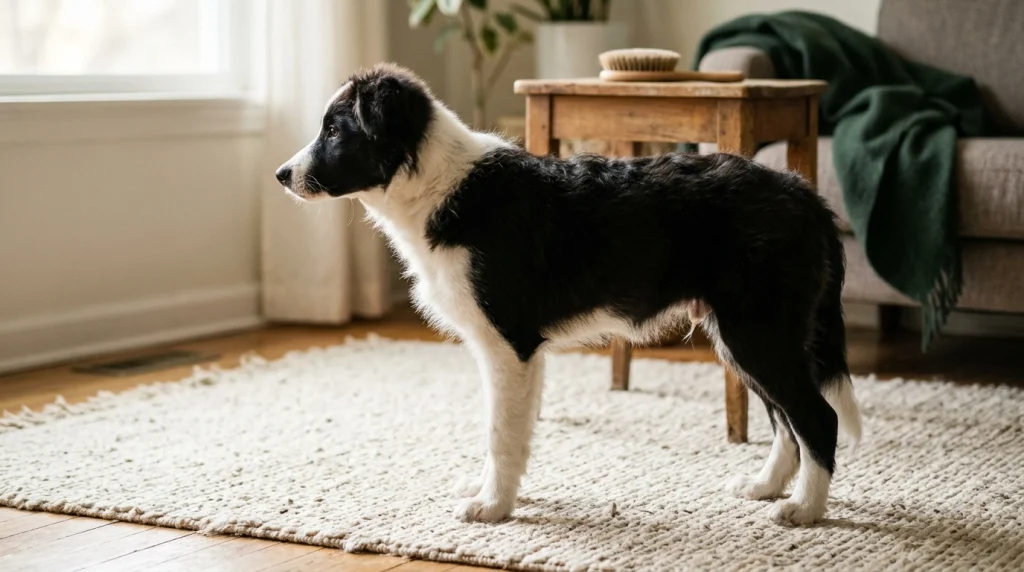
Most Border Collies begin transitioning from puppy fur to adult hair at approximately four to six months. The process is gradual, and some dogs do not show their mature coat clearly until they are around 10–15 months old.
The Border Collie Club of South Australia’s extended breed standard explains that puppies can display different coat qualities until the adult topcoat starts appearing at four to six months. This supports using that age as a starting point rather than a deadline for complete coat development.
Use these age ranges as a general guide, not a strict schedule:
- 8–12 weeks: Your puppy usually has a soft, youthful coat. The eventual length and texture may not be obvious.
- 4–6 months: Adult hairs may begin emerging, and loose puppy fur can become more noticeable.
- 6–9 months: The coat may look uneven as the new hair develops. Some puppies begin showing more mature texture or feathering.
- 10–15 months: Many dogs have a more recognizable adult coat, although thickness, length, and finishing details can continue to develop.
These stages overlap. One puppy may look noticeably more mature at eight months, while another may retain a soft appearance for longer. A healthy coat does not need to match a calendar precisely.
What Does the Transition From Puppy Fur to Adult Hair Look Like?
The change is usually easier to recognize by comparing your puppy’s coat over several weeks than by looking for one dramatic shedding event. New hair may grow through the softer puppy fur, gradually changing the coat’s texture and appearance.
The texture may become less fluffy
Young puppy fur often feels especially soft and can look uniformly fluffy. As adult guard hairs develop, some areas may feel firmer or coarser, and the coat may lie differently against the body.
This change is not necessarily uniform. Your puppy may develop more mature hair along the back or shoulders while the chest, hindquarters, or tail still look comparatively soft.
Shedding may increase temporarily
You may find more loose hair on bedding, clothing, brushes, or floors during the transition. That can be part of the normal coat change, although Border Collies also shed throughout the year and may have heavier seasonal shedding.
Shedding alone does not prove that the adult coat has finished growing. Look at the overall pattern, including texture, length, skin condition, and whether new hair is growing normally.
Feathering can develop gradually
In rough-coated Border Collies, longer hair around the chest, backs of the legs, and tail may become more noticeable as the dog matures. These areas can develop at different speeds, so an adolescent puppy may look partly grown into its coat rather than fully finished.
Smooth-coated Border Collies have a shorter outer coat and generally less obvious feathering. Their adult coat can become more mature in texture without developing the flowing appearance of a rough-coated dog.
Does Coat Type Change When the Adult Coat Appears?
Yes, coat type affects what you see as your Border Collie matures, although both recognized varieties have a protective double coat. The American Kennel Club’s Border Collie breed information describes rough coats as medium-length and feathered, while smooth coats are shorter and coarser.
| Feature | Rough coat | Smooth coat |
|---|---|---|
| Adult appearance | Medium-length hair with more visible feathering | Shorter hair lying closer to the body |
| Visible coat change | Length and feathering may become more apparent gradually | Texture and density may change without much added length |
| Grooming focus | Loose undercoat, tangles, and feathered areas | Loose hair and routine skin checks |
The practical difference is that a smooth-coated puppy may already look fairly close to its adult outline while its coat is still maturing. A rough-coated puppy may need more time before its longer areas become obvious.
Do not assume that every fluffy puppy will develop a long coat or that every short-haired puppy will remain exactly the same length. Coat inheritance and individual development influence the final appearance.
Why Is Your Border Collie Puppy Still Fluffy at 6–9 Months?
A puppy that still looks fluffy at this age may simply be developing more slowly. Coat transitions vary between individual dogs, and age alone cannot establish whether the coat has matured normally.
There are several reasonable explanations:
- Individual development: Adult hairs may emerge gradually instead of replacing the puppy appearance all at once.
- Coat variety: A rough-coated Border Collie may need longer for its feathering and overall outline to become obvious.
- Family coat traits: The puppy’s inherited coat characteristics influence its eventual texture and length.
- Incomplete transition: New adult hair may be present even though other areas still have a soft, youthful appearance.
If your puppy is otherwise thriving and the coat is growing evenly, a fluffy appearance by itself is usually not a reason to panic. Compare photographs taken a month apart rather than expecting a dramatic change from one week to the next.
For a closer look at the shedding stage itself, read our guide to when Border Collies lose their puppy coat. That page addresses the puppy-coat transition, while the important distinction here is that shedding can start before the final adult appearance develops.
How Should You Care for the Coat During This Stage?
You do not need a complicated grooming routine to support a normal coat transition. Gentle, consistent brushing helps remove loose hair, identify tangles, and make it easier to notice changes in the skin.
- Brush regularly. Start with a gentle brush suited to your puppy’s coat. Once or twice a week is a useful baseline for many Border Collies, with more frequent brushing when shedding increases or tangles develop.
- Check behind the ears and around the legs. Rough-coated puppies can develop small knots in areas where longer hair rubs together. Work through tangles slowly rather than pulling.
- Inspect the skin. Look for redness, persistent itching, scabs, bald patches, or unusual changes in coat density during grooming.
- Bathe only when needed. Use a dog-appropriate shampoo and rinse thoroughly. Frequent unnecessary bathing can dry the skin and does not make the adult coat grow in faster.
- Avoid shaving for convenience. Both coat varieties have protective double coats. Shaving a healthy coat is not a reliable way to stop shedding or speed up maturation.
For more specific instructions, our guide to how often a Border Collie should be groomed explains how to adapt routine care to coat condition and shedding.
Tip
Take a clear photo of your puppy’s back, chest, and tail every four weeks under similar lighting. Comparing the photos can help you spot gradual changes in length and texture without relying on memory.
When Should a Coat Change Concern You?
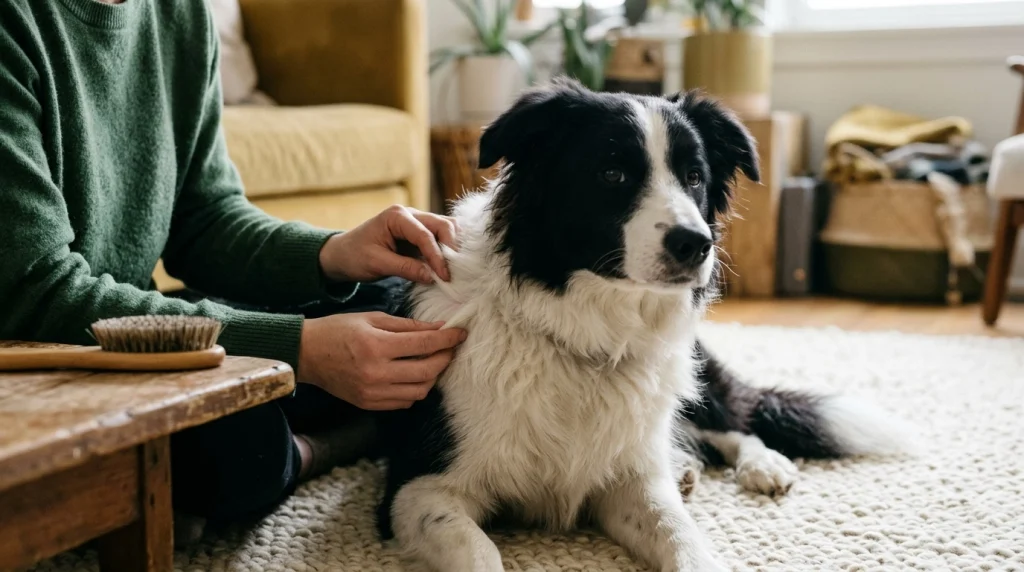
A slow transition is different from a coat that is becoming unhealthy. Normal puppy development should not be assumed to explain every instance of hair loss, itching, or skin irritation.
Contact your veterinarian if you notice:
- Distinct bald patches or rapidly thinning hair.
- Persistent scratching, redness, sores, or scaly skin.
- Strong or unusual skin odor, especially with irritation.
- Hair loss accompanied by reduced appetite, low energy, or other changes in health.
- A sudden, marked change in coat quality that does not have an obvious explanation.
These signs can have causes unrelated to the normal puppy-to-adult transition. A veterinarian can examine the skin and coat and determine whether testing or treatment is needed.
If your puppy is healthy but the coat still looks immature at 10–12 months, that alone does not establish a problem. If the coat seems not to be developing at all, or you are uncertain whether the pattern is normal for your dog’s family, ask your veterinarian and breeder for guidance.
What Should You Expect by the First Birthday?
By around 12 months, many Border Collies show a more mature coat than they had as young puppies. However, the first birthday is not a guaranteed finish line: individual dogs can continue developing coat length, texture, and fullness beyond that point.
Focus on healthy growth rather than achieving a particular look by a particular month. A clean coat with healthy skin and gradual, even development matters more than whether your puppy has a dramatic mane or fully feathered tail at one year old.
Related Product
Gentle Dog Grooming Brush
A gentle brush can help remove loose puppy fur and keep longer areas manageable while your Border Collie’s adult coat develops.
As an Amazon Associate, we earn from qualifying purchases.
Frequently Asked Questions
Does a Border Collie get its adult coat at exactly six months?
No. Six months is around the time adult hair may begin appearing, not a deadline for complete development. Some puppies show the change earlier, while others mature more gradually into their first year or beyond.
Will my Border Collie’s coat change color as it matures?
Its appearance may change as the coat develops, and some dogs show differences in shade or contrast as they mature. The amount of change varies, so puppy coloring alone cannot predict every detail of the adult coat.
Can you tell whether a Border Collie puppy will have a rough or smooth coat?
Early appearance and the parents’ coats can offer clues, but a young puppy’s final coat may not be obvious immediately. The adult coat’s length and feathering become easier to assess as the dog matures.
Does a Border Collie shed more when its adult coat comes in?
Some puppies shed more noticeably during the coat transition. Border Collies also shed year-round, with heavier shedding at certain times, so an increase in loose hair does not automatically mean the adult coat is finished growing.
Should I trim my Border Collie puppy’s coat to help it grow properly?
No. Trimming is not necessary to make the adult coat develop. Routine brushing and occasional hygienic trimming when appropriate are usually enough; avoid shaving a healthy double coat simply to influence growth or shedding.
What if my Border Collie is 15 months old and still has a soft coat?
Coat texture varies between dogs, and softness alone does not prove that development is abnormal. If the coat is healthy and growing evenly, it may simply reflect your dog’s individual traits. Ask a veterinarian if you also notice thinning, bald patches, irritation, or other changes.
Conclusion
Border Collie puppies commonly begin developing their adult coat at four to six months, but the complete transition can take until around 10–15 months or longer in some individuals. Rough-coated puppies may take more time to show their mature feathering, while smooth-coated puppies can appear more adult-like earlier.
Keep brushing gentle and consistent, watch for gradual changes, and avoid shaving a healthy double coat to influence its development. Most importantly, judge the coat by its overall health rather than age alone. If you see bald patches, persistent irritation, or unusual hair loss, get veterinary advice instead of assuming it is a normal growth stage.