

Quick Answer
You usually do not need to bathe a Border Collie after ordinary rain. Borders have a dense, weather-resistant double coat, so towel drying, paw cleaning, and brushing are often enough after a wet walk. The AKC’s Border Collie guidance confirms that both rough and smooth varieties have dense double coats.
What to do after a rainy walk
- Light rain: Towel the coat and check whether moisture remains near the skin.
- Muddy paws: Rinse or wipe the paws and lower legs instead of bathing the whole dog.
- Dried mud: Let manageable surface mud dry, then brush it from the coat gently.
- Heavy contamination: Bathe if the coat contains sewage, road chemicals, oily grime, or another questionable substance.
- Persistent odor: Check the skin, ears, paws, and undercoat instead of automatically shampooing again.
- Skin problems: Ask your veterinarian before changing bathing frequency or using medicated products.
Simple rule
- If rain only made your Border Collie wet, dry them. If the walk made them genuinely dirty or contaminated, clean what needs cleaning.
Rainy walks and Border Collies seem made for each other. A working sheepdog rarely worries about drizzle, puddles, or wet grass as much as the person holding the leash does.
I’ve found that the biggest mistake is treating every wet coat like a dirty coat. This guide explains when drying is enough, when spot-cleaning works, and when a complete bath makes sense.
In This Guide
- Does a Border Collie Need a Bath After Rain?
- How Does Rain Affect a Border Collie’s Double Coat?
- What Should You Do After a Rainy Walk?
- When Should You Bathe a Border Collie After Rain?
- Rain vs. Mud: What Level of Cleaning Is Needed?
- How Should You Dry a Border Collie After Rain?
- Can Frequent Post-Rain Baths Cause Problems?
- Frequently Asked Questions
- Final Takeaway
Does a Border Collie Need a Bath After Rain?
No. A Border Collie that is simply wet from clean rain usually needs drying rather than shampooing.
Bathing becomes useful when rain combines with significant mud, foul material, chemicals, salt, dirty standing water, or another substance you don’t want remaining on the skin.
Wet does not automatically mean dirty
A rain-soaked coat may look dramatic. Once dry, however, a surprising amount of ordinary soil can fall or brush away.
- Clean rainwater: Usually requires drying only.
- Wet grass: Check paws, belly, and feathering for debris.
- Light mud splashes: Spot-rinse the affected areas.
- Heavy sticky mud: A proper rinse or bath may be easier.
- Unknown substances: Remove them promptly and seek veterinary advice if toxicity is possible.
The ASPCA’s dog grooming guidance recommends dog-specific shampoo when bathing is necessary. It also emphasizes thoroughly drying dogs after washing.
My rule after a rainy walk is simple: I check what reached the skin before deciding what to do. A dog with damp guard hairs needs far less cleaning than one coated in gritty roadside sludge.
How Does Rain Affect a Border Collie’s Double Coat?
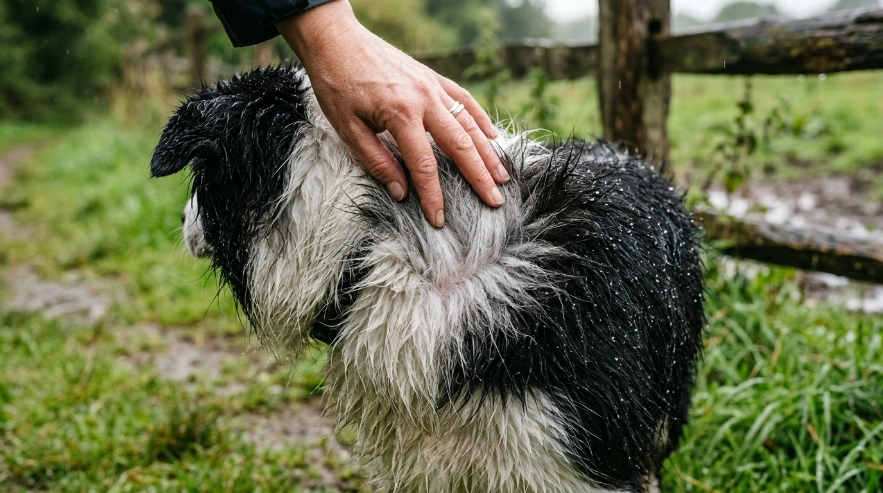
A Border Collie’s double coat consists of a coarser protective outer coat and a softer, dense undercoat. Both rough-coated and smooth-coated Border Collies have this two-layer structure.
Definition: The double coat is a weather-protective hair system in which outer guard hairs help repel moisture and debris while the undercoat provides insulation.
Why can the outside look wetter than the skin?
The outer guard hairs can catch water while limiting how quickly it reaches deeper layers. This is one reason a short spell of rain does not automatically require bathing.
Longer exposure changes things. Persistent rain can eventually soak through, especially around the chest, belly, rear legs, tail, and areas where the coat separates during movement.
- Rough coat: Longer feathering collects more water, grass, and mud.
- Smooth coat: Shorter outer hair is easier to towel, but the undercoat still needs checking.
- Heavy seasonal coat: Dense undercoat can hold moisture longer.
- Matted coat: Tangled hair reduces airflow and makes drying more difficult.
Border Collies share this double-coat principle with breeds such as the Australian Shepherd. Their working heritage favored coats capable of handling outdoor conditions rather than coats requiring shampoo after every shower.
What Should You Do After a Rainy Walk?
Start with the least intensive cleaning method that gets your Border Collie comfortably clean and dry. Most post-rain routines take only a few focused steps.
1. Let your Border Collie shake
Give your dog a safe place to shake before reaching for a towel. A natural shake removes a useful amount of surface water quickly.
2. Check the paws and lower legs
Look between the toes and around the pads. Remove mud, gravel, grass, small twigs, and other material picked up during the walk.
A bowl of clean lukewarm water or gentle paw rinse often solves muddy feet. You don’t need to shampoo the entire dog for four dirty paws.
3. Blot the coat
Press an absorbent towel into the coat instead of scrubbing vigorously. Rough rubbing can create tangles, especially in feathering.
- Blot the neck and shoulders.
- Press moisture from the chest.
- Dry the belly and armpits.
- Squeeze longer leg feathering gently.
- Check behind the ears and around the tail.
4. Decide whether the dirt can dry and brush out
Clean, ordinary mud often becomes easier to remove when it dries. This works especially well for light splashes on the outer coat.
Don’t leave thick, skin-level mud packed into the undercoat. Rinse heavily soiled areas when brushing would pull or hurt.
5. Check again at skin level
Part the hair with your fingers. The outer coat can feel nearly dry while moisture remains underneath.
I pay extra attention behind the ears and along the chest on my wet-weather checks. Those areas can fool you because the top hairs fluff up before deeper hair dries.
When Should You Bathe a Border Collie After Rain?
Give a full bath when simple drying or spot-cleaning cannot remove what is on the coat. The decision should depend on contamination, not rainfall itself.
When is shampoo reasonable?
- Heavy mud: Thick mud has reached the skin or become packed through feathering.
- Foul material: Your dog rolled in animal waste, decomposing matter, or something similarly unpleasant.
- Road grime: Splash water contains oily residue, de-icing material, or questionable roadside contamination.
- Dirty standing water: Your dog played in stagnant puddles, ditches, or floodwater.
- Persistent smell: A foul odor remains after complete drying and normal brushing.
- Veterinary instructions: Your veterinarian has prescribed a specific bathing or medicated-shampoo routine.
The VCA grooming and coat-care guide notes that dogs running through puddles or dirty water may need bathing after a muddy walk. It also recommends shampoo formulated for dogs rather than human shampoo.
What if the dog contacted something potentially toxic?
Don’t rely on an ordinary grooming routine when an unknown chemical, pesticide, fuel, or other potentially harmful substance is involved. Prevent licking and contact your veterinarian for appropriate decontamination advice.
Vet note: Skin redness, pain, repeated licking, swelling, vomiting, unusual behavior, or suspected chemical exposure should be discussed with your own veterinarian.
Rain vs. Mud: What Level of Cleaning Is Needed?
The easiest way to avoid unnecessary baths is to match the cleaning method to the mess. Here’s the practical system I use.
| After-walk condition | Best first step | Full shampoo bath? |
|---|---|---|
| Light clean rain | Towel dry and check undercoat | Usually no |
| Wet grass and clean paws | Dry coat and inspect feet | No |
| Light mud on legs | Rinse legs or let surface mud dry before brushing | Usually no |
| Thick mud through undercoat | Thorough rinse and clean affected coat | Sometimes |
| Dirty ditch or stagnant water | Thorough cleaning with dog-safe products as appropriate | Often sensible |
| Chemical or unknown contamination | Prevent licking and seek professional advice | Follow veterinary guidance |
A quick paw rinse can therefore replace many unnecessary baths. That’s especially useful during weeks when your Border Collie goes outside in rain every day.
How Should You Dry a Border Collie After Rain?
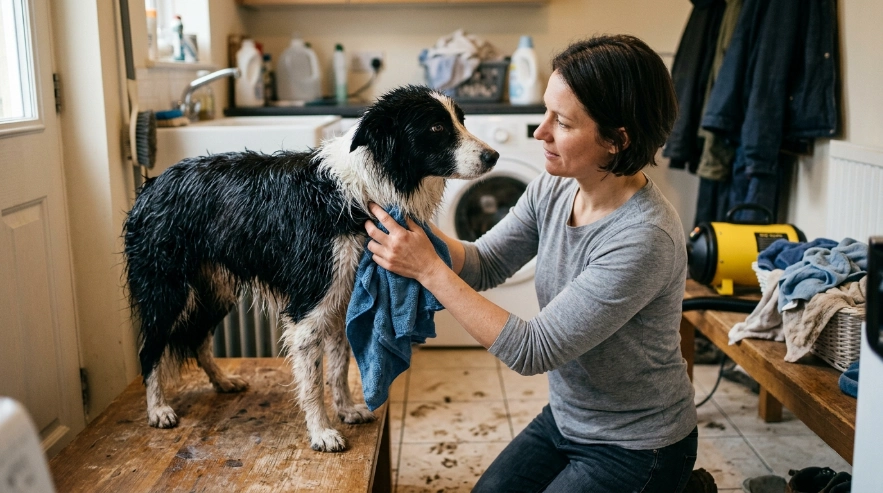
Drying matters more than shampooing after ordinary rain. Your goal is to remove excess water and make sure dense areas are not staying persistently wet.
Use towels first
Start with an absorbent towel and press it through the coat. Switch towels when the first becomes saturated.
The veterinarian-reviewed PetMD dog-bathing guide recommends gentle towel drying and notes that thick-coated dogs may need multiple towels or a pet-safe dryer on a low, cool setting.
When should you use airflow?
A dog-specific dryer can help with a thoroughly soaked undercoat. Keep airflow cool or comfortably low, and avoid holding concentrated air against one spot.
- Work from the shoulders toward the rear.
- Lift dense hair gently with your fingers.
- Check the chest and armpits.
- Feel the belly and rear-leg feathering.
- Inspect the tail base and behind the ears.
Can a Border Collie air dry after rain?
Partial air drying is often fine after you have already removed most surface moisture. Keep the dog indoors somewhere comfortable with good airflow.
Don’t judge dryness from appearance alone. Push your fingers through the coat and feel close to the skin.
As of 2026, this remains one of the simplest Border Collie grooming habits worth learning. A few careful minutes after wet walks can reduce tangles, damp bedding, and repeated unnecessary washing.
Can Frequent Post-Rain Baths Cause Problems?
Bathing after every rainy walk is unnecessary for most healthy Border Collies. How often a dog needs shampoo depends on coat condition, lifestyle, skin health, season, and veterinary advice.
The key distinction is between rinsing dirt away and performing a complete shampoo bath. Clean water on muddy paws is not the same as repeatedly shampooing the whole double coat.
Why not shampoo after every wet walk?
- Skin dryness: Excessive bathing can contribute to dry or irritated skin in some dogs.
- More drying work: Shampooing means completely soaking an undercoat that might otherwise need only towel drying.
- More tangles: Repeated wetting and rough handling can complicate longer feathering.
- Bath resistance: Turning every rainy outing into bath time can make grooming unnecessarily stressful.
- No added benefit: Clean rainwater does not automatically create a hygiene problem that shampoo must solve.
A practical bathing schedule should respond to your individual dog rather than a fixed calendar. Outdoor working Borders may get dirty more frequently than primarily indoor companions.
Dogs with allergies or diagnosed skin disease are different. Follow veterinary instructions because some conditions call for specific medicated shampoos and carefully timed baths.
Vet note: If your Border Collie develops recurring itching, flakes, redness, sores, hair loss, or strong skin odor, ask your veterinarian before increasing bath frequency.
Frequently Asked Questions
Should I bathe my Border Collie every time it rains?
No. Clean rain usually calls for drying rather than a complete shampoo bath. Check the paws, belly, chest, and undercoat, then spot-clean any mud or debris that needs attention.
Can I just towel dry my Border Collie after rain?
Yes, when the coat is only moderately wet. Blot thoroughly, then part the coat with your fingers to confirm that dense areas near the skin are drying properly.
Should I rinse muddy Border Collie paws after every rainy walk?
Rinsing muddy paws with clean, comfortable water is reasonable. Clean between the toes and pads, then dry them thoroughly rather than shampooing your dog’s whole body.
Can I let mud dry on my Border Collie?
Light surface mud can often dry and brush out easily. Rinse instead when mud is thick, packed into the undercoat, irritating the skin, or mixed with road chemicals or questionable substances.
Why does my Border Collie smell after being in the rain?
A temporarily stronger “wet dog” smell may disappear after complete drying. Persistent, sour, yeasty, or localized odor deserves a closer check of the skin, ears, paws, and undercoat, especially when itching or redness occurs.
Can I use human shampoo after a muddy walk?
No. Choose shampoo formulated for dogs when a complete bath is necessary. Human shampoos are designed for human skin and can be too harsh for a dog’s skin and coat.
What if my Border Collie gets soaked in a storm?
Bring your dog somewhere warm and dry, towel off excess water, and check the undercoat. A bath is unnecessary unless the coat also became dirty or contaminated; drying is the priority after clean rain.
Final Takeaway
You don’t need to bathe a Border Collie after every rainy walk. For ordinary rain, towel drying, checking the undercoat, cleaning the paws, and brushing away dried dirt are usually enough.
Save full shampoo baths for the times they solve a real problem. Heavy mud, foul material, dirty standing water, or significant contamination are much better reasons than rain itself.
- Wet but clean: Dry the coat.
- Muddy in a few areas: Spot-rinse and dry.
- Heavily dirty: Consider a dog-safe bath.
- Potentially contaminated: Clean promptly and seek professional advice when needed.
- Skin looks abnormal: Contact your veterinarian rather than repeatedly bathing.
Once you get used to checking the coat instead of reacting to the weather, rainy-day grooming becomes much easier. Your Border Collie gets clean when needed without turning every wet adventure into bath day.
