

Quick Answer
Border Collies are high maintenance because they combine intense physical energy with exceptional intelligence, strong herding instincts, and a constant need for purposeful activity. According to the American Kennel Club’s Border Collie breed guidance, they are energetic working dogs that need owners with enough time and energy to keep them occupied.
Why they require so much work
- High exercise needs: A short walk usually isn’t enough for a healthy adult Border Collie.
- Busy minds: They need training, problem-solving, games, or another mentally challenging job.
- Herding drive: Chasing, staring, circling, and controlling movement can appear in everyday home life.
- Ongoing training: Their fast learning works best when owners provide clear rules and consistency.
- Regular grooming: Their double coat sheds and needs routine brushing, especially during heavier shedding periods.
The ownership test
- Choose this breed because you enjoy daily interaction, training, and activity—not simply because Border Collies look smart and impressive.
Border Collies, sometimes called Borders or simply BCs, can make remarkable companions. Their intelligence is also one reason people underestimate how demanding they can be.
As of 2026, my simplest advice is this: don’t judge the breed by how easily it learns commands. Judge it by whether your normal daily routine can keep that intelligent working brain productively occupied.
In This Guide
- What Makes Border Collies So High Maintenance?
- How Much Exercise and Mental Stimulation Do They Need?
- Why Does Their Intelligence Make Them More Work?
- Does the Border Collie Herding Instinct Cause Problems?
- Are Border Collies High Maintenance to Groom?
- Do Border Collies Have High Health-Care Needs?
- Can a Busy Owner Realistically Handle a Border Collie?
- Frequently Asked Questions
- Is a Border Collie Worth the Extra Work?
What Makes Border Collies So High Maintenance?
Border Collies are demanding because they were developed for sustained, mentally complex work. Herding livestock requires movement, concentration, fast decisions, responsiveness, and enormous awareness of the surrounding environment.
A Border Collie’s working drive is its natural motivation to stay engaged with a task. That drive doesn’t automatically disappear when the dog moves from a farm into a suburban home.
They aren’t designed for an inactive routine
A Border may happily sleep after a satisfying day. The problem appears when several quiet, uneventful days become the normal schedule.
Common maintenance demands include:
- Daily physical activity beyond basic bathroom walks
- Mental enrichment through puzzles, scent work, games, or training
- Frequent interaction with people rather than long periods of isolation
- Consistent rules around chasing, barking, jumping, and household manners
- Regular coat care and cleaning during shedding periods
The ASPCA’s general dog-care guidance notes that exercise needs differ by breed, age, and health. It also explains that exercise helps stimulate a dog’s mind and can reduce boredom-related behavior.
High maintenance doesn’t mean “bad dog”
This distinction matters. A Border Collie that digs, barks, paces, steals objects, or invents games isn’t necessarily stubborn.
Sometimes the dog’s daily routine simply isn’t meeting the needs of a high-drive herding breed.
- A bored Border may find its own activity.
- An overstimulated Border may struggle to settle.
- An undertrained Border may practice unwanted behavior repeatedly.
- A fulfilled Border is often impressively focused and cooperative.
The maintenance comes from creating that last outcome consistently.
How Much Exercise and Mental Stimulation Do Border Collies Need?
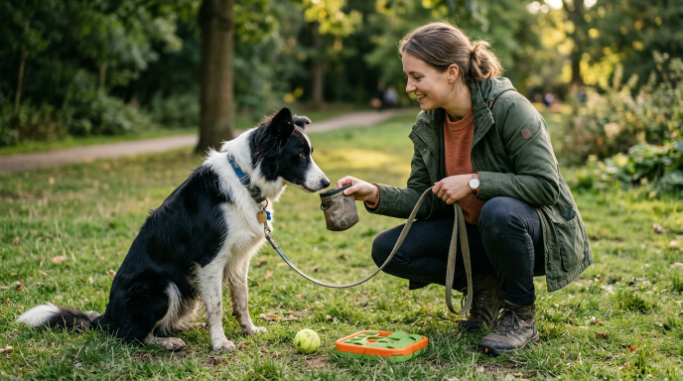
Most healthy adult Border Collies need considerably more activity than a leisurely walk around the neighborhood. However, there isn’t one medically correct number of exercise minutes for every dog.
Age, conditioning, health, weather, temperament, and working lineage all matter.
A practical daily planning range
For a healthy adult, I would plan the day around several different forms of activity rather than trying to exhaust the dog with nonstop running. Quality matters as much as duration.
| Daily activity | Practical planning range | Purpose |
|---|---|---|
| Physical exercise | About 60–120 minutes split across the day | Movement, fitness, exploration |
| Focused training | Two or three 5–10 minute sessions | Impulse control and communication |
| Mental enrichment | 15–30 minutes | Problem-solving and concentration |
| Calm downtime | Built into the daily schedule | Learning to switch off and rest |
Those numbers are planning examples, not veterinary prescriptions. Puppies, seniors, injured dogs, and poorly conditioned adults need different routines.
More running isn’t always the answer
Constantly trying to physically exhaust a Border Collie can create an increasingly fit athlete. It doesn’t automatically teach calm behavior.
A balanced day can include:
- Brisk walks with time to sniff
- Fetch with clear start and stop cues
- Short obedience sessions
- Food puzzles or hidden-treat searches
- Tug with rules
- Agility foundations or appropriate dog sports
- Place, settle, and relaxation practice
That mix works both the body and brain. It also teaches the dog that excitement isn’t the only rewarding state.
Why Does Their Intelligence Make Border Collies More Work?
Border Collies learn quickly, but fast learning works in both directions. They can learn the behavior you intended and the loophole you accidentally created.
That is why intelligence doesn’t necessarily produce an easy pet.
They notice patterns you may not notice
Suppose you throw a ball every time your Border drops it beside your chair. The dog may soon learn that persistent staring controls your behavior.
Give in repeatedly, and you’ve trained a routine without planning to.
- Door opens after barking.
- Ball gets thrown after staring.
- Attention arrives after pawing.
- Chasing begins when children run.
- Kitchen activity predicts dropped food.
This is where Border Collie ownership becomes mentally demanding for the human. Consistency matters because the dog is constantly learning from consequences.
Training needs to continue after puppyhood
Basic sit and stay commands are a beginning, not the finished job. A high-drive adult also benefits from impulse control, recall, settling, handling skills, and safe ways to use instinctive behavior.
Reward-based training is particularly useful because you can channel the dog’s desire to work toward behaviors you want repeated.
- Reward calm behavior before excitement starts.
- Practice recall away from major distractions first.
- Teach an off-switch alongside active games.
- Keep sessions short enough to maintain concentration.
- Increase difficulty gradually.
My practical rule is simple: don’t only train a Border Collie to do more. Spend equal effort teaching the dog when nothing needs to happen.
Does the Border Collie Herding Instinct Cause Problems?
It can. Herding behavior is normal breed behavior, but its expression can become inconvenient or unsafe in a household.
Herding instinct is the inherited tendency to control the movement of animals. Border Collies often use staring, positioning, circling, stalking, and rapid movement to influence that movement.
People can become substitute livestock
Some Borders try to control running children, bicycles, joggers, other dogs, or moving vehicles. Behaviors vary greatly between individuals.
Watch for patterns such as:
- Intense staring at moving people
- Crouching or stalking before a chase
- Circling children during play
- Chasing wheels or bicycles
- Nipping toward heels during excitement
- Fixating on shadows, reflections, or repetitive movement
Don’t rely on punishment to remove an instinctive behavior. Management, appropriate outlets, distance from triggers, and reward-based replacement behaviors are usually more useful.
The Merck Veterinary Manual’s guidance on canine behavior problems emphasizes suitable exercise, environmental enrichment, routine, and positive reinforcement when addressing problem behaviors.
Management prevents rehearsal
A behavior becomes harder to change when the dog practices it hundreds of times. Prevention therefore matters.
- Use a leash near traffic.
- Supervise interactions with running children.
- Block access to windows that trigger obsessive chasing.
- Interrupt fixation before the dog becomes unreachable.
- Redirect toward a trained behavior or appropriate game.
If chasing or repetitive behavior becomes intense, difficult to interrupt, or dangerous, involve a qualified trainer or veterinary behavior professional.
Are Border Collies High Maintenance to Groom?
Border Collies aren’t among the most difficult breeds to groom, but they aren’t maintenance-free. Both rough-coated and smooth-coated Borders carry a protective double coat.
The rough coat has more visible feathering. The smooth coat is shorter, but it can still shed considerably.
Expect brushing and loose hair
For many household Borders, brushing once or twice each week is a reasonable baseline. Heavier seasonal shedding can make more frequent brushing useful.
A simple grooming routine includes:
- Brushing: Remove loose undercoat, debris, tangles, and developing mats.
- Nail care: Keep nails at a comfortable length and check them regularly.
- Ear checks: Look for unusual odor, redness, discharge, or irritation.
- Dental care: Make tooth care part of the normal routine.
- Paw checks: Inspect pads after hiking, running, or rough outdoor activity.
Don’t assume shaving the coat is the easy solution to shedding. Routine brushing and sensible coat care are usually more appropriate for a normal double coat.
The hidden maintenance is cleaning the house
Active dogs carry outdoor life indoors. Mud, wet paws, grass, seeds, and loose coat can all become part of the housekeeping routine.
This may sound minor compared with training. Over ten or fifteen years of ownership, however, repeated small chores matter.
Do Border Collies Have High Health-Care Needs?
Border Collies are generally athletic dogs, but responsible ownership still includes preventive veterinary care and awareness of breed-associated conditions. Health screening also matters when choosing a breeder.
PetMD’s Border Collie health guide discusses conditions seen in the breed, including hip dysplasia, epilepsy, Collie eye anomaly, MDR1 drug sensitivity, and certain inherited disorders.
Maintenance includes prevention
You don’t need to spend every day worrying about disease. You do need a sensible veterinary plan.
- Schedule routine veterinary examinations.
- Keep vaccinations and parasite prevention appropriate to your dog’s situation.
- Discuss genetic screening when buying from a breeder.
- Watch for unexplained limping, seizures, vision changes, or major behavior changes.
- Adjust exercise when age, injury, heat, or illness requires it.
Vet note: Breed tendencies never diagnose an individual dog. Ask your own veterinarian about symptoms, exercise limits, medication sensitivities, genetic testing, or health concerns.
Active dogs can hide discomfort
Drive can sometimes make an enthusiastic dog continue working despite soreness. Owners therefore need to look beyond willingness to chase another ball.
Changes in gait, jumping, recovery, posture, appetite, sleep, or enthusiasm deserve attention when they persist.
Can a Busy Owner Realistically Handle a Border Collie?
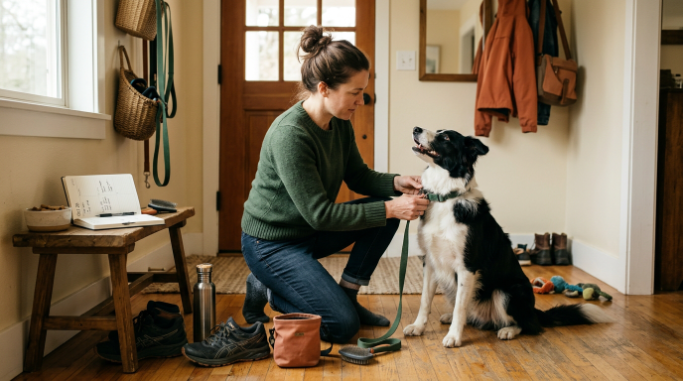
Yes, but only if “busy” still leaves predictable time for the dog. A large yard by itself doesn’t replace interaction, training, and meaningful activity.
The more important question is whether Border Collie care fits naturally into your lifestyle.
A Border Collie may fit you if…
- You enjoy walking, hiking, training, or dog sports most days.
- You like teaching behaviors and solving training problems.
- You can provide structured activity before and after work.
- You don’t mind regular brushing and household shedding.
- You want a dog that interacts intensely with you.
- You can afford routine veterinary care and professional training when needed.
Think carefully if…
- You regularly work long hours with no plan for the dog.
- You want a pet that entertains itself in the backyard.
- Daily exercise already feels difficult to fit into your schedule.
- You dislike repetitive training and behavior management.
- You need a naturally low-energy companion.
- You are choosing the breed mainly because it is famous for intelligence.
A retired or older owner can certainly enjoy a Border Collie when activity level, mobility, support, and the individual dog’s temperament match. Age alone doesn’t determine whether someone is a good owner.
For someone wanting companionship without intensive daily exercise or training, however, another breed or an older, calmer individual dog may be a better fit.
Frequently Asked Questions
Are Border Collies the most high-maintenance dogs?
Not necessarily. Several working and herding breeds can be demanding, but Border Collies stand out because they combine athletic energy, rapid learning, environmental sensitivity, and strong working instincts.
The right owner may find that workload enjoyable rather than burdensome.
Why is my Border Collie never tired?
A Border Collie can become physically fit enough that simply adding more running stops producing the result you expect. Combine appropriate exercise with sniffing, training, problem-solving, and deliberate relaxation practice.
If restlessness changes suddenly or seems abnormal, speak with your veterinarian.
Can you leave a Border Collie alone during the workday?
Some adult Border Collies can learn to spend reasonable periods alone when their physical, social, bathroom, and mental needs are met. Long, inactive days followed by only a short walk are much harder for many individuals.
Puppies generally require much more frequent care and supervision.
Do Border Collies calm down with age?
Many become more settled as they mature, but maturity doesn’t erase their need for activity and mental engagement. Training an off-switch and calm household habits is more reliable than waiting for age to solve everything.
Are Border Collies good for first-time dog owners?
They can be, but the learning curve is steep. A committed first-time owner who enjoys training and has appropriate support may succeed, while an experienced owner with an incompatible lifestyle may struggle.
Are Border Collies good apartment dogs?
An apartment isn’t automatically a problem because square footage doesn’t exercise a dog. The bigger issue is whether the owner provides enough outdoor activity, enrichment, training, bathroom breaks, and quiet-settling practice every day.
What happens when a Border Collie gets bored?
Boredom may show up as chewing, digging, barking, pacing, stealing objects, demanding games, chasing movement, or other self-created activities. Persistent repetitive behavior can have several causes, so severe or unusual behavior deserves professional assessment.
Is a Border Collie Worth the Extra Work?
For the right person, absolutely. Border Collies can offer an extraordinary combination of responsiveness, athleticism, focus, and partnership.
The tradeoff is daily involvement. They aren’t dogs I would choose for someone hoping that food, a yard, and two short walks will cover most of the responsibility.
- Plan for meaningful daily exercise.
- Exercise the brain as well as the body.
- Teach calmness, not only exciting tricks.
- Manage herding and chasing behavior early.
- Keep grooming and preventive health care routine.
- Choose the individual dog whose drive matches your life.
If that sounds like an enjoyable lifestyle rather than a burden, the breed’s “high maintenance” reputation may not scare you at all. It may describe exactly the kind of active relationship you want with a dog.
