

Quick Answer
A Border Collie needs substantial daily attention, but that does not mean entertaining them every waking minute. For most healthy adults, plan for roughly 1–2 hours of physical exercise, several short training or enrichment sessions, regular companionship, and enough calm downtime to learn how to settle. The AKC’s Border Collie guidance also stresses the breed’s strong need for activity and mental stimulation.
What Daily Attention Should Include
- Physical exercise: Brisk walks, running, hiking, structured play, or another age-appropriate activity.
- Mental work: Training, scent games, food puzzles, problem-solving, and learning new skills.
- Social contact: Time with you that includes interaction rather than simply sharing the same room.
- Purposeful jobs: Obedience, agility, herding-style games, toy searches, or useful household routines.
- Quiet time: Planned rest so your Border Collie learns that every moment does not require action.
The Key
- Spread attention across the day instead of trying to exhaust your dog in one long session.
If you’re asking how much attention a Border Collie needs, you’re probably wondering whether this brilliant herding breed will fit your daily life. The answer depends less on constant petting and more on giving the dog meaningful physical, mental, and social engagement.
As of 2026, my practical approach is to think about quality, variety, and routine rather than chasing one perfect number of hours.
In This Guide
- What Does “Attention” Mean for a Border Collie?
- How Many Hours of Attention Does a Border Collie Need?
- What Kind of Attention Does a Border Collie Need Most?
- Can Border Collies Be Left Alone?
- How Do You Know a Border Collie Needs More Attention?
- Can You Give a Border Collie Too Much Attention?
- What Does a Good Border Collie Daily Routine Look Like?
- Frequently Asked Questions
- Final Takeaway
What Does “Attention” Mean for a Border Collie?
A Border Collie’s attention need is the combination of exercise, mental stimulation, training, social interaction, and structured rest required to keep the dog appropriately engaged. Simply sitting beside your dog all day does not meet the same need.
Border Collies were developed as herding dogs capable of watching movement, responding to handlers, solving problems, and working for extended periods.
Simple definition: Attention for a Border Collie means giving their body and brain useful things to do while also teaching them how to relax when nothing is happening.
This explains why a quick walk followed by hours of boredom often leaves these dogs unsatisfied. They may have moved their legs without doing much thinking.
It also explains why ten focused minutes of training can be valuable. Your dog must watch you, make choices, remember cues, and control impulses.
- Physical attention gives the dog an outlet for energy.
- Mental attention challenges their problem-solving ability.
- Social attention maintains connection with the family.
- Training attention gives their intelligence a productive direction.
- Rest training teaches the dog that switching off is also normal.
The goal is therefore not to create a dog that needs you every second. It is to build a dog that enjoys working with you and can also settle independently.
How Many Hours of Attention Does a Border Collie Need?
Most healthy adult Border Collies need around 1–2 hours of physical exercise each day, according to general Border Collie care guidance from PetMD. They also need mental activity, training, interaction, and rest.
For planning purposes, many households should expect to spend roughly 2–3 hours across the day on purposeful engagement. This time does not need to happen continuously.
| Life Stage | Physical Activity | Mental/Social Attention | Best Approach |
|---|---|---|---|
| Puppy | Several short, gentle sessions | Frequent short training, play, socialization | Avoid forced endurance and repeated hard jumping |
| Healthy adult | About 1–2 hours daily for many dogs | Training and enrichment spread through the day | Mix movement, thinking, sniffing, and rest |
| Senior | Shorter, lower-impact sessions | Gentle puzzles, sniffing, easy training | Adjust for mobility, stamina, and health |
Puppies should not simply receive a smaller version of an adult athlete’s routine. Developing bodies benefit from shorter play, exploration, socialization, and basic training.
Seniors often still want interaction even when their bodies slow down. Sniff walks, easy searches, and low-impact training can keep their day interesting.
Vet note: Exercise needs change with age, joint health, medical conditions, fitness, and recovery. Ask your veterinarian for individual guidance if your dog shows pain, limping, unusual fatigue, or a sudden change in activity.
Section Takeaway: Do not measure attention by one stopwatch. A balanced Border Collie day combines physical exercise with thinking, companionship, training, and intentional rest.
What Kind of Attention Does a Border Collie Need Most?
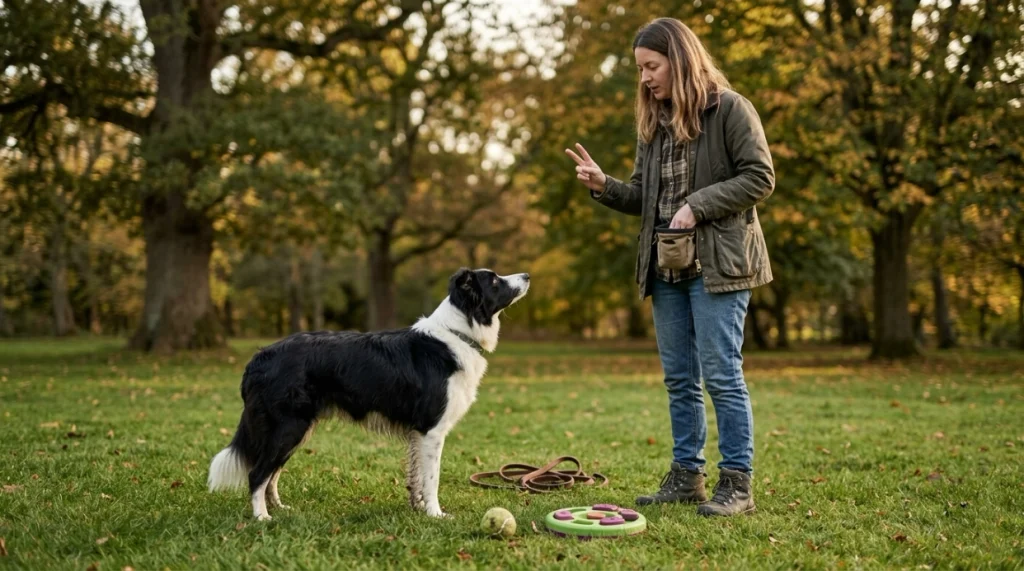
Border Collies usually benefit most from interactive attention that gives them a problem to solve. Endless cuddling or repetitive ball throwing is not a complete enrichment plan.
The VCA Border Collie profile describes the breed as highly focused and recommends structured, mentally challenging activity.
1. Purposeful Physical Exercise
Walking matters, but many healthy adults need more variety than slow pavement walks. Suitable activities can include running, hiking, fetch, controlled disc games, swimming, or secure off-leash exploration.
- Use brisk walks for steady movement.
- Include slower sniff walks for exploration.
- Use fetch in controlled sets rather than nonstop repetition.
- Build hiking or running distance gradually.
- Match intensity to weather and conditioning.
2. Short Training Sessions
I prefer several brief sessions over one exhausting lesson. Five to ten focused minutes can be enough to practice useful skills without letting frustration build.
Good topics include recall, stays, directional cues, heelwork, tricks, object names, impulse control, and settling on a mat.
3. Mental Enrichment
Food puzzles and scent games let your dog earn information and rewards through problem-solving. PetMD’s mental stimulation guidance also highlights enrichment as an important part of canine well-being.
- Hide treats around one room.
- Feed part of a meal through a puzzle toy.
- Teach the names of two or three toys.
- Ask the dog to find a family member.
- Practice simple scent searches in boxes.
4. Jobs That Feel Meaningful
A “job” does not require sheep or a farm. It simply gives the dog a predictable task with rules and a clear outcome.
Agility foundations, treibball, obedience, toy cleanup, nose work, and carrying an appropriate item can all provide that sense of purpose.
5. Calm Social Time
Not every interaction must raise your dog’s adrenaline. Grooming, quiet handling, sitting together after a walk, and relaxed companionship also strengthen your routine.
Section Takeaway: The best attention makes a Border Collie think, move, cooperate, and then settle. Variety usually works better than trying to tire the dog through harder exercise alone.
Can Border Collies Be Left Alone?
Yes, many well-adjusted adult Border Collies can spend reasonable periods alone after gradual training. However, routinely expecting one to handle long, unstimulating days can be difficult for this people-focused working breed.
Being alone is not automatically harmful. The bigger questions are what happens before the alone period, how long it lasts, and how the individual dog responds.
- Before leaving: Provide a bathroom break, appropriate activity, and a chance to settle.
- During alone time: Give the dog a safe resting area and suitable enrichment when appropriate.
- After returning: Offer purposeful interaction instead of immediately creating frantic excitement.
- Build gradually: Start with short absences rather than suddenly leaving a young dog for a full workday.
A dog that sleeps peacefully while you are gone is different from one that panics. Watch behavior rather than assuming every Border Collie has the same limit.
If you see intense vocalization, drooling, escape attempts, destruction around doors, toileting despite house training, or panic linked to departures, speak with a veterinarian or qualified behavior professional.
How Do You Know a Border Collie Needs More Attention?
A Border Collie that lacks suitable engagement often creates something else to do. The behavior may look like “bad manners,” but boredom, frustration, inconsistent routines, or insufficient mental work can contribute.
Common warning signs include the following:
- Persistent pacing: Your dog struggles to relax despite being physically healthy.
- Demand barking: Vocal behavior repeatedly appears when nothing interesting is happening.
- Destructive chewing: Furniture or household objects become self-created entertainment.
- Digging: The yard becomes an outlet for unused energy or curiosity.
- Movement chasing: Cars, bikes, children, shadows, or other moving targets become an obsession.
- Constant attention seeking: Your dog repeatedly nudges, paws, stares, or brings toys without settling afterward.
- Herding family members: Stalking, circling, or heel-nipping may increase around active people.
The AKC’s guidance on boredom in dogs notes behaviors such as digging, restlessness, barking, and destructive activity as possible signs that a dog needs more appropriate outlets.
Do not respond to every unwanted behavior by adding another hour of high-speed fetch. A dog can be physically tired while still lacking structure or mental satisfaction.
Try changing one part of the routine at a time. Add a sniff walk, a short training session, a food search, or a calmer problem-solving activity and observe whether settling improves.
Can You Give a Border Collie Too Much Attention?
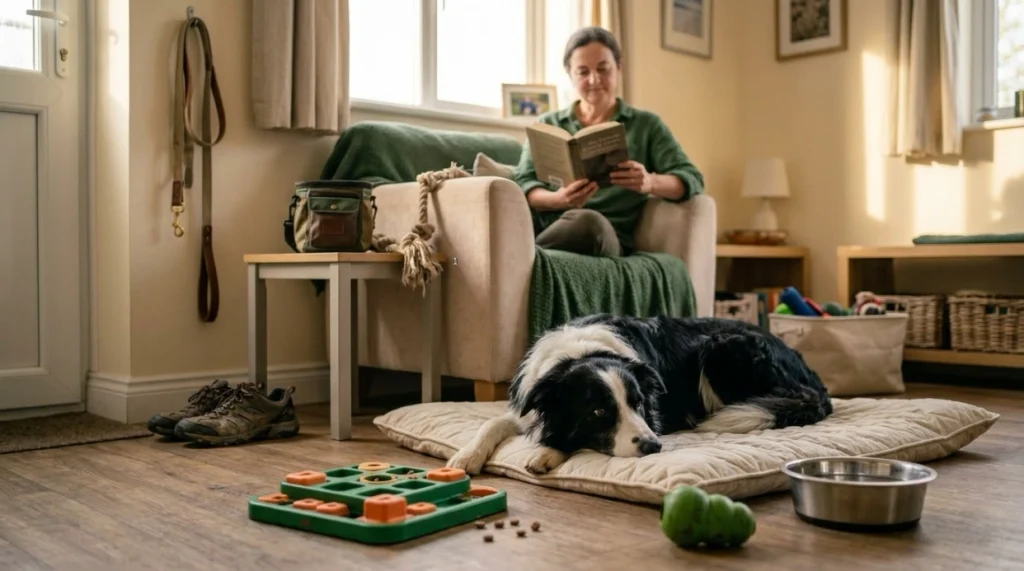
Yes. Constant entertainment can accidentally teach a Border Collie that humans should provide stimulation whenever the dog demands it.
This matters because learning how to relax is a life skill. An adult dog should not need a ball thrown every few minutes from breakfast until bedtime.
Teach an “Off Switch”
An off switch means the dog can transition from activity to calm behavior. It does not mean suppressing the breed’s energy.
- Finish an activity before your dog becomes frantic.
- Offer water and a bathroom opportunity if needed.
- Move to a quiet environment.
- Reward lying calmly on a bed or mat.
- Gradually increase the length of peaceful downtime.
A predictable rhythm works well: activity, recovery, calm time, then another useful activity later. This prevents the entire day from becoming one long cycle of escalating excitement.
Also avoid rewarding every demand for interaction. When your dog’s needs have been met, it is reasonable to encourage independent rest.
What Does a Good Border Collie Daily Routine Look Like?
A strong daily routine spreads attention across several short blocks. This approach serves the dog’s body and brain without making you responsible for constant entertainment.
| Time | Example Activity | Main Benefit |
|---|---|---|
| Morning | 30–45 minute walk, jog, or active outing | Physical exercise and exploration |
| Breakfast | Puzzle feeder or simple food search | Mental work |
| Midday | 5–10 minutes of training plus a bathroom break | Focus and communication |
| Afternoon | 20–30 minutes of structured play or enrichment | Energy outlet and problem-solving |
| Evening | 30–45 minute walk with sniffing | Movement and decompression |
| Later evening | Calm chew, grooming, or mat time | Settling and recovery |
This is an example, not a prescription. Working-line dogs, young adults, calmer individuals, seniors, and dogs with health limitations can need different routines.
I recommend watching what happens after activities. A good routine should help your dog become satisfied and able to settle, not progressively more frantic.
If your Border Collie stays restless, experiment with activity quality before simply increasing duration. Ten minutes of scent work may sometimes accomplish more than another repetitive walk around the same block.
Frequently Asked Questions
Do Border Collies need attention all day?
No. Border Collies need substantial daily interaction, but healthy adult dogs should also learn to rest independently. A good schedule alternates meaningful exercise, training, enrichment, social time, and quiet periods instead of providing nonstop entertainment.
Is two hours of attention enough for a Border Collie?
Two hours of purposeful activity may work for some adults, especially when it combines exercise and mental work. Other Border Collies may need more interaction, so judge the routine by age, health, temperament, working drive, and ability to settle.
How much mental stimulation does a Border Collie need?
There is no universal minute requirement. Several short sessions of training, scent work, puzzles, or problem-solving spread through the day are often more practical than one long mental workout.
Can a Border Collie stay home while I work?
Some trained adults can tolerate appropriate periods alone, but a lifestyle built around long daily absences and little engagement can be challenging. Exercise before and after work, enrichment, gradual alone-time training, and individual temperament all matter.
Why does my Border Collie constantly ask me to play?
The dog may be bored, may have learned that demanding behavior works, or may struggle to settle after exciting activities. Review the whole routine and include mental work plus deliberate calm-time training instead of answering every request with more fetch.
Are Border Collie puppies more demanding than adults?
Puppies often need frequent supervision, socialization, bathroom breaks, training, and short play sessions. Their attention comes in smaller blocks because young bodies and brains still need substantial sleep and recovery.
Will getting a second dog reduce my Border Collie’s attention needs?
Not necessarily. Another dog may provide companionship and play, but it does not replace human training, exercise planning, socialization, or individual interaction. You will also need time to manage and train both dogs separately.
Final Takeaway
So, how much attention does a Border Collie need? For a healthy adult, expect substantial daily involvement: often 1–2 hours of physical exercise plus short periods of training, mental enrichment, social contact, and calm downtime spread across the day.
The most important lesson is that attention should have purpose. A Border Collie usually benefits more from a balanced routine than from hours of repetitive exercise or constant entertainment.
Give the dog opportunities to move, think, work with you, explore, and rest. When those pieces are balanced, you’re much more likely to have a Border Collie who can be energetic outdoors and pleasantly settled at home.
