
A Bump on My Dog’s Back: What It Could Mean and What to Do Next

Finding a new lump on your dog’s back is one of those moments that can make your stomach drop. The good news is that not every bump is dangerous. The more useful question is not “what if it’s cancer?” but “what clues tell me whether this needs a vet soon, or whether it can be watched for a short time?”
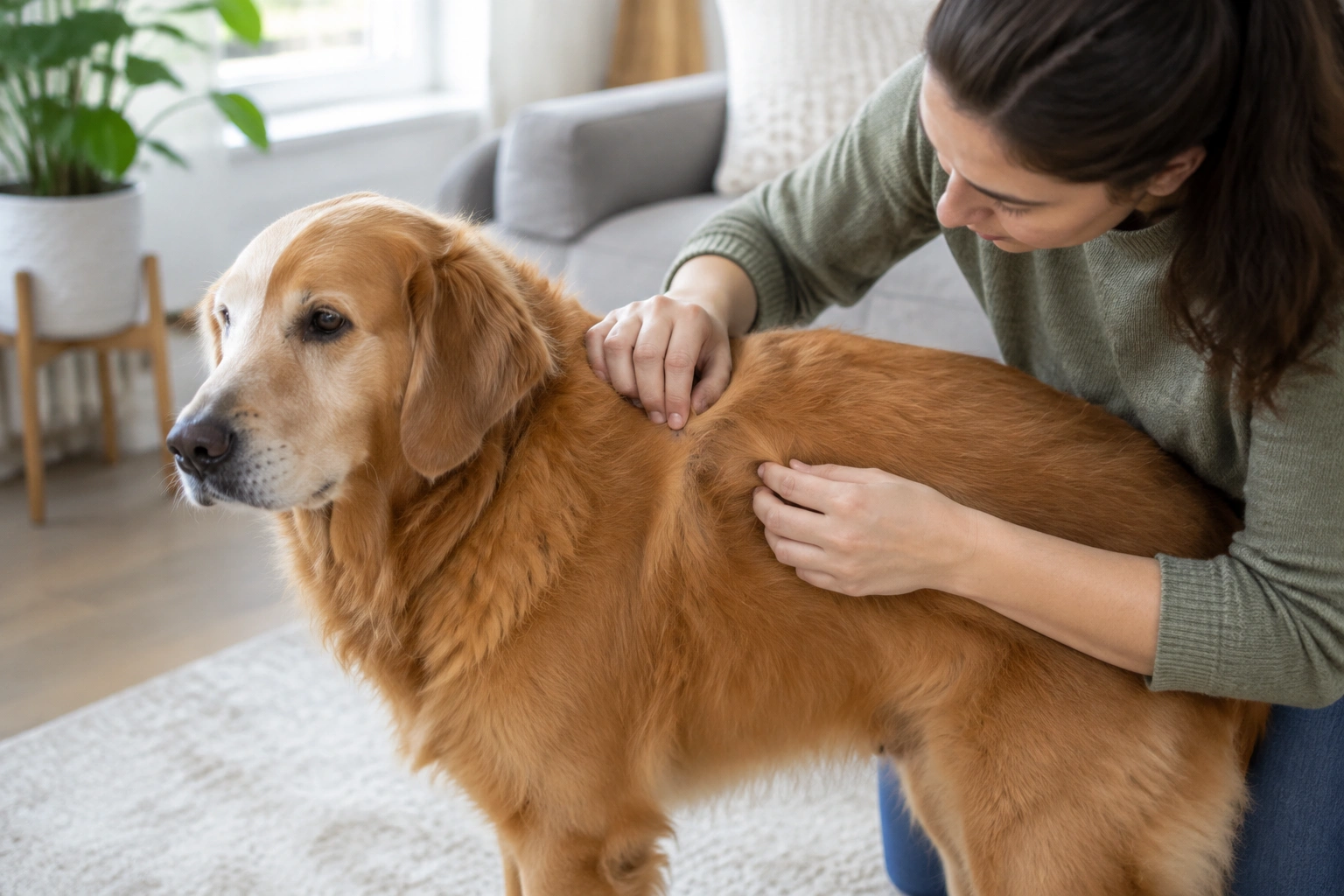
On a dog’s back, a bump might be a harmless skin lump, a cyst, a wart, a tick, an insect bite, an abscess, a skin infection, or a tumor. Some are superficial and easy to manage. Others sit deeper under the skin and need sampling to know what they are. Trauma or a retained foreign body can also cause a bump on a dog’s back. The job in the first 24 hours is to sort the bump into “monitor,” “book a vet visit,” or “go sooner.”
What a bump on your dog’s back could be
A back lump is a description, not a diagnosis. Location helps narrow the list, but it does not tell you the answer by itself.
Here are the most common categories to think through:
Soft tissue lumps
A lipoma is a fatty lump under the skin. These are often soft and movable. They can feel like a little pocket of dough under the skin, and many owners find them during petting or grooming.
Skin growths
A wart or other small skin growth can look rough, cauliflower-like, or just slightly raised. Some stay tiny and never bother the dog. Others rub, crack, or change over time.
Cysts
A sebaceous cyst can form when a gland overproduces fluid and creates a lump under the skin. These are common in dogs. If a cyst becomes infected, you may see heat, redness, or discharge.
Insect bites or ticks
A sudden bump after outdoor time may be an insect bite, a tick, or a localized reaction. These are often itchy or irritated rather than deeply fixed in place.
Abscesses and infections
A painful, warm, swollen bump can point to an abscess or skin infection. These may develop after a bite, scratch, puncture, or a foreign body. If they start draining, that is a strong sign the area needs veterinary attention.
Tumors
Some lumps are tumors, and not all tumors are malignant. The key is that you usually cannot tell by feel alone. A small lump can still be important if it is firm, fixed, or changing quickly.
One useful detail from veterinary sources: some growths that are common near the anus, called perianal adenomas, can also occur on the abdomen, on the back, and near the tail. They are benign growths common in older, unneutered male dogs. That is one reason a “back bump” should not be dismissed just because it looks like a skin tag or small nodule.
First, judge whether it seems urgent
The fastest way to make a good decision is to look for red flags. A bump that is rapidly growing, painful, hot, bleeding, oozing, ulcerated, or making your dog lethargic should be examined promptly.
A useful rule: if the lump is changing over hours to days, do not treat it like a stable skin tag.
Go to a veterinarian soon if the bump is:
- new and clearly enlarging
- firm or fixed under the skin
- painful to touch
- red, warm, or swollen
- draining fluid, pus, or blood
- ulcerated or open
- causing licking, scratching, or obvious discomfort
- accompanied by lethargy or reduced appetite
Seek urgent care if:
- the area is suddenly much larger
- your dog seems unwell overall
- there is active bleeding you cannot control
- the lump is very painful
- the skin is open and the tissue looks infected or damaged
A bump does not have to be huge to matter. Small masses can still be important, which is why vets often want a sample rather than a guess.
How benign lumps usually differ from concerning ones
You are not trying to diagnose the exact condition at home. You are trying to judge risk.
Soft and movable versus firm and fixed
A soft, movable lump is often less concerning than a firm mass that feels attached to deeper tissue. That said, “soft” does not equal “safe,” and “firm” does not automatically mean cancer.
Stable versus changing
A bump that has stayed the same size for months is more reassuring than one that changes noticeably over days or a few weeks. Change matters more than size alone.
Painless versus painful
A painless lump can still be serious, but pain raises concern for inflammation, infection, bite wounds, or an abscess. If your dog flinches, turns, or guards the spot, that changes the picture.
Smooth versus irritated
A smooth, skin-colored bump is different from one that is red, crusted, bleeding, or moist. Surface irritation often means the skin itself is involved.
One lump versus many
Multiple small bumps can happen with benign growths, but they can also appear with other skin issues. The pattern matters, not just the count.
Here is a quick comparison you can use while you inspect the spot:
| What it feels/looks like | More reassuring | More concerning |
|---|---|---|
| Texture | Soft, squishy, movable | Firm, fixed, irregular |
| Change | Stable for weeks or months | Growing quickly |
| Pain | Dog ignores it | Tender, warm, or painful |
| Skin surface | Normal skin | Red, crusted, bleeding, open |
| General health | Dog acts normal | Lethargy, low appetite, feverish behavior |
What to do in the first 24 to 48 hours
If the bump is not showing red flags, your next move is careful observation, not guessing.
Do this
- Check the bump once or twice a day.
- Note whether it is soft, firm, movable, or fixed.
- Look for redness, heat, discharge, or crusting.
- Watch whether your dog scratches, licks, or avoids being touched there.
- Compare the spot to the surrounding skin.
Do not do this
- Do not squeeze it.
- Do not pop it.
- Do not lance it.
- Do not apply human creams, antibiotics, or random home remedies.
- Do not assume it is “just a bite” if it keeps changing.
The reason to avoid squeezing or popping is simple: if the lump is a cyst, abscess, or tumor, you can make the area more inflamed, contaminate it, or delay a proper diagnosis.
For a dog that is otherwise normal and the bump looks minor, a short monitoring window can be reasonable. But observation stops being useful the moment the lump starts changing, becomes painful, or develops skin damage. If you are unsure in that first 24 to 48 hours, a veterinarian may advise either close monitoring or a same-day exam depending on your dog’s age, the lump’s location, and how quickly it is changing.
How to document the bump so changes are obvious
If you want a vet to assess the bump efficiently, bring them a baseline.
Take a clear photo in good light and include something for scale, such as a coin or ruler. Then write down:
- exact location on the back
- approximate size in millimeters or centimeters
- color
- shape
- texture
- whether it moves under the skin
- whether it seems painful
- whether it is itchy, hot, or draining
A simple note like “pea-sized, soft, movable, skin-colored, no pain” is much more useful than “small bump.”
If the lump changes, repeat the photo from the same angle. That makes growth easier to prove and helps the vet decide whether sampling is needed.
When to see a veterinarian
This is the point where many owners hesitate: “It’s small, so do I really need a vet?”
The answer is often yes if the lump is new, firm, fixed, unexplained, or changing. Size alone is not a reliable safety test. A small mass can still need sampling, especially if it has suspicious features. You also should not try to decide at home whether a lump is cancer or benign, because even small masses often need a sample to tell the difference.
Veterinarians commonly use a fine needle aspirate first. That means they use a thin needle to collect cells from the lump and look at them under a microscope. It is often the quickest way to get useful information without surgery.
If the sample is unclear or inconclusive, or if the vet needs more tissue to understand what the lump is, they may recommend a biopsy. That gives more tissue and often a more definitive answer.
This is why some vets recommend sampling even when the lump does not look dramatic. A small lesion can still be the wrong kind of small lesion.
If your dog is an active Border Collie, outdoor life can muddy the picture. Scrapes, burrs, insect bites, and minor trauma can all create a bump that looks alarming at first. The practical test is change: a minor irritation should settle, not enlarge or become more painful. If your dog spends a lot of time running through brush, swimming, or working in rough terrain, a “wait and see” approach should be shorter, not longer.
How veterinarians diagnose a back lump
The usual diagnostic path is straightforward:
1. Physical exam
The vet will feel the lump and check whether it is attached to the skin or deeper tissue. They may also look for other masses, because one visible bump is not always the only one present.
2. Fine needle aspirate
This is often the first test. It is quick, commonly done in the clinic, and can help distinguish fat, inflammation, infection, and some tumor types. Sometimes the sample does not provide a clear answer, especially if the lump is very firm, mostly fluid-filled, inflamed, or made of tissue that does not aspirate well.
3. Biopsy if needed
If the aspirate does not give a clear answer, or if the lump has concerning features, a biopsy may be recommended. A biopsy is used when more tissue is needed to make a better diagnosis.
4. Additional testing if indicated
Depending on what the lump looks like, the vet may suggest imaging or other tests. That usually happens when the mass seems deeper, more complex, or more suspicious.
The point of testing is not to “overreact.” It is to avoid guessing. Guessing is what lets important lumps sit too long.
What treatment depends on the cause
Treatment follows the diagnosis, not the appearance.
Common possibilities
- Lipoma: often monitored if it is not bothering the dog
- Cyst: may be monitored, drained, or removed if infected or recurrent
- Wart or benign skin growth: may be watched or removed if it rubs, bleeds, or changes
- Abscess or infection: often needs veterinary treatment, which may include antibiotics or drainage
- Inflammatory swelling or bite reaction: may settle with time or need medication
- Tumor: may need surgical removal and further testing, or monitoring in selected cases
The key trade-off is this: a simple benign lump may only need monitoring, but a suspicious lump is worth sampling early because delay can make treatment more complicated later.
Common mistakes to avoid
Most problems with back bumps come from either waiting too long or trying to fix the wrong thing at home.
Avoid these mistakes:
– assuming a painless lump is harmless
– waiting weeks while it keeps growing
– squeezing or popping it
– putting on human ointments
– treating every bump like an emergency
– treating every bump like nothing
If you remember only one thing, make it this: change is the clue that matters most. A stable lump is one conversation. A changing lump is a different one.
FAQ: a bump on my dog’s back
Is a bump on my dog’s back always cancer?
No. Many bumps are benign, including cysts, lipomas, warts, and other skin growths. But you usually cannot confirm that by looking alone.
Should I wait if the bump does not seem to bother my dog?
Only briefly, and only if it is small, soft, and stable. If it is new, firm, fixed, or changing, book a vet visit.
Can I tell by touch whether it is a lipoma?
Sometimes a lipoma feels soft and movable, but touch is not reliable enough to diagnose it. A fine needle aspirate is often the better next step.
What if the bump is red and warm?
That raises concern for inflammation or infection. If there is pain, discharge, or swelling, get veterinary advice sooner.
How often should I check it?
Check it daily for the first couple of days, then compare it every few days if your vet says monitoring is reasonable. Use photos and measurements so you are not relying on memory.
Can a tiny bump still matter?
Yes. Small size does not rule out a problem. New or changing masses deserve attention even when they look minor.
The practical next step
If the bump is soft, small, and unchanged, document it carefully and keep a close eye on it. If it is firm, fixed, painful, hot, draining, or growing, schedule a veterinary exam rather than trying to figure it out at home. When in doubt, a quick check and a simple sample often save time, worry, and guesswork.
