
What Is the Best Shampoo for a Border Collie?

Quick Answer
For most Border Collies, the best shampoo is a gentle, pH-balanced dog shampoo that cleans the dense double coat without stripping the skin. I prefer mild formulas with simple ingredients, easy rinsing, and little fragrance, which also matches AKC guidance on choosing dog shampoo.
What to choose
- Normal skin: Choose a mild everyday dog shampoo with gentle cleansing ingredients.
- Dry coat: Look for moisturizing ingredients such as oatmeal, aloe, glycerin, or conditioning agents.
- Sensitive skin: Choose a fragrance-free or lightly scented hypoallergenic dog formula.
- Heavy shedding: Use a gentle deshedding shampoo only as part of brushing and coat care.
- Skin problems: Ask your veterinarian before using medicated, antifungal, or antibacterial shampoo.
My main rule
- Use shampoo made for dogs, rinse the undercoat thoroughly, and dry the coat completely.
Border Collies can collect an impressive amount of mud without looking dirty from a distance. Once you push your fingers through that dense coat, though, you often find dust, loose undercoat, and dried dirt hiding near the skin.
I use a different approach for Border Collies than I would for a short, single-coated dog. This guide explains which shampoo types work best, what ingredients matter, how often to bathe, and when a skin problem needs veterinary attention.
In This Guide
- What shampoo is best for a Border Collie?
- Why does a Border Collie’s double coat change shampoo choice?
- What ingredients should you look for?
- Which shampoos should you avoid?
- Which shampoo type fits your Border Collie’s needs?
- How often should you shampoo a Border Collie?
- How do you wash a Border Collie’s double coat properly?
- Does a Border Collie need conditioner or deshedding shampoo?
- When should a skin problem go to the vet?
- Frequently asked questions
- Final takeaway
What shampoo is best for a Border Collie?
The best general-purpose shampoo for a healthy Border Collie is a gentle, dog-specific, pH-balanced cleansing shampoo. It should remove dirt while rinsing easily from the thick undercoat.
There isn’t one bottle that suits every Border Collie. Skin condition matters more than the breed name printed on a label.
- Healthy skin and coat: Use a mild moisturizing dog shampoo.
- Dry or flaky skin: Consider oatmeal or another moisturizing formula.
- Easily irritated skin: Try a hypoallergenic, fragrance-free option.
- Heavy seasonal shedding: Combine gentle shampoo with thorough brushing.
- Recurring itching or odor: Get veterinary advice before changing shampoos repeatedly.
As of 2026, veterinary-reviewed shampoo guidance continues to emphasize choosing products formulated for dogs and matching the formula to the dog’s skin and coat needs. Stronger isn’t automatically better.
With my own Border Collie grooming routine, rinsing matters almost as much as the shampoo. A beautiful formula doesn’t help if residue stays trapped beneath the outer coat.
Section Takeaway: Start with a mild dog shampoo unless your Border Collie’s skin gives you a specific reason to choose something else.
Why does a Border Collie’s double coat change shampoo choice?
Border Collies have a weather-resistant double coat. That means shampoo must travel through the outer coat, reach the skin, and rinse back out without leaving buildup.
Definition: A Border Collie’s double coat has a protective outer layer of guard hairs and a softer, denser undercoat beneath it.
The breed has both rough and smooth coat varieties. Both are double-coated, even though a smooth-coated Border Collie can look much less fluffy.
The AKC’s double-coat grooming guidance identifies the Border Collie as a medium double-coated breed. Regular brushing helps prevent loose undercoat from packing together.
- Rough coats: Longer feathering can trap shampoo and moisture more easily.
- Smooth coats: Rinse faster but still have dense undercoat beneath the topcoat.
- Shedding coats: Loose undercoat should be brushed out before and after bathing.
This is why I don’t choose Border Collie shampoo mainly by scent. I care more about how easily it distributes, how gently it cleans, and how completely it rinses.
What ingredients should you look for in Border Collie shampoo?
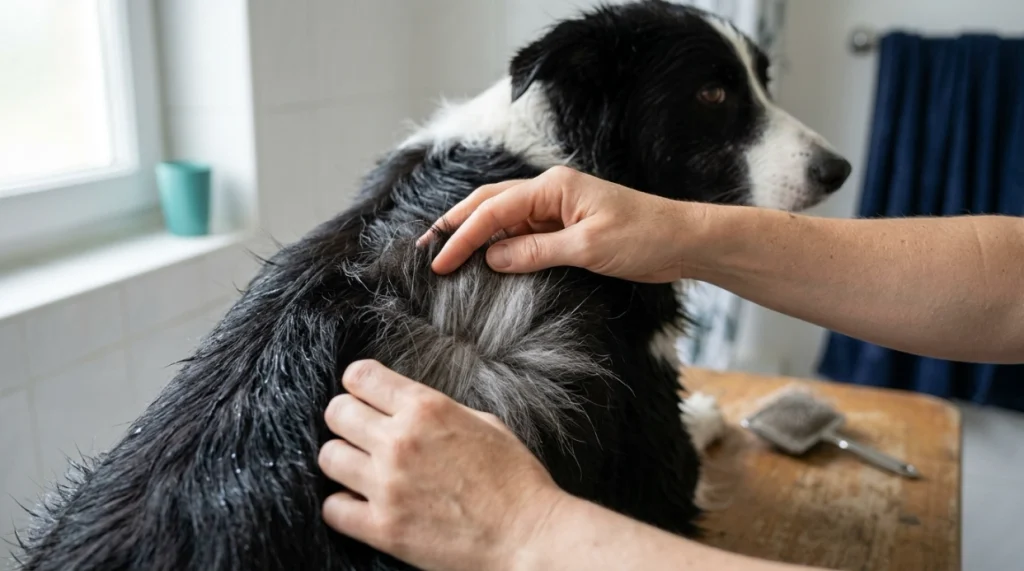
Look for ingredients that match your dog’s actual skin condition. A normal, healthy coat usually needs fewer special ingredients than an itchy or dry one.
Gentle cleansing agents
A shampoo still needs enough cleansing power to remove mud, grease, and environmental debris. The goal is cleaning without leaving the skin feeling stripped or tight.
Oatmeal and moisturizing ingredients
Oatmeal formulas are popular for dogs with dry or mildly uncomfortable skin. Aloe, glycerin, and conditioning ingredients can also help maintain a softer feel.
Low fragrance or fragrance-free formulas
I usually favor lighter fragrance, especially for dogs that have reacted to grooming products before. Heavy perfume isn’t necessary for getting a Border Collie clean.
- Dog-specific formulation
- Easy-rinsing texture
- Moisturizing ingredients when needed
- Clear ingredient labeling
- Fragrance level your dog tolerates
Don’t treat a long ingredient list as proof of quality. The right formula is the one that cleans well without causing dryness, redness, or repeated scratching.
Which shampoos should you avoid on a Border Collie?
Avoid using ordinary human shampoo as your regular Border Collie shampoo. Human and dog skin have different needs, so products designed for people aren’t the best routine choice.
PetMD’s veterinary guidance also advises against routine use of human shampoo and explains why dog-specific shampoo is preferred.
- Human shampoo: Not designed around canine skin and coat requirements.
- Dish detergent: Too harsh for normal, repeated bathing.
- Strong perfume: Unnecessary for cleaning and may not suit sensitive dogs.
- Medicated shampoo: Don’t choose one simply because your dog scratches occasionally.
- Unclear essential-oil blends: Use only products specifically formulated and labeled for dogs.
Flea and tick shampoos also shouldn’t become an automatic everyday shampoo. Choose parasite-control products according to veterinary guidance and their label directions.
Vet note: Persistent redness, sores, hair loss, strong odor, or intense itching needs veterinary evaluation rather than repeated shampoo experiments.
Which shampoo type fits your Border Collie’s needs?
Match the shampoo to the problem you’re trying to solve. Most healthy Border Collies don’t need a medicated or highly specialized formula.
| Border Collie need | Best shampoo type | What to look for | Main caution |
|---|---|---|---|
| Normal skin | Gentle everyday dog shampoo | Mild cleansing, easy rinsing | Avoid unnecessary strong fragrance |
| Dry or flaky coat | Moisturizing or oatmeal shampoo | Oatmeal, aloe, glycerin | Ongoing flakes may have another cause |
| Sensitive skin | Hypoallergenic formula | Simple formula, low fragrance | Stop if irritation appears |
| Heavy shedding | Gentle deshedding shampoo | Conditioning, coat slip | Doesn’t replace brushing |
| Diagnosed skin condition | Veterinary medicated shampoo | Ingredients chosen for diagnosis | Follow veterinary directions |
PetMD’s 2026 veterinary-reviewed guide to choosing dog shampoos for different needs follows the same basic principle. The best choice depends on the dog’s skin, coat, and reason for bathing.
How often should you shampoo a Border Collie?
There is no single bathing schedule that fits every Border Collie. Activity, mud, swimming, climate, coat condition, and skin health all change the answer.
For a healthy companion Border Collie, I use roughly every four to eight weeks as a practical starting range. I bathe sooner when the dog is dirty, greasy, or has rolled in something unpleasant.
- Mostly indoors: Baths can usually be spaced farther apart.
- Farm or working dog: Mud and livestock environments may require more frequent cleaning.
- Frequent swimmer: Rinsing after dirty, salty, or treated water can be useful.
- Skin condition: Follow the bathing frequency given by your veterinarian.
The ASPCA’s dog grooming guidance notes that bathing needs vary and that outdoor dogs or dogs with skin problems may require more frequent baths.
Don’t confuse shedding with dirtiness. During a coat blow, extra brushing often helps more than adding another bath every few days.
How do you wash a Border Collie’s double coat properly?
Brush before you turn on the water. Removing loose undercoat first makes it easier for water and shampoo to reach the skin.
- Brush thoroughly. Work out loose hair, small tangles, and debris before soaking the coat.
- Use lukewarm water. Wet the coat down to the skin rather than spraying only the top layer.
- Apply shampoo evenly. Work in sections so the product reaches through the double coat.
- Massage gently. Don’t aggressively scrub or tangle long feathering.
- Rinse longer than expected. Keep rinsing until water runs clean and the coat no longer feels slippery.
- Towel press the coat. Blot and squeeze moisture rather than rubbing roughly.
- Dry completely. Pay attention to the dense undercoat, especially in humid weather.
My biggest practical mistake with a young Border Collie was assuming the coat was dry because the surface felt dry. When I parted the fur, the undercoat was still damp near the shoulders and hindquarters.
Since then, I check the coat at skin level before calling bath time finished. Thick double coats can hide moisture surprisingly well.
Does a Border Collie need conditioner or deshedding shampoo?
Conditioner isn’t mandatory for every Border Collie. It can be useful when the coat feels dry, tangles easily, or has longer rough-coated feathering.
- Rough-coated dogs: A light conditioner can improve slip through longer hair.
- Dry coats: Conditioning may reduce the brittle feeling that follows cleansing.
- Heavy shedding: Deshedding formulas may loosen dead undercoat during grooming.
- Normal smooth coats: A separate conditioner may offer little benefit.
Don’t expect a deshedding shampoo to stop normal Border Collie shedding. The most useful tools remain regular brushing, undercoat removal, good nutrition, and normal coat maintenance.
Also avoid shaving the double coat simply to control shedding. The outer and inner layers have protective functions that are worth preserving.
When should a Border Collie’s skin problem go to the vet?
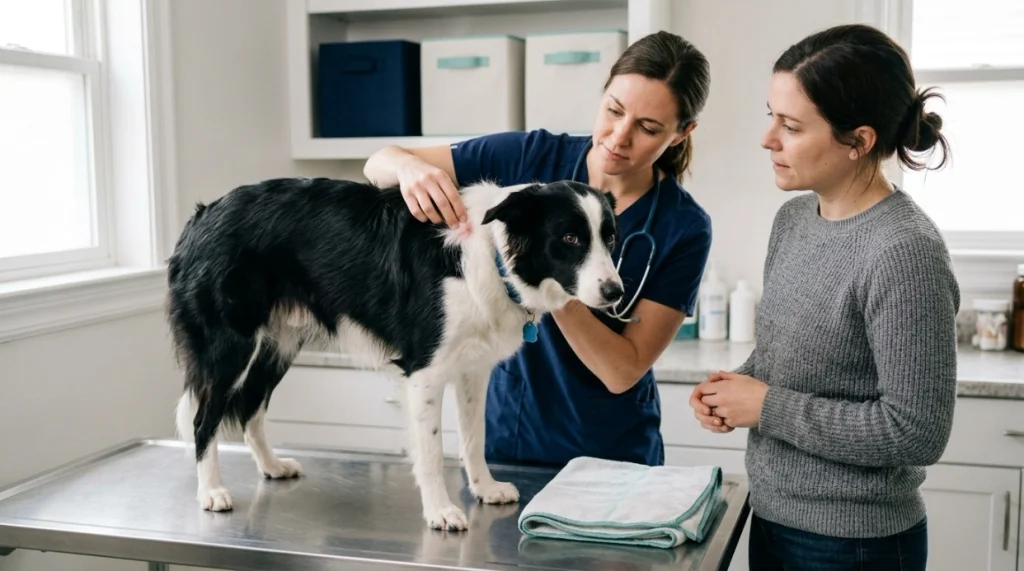
Shampoo can clean skin and support coat care, but it cannot diagnose the cause of persistent irritation. Repeatedly switching products can also make it harder to identify what is happening.
- Persistent or intense scratching
- Red or inflamed skin
- Open sores, scabs, or moist patches
- Unusual hair loss
- Strong or recurring skin odor
- Repeated ear or paw irritation alongside itching
- Symptoms that worsen after bathing
A veterinarian may recommend a medicated shampoo when there is a diagnosed bacterial, fungal, allergic, or other dermatological problem. Those products often have specific application and contact-time instructions.
Vet note: If itching, redness, odor, hair loss, or sores keep returning, speak with your veterinarian instead of relying on over-the-counter shampoo alone.
Frequently Asked Questions
Can I use oatmeal shampoo on a Border Collie?
Yes, a dog-specific oatmeal shampoo can be a good option for a Border Collie with dry or mildly sensitive skin. Choose a gentle formula and stop using it if your dog becomes redder or itchier afterward.
Can I use human shampoo on my Border Collie?
Human shampoo isn’t recommended for routine Border Collie bathing. Use a shampoo formulated for dogs because canine skin and coat requirements differ from ours.
What is the best shampoo for a Border Collie puppy?
Choose a mild shampoo specifically labeled as suitable for puppies. Keep bath sessions short, use lukewarm water, protect the eyes and ears, rinse thoroughly, and keep the puppy warm while drying.
What shampoo is best for a Border Collie that sheds a lot?
A gentle deshedding shampoo may help loosen dead undercoat during seasonal shedding. It won’t stop normal shedding, so combine bathing with frequent brushing and appropriate undercoat grooming.
What shampoo is best for an itchy Border Collie?
For mild dryness, a fragrance-free moisturizing or oatmeal dog shampoo may help. Persistent itching can have many causes, so ongoing symptoms should be evaluated by a veterinarian before you use medicated shampoo.
Should I use shampoo every time my Border Collie gets muddy?
Not necessarily. Light surface mud can often be rinsed with water, dried, and brushed out without doing a full shampoo bath each time.
Do rough and smooth Border Collies need different shampoos?
Usually they can use the same gentle dog shampoo if their skin is healthy. Rough coats may benefit more from conditioning because longer feathering can tangle and retain moisture more easily.
Final Takeaway: Choosing the Best Border Collie Shampoo
For most Border Collies, keep shampoo selection simple. Choose a gentle dog-specific formula, match it to the dog’s skin condition, and focus on thorough rinsing and drying.
A healthy double coat doesn’t need aggressive cleaning. Regular brushing, sensible bathing, and quick attention to persistent skin changes will do far more for your Border Collie’s coat than chasing the strongest or most heavily scented shampoo.
