
Border Collie Feeding Chart: How Much to Feed by Age, Weight, and Activity

Border Collies are not a “feed the bag and forget it” breed. Their needs swing with age, workload, and even the difference between a relaxed pet and a dog doing daily herding or agility. A useful feeding plan has to be practical enough to follow, but flexible enough to adjust when your dog’s body changes.
This guide gives you a working border collie feeding chart, then shows you how to use it without getting trapped by cup counts alone. You’ll see how to think in calories, how to split meals, and how to tell when your Border Collie needs more—or less—food.
Border Collie Feeding Chart by Age, Weight, and Activity Level
Use this chart as a starting point, not a rigid rulebook. The cup ranges below assume a kibble density of about 350 kcal per cup. If your food is more or less calorie-dense, the cup amount will change even when the calories stay the same.
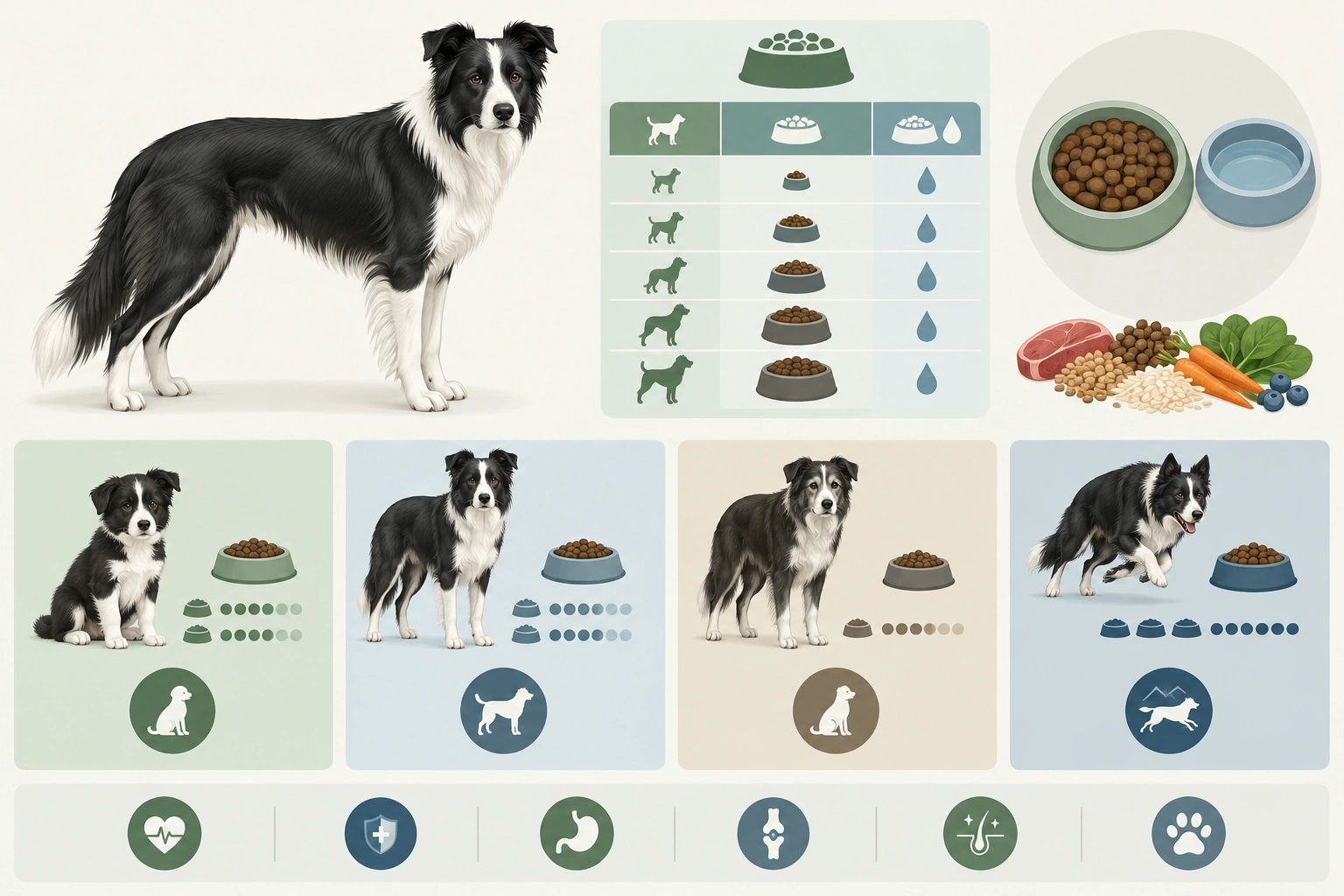
| Life stage | Weight / activity | Approx. daily calories | Approx. cups/day at 350 kcal/cup | Meals per day | Notes |
|---|---|---|---|---|---|
| Puppy, 8–12 weeks | 6–10 lb, moderate growth | 500–700 kcal | 1.4–2.0 cups | 3–4 | Frequent meals help support growth and reduce stomach overload |
| Puppy, 8–12 weeks | 10–15 lb, larger / more active puppy | 700–900 kcal | 2.0–2.6 cups | 3–4 | Keep the puppy lean; adjust based on body condition and stool quality |
| Puppy, 3–6 months | 12–20 lb, moderate activity | 600–900 kcal | 1.7–2.6 cups | 3 | Many puppies stay on 3 meals until appetite and growth become steadier |
| Puppy, 3–6 months | 20–30 lb, higher activity | 900–1,150 kcal | 2.6–3.3 cups | 3 | If growth is rapid, use the lower end of the range first |
| Puppy, 6–12 months | 25–35 lb, moderate activity | 850–1,150 kcal | 2.4–3.3 cups | 2–3 | Many dogs can move to 2 meals near the end of this stage |
| Adult, low activity | 30–35 lb | 650–850 kcal | 1.9–2.4 cups | 2 | Best for pets with modest daily exercise |
| Adult, low activity | 35–45 lb | 750–1,000 kcal | 2.1–2.9 cups | 2 | Use the lower end if the dog is neutered or gains weight easily |
| Adult, moderate activity | 30–35 lb | 850–1,050 kcal | 2.4–3.0 cups | 2 | Common range for active pet Border Collies |
| Adult, moderate activity | 35–45 lb | 1,000–1,250 kcal | 2.9–3.6 cups | 2 | Increase only if body condition or weight trend shows the need |
| Adult, high activity / working | 30–35 lb | 1,150–1,450 kcal | 3.3–4.1 cups | 2–3 | Herding, agility, long hikes, or daily training can raise needs |
| Adult, high activity / working | 35–45 lb | 1,350–1,700 kcal | 3.9–4.9 cups | 2–3 | Some working dogs need more frequent meals to hold condition |
| Senior, lower activity | 30–35 lb | 600–800 kcal | 1.7–2.3 cups | 2 | Watch for muscle loss as well as fat gain |
| Senior, lower activity | 35–45 lb | 700–950 kcal | 2.0–2.7 cups | 2 | Older dogs may need fewer calories, but not always less protein |
A few important notes about the table:
- Adult Border Collies often fall around 30–45 lb, but your dog may be outside that range and still be perfectly healthy.
- Working dogs can need more food than pet dogs, because their energy output is higher.
- Puppies should not be fed like small adults. They need more frequent meals and a growth-focused diet.
- If your food is not close to 350 kcal per cup, use the calorie target first and convert from there.
If you want a quick reality check, Purina’s adult dog chart gives a general reference point: dogs in the 21 to 35 lb range often eat 1⅓ to 2 cups per day, while 26 to 50 lb dogs often eat 2 to 2⅔ cups per day depending on the food and dog. That’s a useful baseline for many adult Border Collies, but not a universal answer. Purina’s feeding chart is a good reminder that package guidance is only the starting point.
How to Read the Chart: Calories, Cups, and Why Brand Labels Vary
Cup measurements are convenient, but calories are what actually drive weight gain, weight loss, and energy. Two dry foods can both recommend “2 cups a day” and still deliver very different calorie totals.
That’s why the feeding chart on the bag matters. Purina specifically notes that once you choose a complete and balanced food, the chart on the package helps determine how much to feed. In practice, that means you should:
- Check the food’s calories per cup or per can.
- Match that to your dog’s age and activity.
- Adjust after 2–3 weeks based on body condition and weight trend.
How to convert calories to cups
Use this formula:
daily calories ÷ calories per cup = cups per day
For example:
- 350 kcal/cup food
- 1,050 kcal needed per day
- 1,050 ÷ 350 = 3 cups per day
Worked example 1: low-activity pet Border Collie
A 40 lb low-activity Border Collie may need about 800 kcal per day.
If the kibble has 350 kcal per cup:
- 800 ÷ 350 = 2.3 cups per day
A practical feeding plan would be about 2¼ cups daily, split into 2 meals.
Worked example 2: highly active or working Border Collie
A 40 lb highly active Border Collie may need about 1,500 kcal per day.
If the kibble has 350 kcal per cup:
- 1,500 ÷ 350 = 4.3 cups per day
A practical feeding plan would be about 4 to 4¼ cups daily, usually split into 2 or 3 meals.
A Border Collie eating a calorie-dense performance kibble may need fewer cups than a dog eating a lower-calorie maintenance food. Wet food, fresh food, and raw diets create even bigger differences because volume, moisture, and calorie density are not the same.
For raw feeding, one source commonly used by raw-feeding owners suggests adult Border Collies may eat about 2–3% of their ideal body weight per day, with highly active dogs needing more and dogs needing weight loss sometimes fed closer to 2%. Puppies are described there as needing much more at first—around 8–10% of body weight at 8 weeks, tapering toward adult levels as they mature. That is a raw-feeding framework, not a universal rule for all dogs, but it shows why life stage matters so much. Border Collie raw feeding guidance
How Much to Feed a Border Collie Puppy
Puppies need more than adult dogs because they are building bone, muscle, and organs at the same time. They also have smaller stomachs, which is why one or two large meals is usually the wrong setup.
Puppy feeding schedule by age
- 8 to 12 weeks: 3 to 4 meals a day
- 3 to 6 months: usually 3 meals a day
- 6 to 12 months: 2 to 3 meals a day, depending on growth and appetite
Puppy feeding chart by weight and age
Use the table below as a practical starting point for a Border Collie puppy eating kibble around 350 kcal per cup.
| Puppy age | Puppy weight | Approx. daily calories | Approx. cups/day |
|---|---|---|---|
| 8–12 weeks | 6–10 lb | 500–700 kcal | 1.4–2.0 cups |
| 8–12 weeks | 10–15 lb | 700–900 kcal | 2.0–2.6 cups |
| 3–6 months | 12–20 lb | 600–900 kcal | 1.7–2.6 cups |
| 3–6 months | 20–30 lb | 900–1,150 kcal | 2.6–3.3 cups |
| 6–12 months | 25–35 lb | 850–1,150 kcal | 2.4–3.3 cups |
A Border Collie puppy should look lean, not chunky. You want steady growth, not rapid weight gain. If your puppy is finishing every meal instantly and still acting hungry, that alone does not always mean the portions are too small. Many puppies are enthusiastic eaters. The better check is body shape and growth trend.
Practical puppy adjustment rule
Increase food if:
– ribs are becoming easy to see,
– the puppy is losing weight or stalling on growth,
– energy is dropping,
– stools are normal and the puppy still seems hungry after meals.
Reduce slightly if:
– the waist disappears,
– fat pads start covering the ribs,
– growth is outpacing coordination,
– stools become too soft after larger meals.
For puppies, small changes are easier to evaluate than big ones. A 5–10% adjustment is usually enough to see whether the current amount is moving in the right direction.
When to move from puppy food to adult food
For Border Collies, the switch usually makes sense when growth is slowing and the dog is nearing adult size, often somewhere in the 10–12 month range. Some bigger or slower-maturing dogs may need a little longer, so the best cue is body size and your vet’s guidance rather than age alone. Transition over about 7 to 10 days so the stomach has time to adjust.
How Much to Feed an Adult Border Collie
Most adult Border Collies do well on two meals per day. That routine is simple, helps avoid huge single meals, and is easier to balance with training.
For a typical pet Border Collie around 30–40 lb, a common dry-food starting point is roughly 1⅓ to 2 cups per day for the lower end of activity, or about 1¾ to 2½ cups per day for a more active dog. Those are starting ranges, not fixed targets.
Adult feeding chart by weight and activity
Use this table if you want a more direct calorie-based starting point for an adult Border Collie eating kibble around 350 kcal per cup.
| Adult weight | Low activity | Moderate activity | High activity / working |
|---|---|---|---|
| 30–35 lb | 650–850 kcal / 1.9–2.4 cups | 850–1,050 kcal / 2.4–3.0 cups | 1,150–1,450 kcal / 3.3–4.1 cups |
| 35–45 lb | 750–1,000 kcal / 2.1–2.9 cups | 1,000–1,250 kcal / 2.9–3.6 cups | 1,350–1,700 kcal / 3.9–4.9 cups |
What changes adult portions
- Activity level: A dog that hikes, trains, or herds daily may need more calories than a relaxed pet.
- Neuter status: Some neutered dogs need fewer calories than intact dogs, though this varies.
- Metabolism: Border Collies can be surprisingly efficient or surprisingly hard to keep on weight.
- Food density: One kibble may be 350 kcal per cup; another may be much higher or lower.
If your adult Border Collie is maintaining a healthy body condition, eating willingly, and has stable energy, the portion is probably close. If you are constantly adjusting because weight keeps drifting, the issue is usually not willpower—it’s that the current food amount doesn’t match the dog’s real output.
How Much to Feed a Senior Border Collie
Senior feeding is less about “less food” and more about “the right amount for the body you have now.” Some older Border Collies move less and need fewer calories. Others slow down a bit but still burn enough energy that cutting food too sharply causes muscle loss.
A senior Border Collie often does best with:
- slightly smaller portions if activity has dropped,
- enough protein to help preserve muscle,
- close monitoring of weight every 2–4 weeks.
Senior feeding chart by weight and activity
| Senior weight | Lower activity | Approx. daily calories | Approx. cups/day at 350 kcal/cup |
|---|---|---|---|
| 30–35 lb | low activity | 600–800 kcal | 1.7–2.3 cups |
| 35–45 lb | low activity | 700–950 kcal | 2.0–2.7 cups |
If your senior dog is getting softer around the middle, reduce calories gradually. If the dog looks thinner over the hips or shoulders, don’t assume age alone is to blame. Older dogs can lose muscle even when they still seem eager at mealtimes.
Adjusting for Pet vs Working Border Collies
This is where many feeding mistakes happen. A family pet and a dog working livestock every day are not eating for the same job.
Lower-activity pet Border Collie
A pet Border Collie may need the lower end of the adult range, especially if daily exercise is limited to walks and some play. These dogs can gain weight quickly if treats are generous.
Highly active or working Border Collie
A working dog may need more calories than a pet dog eating the same food. Herding, agility, long runs, and full training days all increase calories burned. Some dogs also need more frequent meals if they struggle to keep weight on with just two feedings.
The best decision rule is simple: increase food only when body condition and weight trend show the current amount is not enough. Don’t guess based on how energetic the dog seems. Border Collies can look tireless even when they’re already eating enough—or too much.
How Often to Feed a Border Collie
Meal frequency is mostly about age and digestion.
2 meals per day
Best for most adult Border Collies. It’s simple, stable, and easy to pair with training.
3 meals per day
Useful for younger puppies, very active dogs, or dogs that seem too hungry on two meals.
4 meals per day
Best for very young puppies or dogs that need smaller portions spread out to avoid digestive upset.
A practical sample schedule:
- Puppy: 7 a.m., 12 p.m., 5 p.m., 9 p.m.
- Adult: 7 a.m. and 6 p.m.
- Working dog needing more total food: 6 a.m., 12 p.m., 6 p.m.
If you feed around exercise, keep the meal timing sensible. A very large meal right before hard activity is a bad idea; it is easier on the dog to separate major meals from intense work.
Treats, Training Rewards, and Toppers: How to Budget Them
Treats are part of the diet, not a bonus category. A practical target is to keep treats and toppers to no more than about 10% of daily calories. On heavy training days, use less from the bowl if rewards are going up.
For example:
– a dog eating 1,000 kcal per day should usually keep treats around 100 kcal or less,
– a dog eating 1,500 kcal per day should usually keep treats around 150 kcal or less.
If you use a lot of training rewards, reduce the main meal portion so the total daily calories stay on target. A simple way to do that is to subtract the treat calories from the meal calories:
- 1,000 kcal daily target
- 100 kcal in treats
- 900 kcal left for meals
Good ways to control this:
– use part of the dog’s normal kibble as training rewards,
– reserve higher-value treats for short training sessions,
– measure toppers instead of pouring them freely.
If your Border Collie gets excited for food and training, that can make life easier—but only if you budget the calories.
How to Tell if Your Border Collie Is Underfed or Overfed
Body condition beats the scale alone.
Simple body condition score reference
A Border Collie is usually in ideal condition around a 4 to 5 on a 9-point body condition score.
Ideal-weight checklist
Your dog is probably close to ideal if you can:
– feel the ribs easily with light pressure, but not see them sharply,
– see a visible waist from above,
– notice a tummy tuck from the side,
– move the dog’s weight without a thick layer of fat over the ribs and spine.
Signs your Border Collie may be underfed
- ribs, spine, or hip bones are too prominent,
- waist is extreme,
- muscle seems to be dropping,
- energy is low,
- weight keeps falling despite normal feeding.
Signs your Border Collie may be overfed
- you can’t feel the ribs easily under light pressure,
- the waist is hard to see,
- the belly looks rounder from the side,
- movement seems stiff or heavy,
- weight keeps creeping up.
A healthy Border Collie should feel lean and athletic, with ribs easy to feel but not sharply visible. If you’re unsure, take photos from above and from the side every couple of weeks. Small changes are easier to spot in pictures than in daily life.
Choosing the Right Food Type: Kibble, Wet, Fresh, or Raw
There is no single “best” format for every Border Collie. What matters is whether you can feed it consistently and accurately.
Kibble
Best for convenience and portion control. Easy to measure, easy to store, and usually the simplest way to track calories. If the kibble is around 350 kcal per cup, it is straightforward to convert calories to cups.
Wet food
Often more palatable and useful for picky eaters, but it can be harder to portion by eye because moisture content is high. Use the can or pouch calorie label, not the volume alone, because a cup of wet food is not equivalent to a cup of kibble.
Fresh or home-prepared diets
Can work well if they are complete and balanced, but they require more planning and consistency. Portion by calories or by a vet-formulated recipe rather than by appearance.
Raw
Some owners prefer raw feeding for personal reasons. If you go this route, the portion math is different. The raw-feeding guidance above uses body-weight percentages, which is simpler than cup counting, but it still requires careful monitoring and a balanced recipe.
How to swap between food types without overfeeding
- Kibble to wet food: compare calories, not cups. Wet food usually takes more volume for the same calories.
- Kibble to fresh food: use the calorie target from the recipe or label, then weigh the food if possible.
- Kibble to raw: use the raw diet’s gram or ounce guidance, then check body condition weekly at first.
The main trade-off is this: kibble is easiest to measure, while wet, fresh, and raw diets often need more careful conversion and more attention to calories.
When to Switch from Puppy to Adult Food, and Adult to Senior Food
Switch food based on life stage, not just convenience.
Puppy to adult
Move when growth is slowing and the dog is nearing adult size, often around 10 to 12 months for Border Collies. Transition over about 7 to 10 days so the stomach has time to adjust.
Adult to senior
There is no universal birthday that forces a switch. If your older Border Collie is slowing down, gaining weight, or losing muscle, that is the signal to review the diet. Some senior dogs stay on adult food if it still suits their body and activity.
When changing foods, keep the total calories as stable as possible during the transition. If you switch food and reduce portions at the same time, it becomes hard to tell what caused the change in appetite or stool quality.
When to Ask Your Veterinarian
Ask your veterinarian if your Border Collie:
– is not gaining properly as a puppy,
– is losing weight without a clear reason,
– seems hungry all the time but still loses condition,
– has persistent loose stools or vomiting,
– needs unusually high food amounts to maintain weight,
– is a senior with noticeable muscle loss.
That’s especially important if your dog’s appetite changes suddenly. Feeding adjustments can solve a lot, but not every weight problem is a portion problem.
FAQs
How many cups should I feed my Border Collie?
For many adult Border Collies, a starting point is around 1⅓ to 2½ cups of dry food per day, depending on body weight and activity. Check the food’s calorie density, because cups vary by brand.
Should I feed my Border Collie once or twice a day?
Twice a day is the usual choice for adults. Puppies need more frequent meals, often 3 to 4 per day.
Does a working Border Collie need more food?
Usually yes. Herding, agility, long runs, and other sustained work can raise calorie needs above a pet dog’s intake.
When should I switch from puppy food to adult food?
For Border Collies, the switch is often around 10 to 12 months, once growth slows. Make the change gradually over 7 to 10 days.
Are treats okay every day?
Yes, but they should come from the same calorie budget as the rest of the diet. A good target is to keep treats to about 10% of daily calories or less.
Is raw feeding better for Border Collies?
Not automatically. Raw feeding can work for some owners, but it needs careful planning and balanced nutrition. Kibble is often easier to measure and manage consistently.
How do I know if I’m feeding too much?
If your Border Collie is losing its waist, becoming harder to feel over the ribs, or gaining weight steadily, the current portions are probably too high.
How do I know if I’m feeding too little?
Visible ribs, dropping weight, low energy, or a dog that seems unable to maintain condition on a normal feeding plan are common warning signs.
Should I follow the food bag chart or a breed chart?
Use both. The bag chart gives the food-specific baseline, and a breed-specific guide helps you adjust for Border Collie activity and body type.
What if my Border Collie is always hungry?
First check the body condition. Some dogs act hungry even when they’re well fed. If weight is stable and the dog looks lean but healthy, the appetite may be normal. If weight is falling or stool quality is poor, talk to your vet.
Should Border Collies eat grain-free food?
Not automatically. Choose a complete and balanced diet that suits your dog’s needs. If you’re unsure, ask your vet rather than choosing based on trend alone.
A Border Collie feeding plan works best when you treat the chart as a starting point, then fine-tune it with your eyes, hands, and the scale. That is usually how you land on the right amount—not by guessing, and not by following one number forever.
