
Border Collie Food Amount by Weight: A Practical Feeding Guide

If you want a usable starting point for feeding a Border Collie, body weight is the best place to begin. It gives you a baseline, but it is not the whole answer. Age, activity level, body condition, and the calorie density of the food all change the final portion.
A Border Collie that weighs 18 kg will not necessarily eat the same amount of food as another 18 kg Border Collie if one is a couch companion and the other is training, hiking, or working every day. The number on the scale starts the calculation; the dog’s shape and energy use finish it.
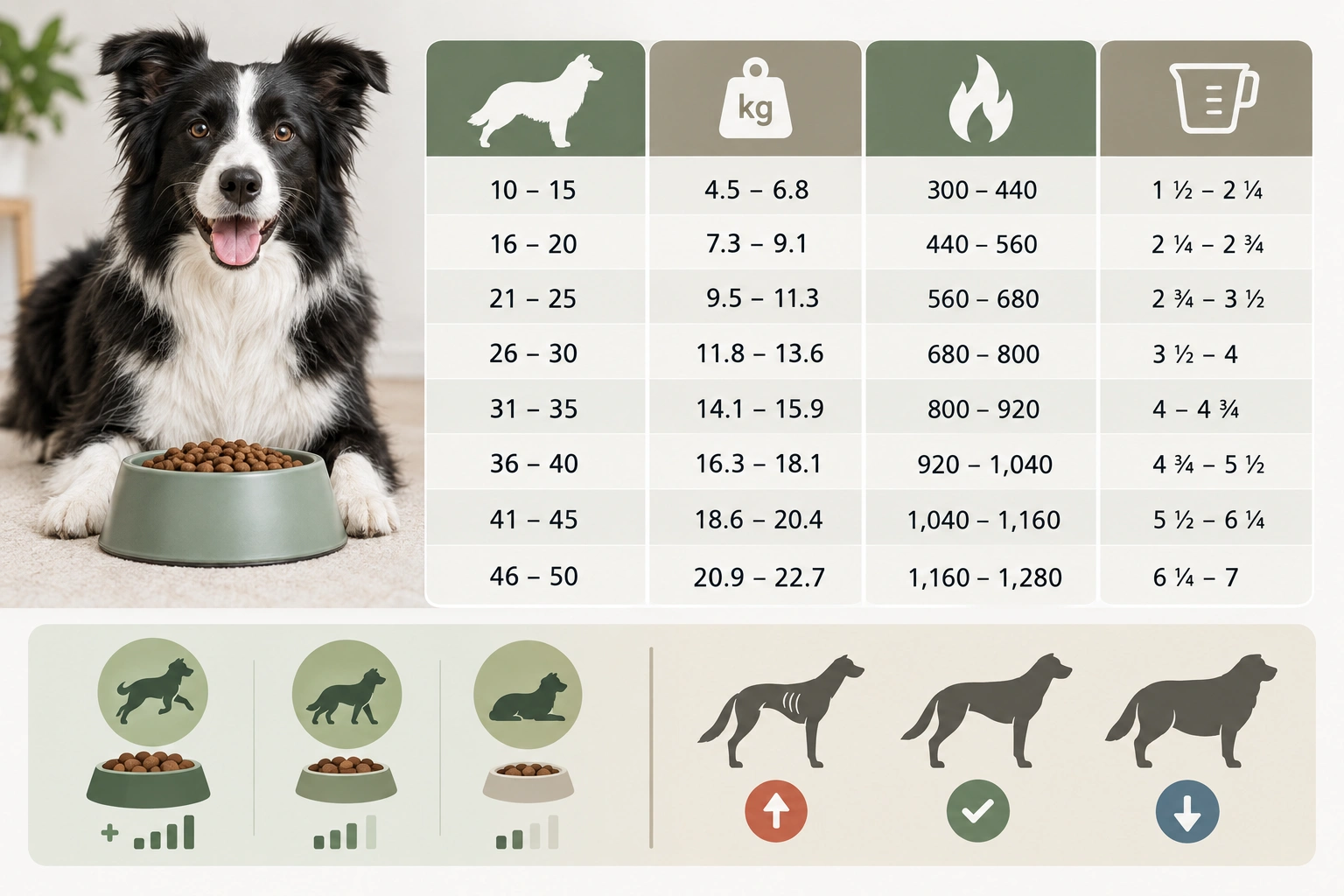
How Much Should a Border Collie Eat by Weight?
For an average adult Border Collie, a practical calorie starting point is about 60–75 calories per kg of body weight per day. That range is best treated as a starting estimate, not a universal breed standard. In practice, calorie needs are usually estimated from metabolic weight formulas and then adjusted for body condition, age, and activity. One Border Collie feeding guide puts an 18 kg dog at roughly 1,080–1,350 calories per day, which is a useful reference point for a healthy adult with moderate activity. See the source here: Border Collie calorie guidance.
For raw-style feeding, one Border Collie guide suggests adults are often fed 2–3% of ideal body weight per day, while puppies are fed a higher percentage based on age. That method is not the same as kibble feeding, but it shows the same principle: lighter, growing, or more active dogs need proportionally more food than sedentary adults. Source: Border Collie raw feeding guide.
Quick rule of thumb
- Adult Border Collie, moderate activity: use 60–75 kcal/kg/day as a starting range.
- Very active Border Collie: may need more than the low end of that range.
- Overweight Border Collie: calculate from ideal weight, not current weight.
- Puppy: needs a separate age-based approach, not the adult formula.
Border Collie Feeding Chart by Pounds and Kilograms
This chart gives you a practical starting point for adult dogs using the calorie range above. Because foods vary in calorie density, the chart is more accurate in calories than in cups.
| Body weight | Approx. daily calories | What that usually means |
|---|---|---|
| 20 lb / 9 kg | 540–675 kcal | Small adult, moderate activity |
| 25 lb / 11 kg | 660–825 kcal | Lean adult, moderate activity |
| 30 lb / 14 kg | 840–1,050 kcal | Common adult range |
| 35 lb / 16 kg | 960–1,200 kcal | Medium adult, moderate activity |
| 40 lb / 18 kg | 1,080–1,350 kcal | Example range often used in guides |
| 45 lb / 20 kg | 1,200–1,500 kcal | Larger or more active adult |
| 50 lb / 23 kg | 1,380–1,725 kcal | Larger adult, activity matters a lot |
This is a starting chart, not a finished prescription. A 40 lb Border Collie that runs agility several times a week may need more than a low-activity dog of the same weight, while a neutered, low-activity dog may do better closer to the bottom of the range.
How to Calculate Daily Calories From Body Weight
The easiest way to estimate a daily amount is:
Body weight in kg × 60 to 75 = daily calories
Example:
– 18 kg Border Collie
– 18 × 60 = 1,080 kcal
– 18 × 75 = 1,350 kcal
That gives you a working range. Then you narrow it based on the dog in front of you:
- If the dog is lean and very active, move higher.
- If the dog is gaining weight too easily, move lower.
- If the dog is a puppy, use an age-specific puppy method instead of the adult formula.
- If the dog is overweight, use ideal weight rather than current weight.
This is why package directions can be misleading. Two foods can have the same cup size but very different calorie counts. The cup is only a container; the calories are what matter.
How to Convert Calories Into Cups, Grams, or Ounces
To turn calories into an actual portion, check the food label for kcal per cup, kcal per gram, or kcal per can.
Dry kibble example
Purina’s feeding chart shows that dogs in the 26 to 50 lb range may eat 2 to 2-2/3 cups per day, and dogs in the 51 to 75 lb range may eat 2-2/3 to 3-1/3 cups per day, depending on the food and dog size. That is a brand-specific chart, but it demonstrates the key point: cup amounts change with calorie density. Source: Purina dog feeding chart.
Simple conversion method
- Find your dog’s calorie target.
- Find the food’s kcal per cup.
- Divide daily calories by kcal per cup.
Example:
– Daily target: 1,200 kcal
– Food density: 400 kcal per cup
– 1,200 ÷ 400 = 3 cups per day
Worked grams example
If the same kibble provides 400 kcal per cup and the label says 1 cup = 100 grams, then:
- 3 cups per day = 300 grams per day
If you want a more direct gram calculation, use the food’s kcal per kg or kcal per gram if the label provides it. For example, if a kibble has 4 kcal per gram, then a 1,200 kcal daily target would be:
- 1,200 ÷ 4 = 300 grams per day
Why a kitchen scale is often better
A measuring cup is convenient, but a scale is more precise. Kibble pieces vary in size, and “one cup” can be packed loosely or tightly. If your Border Collie needs a consistent amount, weighing the food in grams is the cleanest method.
A practical rule:
– Use cups for convenience.
– Use grams for accuracy.
– Use calories for the actual feeding decision.
Dry food vs wet food
Wet food usually contains fewer calories per gram than kibble because it has much more moisture. That means a dog may need a larger volume of wet food to get the same calories. Always compare the label’s calorie content rather than assuming a can equals a cup.
Puppy vs Adult vs Senior Border Collie Food Amounts
Life stage changes the math.
Border Collie puppies
A puppy needs more food per pound than an adult because growth is expensive. One Border Collie raw-feeding guide lists puppy amounts by age as percentages of body weight: 8–10% at 7–10 weeks, 7–8% at 10–16 weeks, 6–7% at 16–20 weeks, 5–6% at 20–24 weeks, 4–5% at 24–36 weeks, and 3–4% at 36–56 weeks. Source: Border Collie puppy feeding guide.
That does not mean every puppy should eat raw food. It means puppy feeding is usually based on a higher percentage of body weight than adult feeding.
A practical takeaway:
– Puppies are fed more often and more per pound than adults.
– Their portions need regular adjustment as they grow.
– Over-restricting a puppy is a bad trade-off; steady growth matters more than keeping the bowl small.
Adult Border Collies
Most adult Border Collies do well on two meals a day. One Border Collie feeding page says dogs can switch to adult food at 13 months and be fed 2 meals a day. Source: Border Collie feeding page.
That timing is a reasonable guide, but the exact switch depends on the dog’s size, maturity, and the food being used. Smaller, less complex feeding plans are easier to manage once growth slows.
Senior Border Collies
Older Border Collies often need fewer calories if their activity drops. Some stay very fit well into later life, but many become less active and lose muscle more easily. That means the right amount is not simply “less food because senior.” It is “enough food to keep a healthy body shape without letting weight creep up.”
How Activity Level Changes Portion Size
Two Border Collies of the same weight can need different amounts of food.
Low-activity Border Collie
This is the dog that gets walks, some play, and not much more. A low-activity Border Collie usually needs the lower end of the adult calorie range, especially if neutered.
Moderately active Border Collie
This dog gets daily exercise, some training, and regular movement. The middle of the calorie range often fits best here.
Highly active or working Border Collie
A Border Collie doing agility, herding, long hikes, or daily work may need noticeably more food than a pet dog of the same weight. This is where body condition matters most. If the dog starts to get leaner, the current amount is too low. If the waist disappears, the amount is too high.
A useful adjustment rule:
– Increase or decrease by about 10% at a time
– Hold that change for 1 to 2 weeks
– Recheck weight and body shape before changing again
Should You Feed Based on Current Weight or Ideal Weight?
If your Border Collie is already at a healthy weight, current weight is fine.
If your dog is overweight, use ideal weight instead. Feeding an overweight dog based on current weight often keeps the dog overweight, because the calculation is built on a number that is already too high.
If your dog is underweight, current weight can also be misleading. In that case, a vet-guided plan is safer than simply doubling the food.
Simple decision rule
- Healthy body condition: use current weight
- Overweight dog: use ideal weight
- Underweight dog: ask your veterinarian before making large changes
How to Use Body Condition Score to Fine-Tune Portions
Weight alone misses important detail. A Border Collie can weigh “right” and still be too fat or too thin.
Look for these signs of a healthy body condition:
– Ribs are easy to feel, but not sharply visible
– Waist is visible from above
– Tuck-up is visible from the side
– No heavy fat pad over the back or tail base
If the ribs are hard to feel and the waist is gone, the dog is probably getting too much. If the ribs are prominent and the dog looks flat-sided, the dog may need more.
This is the part that keeps feeding practical. The scale gives you a number; body condition tells you whether the number is working.
How to Read Dog Food Labels and Feeding Guides
Dog food labels usually give a feeding chart by weight, but those charts assume an average dog. They do not know whether your Border Collie is:
– a puppy or adult
– neutered or intact
– working hard or resting more
– naturally lean or prone to weight gain
Use the label as a starting point, then compare it with your own body-weight calculation. If the brand’s cup chart conflicts with the calorie information, trust the kcal per cup or kcal per kg number first and treat the cup chart as secondary guidance.
What to check on the label
- kcal per cup or kcal per kg
- feeding chart by body weight
- life stage the food is made for
- whether treats are included in the calorie plan
If you feed several treats a day, those calories count. A Border Collie that gets training treats, chews, and table scraps may need less at mealtime than the package suggests.
Signs Your Border Collie Is Eating Too Much or Too Little
Too much food
- Weight gain over time
- Loss of waist
- Ribs harder to feel
- Slower movement or less enthusiasm for exercise
- Begging more often does not mean the dog is underfed
Too little food
- Weight loss
- Visible ribs and spine
- Poor coat condition
- Low energy
- Constant hunger plus body weight dropping
A dog that is losing weight unexpectedly or refusing food needs more than a portion tweak. That is a veterinary conversation, not just a feeding adjustment.
How to Adjust Food Amount Safely Over Time
Large changes are rarely helpful.
A practical adjustment plan
- Pick a starting amount from body weight.
- Feed that amount for 10–14 days.
- Weigh the dog or check body condition.
- Adjust by about 10%.
- Recheck again after another 1–2 weeks.
If you need to change foods, transition gradually over several days to avoid stomach upset. Border Collies are active dogs, but their digestion still tends to prefer routine.
Common Feeding Mistakes Border Collie Owners Make
The biggest mistakes are usually simple:
- Using the package chart without adjustment
- Feeding from current weight when the dog is overweight
- Forgetting treats and chews
- Assuming one cup is the same across all foods
- Feeding a puppy like an adult
- Increasing food too quickly after more exercise
- Ignoring body condition and only watching the scale
The fix is not complicated: base the first estimate on weight, then confirm it with body shape and weekly trends.
When to Ask Your Veterinarian
Ask your veterinarian if your Border Collie:
– is losing or gaining weight without a clear reason
– looks underweight or obese by body condition
– has a poor appetite for more than a day or two
– is a puppy with uncertain growth needs
– has a medical condition that affects feeding
– needs a major diet change because activity has changed a lot
If you want broader guidance on choosing the right food before you calculate portions, this page may help: what is the best food for a Border Collie.
FAQ
How many cups should a Border Collie eat per day?
There is no single cup number that fits every Border Collie. The right amount depends on the food’s calorie density, your dog’s weight, and activity level. A 40 lb dog might eat around 2 to 3 cups of one kibble, but a different food could require a very different amount.
Is it better to feed by weight or by cups?
Weight is better for accuracy. Cups are fine for convenience, but calories and grams are more dependable because foods vary so much in density.
Should I feed my Border Collie once or twice a day?
Most adult Border Collies do well on two meals a day. Puppies usually need more frequent meals. Twice daily is also easier for portion control and hunger management in many adults.
How do I know if my Border Collie is overweight?
Check the waist from above and the tuck-up from the side. If you cannot feel the ribs easily under a light layer of fat, the dog may be carrying too much. A vet can confirm body condition if you are unsure.
Do active Border Collies need more food?
Usually yes. The more intense and frequent the activity, the more calories the dog may need. The key is to increase gradually and watch body condition, not to guess based on exercise alone.
When should a Border Collie switch from puppy food to adult food?
One Border Collie feeding guide says adult food can start at around 13 months. That is a reasonable benchmark, but the best timing depends on the individual dog and the food being used.
Should treats be counted in daily food amount?
Yes. Treats are calories. If you use a lot of training rewards, reduce the meal portion so the total daily intake stays on target.
Can I use the same feeding amount for wet food and kibble?
No. Wet food and kibble have very different calorie densities. Always check the label and convert from calories, not volume alone.
If my Border Collie is gaining weight, should I cut food right away?
Make a modest reduction, usually around 10%, then reassess after 1 to 2 weeks. Large cuts can create hunger and make the change harder to manage.
What if my Border Collie is always hungry?
Hunger alone does not prove underfeeding. Check body condition, treat intake, and activity level first. If the dog is losing weight or seems unwell, ask your vet.
