
Why Does a Border Collie Have Tail Feathering?

Quick Answer
A Border Collie has tail feathering because longer guard hairs grow around the tail as part of the breed’s weather-resistant double coat. Feathering is especially noticeable on rough-coated Border Collies, while smooth-coated dogs may have much less. The Border Collie’s coat type, genetics, age, and individual bloodline all affect how full that tail looks.
What Border Collie tail feathering usually means
- Normal coat feature: Longer hairs around the tail are a natural part of many Border Collie coats.
- More in rough coats: Rough-coated Borders usually develop a fuller, more obvious plume.
- Less in smooth coats: Smooth-coated dogs can have little visible feathering and still be completely normal.
- Develops gradually: Puppies often need many months before their adult tail coat becomes obvious.
- Needs brushing: Long tail hairs can collect burrs, debris, and loose undercoat or form tangles.
One thing to check
- If the tail suddenly becomes thin, bald, irritated, or unusually itchy, don’t assume it’s a normal coat change. Check with your veterinarian.
One of my favorite Border Collie features is the sweeping tail that seems to change shape with every mood. Owners often notice those long hairs and wonder why their dog has such dramatic tail feathering.
The answer comes down mainly to coat genetics and the Border Collie’s working-dog heritage. Here’s what that feathering is, why some Borders have much more than others, and how I care for it without damaging the coat.
In This Guide
- What Is Tail Feathering on a Border Collie?
- Why Do Border Collies Have Feathering on Their Tails?
- Do All Border Collies Have the Same Tail Feathering?
- When Does a Border Collie’s Tail Feathering Develop?
- Does Tail Feathering Have a Purpose?
- How Should You Groom a Feathered Border Collie Tail?
- Should You Trim Border Collie Tail Feathering?
- When Can Changes in Tail Feathering Signal a Problem?
- Border Collie Tail Feathering FAQ
What Is Tail Feathering on a Border Collie?
Tail feathering is the longer fringe of hair growing from a dog’s tail. It creates the flowing or plume-like appearance you see on many rough-coated Border Collies.
The hairs aren’t separate decorations or a different coat. They’re simply longer portions of the outer coat growing over the dog’s dense undercoat.
Definition: A Border Collie’s tail feathering is the longer coat growing along and beneath the tail, often producing a flowing fringe or plume.
Border Collies have a double coat. That means they carry both a softer insulating undercoat and tougher outer hairs often called guard hairs.
The official Border Collie standard recognizes rough and smooth coat varieties. Both should have dense, weather-resistant double coats, though the amount and placement of longer hair differ.
You’ll usually notice feathering in several places on rough-coated dogs:
- Tail: Longer hair creates the familiar plume.
- Back of the front legs: Fine fringe often grows behind the legs.
- Rear thighs: Longer coat can form noticeable “pants.”
- Chest and underside: Rough dogs often carry more coat here.
- Neck: Some develop a fuller ruff around the shoulders and chest.
The tail is especially noticeable because it’s constantly moving. When a Border runs or turns sharply, those longer hairs spread out and exaggerate its movement.
Why Do Border Collies Have Feathering on Their Tails?
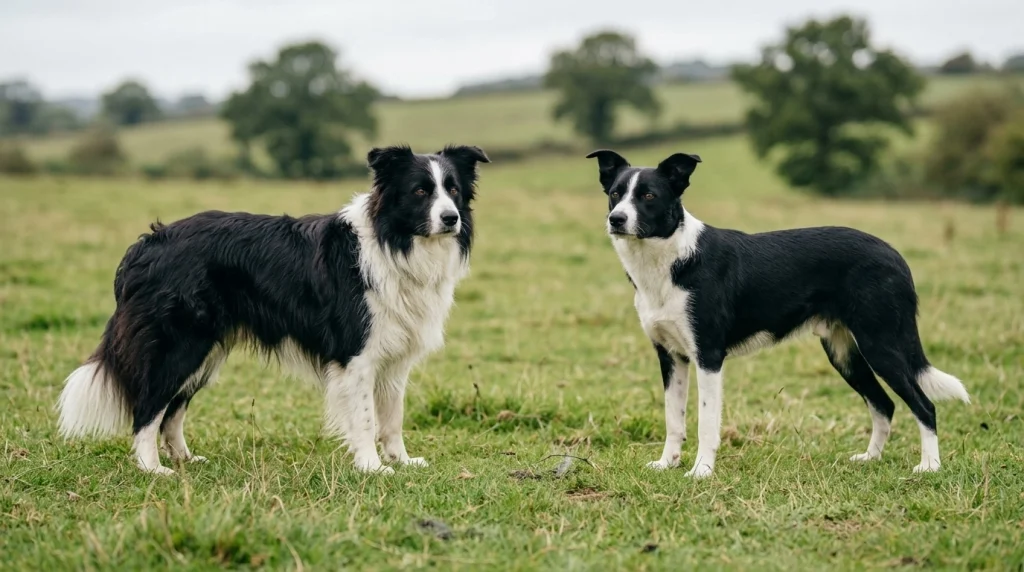
Border Collies have tail feathering primarily because of inherited coat characteristics. Generations of working dogs developed coats suited to outdoor life, and many inherited longer guard hairs around the tail and body.
It comes from the Border Collie’s double coat
The Border Collie developed as a livestock-working dog in the border country of Scotland and England. Dogs working outdoors needed coats capable of handling changing weather and demanding terrain.
The breed’s working heritage placed greater importance on usefulness, stamina, and herding ability than on producing one identical appearance.
That’s one reason modern Border Collies show considerable variation. You can meet two purebred Borders with noticeably different coat lengths, markings, ear sets, and tail furnishings.
Genetics controls how much feathering appears
Some families consistently produce thick rough coats. Other bloodlines tend toward moderate coats or short, practical working coats.
Even littermates may not mature with identical feathering. Coat inheritance involves more than simply labeling one puppy “rough” and another “smooth.”
In my experience, this is where owners sometimes compare their young Border with heavily coated adults online and start worrying. A lighter tail doesn’t mean anything is wrong with the dog.
Look at the whole coat instead:
- Is your Border rough-coated or smooth-coated?
- Does the coat look healthy and evenly distributed?
- Are there actual bald areas or just naturally shorter hair?
- Is the dog still growing its adult coat?
- Do close relatives have similarly light or heavy feathering?
Those questions tell you more than comparing tail size with another Border Collie.
Do All Border Collies Have the Same Tail Feathering?
No. Rough and smooth Border Collies can differ significantly in visible feathering, and individual dogs vary within both coat types.
Neither coat variety makes a dog more or less of a Border Collie. The American Kennel Club recognizes both varieties without preferring one over the other.
| Feature | Rough-Coated Border Collie | Smooth-Coated Border Collie |
|---|---|---|
| Body coat | Medium length and visibly fuller | Short over most of the body |
| Tail appearance | Often fuller and plume-like | Usually sleeker with less obvious fringe |
| Leg feathering | Usually noticeable on legs and haunches | May be slight or minimal |
| Undercoat | Dense, soft undercoat | Dense double-coat structure also present |
| Tangle risk | Higher around long feathered areas | Usually lower, though shedding still occurs |
| Breed-standard status | Accepted coat variety | Accepted coat variety |
A moderately coated Border may fall visually between the extremes. Working-bred dogs especially can show plenty of natural variation.
Color doesn’t determine feathering either. Black-and-white, red, blue merle, tricolor, sable, and other Border Collie colors can occur with different coat lengths.
When Does a Border Collie’s Tail Feathering Develop?
A Border Collie’s tail feathering develops gradually as the puppy coat gives way to the adult double coat. Don’t expect a young puppy’s tail to predict its final appearance perfectly.
Puppies usually start with softer coats
Young Border Collies commonly have soft puppy fur that changes in density and texture while they mature. Rough-coated pups may show early fluff without yet having their finished adult feathering.
During the first year, you may notice longer hairs appearing around the tail, chest, hindquarters, and legs. The change isn’t always even.
The coat can keep maturing after the first year
Some Borders develop their finished-looking coat fairly early. Others continue gaining fullness as they move through adolescence and early adulthood.
Instead of expecting one exact deadline, I watch the trend. A healthy young dog whose tail gradually becomes fuller is following a normal pattern.
Several factors can influence what you see:
- Genetics: This is the biggest factor in eventual coat type and feathering.
- Age: Puppy and adolescent coats can look different from mature coats.
- Season: The undercoat changes as dogs shed and regrow coat.
- Sex and hormones: Hormonal changes can affect coat cycles and appearance.
- Overall health: Skin and coat condition can change when a dog isn’t well.
As of 2026, there still isn’t a useful universal age when every Border Collie’s adult tail plume should be “finished.” Individual variation is too wide for that rule to help owners.
Does Border Collie Tail Feathering Have a Purpose?
Tail feathering is part of the Border Collie’s overall protective coat rather than a specialized tool with one single purpose. The dog’s complete double coat offers more practical protection than the feathering alone.
The outer coat helps protect the dog
Guard hairs help shield the skin from dirt, moisture, vegetation, and environmental exposure. The soft undercoat provides insulation beneath them.
This combination makes sense for a breed historically expected to work outside. Border Collies didn’t spend their working days on clean indoor floors.
The AKC describes the breed’s coats as dense and weather-resistant. It also advises regular grooming to remove mats, tangles, and debris.
The tail also communicates
A Border Collie’s tail position tells you plenty about what the dog is doing. During focused work, the tail may stay lower, while excitement can produce a higher, more animated carriage.
Feathering makes those movements more visually obvious, but the hair itself isn’t the communication system. The important signal comes from the tail’s position, movement, and the rest of the dog’s body language.
Never judge emotion from the tail alone. Look at the ears, eyes, mouth, posture, movement, and situation together.
How Should You Groom a Feathered Border Collie Tail?
Brush tail feathering gently enough to preserve the coat while removing loose hair and tangles. Most problems start when small knots are allowed to tighten.
The ASPCA’s dog grooming guidance recommends brushing before bathing to remove dead hair and mats. That’s a habit I use with feathered tails too.
A simple tail-grooming routine
- Check with your fingers first. Feel beneath the visible outer coat for knots, burrs, grass seeds, or damp clumps.
- Separate the hair into small sections. Don’t try to drag a brush through the entire plume at once.
- Start near the ends. Work through small tangles before moving closer to the skin.
- Brush in the natural direction. Use controlled strokes rather than repeatedly ripping through resistance.
- Finish with a comb check. A comb helps reveal small tangles your brush may have missed.
For most Borders, coat care matters more than aggressive trimming. The AKC suggests brushing Border Collies once or twice weekly, with more frequent grooming during heavy shedding periods.
PetMD’s coat-care guidance also emphasizes regular brushing for removing loose coat and helping maintain skin and coat condition.
Pay extra attention after outdoor adventures
Tail feathering behaves like a small broom in long grass. It can collect seeds, burrs, mud, leaves, and tiny sticks surprisingly quickly.
I make a quick tail check part of the post-walk routine whenever a Border has been running through fields or heavy vegetation. Thirty seconds then can prevent a stubborn knot later.
Be especially careful with grass awns and embedded plant material. If something has penetrated the skin or sits in a sensitive area, let a veterinarian handle it.
Should You Trim Border Collie Tail Feathering?
You usually don’t need to remove healthy Border Collie tail feathering. Light tidying can sometimes be useful, but routine shaving of the double coat isn’t the same thing as grooming.
Minor neatening is different from shaving
You might trim a damaged end or carefully neaten hair that repeatedly becomes soiled. If you’re unsure where or how much to cut, a groomer experienced with double-coated breeds is the safer choice.
Avoid sculpting the entire dog simply to reduce shedding. Cutting hair doesn’t stop the natural shedding cycle occurring underneath.
The AKC specifically cautions against shaving double-coated dogs simply to cool them in warm weather. The outer coat still has protective functions after the undercoat sheds seasonally.
You can read the broader explanation in the AKC’s guidance on shaving double-coated dogs.
What if the tail is badly matted?
Don’t repeatedly yank at a tight mat near the skin. That can hurt and may irritate or injure the skin underneath.
For a small loose knot, gentle finger separation followed by careful brushing may work. Severe or skin-tight matting is better handled by an experienced groomer or veterinary team.
Prevention is easier. Frequent quick checks beat one painful grooming session after several weeks of neglect.
When Can Changes in Tail Feathering Signal a Problem?
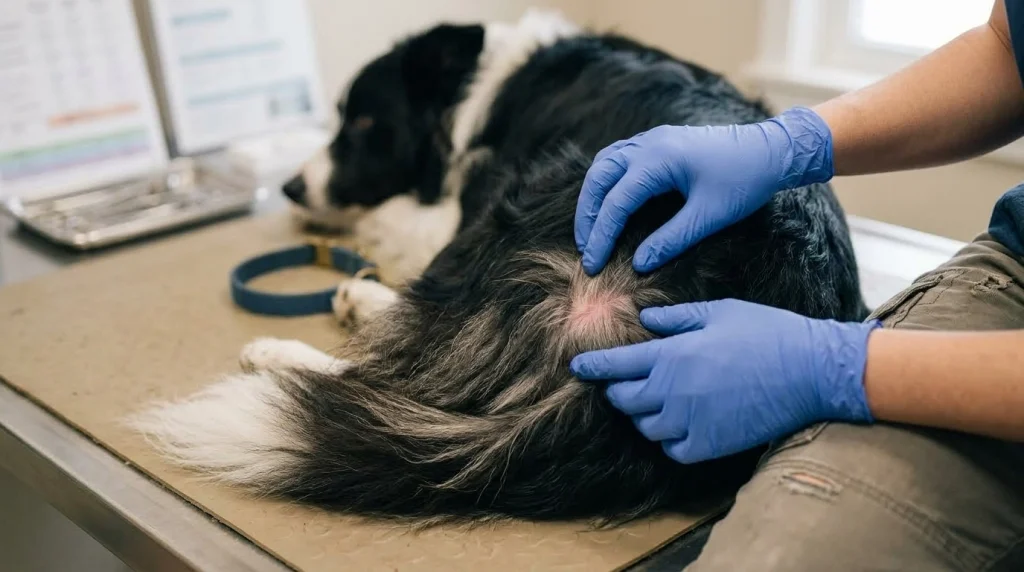
A naturally lightly feathered tail isn’t usually concerning. A sudden change from your dog’s normal coat deserves more attention.
Watch for changes such as:
- Patchy hair loss: Areas become noticeably bald rather than simply short-coated.
- Persistent scratching: Your dog repeatedly bites, licks, or chews the tail.
- Red or inflamed skin: The skin beneath the feathering looks irritated.
- Scabs or sores: Lesions appear under the coat.
- Strong odor: The tail or nearby skin develops an unusual persistent smell.
- Sudden thinning: Coat density changes significantly outside normal shedding.
- Pain: Your dog reacts when the tail or surrounding skin is touched.
Normal seasonal shedding usually looks different from localized baldness. Border Collies can lose impressive amounts of undercoat while still maintaining healthy skin and outer hair.
Persistent licking or chewing can occur with several medical or behavioral problems. Don’t diagnose the cause from coat appearance alone.
Vet note: Sudden hair loss, irritated skin, persistent itching, sores, or repeated tail chewing should be assessed by your veterinarian. Coat changes can have many causes, and the appearance alone can’t identify the underlying problem.
General resources such as the ASPCA dog care section can help with routine care, but they’re not a replacement for examining an individual dog.
Border Collie Tail Feathering FAQ
Why is my Border Collie’s tail so fluffy?
Your Border Collie probably inherited a rougher, longer coat with abundant guard hairs around the tail. Genetics, age, season, and individual bloodline influence how full the plume becomes.
Why doesn’t my Border Collie have much tail feathering?
Some Border Collies naturally have smooth or moderately short coats with limited tail fringe. A lightly feathered tail can be completely normal when the coat and skin are otherwise healthy.
Will my Border Collie puppy’s tail get fluffier?
It may. Puppy coats change as the adult double coat develops, and rough-coated dogs often gain more visible feathering through adolescence.
However, genetics determines the eventual coat more than age alone. Some adult Borders remain much sleeker than others.
Does a purebred Border Collie have to have a feathered tail?
No. Border Collies occur in both rough and smooth coat varieties, so the amount of visible tail feathering varies considerably.
Coat length alone can’t determine whether a dog is purebred. Pedigree records or appropriate ancestry testing provide much better evidence.
Can I cut the long hair on my Border Collie’s tail?
Small amounts can be neatened when needed, but healthy feathering usually doesn’t need major cutting. Avoid shaving the double coat for convenience or to make the dog cooler.
How often should I brush a Border Collie’s tail?
Check it whenever you groom the rest of the coat, with extra attention after muddy walks or runs through vegetation. Many Borders benefit from brushing once or twice weekly and more often during shedding season.
Why is my Border Collie’s tail feathering suddenly thinning?
Seasonal shedding can temporarily change fullness, but sudden localized thinning deserves attention. If you also notice itching, redness, sores, chewing, pain, or bald patches, contact your veterinarian.
The Takeaway on Border Collie Tail Feathering
Border Collie tail feathering is a normal expression of the breed’s double coat, especially in rough-coated dogs. Genetics determines much of its length and fullness, so there’s no single correct plume size.
I focus less on making a Border’s tail look perfectly fluffy and more on keeping it clean, comfortable, and tangle-free. Regular gentle brushing and quick post-adventure checks usually accomplish exactly that.
If your dog’s tail has always been lightly feathered, enjoy the coat nature gave them. If the coat suddenly changes or the skin looks unhealthy, that’s when a veterinarian should take a closer look.