
Can a Male Dog Still Mate After Being Neutered? What Owners Need to Know

If you are asking whether a male dog can still mate after being neutered, the short answer is yes, he may still be able to perform mating behavior — but that does not mean he can necessarily father puppies.
That distinction matters. Owners often use “mate” to mean three different things:
- Trying to mount or hump
- Physically completing mating behavior
- Actually impregnating a female
Neutering changes those three things differently. A dog can still mount, show interest, or even get an erection after neutering. What usually changes is fertility: over time, he stops producing sperm and can no longer cause pregnancy.
Yes, a neutered male dog may still be able to physically penetrate and ejaculate, because those actions are separate from fertility. Even if ejaculation happens, that does not automatically mean he can make a female pregnant.
For households with an intact female, that timing is the part that matters most. A recently neutered male is not automatically a zero-risk dog on the day he comes home from surgery. If you need a practical rule, keep intact females separated for several weeks after neuter surgery, and confirm the exact window with your veterinarian.
For a broader look at how behavior and body signals can be easy to misread in dogs, see our guide on why dogs cough after drinking water, where the same principle applies: the visible sign is not always the real problem.
Can a Male Dog Still Mate After Being Neutered?
Yes — in the physical sense, a neutered male dog can still try to mate.
He still has a penis, and he can still show the behaviors that look like mating: mounting, thrusting, and sometimes even tying with a female. A dog may also continue to respond to the scent or behavior of an intact female in heat.
What neutering does is remove the testes, which are the main source of sperm production and most testosterone. That means the dog’s reproductive ability changes, but the behavior may not disappear right away, and in some dogs it never disappears completely.
Here is the practical takeaway:
- Mounting behavior can continue after neutering
- Actual fertility drops over time
- Pregnancy risk is highest soon after surgery
- A “fixed” dog is not the same thing as a dog with no sexual behavior
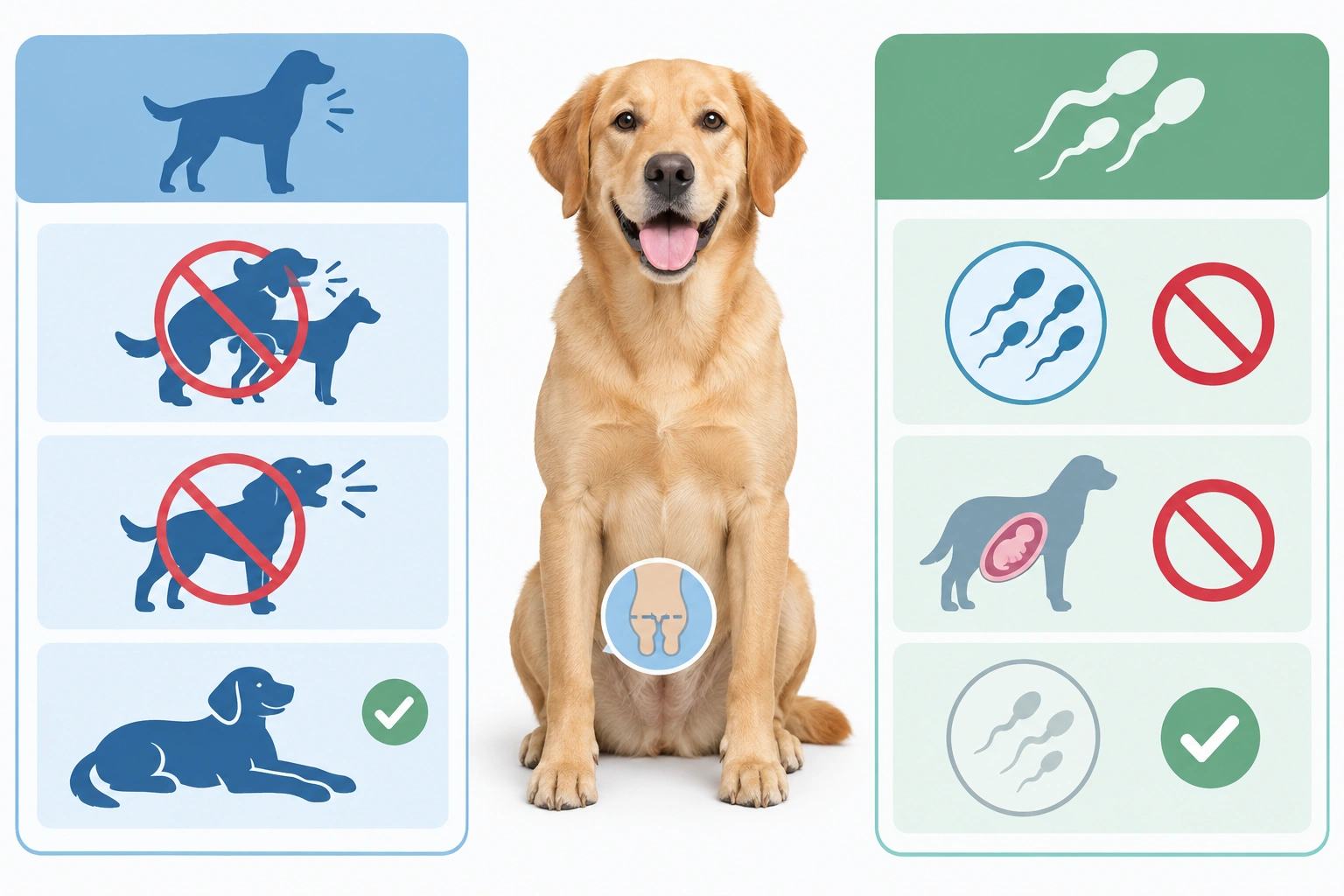
That is why owners sometimes report, “My dog was neutered, but he still tries to mate.” In many cases, both things are true: the behavior is still there, but the fertility is gone or nearly gone.
Mating Behavior vs. Fertility: What Neutering Actually Changes
This is the core confusion point.
Mating behavior
This includes mounting, humping, thrusting, sniffing an intact female, and acting highly interested in a female in heat. These behaviors can be driven by:
- residual hormones
- habit
- excitement
- stress
- social arousal
- learned behavior
Fertility
This is the dog’s ability to produce viable sperm and cause pregnancy.
Neutering removes the testes, so the dog no longer makes new sperm in the normal way. But that does not instantly erase every sperm already stored in the reproductive tract, and it does not instantly erase learned behavior.
A useful comparison:
- Behavior can linger
- Fertility fades
- Those two timelines are not identical
That difference is why a neutered dog may still appear “interested” without being able to impregnate a female. It also explains why owners can’t judge pregnancy risk by behavior alone.
For a reliable veterinary overview of why neutering changes reproduction but doesn’t always erase behavior immediately, VCA Hospitals’ neutering guidance is a helpful reference point.
How Long a Recently Neutered Dog May Still Be Fertile
A recently neutered dog may still be fertile for a short period after surgery.
A practical safety window is to assume pregnancy risk can last for several weeks after castration, because sperm may remain in the reproductive tract for a short time. Different veterinary references describe this window somewhat differently, so it is best treated as a precaution rather than a universal rule.
That means the first few weeks after surgery are not the time to relax management.
Practical rule
If your dog was neutered recently and there is an intact female in the home or nearby, keep them separated until your veterinarian says the post-neuter fertility window has passed.
Why this matters
Owners sometimes assume surgery means instant infertility. That assumption can lead to an accidental breeding during the recovery period, especially if a female is already in heat or close to it.
A Border Collie household can be especially tricky here because these dogs are energetic, persistent, and quick to seize on stimulation. A determined male may keep trying to reach a female even while the owner assumes he is “safe now.”
Can a Neutered Male Still Impregnate a Female?
Usually, not once the post-neuter fertility window has passed.
But yes, a recently neutered male may still be able to impregnate a female if there is still viable sperm in the tract. That is the real-world risk owners need to plan for.
If a suspected mating happens and the female is in heat, contact your veterinarian promptly the same day. Ask whether the timing creates a pregnancy risk and what the best next step is for the female, since timing matters most during a heat cycle.
Think of it this way:
- Right after surgery: pregnancy risk can still exist
- Several weeks later: risk drops sharply
- Long after recovery: pregnancy risk should be gone unless something unusual is going on
If a neutered dog is trying to mate with an intact female in heat, the safest assumption is that the female is still at risk until enough time has passed after surgery. Do not rely on the word “neutered” alone if the surgery was recent.
What to do if accidental mating happens soon after neuter
Call your veterinarian promptly. They can tell you whether the timing creates a genuine pregnancy risk and what monitoring or next steps make sense.
Why Neutered Dogs May Still Hump, Mount, or Act Interested
A dog does not need functioning testes to mount another dog.
This is why owners sometimes see a neutered male:
- hump another dog at the park
- mount a female in heat
- get overstimulated during play
- try to mate after surgery even though fertility is gone
That behavior can come from several places.
1. Residual hormones
Testosterone does not vanish instantly. As hormone levels fall, sexual behavior may gradually reduce rather than stop overnight.
2. Learned habit
If mounting has worked as an attention-getting or self-rewarding behavior in the past, the dog may keep doing it.
3. Excitement or overarousal
Some dogs mount when they are overexcited, not sexually motivated. This is common in high-energy dogs.
4. Stress relief
Mounting can be a displacement behavior when a dog feels unsure, conflicted, or overstimulated.
5. Social triggers
A female in heat, a rowdy play session, or a crowded dog park can all trigger mounting.
That means the behavior is not proof of fertility. It is a behavior problem, a hormone lag issue, or both.
For many owners, the most useful mindset is: treat mounting as a behavior to manage, not as a sign that the neuter “didn’t work.”
IMAGE 1 PLACEMENT
How Long to Keep a Neutered Male Away from an Intact Female
If there is an intact female in the home, or one your dog may meet, separation is the safest choice until the post-op fertility period is over.
Practical decision guide
- Neutered within the last few weeks: keep him away from an intact female in heat
- Neutered long enough ago that your vet considers him infertile: pregnancy risk is generally much lower
- Unsure of the neuter date or post-op status: treat him as potentially fertile until you confirm it
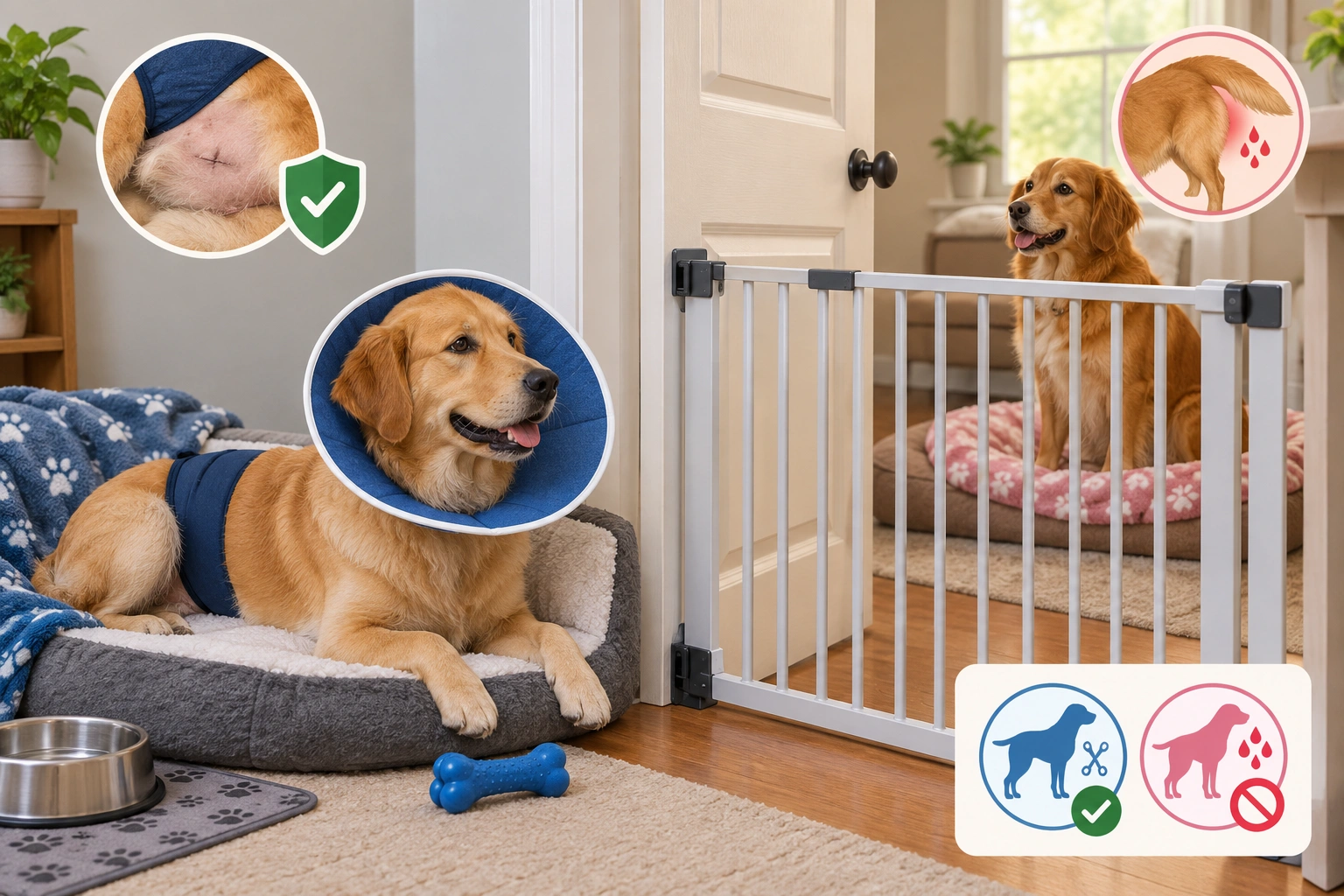
If the female is in heat
Do not “test” the situation. Heat cycles are exactly when a male will be most motivated to mate, and the timing is when owners make the most expensive mistakes.
If the dogs live in the same house
Use physical separation, not just supervision. Doors, crates, baby gates, and separate rooms are more reliable than hoping the male will ignore the female.
A female in heat can attract even a dog that seems calm in every other setting. That attraction can override training in a way many owners underestimate.
When Ongoing Sexual Behavior May Signal a Veterinary Issue
Most mounting after neutering is not an emergency. Still, there are situations where persistent male-typical behavior deserves a vet check.
Often still normal
These signs can happen even in a neutered dog and do not automatically mean something is wrong:
- occasional mounting during play
- brief interest in a female in heat
- behavior that comes and goes with excitement or stress
- gradual improvement over the weeks after surgery
More concerning
A veterinary exam is a good idea if:
- your dog was neutered long ago but still behaves strongly intact
- he shows repeated mounting plus other male-typical behaviors
- there is concern the surgery may not have been complete
- one or both testicles were not clearly removed
- he was cryptorchid, meaning a testicle may have been retained
Why this matters
Rarely, a dog may still have retained testicular tissue, or he may have been incompletely neutered. In those cases, hormone production can continue, and the dog may still act and possibly function more like an intact male than expected.
If your dog’s behavior never changed at all after neutering, that does not automatically mean something is wrong — but it is enough reason to ask your veterinarian whether follow-up testing or an exam is warranted. A vet may check for retained tissue with an exam and, when appropriate, hormone testing.
Neutering vs. Vasectomy: Why They Are Not the Same
People sometimes use these terms interchangeably, but they are different procedures with different outcomes.
Neutering
This removes the testes. Result:
- no new sperm production in the normal way
- testosterone falls over time
- sexual behavior often decreases, but not always completely
Vasectomy
This blocks the tubes that carry sperm but leaves the testes in place. Result:
- testosterone remains much more intact
- sexual behavior may continue more strongly
- the dog may still act like an intact male
- fertility is reduced, but the hormonal picture is very different
That distinction matters if you are trying to interpret behavior. A vasectomized dog may still show more testosterone-driven behavior than a neutered dog. If you are unsure which procedure your dog had, ask your veterinarian directly rather than guessing.
Practical Decision Guide for Dog Owners
Use this quick framework when you are trying to decide what to do.
Separate the dogs if:
- the male was neutered recently
- the female is in heat or may soon be in heat
- you cannot confirm how long it has been since surgery
- the male is repeatedly trying to mount
Monitor, but do not panic, if:
- the dog is fully past the post-neuter fertility window
- the behavior is occasional and seems triggered by excitement or play
- there is no intact female involved
Book a vet check if:
- the dog still seems strongly sexually driven long after neutering
- the surgery history is unclear
- you suspect cryptorchidism or retained testicular tissue
- an accidental mating may have happened during the recovery window
The goal is not to guess. The goal is to sort behavior from fertility and then act on the risk that actually matters.
When to See a Veterinarian or Certified Trainer
See a veterinarian if:
- your dog was neutered recently and may have mated with an intact female
- you are unsure whether the surgery was complete
- your dog still shows unusually strong male-typical behavior months later
- one testicle was never seen before surgery, or cryptorchidism was discussed
- you need help deciding whether a pregnancy risk still exists
See a certified trainer if:
- the dog is past the fertility window but keeps mounting out of excitement, stress, or habit
- the behavior is creating conflict with other dogs
- you need a management plan for dog parks, multi-dog homes, or a house with a female in heat
Training can help with impulse control and redirection. It cannot, however, change whether a dog is still fertile. That part is a veterinary question, not a training one.
FAQs
Can a neutered male dog still physically mate?
Yes. He may still mount, thrust, and sometimes complete mating behavior even though he is no longer fertile.
Can a neutered dog still get a female pregnant?
A recently neutered dog may still be able to, because residual sperm can remain for a short period after surgery. Once that window has passed, pregnancy risk should drop sharply unless there is an unusual medical issue.
How long after neutering is a male dog still fertile?
A practical safety window is several weeks after surgery, and your veterinarian can tell you the exact period to use for your dog. Keep intact females separated during that time.
Why does my neutered dog still hump?
Mounting can continue because of residual hormones, habit, excitement, stress, or social triggers. It does not automatically mean he is fertile.
Can a neutered dog still tie with a female?
Yes, a neutered male can still physically tie or get stuck during mating. That does not necessarily mean he can impregnate the female, especially if he is past the fertility window.
Should I keep my dog away from females after neuter surgery?
Yes, if the female is intact or in heat, keep them separated during the early post-op period. That is the safest way to prevent accidental breeding.
Does neutering stop all sexual behavior?
No. It often reduces sexual behavior, but it does not guarantee that mounting or mating attempts will disappear.
Final Takeaway
A male dog can still mate physically after being neutered, at least in the sense that he may mount, thrust, and even tie with a female. What neutering changes is fertility, and that change is not always immediate. If the surgery was recent, treat him as potentially fertile until the post-neuter window has passed. If the behavior continues long after that, look for training issues, incomplete neutering, or a veterinary reason worth checking.