
Can Border Collies Eat Scrambled Eggs?

Quick Answer
Yes, Border Collies can eat scrambled eggs when the eggs are fully cooked and served plain. The safest version contains no butter, oil, salt, cheese, onion, garlic, or seasoning, which matches guidance on feeding cooked eggs to dogs.
What Border Collie owners should know
- Cook them fully: Avoid raw or undercooked egg because of bacterial and nutritional concerns.
- Keep them plain: Scramble the egg without butter, oil, salt, milk, cheese, or seasoning.
- Start small: Offer a few bites the first time and watch your Collie for digestive upset.
- Treat, not meal: Eggs should supplement a complete dog food rather than replace it.
- Count the calories: Egg treats should fit within your dog’s overall daily treat allowance.
Simple serving tip
- For a first serving, offer one or two small spoonfuls rather than an entire egg.
Border Collies are energetic, food-aware dogs, and many will happily investigate anything that reaches your breakfast plate. I’ve found that scrambled egg can be a useful high-value treat, but preparation and portion size matter.
This guide explains how to serve scrambled eggs safely, how much to give, what ingredients to avoid, and when eggs may not suit your dog.
In This Guide
- Can Border Collies Eat Scrambled Eggs Safely?
- How Should You Cook Scrambled Eggs for a Border Collie?
- How Much Scrambled Egg Can a Border Collie Eat?
- Are Scrambled Eggs Nutritious for Border Collies?
- Can Border Collie Puppies Eat Scrambled Eggs?
- When Should a Border Collie Avoid Scrambled Eggs?
- Scrambled vs Boiled vs Raw Eggs: Which Is Best?
- Frequently Asked Questions
- Final Takeaway
Can Border Collies Eat Scrambled Eggs Safely?
Yes. A healthy Border Collie can generally eat fully cooked, plain scrambled egg as an occasional treat.
The important words are fully cooked and plain. The egg itself is usually not the problem; human breakfast ingredients often are.
Definition: Dog-safe scrambled eggs are eggs cooked until no raw or runny portion remains, without added seasoning, butter, oil, dairy, onions, garlic, or sauces.
Border Collies don’t require eggs to stay healthy. A complete and balanced dog food should provide their primary nutrition.
Think of scrambled egg as an optional extra. I use foods like this as a reward rather than building a meal around them.
Why being a Border Collie doesn’t change the basic egg rule
A Border Collie’s working heritage makes the breed athletic and active, but it doesn’t give them a special ability to handle rich human food. Their individual age, size, health, and daily calorie needs matter more.
The AKC lists Border Collies around 30 to 55 pounds, although individual working and companion dogs vary. You can check the AKC breed weight chart for general breed-size context.
- Healthy adult: A small serving may work well as an occasional reward.
- Overweight dog: Extra calories require more care.
- Sensitive stomach: Introduce egg in a tiny amount.
- Prescription diet: Ask your veterinarian before adding people food.
- Known food allergy: Avoid eggs if your veterinarian has identified egg as a trigger.
Vet note: A dog’s individual medical history can change what is safe. Ask your veterinarian before changing the diet of a dog with ongoing health problems.
How Should You Cook Scrambled Eggs for a Border Collie?
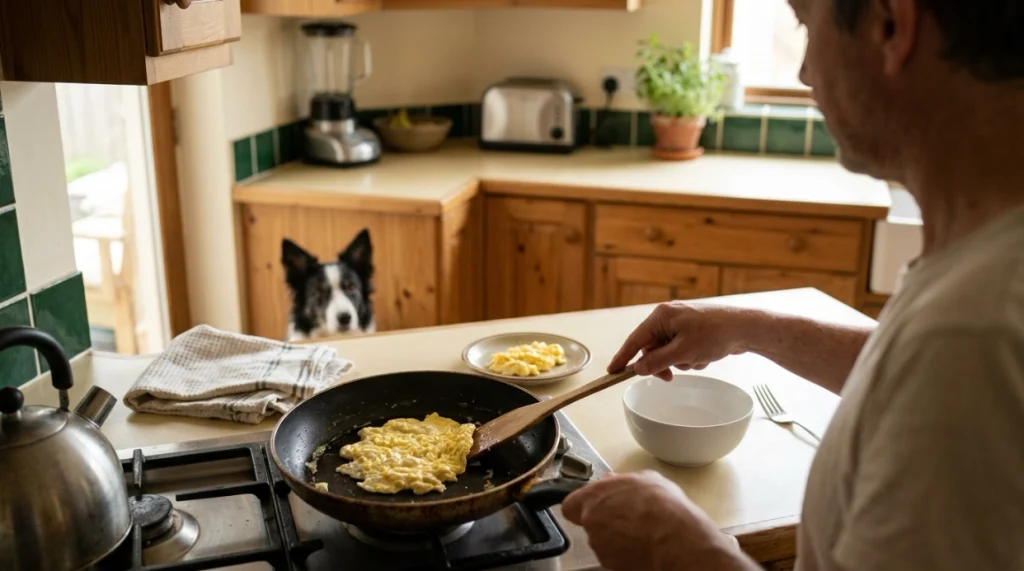
Cook the egg thoroughly in a plain nonstick pan, using no seasoning or added fat. Let it cool before serving.
You don’t need a special dog recipe. Simpler is better.
My simple method
- Crack one egg into a clean bowl.
- Beat it lightly with a fork.
- Pour it into a nonstick pan without butter or cooking oil.
- Cook it completely until there are no raw or runny areas.
- Let it cool to a comfortable temperature.
- Portion out only what your dog needs and refrigerate the remainder promptly.
I often break the cooked egg into tiny pieces. A Border Collie doesn’t need a large bite to consider something a valuable training reward.
That matters with this breed. Clever Collies can earn a surprising number of treats during a short training session.
What should you leave out?
A breakfast scramble made for humans can contain several ingredients your dog doesn’t need. Some ingredients also create genuine safety concerns.
- Salt: Unnecessary for a dog treat.
- Butter and oil: Add extra fat and calories.
- Cheese: Adds calories, fat, and dairy that may upset some dogs.
- Milk or cream: Can cause digestive trouble in dogs that don’t tolerate dairy well.
- Onion: Unsafe for dogs.
- Garlic: Also belongs to the Allium family and should be avoided.
- Hot sauce: Unnecessary and likely to irritate your dog’s digestive system.
The ASPCA list of people foods pets should avoid specifically warns about onions, garlic, excessive salt, and raw eggs.
How Much Scrambled Egg Can a Border Collie Eat?
For most healthy Border Collies, scrambled egg should remain an occasional treat rather than a daily food. Start with a small amount even if your dog could eventually tolerate more.
As of 2026, general veterinary nutrition guidance commonly recommends keeping all treats combined to roughly 10% or less of a dog’s daily calories. The remaining diet should come from complete, balanced food.
A practical portion guide
PetMD’s general egg guidance uses body size rather than breed. That approach makes sense because a 31-pound Border Collie and a 54-pound Border Collie don’t have identical needs.
| Dog size | General egg serving | General frequency | Border Collie context |
|---|---|---|---|
| 21–50 lb | Up to 1 egg | 1–2 times weekly | Covers many adult Border Collies |
| 51–90 lb | Up to 1½ eggs | 1–2 times weekly | Only the heaviest Border Collies enter this category |
These are broad guidelines, not targets. Your Border Collie doesn’t need to receive the maximum serving.
The PetMD egg-feeding guidance also recommends starting with a small portion and watching for digestive or allergic reactions.
What I would give the first time
I prefer caution with a new food. A spoonful or a few small pieces tells you more than immediately feeding a whole egg.
Watch your dog through the following day. Normal appetite, normal stool, and no unusual itching are reassuring signs.
- First introduction: A few small bites.
- Training reward: Tiny pieces mixed among normal treats.
- Meal topper: A small spoonful over regular food.
- Full egg: Only when it comfortably fits the dog’s overall diet and calorie needs.
Are Scrambled Eggs Nutritious for Border Collies?
Yes. Eggs provide useful protein, fats, vitamins, and minerals, but those nutrients don’t make eggs necessary when your Border Collie already eats a balanced diet.
Egg protein contains essential amino acids. These are building blocks the body uses for muscles, tissues, enzymes, and many normal processes.
What nutrients do eggs provide?
- Protein: Supports normal tissue maintenance and repair.
- Fat: Provides concentrated dietary energy.
- Vitamin A: Plays roles in vision, skin, and normal body function.
- Vitamin B12: Supports normal cell and nervous-system functions.
- Riboflavin: Helps normal energy metabolism.
- Selenium: An essential trace mineral.
- Iron: Supports normal oxygen transport and other body functions.
The ASPCA’s dog nutrition guidance includes eggs among animal protein sources while advising against raw eggs.
Still, more protein isn’t automatically better. Your Border Collie’s regular food should already be formulated to provide appropriate nutrients in the right proportions.
Do active Border Collies need extra eggs?
High activity does not automatically mean your dog needs human food. A working sheepdog, agility dog, or flyball competitor may have increased energy needs, but the whole diet should be adjusted thoughtfully.
Adding random extras can make calorie intake difficult to track. This is especially easy with food-motivated Border Collies that train several times each day.
On active training days, I prefer to count valuable food rewards as part of the day’s overall intake. Tiny egg pieces can provide motivation without turning a training session into a second meal.
Vet note: Ask your veterinarian about calorie and nutrient needs if your Border Collie works intensely, competes regularly, needs to gain weight, or needs to lose weight.
Can Border Collie Puppies Eat Scrambled Eggs?
Yes, Border Collie puppies can usually have a small amount of fully cooked, plain scrambled egg. Their balanced puppy food should still provide almost all their nutrition.
Puppies are growing quickly. That makes nutritional balance more important, not less.
Introduce egg gradually
Start with a tiny bite rather than a whole serving. Puppies can develop loose stool simply because a new food is richer or different from their normal diet.
- First taste: One or two tiny pieces.
- Observe: Watch stool, appetite, skin, and general behavior.
- Keep it plain: No seasoning, dairy, or cooking fat.
- Stay consistent: Don’t introduce several new foods on the same day.
Introducing one food at a time has a practical benefit. If your puppy develops diarrhea or itching, you have a better idea which new ingredient may be involved.
Use tiny pieces for training
Border Collie puppies learn fast, and food can be a powerful reinforcement tool. Small egg pieces can work for recall practice, handling exercises, crate games, or calm behavior.
Keep each piece tiny. Your puppy cares more about receiving the reward than its physical size.
I also alternate higher-value foods with regular kibble. That helps prevent an eager puppy from consuming a large amount of rich food during one session.
Vet note: Puppies with digestive problems, poor growth, food sensitivities, or a veterinary diet should receive new foods only with professional guidance.
When Should a Border Collie Avoid Scrambled Eggs?
Some Border Collies shouldn’t receive scrambled eggs without veterinary guidance. Health history matters more than breed enthusiasm for food.
Skip eggs or speak with your vet when your dog has:
- A known egg allergy: Avoid the ingredient completely unless your veterinarian says otherwise.
- A prescription diet: Extra foods can interfere with the purpose of a carefully controlled diet.
- Weight problems: Treat calories can make weight reduction harder.
- Recurring digestive trouble: Rich or unfamiliar food may worsen symptoms.
- A condition requiring fat restriction: Ask your veterinarian whether whole egg is suitable.
- An unexplained illness: Don’t use scrambled egg as a substitute for veterinary assessment.
What does an egg reaction look like?
A dog can react badly to almost any protein source, including egg. Digestive signs are among the easiest for owners to notice.
- Vomiting
- Diarrhea or unusually soft stool
- Repeated itching
- Red or irritated skin
- Hives or swelling
- Coughing or breathing difficulty
Stop offering the food if you suspect a reaction. Breathing difficulty, significant facial swelling, collapse, or severe symptoms require urgent veterinary care.
For routine feeding, the ASPCA also advises keeping people-food additions limited. Its general dog-care guidance notes that cooked egg can be offered while extras should remain a small part of the diet.
Vet note: Vomiting and diarrhea can have many causes. Persistent, severe, bloody, or recurring symptoms deserve veterinary attention rather than repeated diet experiments.
Scrambled vs Boiled vs Raw Eggs: Which Is Best?
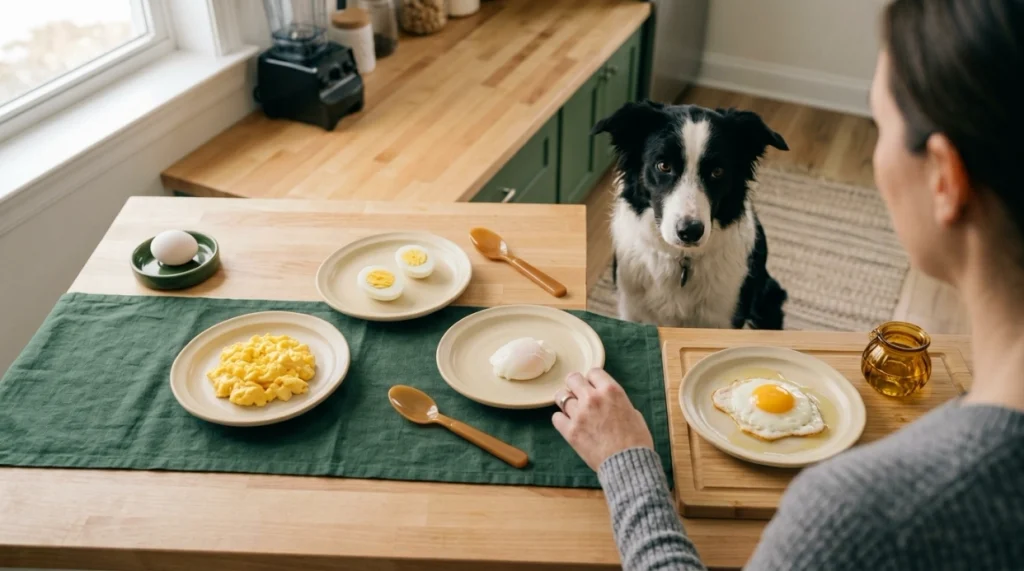
Plain scrambled, boiled, and poached eggs can all work for dogs when fully cooked. Raw egg carries unnecessary bacterial and nutritional risks.
| Egg preparation | Suitable? | Main consideration |
|---|---|---|
| Plain scrambled | Yes | Cook completely with no added ingredients |
| Hard-boiled | Yes | Easy to portion into small pieces |
| Poached | Yes | Cook yolk and white thoroughly |
| Fried | Not my first choice | Often prepared with unnecessary butter or oil |
| Raw or undercooked | Avoid | Bacterial contamination and raw egg-white concerns |
Why I like scrambled egg for training
Scrambled egg tears into soft, tiny pieces without much effort. That makes it convenient when I want a higher-value reward that a dog can swallow quickly.
Hard-boiled egg is less messy for pockets or a treat pouch. Both methods are reasonable if the egg is fully cooked and portions stay sensible.
Why raw egg isn’t worth the gamble
Raw eggs can contain harmful bacteria such as Salmonella. Raw egg white also contains avidin, which can interfere with biotin absorption when consumed in problematic amounts.
Cooking removes the reason to take that risk. A Border Collie receives the enjoyment of egg without needing it served raw.
Vet note: Raw feeding involves broader nutritional and food-safety considerations. Discuss a raw diet with a veterinarian or veterinary nutrition professional rather than adding individual raw ingredients casually.
Frequently Asked Questions
Can Border Collies eat scrambled eggs every day?
Scrambled egg is better treated as an occasional extra rather than an automatic daily addition. Daily feeding can add unnecessary calories and displace balanced dog food, especially when your Border Collie also receives training treats, chews, and table-food extras.
Can Border Collies eat scrambled eggs with milk?
Plain egg is the safer choice. Milk isn’t necessary, and some dogs don’t digest lactose well, so adding dairy can turn an otherwise simple treat into a cause of gas, loose stool, or stomach discomfort.
Can Border Collies eat scrambled eggs with cheese?
A tiny amount of cheese isn’t automatically dangerous to every healthy dog, but it adds fat, calories, sodium, and dairy. I would leave it out and give plain scrambled egg instead.
Can Border Collies eat scrambled eggs with butter?
It’s better to cook your dog’s portion without butter. Butter adds concentrated fat and calories without providing a meaningful advantage, and richer foods can upset some dogs’ stomachs.
Can a Border Collie eat a whole scrambled egg?
Many healthy adult Border Collies fall within a body-size range where a whole egg can fit as an occasional treat. That doesn’t mean every dog needs one, so consider body weight, other treats, activity, health, and daily calories.
Are scrambled eggs good for a Border Collie with an upset stomach?
Plain cooked egg may be tolerated by some dogs, but vomiting or diarrhea shouldn’t automatically be treated with eggs. Digestive problems have many causes, so contact your veterinarian if symptoms are severe, recurring, prolonged, or accompanied by other signs of illness.
Can Border Collies eat eggshells?
I wouldn’t add eggshells simply because they’re available. Calcium supplementation can unbalance a complete diet, and your dog’s need depends on the entire feeding plan, so use eggshell or calcium supplements only with veterinary guidance.
Final Takeaway
Yes, Border Collies can eat scrambled eggs. The safest version is fully cooked, completely plain, cooled before serving, and offered in a portion that fits the dog’s overall diet.
A few pieces can make an excellent high-value reward for a food-motivated Collie. Eggs can also work as an occasional meal topper when your dog tolerates them well.
- Cook thoroughly.
- Skip butter, oil, salt, milk, cheese, onion, garlic, and seasoning.
- Introduce egg in a small amount.
- Keep treats within a sensible calorie allowance.
- Watch for digestive or allergic reactions.
- Ask your veterinarian when health conditions or prescription diets are involved.
If your Border Collie already eats a complete diet, don’t think of scrambled egg as something they need. Think of it as a useful occasional treat that can make training or mealtime a little more interesting.
