
Can You Socialize an Older Dog? A Practical Guide for Adult and Senior Dogs

Yes — in many cases, you can socialize an older dog. For this topic, “older” usually means an adult dog past puppyhood, roughly 1 year and up, though behavior matters more than age alone. But the goal is usually not to turn a fearful adult or senior dog into a social butterfly. The real goal is simpler and more useful: help the dog feel safer, calmer, and more capable around the people, dogs, sounds, and places that currently trigger stress.
That distinction matters. Older dogs often can learn new emotional associations, but they usually need more patience, more structure, and a slower pace than puppies. As Guide Dogs explains, socializing an older dog is similar to training a younger dog, but it often takes more patience and encouragement. In practice, progress is possible, but it is often gradual rather than quick or perfectly linear.
If you only remember one rule, make it this: do not try to “fix” an older dog by throwing them into the very situations they fear. That usually creates more fear, not less.
What Socialization Means for Adult and Senior Dogs
With puppies, socialization is about shaping early impressions before fear habits harden. With adult and senior dogs, socialization is different. You are not just introducing novelty; you are changing how the dog feels about novelty.
For an older dog, socialization usually means helping them:
- stay calm around new people
- tolerate or eventually enjoy the presence of other dogs
- relax in unfamiliar environments
- cope better with sounds, movement, and handling
That is behavior change with an emotional component. It is not the same thing as obedience. A dog can sit, lie down, or walk on a loose leash and still feel panicked inside. Obedience helps you manage the dog. Socialization and behavior modification help change the dog’s underlying response.
In other words, socialization for older dogs usually means increasing tolerance and comfort, not forcing social enthusiasm. That is why some dogs seem “well-trained” but still explode when a stranger reaches toward them, or when another dog appears at the end of the street.
Is Your Dog Under-Socialized, Fearful, Reactive, or Aggressive?
Before you choose a plan, you need to understand what you are actually dealing with. The safest approach depends on whether the dog is under-socialized, fearful, reactive, or showing defensive aggression.
| Pattern | What it often looks like | What usually drives it | Best first move |
|---|---|---|---|
| Under-socialized | Uncertain, awkward, avoidant, slow to warm up | Lack of exposure and practice | Gentle exposure with distance and rewards |
| Fearful | Hiding, trembling, freezing, trying to escape | Anxiety about people, dogs, places, or sounds | Lower intensity, build safety first |
| Reactive | Barking, lunging, pulling, over-arousal | Fear, frustration, or excitement spilling over | Manage distance and work below threshold |
| Defensive aggression | Growling, snapping, biting, hard staring, blocking access | The dog feels unsafe and is trying to create space | Professional help and strict safety management |
A fearful dog is not automatically aggressive. A reactive dog is not automatically “bad.” And an under-socialized dog is not always scared; sometimes they are simply unpracticed and unsure.
The practical test is this: if your dog improves when you add distance, reduce pressure, and pair the trigger with food, you are probably dealing with a dog that can learn through careful exposure. If the dog escalates even when you make the situation easier, you may be looking at a more serious fear or aggression problem that deserves professional input.
How Adult Dog Socialization Differs from Puppy Socialization
Adult and senior dogs learn differently because their emotional history is already written.
Puppies are still forming many of their default responses. Older dogs already have habits, expectations, and sometimes bad experiences layered in. That means they may need:
- more repetitions to feel safe
- more distance from the trigger
- more predictable setups
- smaller steps between “too hard” and “easy enough”
The biggest mistake people make is flooding. Flooding means forcing the dog into a feared situation and hoping exposure alone will make it better. It often does the opposite. Zoom Room gives clear examples of this, such as taking a dog-reactive dog to a crowded dog park or forcing a sound-sensitive dog to sit next to a parade. That is not socialization. It is overwhelm.
Older dogs can absolutely improve, but they usually improve faster when the work is quiet, controlled, and repeatable.
How to Read Stress Signals and Know When Your Dog Is Over Threshold
Threshold is the point where the dog stops learning and starts reacting. Once a dog is over threshold, you are no longer teaching; you are just surviving the moment.
Early stress signals are easy to miss if you only watch for barking or lunging. Look for:
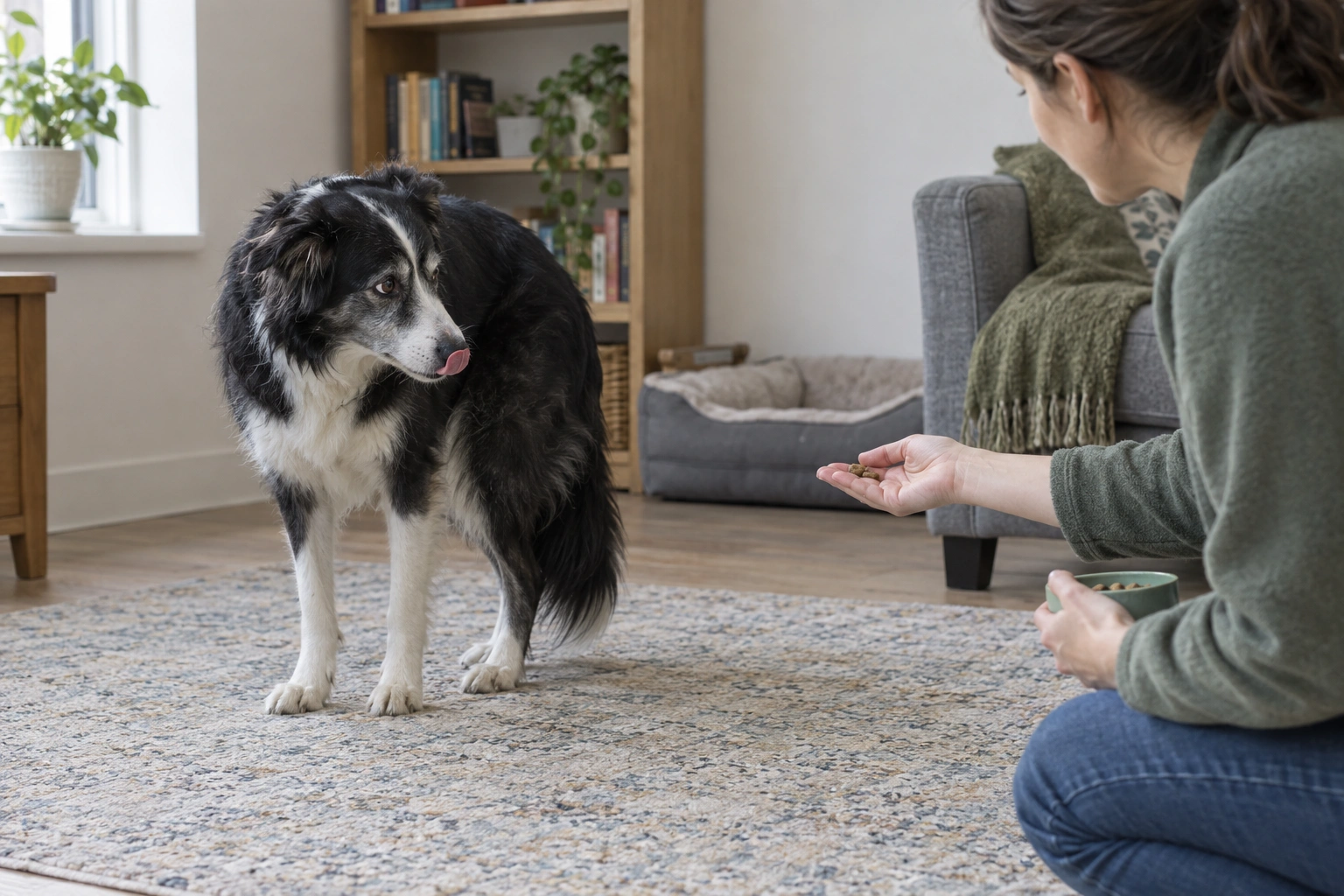
- turning the head away
- lip licking
- yawning when not tired
- freezing
- stiff posture
- whale eye
- tucked tail
- scanning or hypervigilance
- trying to move behind you
- refusing food
Those are useful because they show stress before the dog blows up. If you wait for barking or lunging, you have already waited too long.
A simple rule works well in practice: if your dog can still take food, look around, and recover after seeing the trigger, you are probably in a workable zone. If they cannot eat, cannot disengage, or keep escalating, the setup is too hard.
Here is where many owners accidentally set training back: they think the dog is “getting used to it” because the dog is quiet. But a shut-down dog is not relaxed. A still, tense dog is often more stressed than a noisy one.
The Core Method: Desensitization, Counterconditioning, and Positive Reinforcement
This is the framework that actually changes emotional responses.
Desensitization
Desensitization means exposing the dog to a version of the trigger that is mild enough not to trigger panic. For example, a dog who barks at strangers may start by seeing a person at a distance where the dog can remain calm.
Counterconditioning
Counterconditioning means pairing the trigger with something the dog likes, usually food. The appearance of the trigger predicts something good. Over time, the trigger starts to feel less threatening and more neutral.
Positive reinforcement
Positive reinforcement means rewarding the behavior you want to see more of — calm observation, looking back at you, choosing to disengage, or settling.
The timing matters. The treat should arrive while the trigger is present or right after the dog notices it, while the dog is still calm enough to make the connection. The dog is learning associations, not just random snack delivery.
This is also why distance matters so much. Distance is not avoidance; it is a training tool. If the dog can stay under threshold at 30 feet, you have a chance to build a new response. At 5 feet, you may just be rehearsing panic.
What to Socialize First: People, Dogs, or the Environment
Do not try to fix everything at once. Pick the biggest trigger first.
If your dog is most worried about strangers, work on people before dog greetings. If dog encounters are the main problem, do not start with crowded parks. If the dog is mostly overwhelmed by sound or movement, build confidence in quieter environments before adding social pressure.
A useful priority order is:
- the trigger that creates the biggest daily problem
- the trigger you can control most easily
- the trigger that allows the dog to stay calm enough to learn
For example, a Border Collie who barks at passing dogs on walks may not be ready for direct greetings, but could learn to watch dogs calmly from across a parking lot. That is useful progress. It also keeps the dog from practicing the wrong behavior.
A body-language clue can help with priorities: if the dog stiffens, stares, or fixates on people, start with people; if they spin, bark, or lunge at dogs, start with dog distance; if they startle at noises or busy movement, start with environmental triggers first.
Step-by-Step: Safely Socializing an Older Dog at Home
This is the version I recommend when the dog is safe enough to work at home and the problem is not severe aggression.
1. Set up an easy version of the trigger
Choose a distance, environment, or intensity level where your dog can notice the trigger without melting down. For people, that might mean a guest standing still across the room. For dogs, it may mean watching another dog from a long distance. For sounds, it may mean a recording played very softly.
2. Pair the trigger with something valuable
Use food your dog actually wants. If the dog is too stressed to eat, the setup is too hard.
3. Keep sessions short
A few calm minutes is better than a long session that ends in barking or retreat. End while the dog is still successful.
4. Repeat the same easy setup
Repetition builds confidence. Do not raise the difficulty just because the dog succeeded once.
5. Increase only one variable at a time
Move the trigger slightly closer, add mild motion, or extend the duration — not all three together.
6. Watch recovery, not just reaction
The dog should bounce back quickly after seeing the trigger. If recovery gets slower, you are progressing too fast.
7. Generalize slowly
A dog who can relax with one quiet visitor is not automatically ready for five guests, a busy sidewalk, or a crowded patio. Each new version is a new lesson.
A practical example: if your dog is nervous around visitors, ask one calm friend to enter, ignore the dog, and toss treats gently on the floor. No reaching. No leaning over. No eye contact pressure. That setup often works better than direct petting because it gives the dog control.
How Long Does It Take to Socialize an Older Dog?
There is no honest one-size-fits-all timeline. Some dogs show small improvement in a few sessions. Others need weeks or months of careful work. A dog with a long history of fear, little early exposure, or repeated bad experiences will usually take longer than a dog who is simply rusty and under-practiced.
A realistic example: a mildly under-socialized dog might become noticeably more comfortable with one trigger in a few weeks, while a moderately reactive dog may need several months of structured work, and a severely fearful or aggressive dog may need a longer plan with professional support.
Progress is usually faster when:
- the dog can stay under threshold
- the trigger is predictable
- the owner can control distance
- the dog is food-motivated in the setup
- the sessions are frequent and calm
Progress slows when:
- the dog is repeatedly flooded
- the trigger appears unpredictably
- the dog has already rehearsed reactive behavior many times
- the owner expects direct contact too soon
The key is to judge progress by emotional change, not just by whether the dog “tolerates” the situation. A dog that stops barking because they are shut down is not the same as a dog that is truly becoming comfortable.
Common Mistakes That Make Fear or Reactivity Worse
A few errors show up again and again.
Forcing greetings
Do not make a dog meet people or dogs “to get over it.” That often teaches the dog that their discomfort will be ignored.
Using punishment for fear
Corrections can suppress warning signals without changing the underlying fear. That is dangerous because the dog may stop growling and go straight to biting.
Confusing obedience with social confidence
A dog can “sit” for a stranger and still be terrified. Compliance is not the same as comfort.
Moving too fast
If the dog had one good day, resist the urge to jump to the hardest version of the trigger.
Letting other people break your plan
Well-meaning strangers often ruin progress by reaching, talking loudly, or trying to pet the dog. Protect the training space.
When Temporary Avoidance Is the Right Choice
Avoidance sometimes gets a bad reputation, but temporary avoidance is not failure. It is often smart management.
If your dog is overwhelmed by dog parks, festivals, parades, or crowded patios, the correct move may be to avoid those settings for now. That prevents the dog from rehearsing panic while you build confidence in easier contexts.
This is especially important for reactive dogs. A dog who is not ready for direct dog contact does not need more “practice” at the wrong distance. They need a safer plan.
Think of avoidance as buying time. You are not giving up on socialization; you are preventing damage while you work on the foundation.
When to See a Veterinarian or Certified Trainer
Get help sooner rather than later if you see:
- biting or attempted biting
- repeated snapping
- intense fear that does not improve with distance
- escalating reactivity despite careful work
- guarding behavior
- panic, shutdown, or escape attempts
- a history of trauma or unknown background plus serious fear
A certified dog trainer with behavior experience can help you build a structured plan. A veterinary behaviorist becomes especially important when aggression is escalating, fear is generalized across many settings, or the dog cannot stay under threshold even at significant distance. In some cases, medication may be part of the plan, but that is a veterinary decision, not a training shortcut.
If you are unsure whether your dog is fearful, reactive, or aggressive, that is exactly the kind of uncertainty a professional can help sort out. Guessing wrong can waste months.
Border Collie and Other Sensitive Dogs: Why Breed Tendencies Can Matter
Border Collies often bring extra sensitivity to the table. Many are highly observant, quick to notice movement, and prone to arousal if the environment is busy or unpredictable. That does not mean a Border Collie is destined to be reactive. It does mean you should be careful about overloading them.
For a sensitive dog, the line between alert and overwhelmed can be thin. A Border Collie may look “fine” until the moment they are not. That is why distance, predictability, and calm repetition matter so much.
These dogs often do best when you give them a job during socialization: watch, settle, look back at me, take a treat, move away, repeat. That structure gives the brain something to do besides scanning for threats.
The same logic applies to other sensitive or high-drive dogs. High intelligence does not cancel fear. In some dogs, it makes them better at noticing everything that feels wrong.
The Bottom Line
So, can you socialize an older dog? In many cases, yes. But adult and senior dogs usually need a slower, safer, more individualized process than puppies do. The goal is not to force friendliness. The goal is to change how the dog feels, one controlled experience at a time.
If you work below threshold, use positive reinforcement, and respect the dog’s pace, many older dogs become noticeably calmer and easier to live with. Some will never love every stranger or every dog they meet. That is fine. Success is not a social butterfly. Success is a dog that feels safer in the world.
FAQs
Can an older dog become friendly?
Yes, many older dogs can become noticeably friendlier or at least more comfortable. The outcome depends on the dog’s history, temperament, and how much fear is involved.
Is socialization the same as obedience?
No. Obedience teaches behaviors like sit or stay. Socialization and behavior modification change how the dog feels about people, dogs, sounds, and places.
Should I let my dog meet other dogs to help?
Not if your dog is reactive, fearful, or uncertain. Direct greetings are often too intense at first. Controlled distance usually works better.
What if my dog won’t take treats?
That usually means the setup is too hard. Increase distance, reduce noise, or simplify the environment until the dog can eat again.
How do I know if I should stop a session?
Stop if your dog freezes, escalates, refuses food, cannot recover, or starts showing stronger stress signals. Ending early is better than pushing through.
Can I do this without a trainer?
Sometimes, yes, if the behavior is mild and the dog is safe. If there is biting, severe fear, or persistent reactivity, bring in a qualified professional.
Are Border Collies harder to socialize?
Not always, but many are more sensitive and more easily over-aroused. That means they often need cleaner setups and more careful pacing.
Does socialization mean my dog will love everyone?
No. A realistic win is a dog that can stay calm, recover faster, and handle normal life without constant stress.
How long does it take?
It varies widely. Mild cases may improve in a few weeks, moderate cases often take months, and severe fear or aggression may require a longer plan with professional help.
Is it too late to socialize a senior dog?
Usually not. It may be slower, and the goals may be smaller, but many senior dogs can still learn safer responses with the right plan.
Recommended reading
For related help, see our guide on Border Collie reactivity and how to calm a reactive dog. If you are deciding when professional support is needed, our article on when to hire a dog trainer may also help.
