
Do Border Collies Get Jealous? Signs, Causes, and What to Do

Quick Answer
Yes, Border Collies can show behaviors that look like jealousy when your attention shifts to another dog, pet, person, or baby. These reactions may include pushing between you, whining, pawing, barking, staring, or guarding access to you, although veterinary guidance on dog behavior also reminds us that anxiety, learned attention-seeking, and resource guarding can look similar.
Common signs to watch for
- Blocking access: Your Border Collie wedges between you and another dog or person.
- Demanding attention: Pawing, nudging, barking, or bringing toys increases when you focus elsewhere.
- Close shadowing: Your dog suddenly follows you or presses against your legs.
- Hard watching: Your Border Collie closely monitors the person or pet receiving your attention.
- Guarding behavior: Growling, freezing, or blocking may appear when another animal approaches you.
How to verify the pattern
- Watch whether the behavior reliably appears when your attention moves to a perceived rival and fades when that situation ends.
Border Collies, often called Borders or BCs, form intense working relationships with people. That closeness can make attention-related behavior especially noticeable when something changes in the household.
I don’t assume every push, bark, or stare means jealousy. Context matters more than the label, and this guide shows you how to tell the difference.
In This Guide
- What Does Jealousy Look Like in a Border Collie?
- Why Do Border Collies Act Jealous?
- Is It Jealousy, Resource Guarding, or Attention-Seeking?
- What Usually Triggers Jealous Behavior?
- How Do You Stop Jealous Behavior in a Border Collie?
- What If Your Border Collie Is Jealous of Another Dog?
- What If Your Border Collie Is Jealous of a Partner or Baby?
- When Should Jealous Behavior Concern You?
- Frequently Asked Questions
What Does Jealousy Look Like in a Border Collie?
Jealousy-like behavior usually appears when a Border Collie believes another individual is competing for something valuable. In this case, that valuable resource is often your attention or physical closeness.
A Border Collie’s jealousy-like behavior is a pattern of actions aimed at interrupting, monitoring, or changing an interaction between a valued person and a possible social rival.
The word pattern matters. One paw on your knee isn’t enough to diagnose anything.
Physical interruption is one of the clearest clues
A Border Collie may walk between you and another dog while you’re petting it. Some BCs use their shoulder, nose, or whole body to reclaim space beside you.
Others become more subtle. They may rest their chin on your leg or quietly insert themselves beneath your hand.
Attention-seeking can suddenly increase
- Pawing: Your dog repeatedly touches your arm or leg.
- Nudging: The nose goes under your hand to redirect petting.
- Vocalizing: Whining or barking begins during another interaction.
- Showing off: Your Border Collie suddenly offers familiar tricks without being asked.
- Toy delivery: A ball appears whenever you start interacting with someone else.
I pay close attention to timing. If the behavior starts almost every time another dog receives affection, the trigger tells us more than the behavior alone.
Watch the quieter body-language signals too
Some Border Collies don’t barge into the interaction. Instead, they become still and watch closely.
- Closed mouth and fixed gaze
- Body becoming stiff
- Repeated lip licking
- Turning the head while continuing to watch
- Moving closer to the owner
- Positioning the body between individuals
These signs don’t automatically mean aggression. They tell you your dog may be uncomfortable, aroused, or uncertain.
Why Do Border Collies Act Jealous?
Border Collies aren’t proven to be inherently more jealous than other breeds. However, their intense handler focus, intelligence, sensitivity, and working heritage can make changes in social attention hard to miss.
The American Kennel Club describes the Border Collie as an energetic, intelligent, responsive herding breed. Those traits help explain why Borders closely notice changes in routines and human behavior.
They were bred to watch people closely
Traditional stock work requires a dog to monitor livestock while also remaining responsive to its handler. That creates an unusually attentive working style.
A family Border Collie may apply that same observation skill indoors. Your dog notices who gets touched, who receives treats, and where your attention goes.
Attention itself can become rewarding
Imagine your Border Collie pushes between you and another dog. You laugh, pet the Collie, and say its name.
The dog may learn that pushing works. What began as uncertainty can become a rehearsed attention-seeking habit.
Boredom can amplify the behavior
A mentally satisfied Border Collie has other rewarding activities available. An under-stimulated dog may become far more invested in every movement you make.
- Short training sessions
- Sniffing walks
- Food puzzles
- Structured tug or fetch
- Herding-style games with clear rules
- Settling practice after activity
As of 2026, there still isn’t good evidence showing that Border Collies as a breed experience more jealousy than every other dog. Individual temperament, learning history, household structure, and stress matter greatly.
Is It Jealousy, Resource Guarding, or Attention-Seeking?
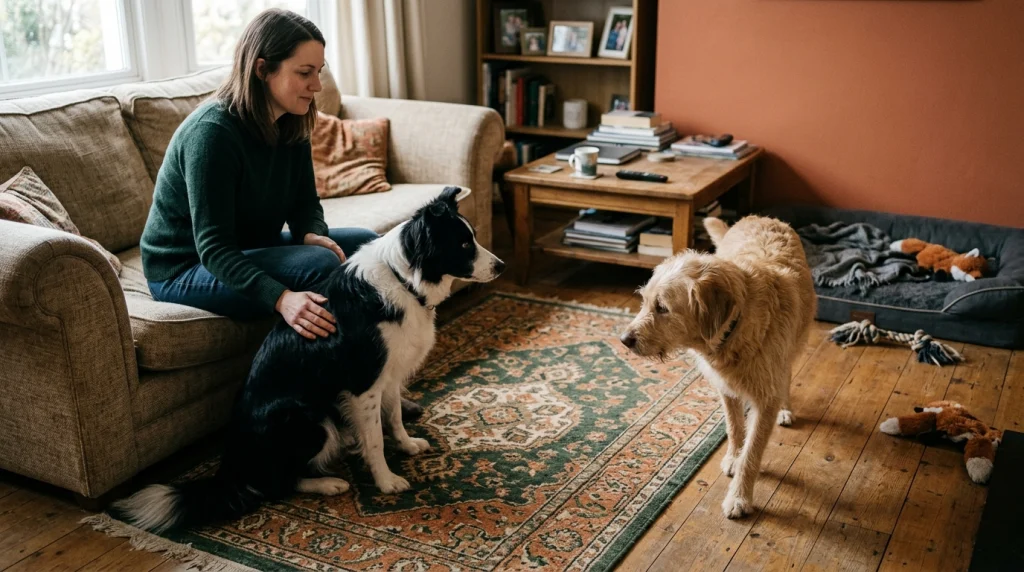
Several behaviors can look almost identical from across the room. The best clue is what happens immediately before the behavior and what the dog appears to gain from it.
| Behavior pattern | Typical trigger | Common signs | Best first response |
|---|---|---|---|
| Jealousy-like behavior | Owner gives social attention elsewhere | Blocking, nudging, monitoring, whining | Reward calm behavior around shared attention |
| Resource guarding | Someone approaches a valued item, place, or person | Freezing, hard stare, growling, snapping | Prevent conflict and get qualified behavior help |
| Learned attention-seeking | Dog wants interaction | Pawing, barking, toy dropping, nudging | Reward calm alternatives instead |
| Separation-related distress | Owner leaves or becomes inaccessible | Pacing, vocalizing, inability to settle | Discuss persistent distress with a vet or behavior professional |
Resource guarding deserves extra caution
Dogs can guard food, toys, beds, resting areas, and sometimes people. The ASPCA provides behavior guidance explaining why guarding valued resources can become a safety problem.
If your Border Collie freezes or growls when another pet approaches you, don’t punish the warning. Punishment can suppress communication without changing the dog’s underlying discomfort.
The safer goal is changing the emotional response while preventing situations that lead to conflict.
What Usually Triggers Jealous Behavior?
Jealous behavior often appears after something changes. The trigger may be obvious, but sometimes it’s a small routine shift that owners overlook.
A new puppy or adult dog
This is one of the easiest situations to recognize. Your established Border Collie suddenly has to share attention, space, toys, walks, and training time.
Even a social dog may need time to adjust. Avoid forcing instant friendship.
A cat or other household pet
Jealousy-like reactions aren’t limited to other dogs. A Border Collie may interrupt when you stroke a cat or allow another pet onto the sofa.
A new partner
Your routine may change when another person begins spending more time in the home. The dog may lose familiar one-on-one time without anyone intentionally reducing it.
A new baby
Babies bring new smells, noises, furniture, visitors, and schedules. They also change where an owner’s hands and attention go.
Prepare your Border Collie gradually instead of waiting until the baby’s arrival.
Changes in work or daily routines
- Returning to an office
- Working from home
- Starting school
- Moving house
- Changing walking schedules
- Hosting long-term guests
Border Collies are excellent pattern learners. When a predictable day suddenly changes, some dogs need help learning the new routine.
How Do You Stop Jealous Behavior in a Border Collie?
Don’t focus on proving whether your Border Collie feels human-style jealousy. Focus on teaching a safe, calm response when your attention goes elsewhere.
1. Identify the exact trigger
Keep a simple log for several days. Note who was present, what happened immediately before the behavior, and what your dog did next.
A clear pattern often appears quickly.
2. Stop accidentally rewarding interruptions
If pawing always earns petting, pawing becomes useful. If barking makes the other dog leave, barking becomes useful too.
Instead, reward a behavior you can live with.
- Sitting beside you
- Lying on a mat
- Looking at you calmly
- Waiting without pushing
3. Practice tiny doses of divided attention
Start with an easy situation. Ask your Border Collie to settle, give another person or pet one or two seconds of attention, then reward your dog for staying calm.
Gradually increase the duration. Keep early sessions around three to five minutes so frustration doesn’t build.
4. Teach a reliable station behavior
A mat, bed, or specific position gives an intelligent Border Collie a clear job. “Go to your mat” is easier to understand than “don’t be jealous.”
Reward the dog frequently at first. Then slowly increase the time between rewards.
5. Protect daily one-on-one time
Shared households work better when each dog still receives individual interaction. Even 10 to 15 focused minutes can create a predictable routine.
Use that time for training, sniffing, gentle play, or grooming your dog enjoys.
6. Meet the Border Collie’s mental needs
Physical exercise alone isn’t enough for many BCs. Problem-solving and controlled training help channel their intense attention.
- Two or three short skill sessions
- Food-search games
- Pattern games around distractions
- Impulse-control exercises
- Age-appropriate physical activity
- Planned quiet time
Section Takeaway: Reward calm behavior before your Border Collie feels forced to compete for attention. Small, repeatable training sessions work better than confronting the dog after it becomes upset.
What If Your Border Collie Is Jealous of Another Dog?
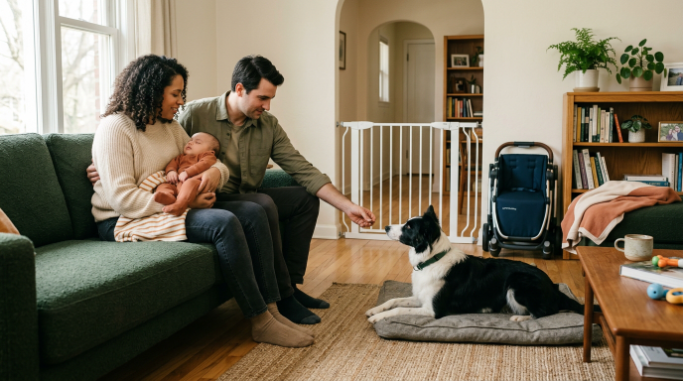
Manage resources first and train second. Preventing repeated conflict keeps both dogs from rehearsing aggressive or pushy behavior.
Give each dog protected resources
- Separate feeding locations
- Individual resting spaces
- Separate high-value chews
- Individual training sessions
- Enough toys for comfortable interaction
Don’t make dogs compete over scarce high-value items. Remove the trigger when you can’t supervise safely.
Reward both dogs for calm coexistence
One useful exercise is parallel settling. Place each dog on a separate mat several feet apart and reward relaxed behavior.
Short sessions are enough at first. Your goal is calm predictability, not forced closeness.
Be careful when your dog appears to guard you
A Border Collie that stiffens, growls, or snaps when another dog approaches your chair may be showing possessive behavior rather than harmless jealousy. VCA Animal Hospitals offers veterinary behavior information on resource-related aggression.
Don’t test how far the dog will go. Use distance, barriers, and professional guidance when aggression is part of the pattern.
What If Your Border Collie Is Jealous of a Partner or Baby?
Create positive associations before demanding close interaction. Your Border Collie should learn that another person’s presence predicts good things rather than lost access to you.
For a new partner
- Let the partner participate in enjoyable walks.
- Have them deliver treats for calm behavior.
- Keep familiar routines where possible.
- Reward your Border Collie for relaxing while you sit together.
Avoid pushing physical affection onto a dog that wants space. Voluntary interaction builds better trust.
For a new baby
Start preparing before the baby comes home. Introduce new equipment, sounds, restricted areas, and schedule changes gradually.
Once the baby arrives, supervise every dog-baby interaction. Physical separation using gates or other secure barriers is often the simplest management tool.
Never assume a previously gentle dog should tolerate climbing, grabbing, or cornering. Children and dogs both need active adult supervision.
When Should Jealous Behavior Concern You?
Mild nudging or attention-seeking is usually manageable with training. Growling, snapping, biting, or rapidly escalating guarding deserves professional attention.
- Your Border Collie has bitten or attempted to bite.
- The dog guards you from children or other pets.
- Growling happens more frequently.
- The dog cannot settle when attention is divided.
- Behavior suddenly changes without an obvious reason.
- Two household dogs are repeatedly fighting.
Management is especially important around children. Don’t deliberately recreate aggressive situations to see whether your dog has improved.
Vet note: Sudden behavioral changes can sometimes accompany pain or other medical problems. Ask your veterinarian about any abrupt or unexplained change before treating it only as a training issue.
A qualified veterinary behaviorist or experienced reward-based behavior professional can help when safety is involved. Severe guarding is not a problem to solve through punishment or intimidation.
Frequently Asked Questions
Do Border Collies get jealous of other dogs?
Yes, Border Collies can show jealousy-like behavior when their owner gives another dog attention. Common reactions include pushing between you, staring, whining, nudging, or attempting to regain interaction.
Do Border Collies get jealous of a new puppy?
They can. A new puppy changes access to attention, toys, resting areas, training, and household routines, so introduce the dogs gradually and maintain individual time with your established Border Collie.
Why does my Border Collie push between me and another dog?
Your Border Collie may be seeking attention, interrupting a social interaction, or protecting access to something it values. Look for stiffness, growling, or snapping because those signs can indicate resource guarding rather than simple attention-seeking.
Are Border Collies possessive of their owners?
Some individuals can become possessive around a preferred person, but it isn’t accurate to assume all Border Collies behave this way. Temperament, previous learning, stress, socialization, and the dog’s environment all influence behavior.
Should I punish my Border Collie for growling at another dog?
No. Growling is an important warning signal that tells you the dog is uncomfortable. Create distance, prevent further conflict, and address the trigger with safe behavior modification rather than punishing the warning.
Will getting another dog help a clingy Border Collie?
Not necessarily. Another dog can provide companionship, but it can also create competition for attention and resources. Solve existing anxiety, guarding, or training problems before adding another pet specifically as a cure.
Can Border Collie jealousy go away?
Many jealousy-like behaviors improve when owners manage triggers and consistently reward calm alternatives. Progress depends on the cause, how long the behavior has been practiced, and whether fear, anxiety, or aggression is involved.
The main takeaway is simple: don’t argue with your Border Collie about jealousy. Watch the trigger, protect everyone from conflict, and teach your dog exactly what calm behavior earns attention.
When you make shared attention predictable instead of competitive, most Border Collies have a much easier job. That’s a language this intelligent herding breed understands well.