
Do Border Collies Like Other Dogs?

Quick Answer
Yes, many Border Collies like other dogs and can form close canine friendships. However, a Border Collie may also be selective, reserved, overly intense, or uncomfortable with certain dogs, so individual temperament matters more than assuming every BC will be social. The AKC’s guidance on dog selectivity explains why dogs can range from highly social to selective around other dogs.
What usually determines whether they get along?
- Early socialization: Positive puppy experiences can help a Border Collie feel comfortable around other dogs.
- Individual personality: Some Border Collies love playmates, while others prefer familiar dogs or extra personal space.
- Herding instinct: Staring, stalking, circling, and chasing can confuse dogs that dislike herding-style behavior.
- Energy match: Two active dogs may play beautifully, but mismatched play styles can cause tension.
- Past experiences: Frightening encounters can make an otherwise social Border Collie more cautious.
Best way to check
- Watch the whole body during a calm, controlled introduction rather than judging friendliness from a wagging tail alone.
Border Collies can be wonderfully social dogs, but they’re rarely simple about relationships. A Border Collie, often shortened to BC or simply “Border” by owners, tends to notice every movement another dog makes.
That sensitivity can create beautiful friendships or awkward interactions. In this 2026 guide, I’ll show you what friendly behavior looks like, how herding instinct affects play, and how to introduce dogs safely.
In This Guide
- Do Border Collies Usually Like Other Dogs?
- Why Do Some Border Collies Love Dogs While Others Don’t?
- How Does Herding Instinct Affect Other Dogs?
- How Can You Tell If a Border Collie Likes Another Dog?
- How Should You Introduce a Border Collie to Another Dog?
- Can Border Collies Live Happily With Another Dog?
- Border Collie vs Australian Shepherd vs Kelpie Social Style
- What If Your Border Collie Is Reactive Toward Other Dogs?
- Frequently Asked Questions
- The Bottom Line
Do Border Collies Usually Like Other Dogs?
Many Border Collies enjoy other dogs, especially when they receive good socialization and meet compatible playmates. Still, being a Border Collie doesn’t automatically make a dog friendly with every canine they encounter.
Definition: A Border Collie’s dog sociability is their individual comfort, interest, and behavior when sharing space or interacting with other dogs.
The breed’s working background matters. Border Collies were developed to control livestock through observation, movement, responsiveness, and intense concentration.
- Some are highly social: They eagerly play with familiar dogs and politely meet newcomers.
- Some are dog tolerant: They coexist comfortably but don’t seek much interaction.
- Some are selective: They like particular dogs but dislike rough or unfamiliar playmates.
- Some are uncomfortable: Fear, frustration, guarding, or past experiences can make interactions difficult.
The American Kennel Club’s Border Collie profile describes the breed as intelligent, energetic, and strongly work-oriented. Those traits often influence how a Border Collie approaches social situations.
I don’t judge a Border Collie’s social ability by whether they charge toward other dogs. Calmly ignoring another dog can be an excellent social skill.
Why Do Some Border Collies Love Dogs While Others Don’t?
Border Collies differ because canine sociability develops from several influences. Breed tendencies matter, but personality and experience matter too.
Early experiences with other dogs
A puppy that meets calm, appropriate dogs can learn valuable communication skills. The goal isn’t to make the puppy greet every dog they see.
Instead, good socialization teaches the puppy that other dogs are normal. They can observe one without becoming frightened or wildly excited.
Temperament and maturity
A playful puppy may become more selective as adulthood approaches. That change doesn’t automatically mean something went wrong.
- Young puppies often seek frequent play.
- Adolescents may become more excitable or intense.
- Adults may prefer specific companions.
- Older dogs may have less patience for chaotic puppies.
Previous negative encounters
One frightening confrontation can influence future behavior. A sensitive Border Collie may remember a dog that rushed, pinned, or frightened them.
After a bad encounter, I would choose controlled distance and calm exposure over forcing another greeting. Confidence grows better when the dog still has choices.
How Does Herding Instinct Affect Other Dogs?
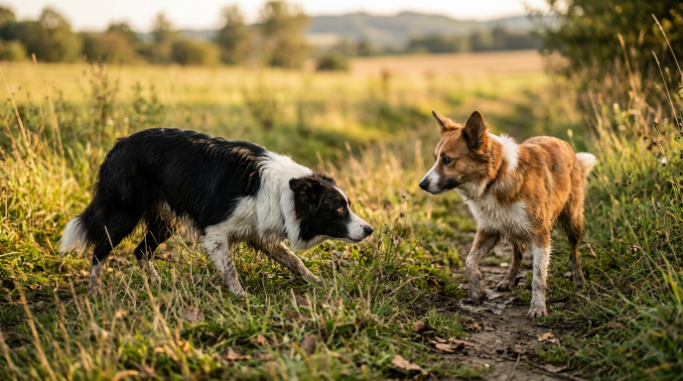
A Border Collie’s herding instinct can strongly shape canine play. Their normal working behaviors may look rude or threatening to dogs unfamiliar with that style.
The classic Border Collie “eye” is an intense fixed stare used while controlling livestock. During play, some Borders also crouch, stalk, chase, circle, or cut across another dog’s path.
Behaviors another dog may misunderstand
- Hard staring: Another dog may interpret prolonged eye contact as social pressure.
- Low stalking: A crouching Border Collie can look predatory even when trying to start a chase.
- Fast pursuit: Constant chasing can overwhelm a slower or less confident dog.
- Body blocking: Cutting off movement may frustrate a dog that wants space.
- Heel-focused behavior: Some Borders try to control movement around running dogs.
Good play should have give-and-take. Both dogs should get opportunities to chase, pause, investigate, and disengage.
If one Border Collie spends the entire session controlling the other dog’s movement, I interrupt the game. A short reset often prevents arousal from climbing too far.
How Can You Tell If a Border Collie Likes Another Dog?
A comfortable Border Collie usually shows loose, flexible body language and voluntarily returns to the interaction. Look at the entire dog rather than one signal.
Positive signs
- Loose movement: The body looks curved and relaxed rather than rigid.
- Play bows: The front drops while the rear stays raised.
- Taking turns: Both dogs switch roles during chasing or wrestling.
- Voluntary pauses: They can stop briefly without immediately restarting conflict.
- Curved approaches: They approach from an angle rather than marching directly face-to-face.
- Easy disengagement: Your Border Collie can leave the interaction without being pursued constantly.
Signs your Border Collie needs more space
- Freezing or suddenly becoming stiff
- Repeatedly trying to move away
- Hiding behind you
- A hard, unbroken stare
- Raised lips or exposed teeth
- Persistent growling with tense posture
- Repeated snapping
- Chasing that becomes one-sided and relentless
A wagging tail doesn’t guarantee friendliness. Tail height, body tension, facial expression, and movement provide important context.
How Should You Introduce a Border Collie to Another Dog?
Start introductions slowly in a neutral outdoor space. Parallel movement is usually easier than forcing two unfamiliar dogs into an immediate face-to-face greeting.
The current PetMD dog-introduction guidance recommends controlled introductions and parallel walking. It also suggests allowing plenty of distance at the beginning.
A simple first-meeting routine
- Choose neutral ground. Avoid starting inside either dog’s home or favorite yard.
- Use secure equipment. Each handler should control one dog with suitable walking gear.
- Begin around 30 feet apart. Increase that distance if either dog becomes tense or fixated.
- Walk in the same direction. Reward calm attention and relaxed movement.
- Gradually reduce distance. Move closer only while both dogs remain comfortable.
- Allow a brief greeting. Keep the first contact short instead of demanding prolonged interaction.
- Resume walking. Movement helps reduce social pressure.
| Stage | Practical Setup | What You Want to See |
|---|---|---|
| First sight | Start around 30 feet apart when space allows | Able to look away and keep moving |
| Parallel walk | Walk in the same direction | Loose bodies and decreasing fixation |
| Closer approach | Reduce distance gradually | Curved approaches and relaxed sniffing |
| Greeting | Keep first contact brief | Both dogs can disengage voluntarily |
Don’t rush because the dogs appear excited. Excitement and comfort aren’t always the same thing.
Can Border Collies Live Happily With Another Dog?
Yes, many Border Collies live successfully with another dog. Compatibility usually depends more on temperament, play style, resources, and household management than breed alone.
Look for compatible energy rather than identical energy
A second high-energy dog can be a great companion. It can also create twice the arousal if neither dog knows how to settle.
I prefer a dog that complements the Border Collie’s personality. A confident but socially polite companion often works better than another dog that constantly demands intense play.
Protect important resources at first
- Feed dogs separately.
- Give each dog their own resting place.
- Supervise high-value chews.
- Put exciting toys away during early meetings.
- Give each dog individual training time.
- Don’t force them to share beds or crates.
Also remember that a second dog doesn’t replace human interaction. Border Collies still need individual training, structured activity, and mental work.
Adult dog or puppy?
A puppy isn’t automatically easier. Some adult Border Collies enjoy puppies, while others find their constant biting and movement exhausting.
A calm adult with proven dog skills may sometimes be the easier match. Introduce any candidate before assuming the relationship will work.
Border Collie vs Australian Shepherd vs Kelpie Social Style
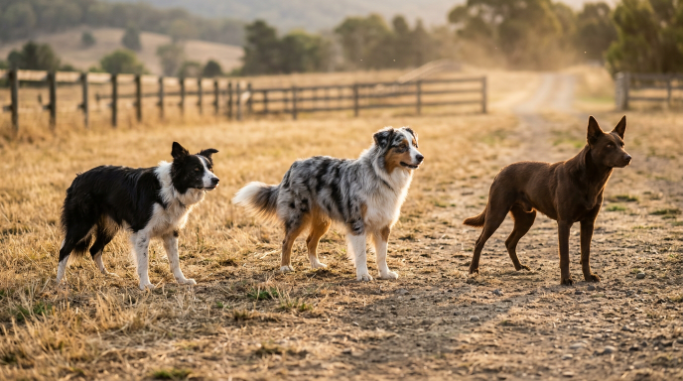
Border Collies, Australian Shepherds, and Australian Kelpies all come from working-herding backgrounds. However, individual temperament still creates more variation than a simple breed label can capture.
| Trait | Border Collie | Australian Shepherd | Australian Kelpie |
|---|---|---|---|
| Working heritage | Stock control through eye, positioning, and movement | Versatile livestock herding and farm work | Fast, athletic livestock work over large areas |
| Common interaction challenge | Intense staring or movement control | High excitement or protective tendencies in some individuals | Fast movement and high working arousal |
| Good playmate quality | Comfortable with chase and able to take breaks | Confident and socially flexible | Athletic but responsive to pauses |
| Management priority | Interrupt fixation before it escalates | Manage excitement and guarding tendencies | Balance activity with calm behavior |
None of these tendencies guarantee behavior. A well-socialized individual from any of these breeds may have excellent canine manners.
What If Your Border Collie Is Reactive Toward Other Dogs?
Reactivity doesn’t automatically mean your Border Collie hates dogs. Barking, lunging, pulling, or staring can come from fear, frustration, overexcitement, or defensive behavior.
Don’t force greetings
A reactive Border Collie doesn’t need repeated close encounters to “get used to” dogs. Forced exposure can make an uncomfortable dog feel trapped.
Instead, find a distance where your dog can notice another dog and still respond to you. Reward calm behavior before gradually working closer over multiple sessions.
Manage the environment
- Cross the street before your dog becomes overwhelmed.
- Avoid narrow paths when another dog approaches.
- Skip uncontrolled dog-park interactions.
- Use visual barriers when necessary.
- Practice attention skills in quiet places first.
- Prevent fence-running and repeated barrier confrontations.
A qualified trainer or behavior professional can help when reactions are intense. The ASPCA provides guidance on finding appropriate behavioral help for challenging dog behavior.
Vet note: Sudden aggression, irritability, or a major behavior change can sometimes accompany pain or illness. Ask your veterinarian to rule out medical causes, especially when the change appears unexpectedly.
Don’t punish growling. A growl gives useful information that your dog is uncomfortable and needs more space.
Frequently Asked Questions
Are Border Collies friendly with strange dogs?
Some Border Collies happily meet unfamiliar dogs, while others prefer known companions. Calm neutrality is also a successful outcome, so your Border Collie doesn’t need to play with every dog to have good social skills.
Do Border Collies need another dog for company?
No. A Border Collie can live happily as the only dog when their needs for exercise, training, enrichment, rest, and social contact are met. A compatible second dog can be enjoyable, but it isn’t a substitute for those needs.
Are Border Collies good with small dogs?
They can be. Size isn’t the only issue, because a Border Collie’s speed and herding behavior may overwhelm a smaller dog even without aggression. Supervise early play and interrupt persistent chasing, pinning, or movement control.
Do Border Collies get jealous of other dogs?
Border Collies can compete for attention or guard valued resources when another dog enters the household. Manage food, toys, resting spaces, and owner attention carefully while building positive associations between the dogs.
Are male or female Border Collies better with other dogs?
Sex alone doesn’t reliably tell you whether two dogs will get along. Temperament, social history, age, play style, health, training, and individual compatibility usually give you more useful information.
Can an adult Border Collie learn to like other dogs?
Yes, many adults can become calmer and more comfortable around dogs through controlled positive experiences. However, the goal doesn’t need to be enthusiastic play; comfortable coexistence and the ability to ignore other dogs can be excellent outcomes.
Should I take my Border Collie to a dog park?
Only if your dog genuinely enjoys that environment and interacts safely. Many Border Collies do better with known playmates, structured walks, training groups, or controlled activities than crowded parks filled with unfamiliar play styles.
The Bottom Line
So, do Border Collies like other dogs? Many do, but the most accurate answer depends on the individual Border Collie’s temperament, experiences, herding behavior, and the dog standing in front of them.
Don’t measure success by how many canine friends your Border Collie collects. A dog that can stay relaxed, communicate clearly, respect another dog’s space, and walk away when needed already has valuable social skills.
Choose compatible companions, keep introductions controlled, and watch the interaction instead of forcing friendship. That’s the approach most likely to help your Border Collie build safe and enjoyable relationships with other dogs.