
Do Border Collies Need a Lot of Room?

Quick Answer
Border Collies do not need a huge house or acres of land, but they do need substantial daily activity and mental work. Even a Border Collie living in an apartment can thrive when the owner consistently meets the breed’s exercise, training, and enrichment needs, which is also emphasized in the AKC’s Border Collie lifestyle guidance.
What matters most
- Home size: A small home can work if the dog gets enough activity outside it.
- Daily exercise: Healthy young adults commonly need around 60–120 minutes of purposeful physical activity.
- Mental work: Training, scent games, puzzles, and dog sports are as important as running.
- Outdoor access: A yard is convenient, but it does not replace walks, training, or interaction.
- Ability to settle: Teaching calm behavior indoors is essential, especially in apartments.
Before getting one
- Look at your daily schedule before worrying about your home’s square footage.
When people ask me, “Do Border Collies need a lot of room?” I usually ask about their schedule before their floor plan. A Border Collie, often shortened to BC, comes from working sheepdog stock built for movement, concentration, and problem-solving.
That doesn’t automatically mean you need a farm. In this guide, I’ll show you what kind of space matters, how apartment life can work, and how much daily activity these dogs need.
In This Guide
- Do Border Collies Need a Big House or Yard?
- Can a Border Collie Live in an Apartment?
- How Much Exercise Does a Border Collie Need?
- What Kind of Space Matters Most?
- How Do You Keep a Border Collie Happy in a Small Home?
- Does a Yard Replace Walks and Training?
- Do Puppies, Adults, and Seniors Need Different Amounts of Space?
- Frequently Asked Questions
- Final Takeaway
Do Border Collies Need a Big House or Yard?
No. Border Collies need access to appropriate activity more than they need a specific amount of indoor square footage.
A large home can make life easier, but unused space does almost nothing for the dog. A bored Border Collie in a five-bedroom house can struggle more than an engaged Border Collie in a small apartment.
Definition: A Border Collie’s space need is the safe room and daily access to movement, training, exploration, and rest that allows the dog to function comfortably. It is not a fixed square-footage requirement.
Why the breed seems to need so much space
Border Collies were developed to control livestock across large areas. Their herding heritage selected for stamina, responsiveness, concentration, and the ability to keep working.
That history still matters in a modern pet home. A companion Border Collie may never see sheep, yet the drive to move, watch, chase, learn, and work can remain strong.
- Physical energy: Many healthy adults are capable of sustained activity.
- Mental intensity: They notice movement and patterns quickly.
- Herding instinct: Some try to control children, pets, bicycles, or moving objects.
- Handler focus: Many thrive when working directly with a person.
- Trainability: They can learn advanced skills quickly, so repetitive routines may become boring.
The same principle applies to other active herding breeds, including the Australian Shepherd and Australian Kelpie. Working heritage often matters more than the physical size of the dog.
Border Collies themselves are only medium-sized dogs. The challenge is not fitting their bodies into your house; it’s fitting their needs into your life.
Can a Border Collie Live in an Apartment?
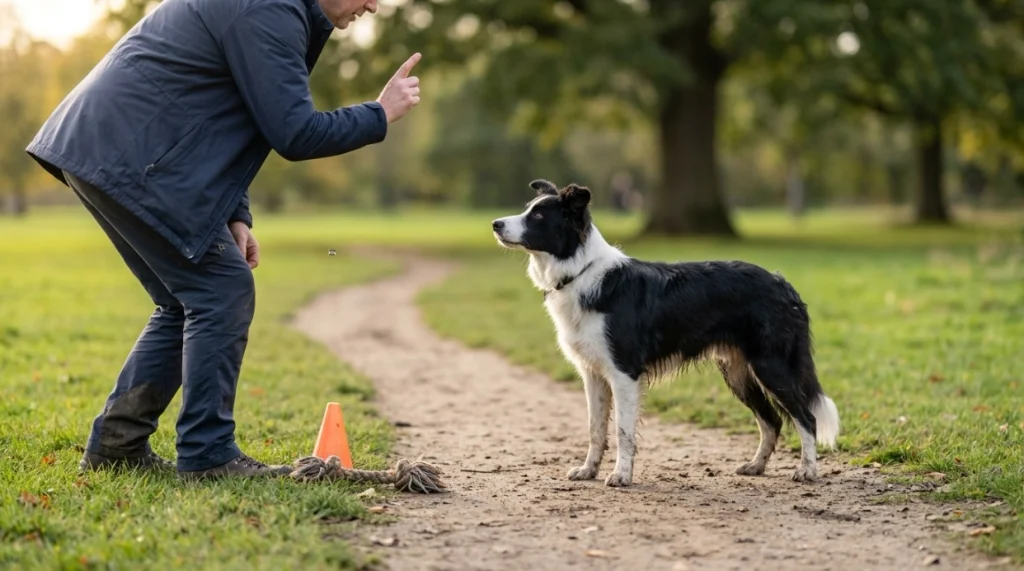
Yes, a Border Collie can live in an apartment. The arrangement works best when the owner deliberately creates outdoor exercise, mental enrichment, and quiet indoor routines every day.
I look at apartment ownership as a management question. You need somewhere safe to exercise the dog, enough time to reach it, and a plan for days when the weather or your schedule changes.
Apartment versus house living
| Home setup | Can it work? | Practical adult routine | Main risk |
|---|---|---|---|
| Apartment, no yard | Yes | About 60–120 minutes of total daily activity, plus short training or enrichment sessions | Too little outdoor access |
| Townhouse or small patio | Yes | Several purposeful outings and daily mental work | Treating the patio as exercise |
| House with fenced yard | Often convenient | Walks, training, games, and interactive yard time | Leaving the dog outside to entertain itself |
| Rural home or acreage | Can be excellent | Structured work, exploration, training, and safe freedom | Assuming acreage automatically meets the dog’s needs |
Apartment noise is another consideration. A dog that reacts to footsteps, elevators, doors, or passing dogs may need extra work on calm behavior.
Teaching a reliable mat settle is one of my favorite small-home skills. It gives the dog a clear job when nothing exciting should be happening.
How Much Exercise Does a Border Collie Need?
Many young and healthy adult Border Collies need roughly one to two hours of physical activity each day. Individual needs vary with age, health, temperament, conditioning, and working drive.
PetMD’s Border Collie breed guidance also describes one to two hours of daily exercise as a common need, particularly in younger dogs. That shouldn’t be interpreted as a requirement for two hours of nonstop running.
Quality matters as much as duration
A Border Collie can become physically tired while remaining mentally restless. That’s why I prefer mixing movement with thinking rather than trying to exhaust the dog through distance alone.
- Sniff walks: Let the dog investigate instead of marching at heel for the entire walk.
- Fetch: Useful in moderation when the dog can stop calmly between repetitions.
- Hiking: Combines movement, smells, terrain, and changing environments.
- Obedience: Short sessions challenge impulse control and concentration.
- Agility foundations: Low-impact skill work can build communication and body awareness.
- Herding: Suitable dogs may enjoy properly supervised herding work or lessons.
- Scent games: Searching for food or objects gives the brain a different kind of task.
More exercise is not always better
One mistake is creating an endurance athlete who never learns to relax. If every restless moment triggers another game of fetch, the dog can start expecting constant entertainment.
I want a Border Collie to understand both “let’s work” and “nothing is happening now.” That off-switch makes small-home living much easier.
A useful adult routine might combine a 30-minute morning outing, a short training session, and a 40-minute evening activity. Smaller enrichment sessions can be scattered through the day.
Section Takeaway: Exercise is essential, but your goal is a physically satisfied dog that can also settle. Mix movement, thinking, sniffing, training, and rest.
What Kind of Space Matters Most?
The most useful space is safe, usable, and connected to activities your dog enjoys. A huge empty lawn is less valuable than reliable access to varied walking routes and training opportunities.
Four types of space I prioritize
- Movement space: Somewhere the dog can walk, trot, explore, or play safely.
- Training space: Even a small living room can handle obedience, tricks, scent games, and body-position exercises.
- Decompression space: Quiet walking areas let dogs sniff and explore without constant commands.
- Rest space: A bed, crate, or mat should provide a predictable place to switch off.
A fenced field is convenient for recall games and active play. It isn’t mandatory when you have safe alternatives such as long-line walks, training facilities, or secure rented exercise areas.
Indoor layout also matters more than people expect. Slippery flooring, constant window traffic, or children racing through the room can keep a motion-sensitive herding dog alert.
Sometimes reducing stimulation helps more than adding space. Curtains, baby gates, a quiet bed, and structured rest can turn a busy home into a calmer one.
How Do You Keep a Border Collie Happy in a Small Home?
Build the dog’s lifestyle outside the walls of the home, then teach calm behavior inside them. Consistency matters more than having a perfect property.
I like routines that alternate activity and recovery. The dog learns that exciting work has a beginning and an end.
A practical small-home daily routine
- Morning: Spend 20–30 minutes walking, sniffing, and practicing a few cues.
- Breakfast: Use part of the meal in a puzzle, scatter feed, or simple search game.
- Midday: Add a toilet walk and several minutes of easy training when possible.
- Late afternoon: Provide 30–45 minutes of walking, hiking, retrieving, running, or another suitable activity.
- Evening: Do 5–15 minutes of skill work, scent work, or cooperative handling.
- Rest: Finish with calm time on a bed or mat rather than another high-arousal game.
You don’t need complicated equipment. One room is enough for stays, heel position, toy discrimination, nose targeting, tricks, and scent searches.
ASPCA canine enrichment guidance also highlights activities that let dogs search, smell, play, chew, and work for food. Those options are especially helpful on days when outdoor exercise is limited.
Watch for signs your routine is falling short
One restless evening doesn’t prove that a dog needs a larger home. Look for repeated patterns across several days instead.
- Pacing despite having opportunities to rest
- Demand barking or constant attention-seeking
- Destructive chewing or digging
- Repeatedly chasing shadows, reflections, or moving objects
- Persistent attempts to herd people or other pets
- Difficulty settling after normal activity
- Increasing frustration during predictable quiet periods
These behaviors can have several causes, including stress or health problems. Increasing exercise blindly isn’t always the right solution.
Section Takeaway: Small-home success comes from predictable exercise, varied mental work, and deliberate relaxation. Square footage cannot replace a good daily routine.
Does a Yard Replace Walks and Training?
No. A yard gives a Border Collie convenient outdoor space, but simply opening the door rarely provides enough physical or mental engagement.
Dogs quickly learn every smell and corner of a familiar yard. Without interaction, many eventually stand by the door, patrol the fence, bark, dig, or wait for something interesting.
Turn the yard into useful space
- Practice recalls between two people.
- Hide toys or food for scent searches.
- Work on stays while you move around the yard.
- Use cones for directional cues.
- Practice calm tug with clear start-and-stop rules.
- Create safe low-impact obstacle exercises for mature, conditioned dogs.
I think of the yard as equipment, not a babysitter. What you do there determines its value.
Walks still expose your Border Collie to changing smells, environments, surfaces, people, and situations. Those experiences give a dog information that the same backyard cannot provide.
Do Puppies, Adults, and Seniors Need Different Amounts of Space?
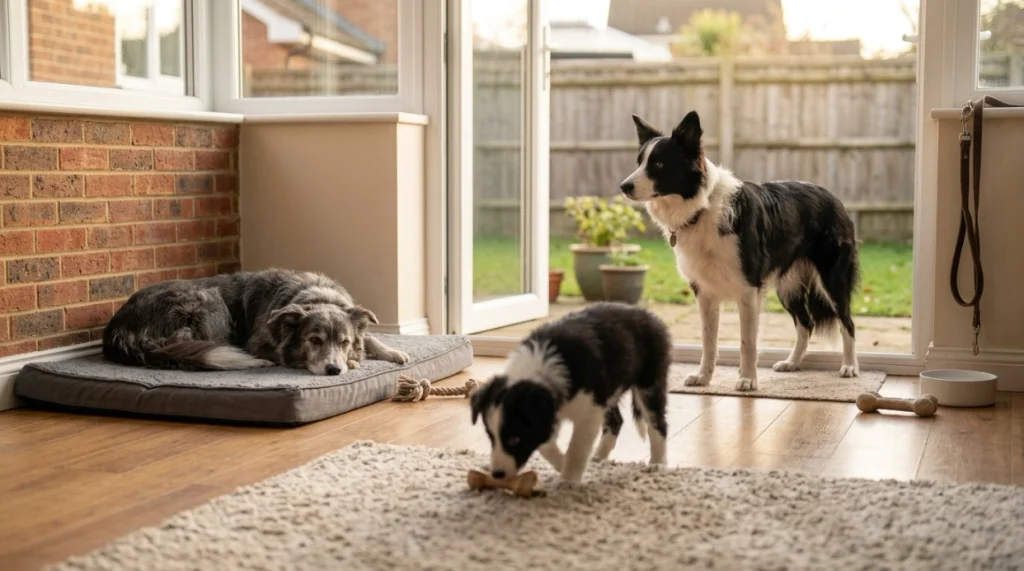
Yes, because the appropriate type and intensity of activity change as a Border Collie ages. A puppy may appear tireless, but developing bones and joints are not ready for an adult athlete’s workload.
| Life stage | Activity approach | Space priority |
|---|---|---|
| Puppy | Frequent short, self-paced play, exploration, socialization, and training | Safe surfaces and controlled environments |
| Healthy young/adult dog | Often around 60–120 minutes of varied daily physical activity, plus mental work | Access to movement, training, and exploration |
| Senior dog | Shorter, gentler activity adjusted to mobility and health | Comfort, traction, easy access, and low-impact movement |
Puppies need restraint, not endless exercise
VCA guidance on puppy exercise recommends avoiding strenuous forced exercise while growth plates are developing. Long runs, repeated high jumps, and demanding endurance work should wait until the dog is physically mature.
A puppy can still learn constantly. Short training sessions, social exploration, sniffing, play, and age-appropriate movement provide plenty to do.
Senior Border Collies still need engagement
Older dogs often benefit from continuing to move, but the activity may need to become gentler. Sniff walks, easy searches, basic obedience, and low-impact games can replace harder running or jumping.
If a Border Collie develops arthritis, persistent stiffness, limping, or another orthopedic problem, the exercise plan should change. The same applies after an injury or significant health diagnosis.
Vet note: Ask your veterinarian about appropriate exercise before beginning strenuous running, jumping, or sport training with a puppy, senior, injured dog, or Border Collie with a medical condition.
Frequently Asked Questions
Can a Border Collie live in a small house?
Yes. A small house can suit a Border Collie when the dog receives sufficient outdoor exercise, training, enrichment, and companionship. The owner’s ability to provide daily activity matters more than the number of rooms.
Do Border Collies need a fenced yard?
A fenced yard is helpful but not mandatory. Owners without one can use leash walks, long lines, secure exercise fields, training facilities, hiking routes, and other safe areas while building strong recall skills.
Is keeping a Border Collie in an apartment unfair?
Apartment living itself is not the problem. It becomes unsuitable when the dog spends most days inactive, understimulated, or unable to toilet and exercise frequently enough.
How big should a yard be for a Border Collie?
There is no universal minimum yard size for the breed. A smaller secure yard used for training and interactive games can be more useful than several acres where the dog receives little structured activity.
Can a Border Collie be happy without off-leash exercise?
Yes, provided you create other appropriate outlets. Long-line walks, hiking, scent work, structured training, safe retrieving, and enclosed exercise areas can provide substantial physical and mental activity without unrestricted off-leash freedom.
Do working-line Border Collies need more space?
Some working-line Border Collies have especially strong stamina, herding drive, motion sensitivity, and desire to work. Their needs vary individually, but a highly driven dog usually requires more purposeful activity and skilled training rather than simply a larger property.
Final Takeaway: Space Matters Less Than Lifestyle
Border Collies need a lot to do, but they don’t automatically need a lot of indoor room. A committed owner can meet those needs from an apartment, townhouse, suburban home, or farm.
As of 2026, the practical question remains the same: can you consistently provide exercise, mental work, interaction, and recovery time? If the answer is yes, the size of your home becomes much less important.
Before bringing a Border Collie home, test the routine on yourself for a week. Make time each day for the walks, training sessions, outdoor trips, and enrichment you expect to provide after the dog arrives.
If that schedule feels sustainable, you’re evaluating the right thing. For this breed, your available time and involvement usually matter more than your available square footage.
