
Do Border Collies Need Another Dog?

Quick Answer
No, Border Collies do not automatically need another dog to be happy. Many thrive as the only dog when they receive enough exercise, mental work, training, and human interaction. A compatible second dog can still be a wonderful companion, but the decision should depend on your Border Collie’s temperament and your ability to care for two dogs. The AKC’s guidance on getting a second dog also recommends considering age, training, compatibility, space, and added responsibility.
A second dog makes more sense when:
- Your dog is social: Your Border Collie consistently enjoys relaxed, friendly interactions with other dogs.
- Energy levels match: Both dogs enjoy a similar amount and style of activity.
- Training is solid: Your current dog already responds reliably to basic cues.
- You have time: You can exercise, train, feed, and bond with each dog separately.
- Resources are sufficient: Your home, schedule, and budget can comfortably support two dogs.
Do not add a dog just to fix:
- Separation anxiety, reactivity, boredom, aggression, or an exercise problem you cannot currently manage.
Border Collies are intensely social with their people, but that doesn’t mean every Border needs a canine roommate. Their working heritage often makes purposeful activity more important than simply having another dog nearby.
As of 2026, I would still judge this decision dog by dog. This guide will help you decide whether companionship would enrich your Border Collie’s life or simply double your workload.
In This Guide
- Do Border Collies Need Canine Companionship?
- What Signs Suggest Your Border Collie May Enjoy Another Dog?
- When Is Getting a Second Dog a Bad Idea?
- What Kind of Dog Makes a Good Border Collie Companion?
- Do Age, Sex, and Breed Matter?
- How Can You Test Compatibility Before Adopting?
- How Should You Introduce a Second Dog?
- Can a Border Collie Be Happy as an Only Dog?
- Frequently Asked Questions
Do Border Collies Need Canine Companionship?
Border Collies need companionship, but that companionship does not have to come from another dog. A well-supported Border can live happily as a single dog.
The Border Collie belongs to the herding group. Generations of working beside handlers helped shape a dog that often watches people closely and enjoys doing tasks with them.
Definition: A Border Collie’s social need is its need for meaningful interaction, security, communication, and shared activity. Another dog can provide some of this, but humans can provide much of it too.
Why another dog isn’t a substitute for exercise
Two dogs may chase and wrestle together. That activity doesn’t replace structured walks, training, sniffing, or mentally demanding games.
According to the American Kennel Club’s Border Collie profile, the breed is energetic, intelligent, responsive, and strongly oriented toward work. That combination explains why simply providing a playmate often fails to solve boredom.
- Physical work: Walking, hiking, running when appropriate, fetch, or controlled dog sports.
- Mental work: Training, scent games, food puzzles, searching, and problem-solving.
- Social time: Calm interaction with people and compatible dogs.
- Rest: Regular quiet periods that teach an active dog how to switch off.
A second dog can enrich that routine. It should be one part of the routine rather than the entire plan.
What Signs Suggest Your Border Collie May Enjoy Another Dog?

A Border Collie may enjoy a canine companion when they already show comfortable, voluntary social behavior with dogs. Look at repeated patterns rather than one exciting play session.
Positive signs I would look for
- Loose body language: Your dog approaches familiar dogs without stiffness or persistent staring.
- Balanced play: Both dogs take turns chasing, pausing, wrestling, and disengaging.
- Easy recovery: Your Border settles after play instead of remaining frantic or over-aroused.
- Shared space tolerance: They can relax near another dog without constantly controlling its movement.
- Healthy boundaries: Your dog can walk away and allows the other dog to do the same.
- No serious guarding: Food, toys, resting areas, and people don’t regularly trigger conflict.
I pay special attention to what happens after the first five minutes. Excitement at a greeting tells me less than the dogs’ ability to relax together afterward.
Border Collie play can look intense
Some Borders crouch, stalk, chase, stare, or cut across another dog’s path. These behaviors connect to their herding heritage, sometimes called herding instinct.
A compatible dog may handle that style well. Another dog may become irritated or frightened by constant staring and chasing.
Good companionship therefore means more than finding another energetic dog. Their communication styles need to fit.
When Is Getting a Second Dog a Bad Idea?
A second dog is usually a poor solution for an existing behavioral problem. Work on the first dog’s needs before adding more complexity.
Pause the plan if your Border Collie has these problems
- Serious aggression toward other dogs
- Strong resource guarding
- Uncontrolled leash reactivity
- Severe fear around dogs
- Unmanaged separation distress
- Frequent destructive behavior caused by insufficient activity
- Weak basic obedience or recall
Dog sociability exists on a spectrum. The AKC’s explanation of dog selectivity notes that some dogs enjoy many dogs, while others prefer only certain individuals.
A selective Border Collie isn’t defective. They may be happiest with one or two carefully chosen friends instead of a permanent roommate.
Don’t buy your Border Collie an exercise machine
I would never choose a second dog primarily because the first one is difficult to tire out. You could end up with two dogs demanding exercise instead of one.
You’ll also need individual training. Dogs that live together still benefit from separate walks, one-to-one sessions, and time alone with you.
Consider your current dog’s health and age
An older Border Collie may enjoy quiet companionship but dislike an energetic puppy jumping on them. Pain or reduced mobility can make tolerance lower.
Vet note: If your dog’s sociability or tolerance has suddenly changed, talk with your veterinarian. Pain and illness can influence behavior, and a medical issue should be ruled out before adding another dog.
What Kind of Dog Makes a Good Border Collie Companion?
The best match is usually based on temperament, communication style, and energy rather than breed name. A calm mixed-breed dog can fit better than another Border Collie.
Use this comparison as a starting point, not a guarantee.
| Companion Type | Typical Match Advantage | Potential Challenge |
|---|---|---|
| Another Border Collie | Similar drive, speed, trainability, and play intensity | Two highly driven dogs can amplify arousal and workload |
| Australian Shepherd | Often enjoys active training and outdoor routines | Both dogs may need substantial individual stimulation |
| Kelpie or working-type herder | Athletic play style and strong enthusiasm for activity | High combined drive can overwhelm a less active household |
| Labrador-type companion | Social, playful temperament may complement an outgoing Border | Play styles may differ considerably between individuals |
| Calm adult mixed breed | Known adult temperament can make matching easier | A low-energy dog may dislike persistent Border Collie play |
Look for complementary behavior
I prefer a dog that can play enthusiastically and then stop. An off-switch is often more valuable than matching maximum energy.
A good candidate should also communicate clearly. Your Border needs to respect signals that mean, “I’ve had enough.”
Section Takeaway: Match the individual dogs, not the labels on their breed profiles. Compatible energy matters, but compatible communication matters just as much.
Do Age, Sex, and Breed Matter?
They can matter, but none predicts success by itself. Temperament and history should carry more weight.
Age difference
Two puppies close in age can be demanding because each needs independent training and social development. One stable adult often makes management easier.
A puppy paired with a senior dog needs even more supervision. The older dog must have places where the puppy cannot bother them.
- Puppy + puppy: Highest training workload and frequent separate sessions.
- Adult + puppy: Can work well if the adult genuinely tolerates young-dog behavior.
- Adult + adult: Established personalities make compatibility easier to evaluate.
- Senior + young dog: Requires careful protection of the senior’s rest and physical comfort.
Does sex matter?
Some owners and breeders prefer opposite-sex pairings. Yet individual temperament, neuter status, social history, and resource guarding can matter more.
Don’t assume two males or two females cannot live together. Likewise, don’t assume an opposite-sex pairing will automatically succeed.
Does the second dog need to be a Border Collie?
No. A Border Collie can form an excellent relationship with many breeds or mixed-breed dogs.
Choose for behavior first. Breed can help you estimate tendencies, but it cannot predict one dog’s personality.
How Can You Test Compatibility Before Adopting?
Arrange several controlled meetings before committing whenever possible. One exciting introduction is not enough to judge household compatibility.
Use a neutral location first
Start outside the resident dog’s home or yard. Walk the dogs in the same direction with enough distance for both to remain relaxed.
Then gradually reduce the distance. Avoid forcing nose-to-nose contact.
Watch the interaction, not just the wagging tails
The AKC’s guidance on introducing dogs recommends watching overall body language and creating distance if either dog becomes uncomfortable.
Useful green flags include:
- Curved rather than stiff approaches
- Loose facial muscles and bodies
- Short greetings followed by natural disengagement
- Play bows and role changes during play
- Ability to respond to the handler around the other dog
- Comfort taking breaks
More concerning signs include persistent freezing, hard staring, blocking, cornering, repeated mounting, or ignoring another dog’s attempts to escape.
Consider fostering before adopting
A foster-to-adopt arrangement can reveal behaviors that a short meeting cannot. You’ll see how both dogs handle meals, visitors, rest, toys, doors, and daily routines.
Even then, manage valuable resources carefully. Early success shouldn’t lead to rushed freedom.
How Should You Introduce a Second Dog?
A slow introduction reduces pressure on both dogs. Think in days and weeks rather than expecting instant friendship.
Veterinary behavior guidance from VCA Animal Hospitals emphasizes managing interactions and reducing competition over valuable resources.
Use this practical introduction sequence
- Meet on neutral ground. Begin with parallel walking rather than immediate free play.
- Keep leashes loose. Tight restraint can add tension and frustration.
- Allow short greetings. Separate again while both dogs remain comfortable.
- Enter home calmly. Remove high-value toys and food before the newcomer arrives.
- Create separate zones. Use gates, pens, crates, or separate rooms for decompression.
- Feed separately. Don’t create unnecessary competition around meals.
- Supervise early interactions. Don’t assume one good afternoon guarantees future harmony.
- Protect individual time. Train and walk each dog separately as well as together.
Keep the first weeks predictable
Routine helps a Border Collie understand that the newcomer hasn’t taken away everything familiar. Keep normal walks, training sessions, meals, and quiet periods consistent.
I also like giving each dog several short breaks apart every day. Constant togetherness can create friction even between dogs that enjoy one another.
Don’t force sharing
Provide separate beds, feeding spaces, chews, and high-value items. You can relax management gradually after you understand both dogs better.
Friendship should develop voluntarily. Peaceful coexistence is already a successful outcome.
Section Takeaway: Introductions work best when both dogs have choice, space, supervision, and separate resources. Slow progress is safer than forcing immediate closeness.
Can a Border Collie Be Happy as an Only Dog?
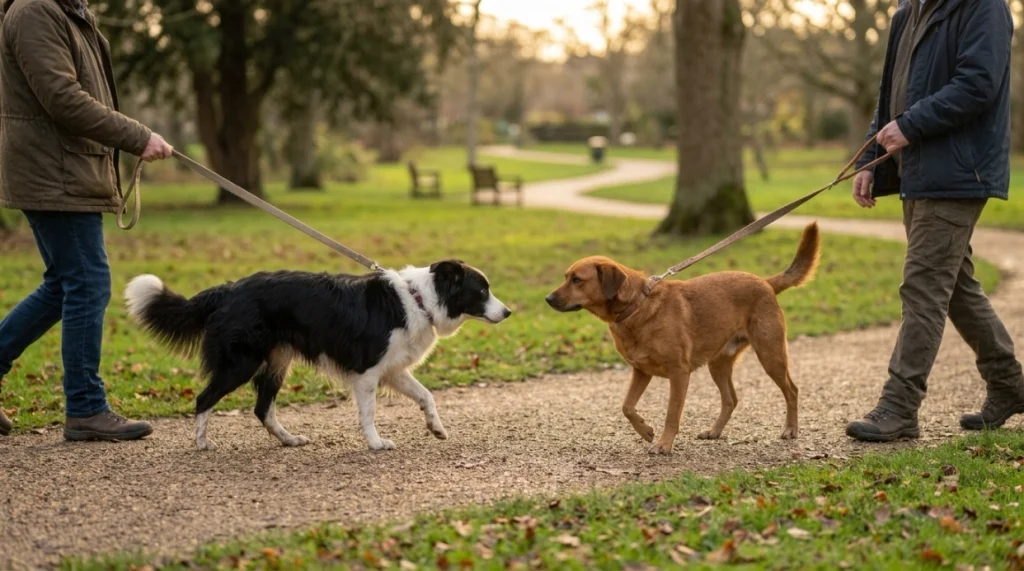
Yes. A Border Collie can live a full, happy life without another dog in the household. The key is meeting the needs that a second dog would not automatically solve anyway.
Build a complete daily routine
- Purposeful exercise: Use walks, running where appropriate, hiking, play, or dog sports.
- Short training sessions: Five to ten focused minutes can challenge the brain without exhausting either of you.
- Sniffing opportunities: Let walks include exploration instead of making every outing fast-paced exercise.
- Problem-solving: Hide food, teach object names, use puzzles, or practice scent searches.
- Social contact: Arrange occasional walks or play sessions with compatible dogs if your Border enjoys them.
- Quiet skills: Teach settling on a mat and comfortable independent rest.
One lesson I consider especially important with Border Collies is that more stimulation isn’t always better. Constant ball throwing and nonstop excitement can create a dog that becomes better at demanding action.
Teach activity and recovery together. Your dog should learn that a satisfying day includes work, connection, and rest.
Don’t confuse attachment with loneliness
A Border Collie following you around doesn’t necessarily mean they need a second dog. Many Borders closely monitor their handlers because attention to human movement is deeply useful in working contexts.
Look at the dog’s whole behavior. A relaxed appetite, normal sleep, enthusiasm for activities, and ability to settle matter more than whether another dog lives in the house.
If your Border enjoys canine friends, you can provide that socially without adopting. Regular walking partners, selected playmates, classes, and dog-sport communities may be enough.
Frequently Asked Questions
Do Border Collies get lonely without another dog?
They can become lonely when they lack social interaction, but another dog isn’t the only solution. Many Border Collies are happy as single dogs when their owners provide regular companionship, training, exercise, enrichment, and opportunities to interact with suitable dogs when they enjoy canine company.
Are two Border Collies better than one?
Two compatible Border Collies can be enjoyable, but two aren’t automatically better. You’ll have twice the feeding, veterinary care, management, training, and exercise responsibility. Each dog should still receive individual attention rather than depending entirely on the other.
Will getting another dog calm my Border Collie down?
Not necessarily. A second dog can increase play and activity instead of reducing it. If your Border is restless because of boredom, insufficient training, anxiety, or excessive arousal, address that issue directly before adding another dog.
What dog breeds get along with Border Collies?
Border Collies can live successfully with Border Collies, Australian Shepherds, Kelpies, Labradors, mixed breeds, and many others. Breed alone doesn’t determine compatibility. Focus on temperament, play style, sociability, age, energy level, and each dog’s ability to respect boundaries.
Should I get my Border Collie a puppy?
A puppy can work well if your adult Border Collie is socially comfortable and tolerant of puppy behavior. Puppies can be persistent, so provide the adult dog with protected resting areas and frequent breaks. Don’t expect your existing dog to raise or entertain the puppy.
Is it better to have two dogs of the same sex or opposite sexes?
Either arrangement can work. Some people prefer opposite-sex pairings, but temperament and social history are more useful than sex alone. Meet the dogs carefully and evaluate their actual interactions instead of assuming a particular pairing will be trouble-free.
How long does it take two dogs to adjust to each other?
There is no fixed timeline. Some dogs relax together within days, while others need several weeks or longer. Keep interactions managed until both dogs consistently eat, rest, play, move through the home, and respond to you comfortably around each other.
Should You Get Your Border Collie Another Dog?
Get a second dog because you genuinely want and can care for two dogs, not because Border Collies supposedly require canine company. Your current dog’s behavior should guide the decision.
If your Border enjoys other dogs, has good household manners, and meets a compatible candidate, another dog can become a rewarding companion. If your Border prefers people or carefully selected dog friends, remaining a one-dog household is perfectly reasonable.
Focus first on exercise, mental challenges, training, calm downtime, and your relationship with your dog. Then treat a second dog as an addition to an already healthy life—not a shortcut for creating one.
