
How Long Can a Dog Be Left Alone? A Practical Guide for Border Collie Owners

If you are trying to figure out how long a dog can be left alone, the honest answer is that there is no single safe number for every dog. Age, bladder control, exercise needs, temperament, and separation tolerance all change the limit. A calm adult dog may handle a workday reasonably well. A puppy, a senior dog with mobility issues, or a Border Collie that has not had enough mental work may struggle long before that.
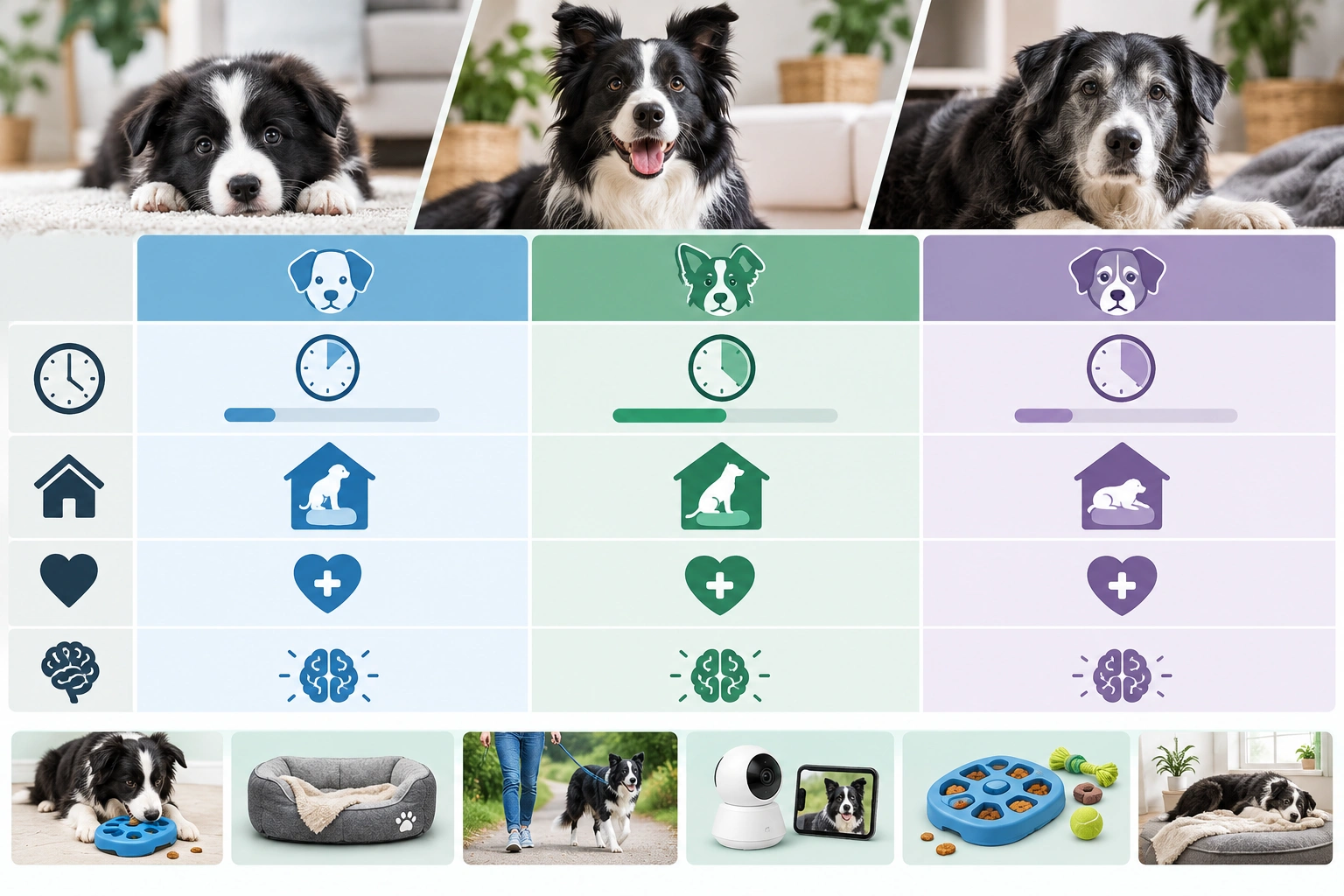
For Border Collie owners, this question matters even more. Border Collies are not just energetic; they are alert, pattern-driven, and often very aware of changes in routine. That can make them brilliant companions, but it also means they notice boredom, under-stimulation, and inconsistency fast.
The goal is not to find the longest possible stretch. It is to find the longest stretch your dog can handle safely, without accidents, panic, destructive behavior, or chronic stress.
How Long Can a Dog Be Left Alone? The Real Answer Depends on More Than Hours
Think of alone time as a three-part decision:
-
Can the dog physically hold it?
Bathroom needs set a hard ceiling, especially for puppies and some seniors. -
Can the dog emotionally cope?
Some dogs are relaxed alone. Others become distressed, vocal, or destructive. -
Is the home setup safe for that length of time?
A dog left in a dog-proofed room has more freedom than one confined in a crate, but also more opportunity to get into trouble.
That means two dogs with the same age and size can have very different limits. One dog may nap through five hours. Another may pace, chew a door frame, or soil the house after two.
A practical way to judge the limit is to ask: Can my dog stay calm, comfortable, and clean for this period, repeatedly, not just once? If the answer is no, the schedule needs support.
Quick Time Guidelines by Age
These are starting points, not universal rules. Use them as a planning frame, then adjust for your dog’s health, training, and temperament. For puppies and seniors especially, the real limit depends on bladder control, training, and stress tolerance, and these are maximums only for well-adjusted dogs.
| Dog life stage | Practical alone-time starting point | What usually changes the limit |
|---|---|---|
| Young puppy under 6 months | Short periods only; often far less than a workday | Bladder control, house training, stress tolerance |
| Adult dog with no separation issues | About 4 to 6 hours is a common baseline | Exercise, routine, breed, health, room to move |
| Healthy adult dog with good setup | Many can handle 6 to 8 hours | Bathroom access, enrichment, prior training |
| Some adult dogs with excellent tolerance | 8 to 9 hours may be manageable | Space, calm temperament, predictable routine |
| Senior dog | Often similar to adult dogs, but sometimes less | Mobility, bladder control, medical needs |
For puppies, the limit is much shorter. A young puppy under 6 months should not be expected to stay alone for long stretches. In practical terms, many puppies need a break every 1 to 2 hours when they are awake, and even a well-managed young puppy usually cannot handle a full workday without help. That is not just about separation stress; it is also about bladder control and the learning stage of house training.
Senior dogs are different again. Some remain easygoing and can manage a normal workday. Others need more frequent bathroom breaks, slower access to water, or closer monitoring because of age-related changes.
What Changes the Limit: Breed, Energy Level, Health, and Temperament
The most common mistake is assuming that size alone tells you the answer. A small dog is not automatically easier to leave alone than a large one. What matters more is how the dog handles physical discomfort, boredom, and being separated from people.
Breed and energy level
High-energy working breeds tend to need more than a quick walk. They need a job for the brain as well as the body. That is why a Border Collie can become unsettled even when the house is safe and the dog is physically healthy.
By comparison, lower-energy breeds often tolerate quiet alone time more easily after a normal walk and bathroom break. A Border Collie usually needs more than that: a real exercise outlet, some mental work, and a routine that helps the dog settle before you leave.
Health and age
A dog with arthritis, digestive issues, incontinence, or anxiety medication changes may need a shorter alone-time window than a healthy adult. Even if the dog is otherwise well-behaved, pain or urgency can make a normal schedule unrealistic.
Temperament and training history
Some dogs are naturally independent. Others are social shadows. If your dog follows you from room to room, becomes unsettled when you pick up your keys, or refuses to settle when left with nothing to do, the limit is probably lower than you want it to be.
There is also a difference between a dog that is simply bored and a dog that is distressed. That difference determines whether you need more enrichment or a separation-related behavior plan.
How Long Can a Border Collie Be Left Alone?
Border Collies are often capable of learning to stay home alone, but they are not usually the breed I would choose for a “leave it and forget it” lifestyle. Their working background matters. They are alert, fast to notice patterns, and often highly motivated by movement, tasks, and interaction.
In practical terms, many Border Collies do best when alone time is paired with:
- a proper exercise session before departure
- mental work, not just physical exercise
- a predictable routine
- a safe space that matches their comfort level
A Border Collie may be able to tolerate the same hours as another adult dog, but not as happily if the day is empty. If the dog is left alone for a full workday, the difference between success and failure is often what happens before you leave and whether the dog gets a midday break.
For a Border Collie owner who works full-time, a realistic setup is often: morning exercise, a calm departure, and a midday dog walker or sitter for a bathroom break and reset. For longer shifts, that usually is not enough on its own, and you may need daycare, a family member, or a split-care plan. In other words, the dog may be able to stay home, but not necessarily to stay home alone for the whole day without support.
A useful rule: if your Border Collie is calm for four hours but starts chewing, pacing, barking, or checking exits by hour six, that is not “bad behavior.” It is information. The current setup is too thin for the dog’s needs.
Signs Your Dog Is Left Alone Too Long
Some dogs make their distress obvious. Others stay quiet but still are not coping well. Look for patterns, not one-off incidents.
Signs of boredom or under-stimulation
- Chewing household items
- Digging at bedding or carpets
- Restless wandering
- Excessive barking at small triggers
- Pulling toys apart quickly
- Hyperactive behavior when you return
Signs of separation-related distress
- Pacing or inability to settle
- Drooling, panting, or trembling
- Howling or persistent vocalizing
- Attempts to escape doors, crates, or windows
- House soiling despite being house-trained
- Self-injury or broken nails from escape attempts
- Panic that starts before you leave, not just after
A simple way to tell boredom from separation anxiety is to look at timing and intensity. Bored dogs usually settle after a while and show frustration behaviors that are annoying but not panicked. Dogs with separation distress often escalate quickly, start reacting before you are even gone, and seem unable to relax once they are alone.
If you suspect boredom, increase exercise, enrichment, and structure. If you suspect distress, shorten absences and get help sooner rather than later. A dog that panics when you pick up your bag may be experiencing separation distress. Those are different problems and should be handled differently.
If the behavior only happens when the dog is alone, the answer is usually not “more punishment.” It is a better setup, a shorter absence, or more gradual training.
How to Prepare a Dog to Stay Home Alone Safely
A good alone-time routine starts before you walk out the door.
1) Give the dog something to do before you leave
A brisk walk, a sniff session, fetch, or structured training can lower the energy level enough to make settling easier. For Border Collies, mental work often matters as much as physical exercise. A dog that has used its brain is more likely to rest.
2) Remove easy opportunities for trouble
Dog-proof the space the same way you would child-proof a room:
– pick up shoes, cords, and loose items
– secure trash bins
– block access to toxic plants or food
– close doors to unsafe rooms
– remove anything the dog could swallow
3) Build a predictable departure routine
Dogs learn patterns quickly. If every departure is chaotic, the dog may start to anticipate stress. Keep your exit routine calm and repetitive.
4) Practice short absences first
Do not test a long workday as the first trial. Build up gradually. A dog that handles 15 minutes well may not yet be ready for 4 hours, and that is normal.
5) Use the right kind of enrichment
Puzzle feeders, lick mats, chew items, and food-dispensing toys can help some dogs settle. The point is not to tire the dog out until it collapses. The point is to give the brain a task that is safe and satisfying.
Crate Training vs Free-Roaming: Which Is Better for Alone Time?
This is not a moral choice. It is a management choice.
Crate training
Pros:
– can reduce damage
– can help some dogs feel secure
– useful for short periods and for dogs already conditioned to relax there
Trade-offs:
– too much confinement can increase stress
– not every dog is comfortable in a crate
– a crate does not solve boredom or separation anxiety
A crate should never be treated as the default answer for long stretches just because it is convenient. It is especially risky as a long-term solution for energetic or anxious dogs, because confinement can add frustration without solving the underlying problem.
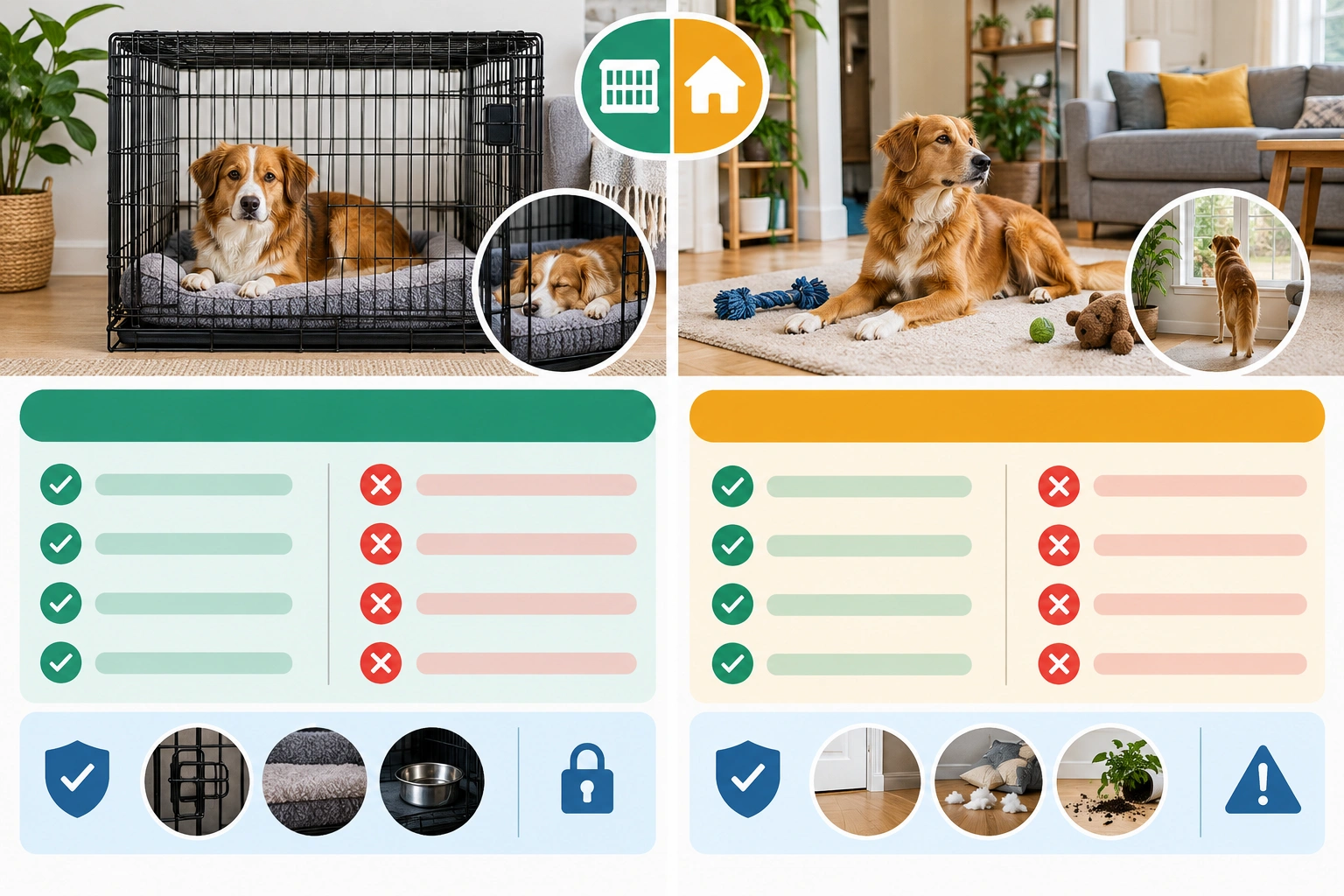
Free-roaming
Pros:
– more comfort and movement
– better for dogs that settle well outside a crate
– can reduce frustration for dogs that dislike confinement
Trade-offs:
– more chance of accidents or destructive behavior
– requires a dog-proofed environment
– not ideal for every dog, especially if the dog is still learning
A practical middle ground is a safe room or gated area rather than full-house access. For many dogs, that gives enough space to change position and rest without opening up the entire house to risk.
How to Make Longer Alone Periods More Manageable
If your schedule means your dog must stay home for longer stretches, make the day easier to live through.
- Rotate enrichment items. Novelty matters. A toy that is ignored every day may become interesting again if it only appears when you leave.
- Use sound masking. Soft background noise can reduce sensitivity to outside sounds for some dogs.
- Create a comfortable resting zone. Good bedding, temperature control, and access to water matter.
- Keep departures and returns low-key. Big emotional exits can make the day feel more dramatic than it needs to be.
- Match the setup to the dog. Some dogs rest better in a crate. Others do better in a gated room with more freedom.
The goal is not to entertain the dog for eight hours straight. It is to make rest more likely and stress less likely.
When You Need Help: Dog Walkers, Pet Sitters, or Daycare
If your dog cannot comfortably handle the full stretch, support is often the simplest fix.
Dog walker
Best when your dog mainly needs:
– a bathroom break
– a short walk
– a mid-day reset
This is often the most practical answer for a dog who can handle the morning and afternoon but struggles with a full workday.
Pet sitter
Best when your dog:
– does poorly with long alone stretches
– needs a calmer, more customized visit
– benefits from someone who can stay longer than a quick walk
Dog daycare
Best when your dog:
– enjoys other dogs
– needs high engagement
– becomes lonely or destructive when left idle
Trade-off: daycare can be too stimulating for some dogs, especially sensitive or socially selective ones. It is not the best fit for every Border Collie, even though some Border Collies love it.
If you are choosing between the three, ask one question: Does my dog need a bathroom break, supervision, or real social/mental stimulation? The answer usually points to the right option.
When a Dog Should Not Be Left Alone That Long
Shorten the alone time or change the plan immediately if your dog:
- is a puppy under 6 months and still learning bladder control
- panics when you prepare to leave
- has repeated accidents when left alone
- injures itself trying to escape
- cannot settle even after exercise and enrichment
- is sick, recovering, or dealing with mobility issues
- becomes destructive only when alone, not when supervised
If the dog is showing persistent distress, do not keep “testing” longer periods and hoping it improves. That usually teaches the dog nothing except that being alone is hard and unpredictable.
Practical Alone-Time Plans for Common Schedules
If you work a standard full-time day
A healthy adult dog may do fine with a morning walk, a calm departure routine, and a midday walker. For a Border Collie, this is often the safer version of a workday than leaving the dog to manage the entire gap alone.
If you work long shifts
Long shifts usually require support. That may mean a dog walker, a sitter, a family member, or daycare. If the dog is crated, the need for breaks becomes even more important.
If your schedule changes often
Dogs do better with predictability. If your routine is irregular, focus on a stable pre-departure pattern and a backup plan for the longest days.
If you live alone
A dog living with one person may have fewer spontaneous breaks than a dog in a busy household. That makes planning more important, not less. A dog with another person in the home may have easier access to bathroom breaks and social contact, but only if someone is actually available and paying attention.
If you have more than one dog
Multiple dogs can make the house feel less empty, but they do not automatically extend safe alone time. One dog may still be anxious, need a bathroom break, or start trouble even if another dog is calm. In some homes, the dogs settle better together; in others, one dog’s stress can spill over to the rest. The limit still depends on each dog’s bladder control, training, and stress tolerance.
When to See a Veterinarian or Certified Trainer
See a veterinarian if your dog’s alone-time problems may be tied to pain, urinary issues, medication changes, or sudden behavior changes.
See a certified trainer or qualified behavior professional if your dog shows signs of separation distress, escape attempts, or panic that does not improve with routine changes. If you see clear distress signs, or if boredom-focused fixes do not help, professional support is the next step rather than more trial and error. The sooner you address it, the easier it is to build a workable plan.
For broader behavior context, the AKC’s guidance on separation anxiety is a useful reference, and the ASPCA’s separation anxiety resources can help you recognize when stress is the real issue rather than simple boredom. If you are weighing containment options, VCA Hospitals’ crate training guidance is also worth reading before you decide how to manage longer absences.
The main thing to remember is simple: the best alone-time plan is the one your dog can actually live with. For many adult dogs, that means 4 to 6 hours is a sensible baseline. For some, a longer workday can work with the right setup. For puppies, anxious dogs, and many Border Collies, the real answer is often shorter periods plus better support.
If you want the day to go smoothly, build the routine around the dog’s needs first and your schedule second. That usually means planning for breaks, choosing the right containment setup, and knowing when to bring in help.
FAQ
How long can a puppy be left alone?
Very young puppies should be left alone only for short periods. Many need bathroom breaks every 1 to 2 hours when awake, and they are not usually ready for a full workday alone.
Can a Border Collie stay home alone all day?
Some Border Collies can manage a full workday with enough exercise, mental stimulation, and a midday break. Many do better with a dog walker, sitter, or other support rather than a full day with no interruption.
Is crate training better than free-roaming for alone time?
Neither is always better. Crates can help some dogs feel secure and prevent damage, but they should not be the default for long stretches, especially for energetic or anxious dogs. Free-roaming works best when the space is safe and the dog is already calm alone.
Do two dogs make it easier to leave them alone?
Sometimes, but not always. A second dog may provide company, but it does not replace bathroom breaks, training, or a safe setup. Each dog still has its own limit.
When should I get help for separation anxiety?
If your dog panics, tries to escape, cannot settle, or shows distress before you even leave, it is time to talk to a veterinarian or qualified behavior professional.
