
How Long Do Frenchies’ Periods Last? A Practical Heat-Cycle Guide for Owners

If your female French Bulldog has started bleeding, swelled up a little, or suddenly turned clingy and restless, you’re probably trying to answer one simple question: how long is this going to last?
The short answer is that the bleeding phase is usually only part of the story. In many Frenchies, the visible “period” lasts roughly a week to two weeks, while the full heat cycle can run longer. That distinction matters, because owners often stop watching too early and assume the dog is no longer fertile when she still may be.
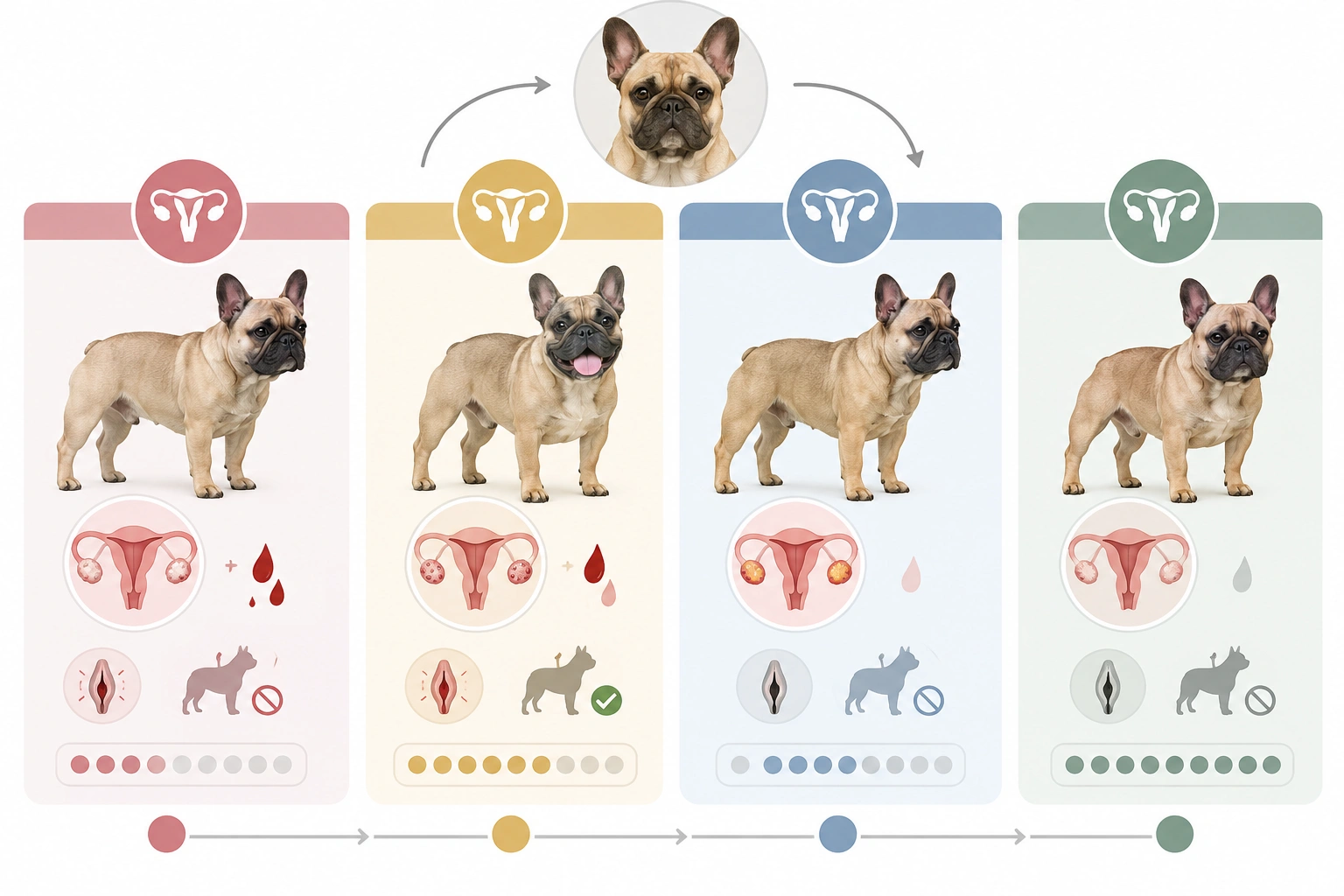
Frenchie takeaway: the bleeding often lasts about 1 to 2 weeks, but the full heat cycle lasts longer—so the end of spotting is not always the end of fertility.
French Bulldogs follow the same estrous cycle as other dogs. What changes from one dog to another is timing, intensity, and how obvious the signs are. Some Frenchies show only light spotting. Others leave a bigger mess, act unusually affectionate, or attract every intact male in the neighborhood.
How Long Do Frenchies’ Periods Last? is not just a cleanup question. It affects safety, pregnancy prevention, and whether you should be planning for spaying or a vet visit.
How Long a French Bulldog Period Usually Lasts
When owners say “period,” they usually mean the bleeding or spotting phase, not the entire reproductive cycle.
For a Frenchie, the bleeding often begins in proestrus, the first stage of heat. During this stage, the vulva swells and bloody discharge appears. Breed-specific guides commonly place this stage somewhere around 5 to 18 days, with many dogs landing closer to a week or so. The full heat cycle continues beyond the visible bleeding.
Here’s the practical way to think about it:
| What you’re tracking | Typical length | What it means |
|---|---|---|
| Bleeding/spotting phase | About 1–2 weeks, sometimes longer or shorter | The visible “period” owners notice first |
| Full heat cycle | Often several weeks total | Includes fertile and non-fertile phases |
| Fertile window | Usually during estrus, not the whole time she bleeds | Pregnancy risk is highest here |
| Between heats | Months of no reproductive activity | The resting phase before the next cycle |
The key mistake is assuming bleeding equals the whole heat. It doesn’t. A Frenchie may still be in heat after the discharge lightens or stops.
A useful rule: if you’re managing pregnancy prevention, treat the dog as potentially fertile until your veterinarian says the cycle has clearly moved past estrus. A practical owner-facing cutoff is to keep strict separation until discharge has stopped and your vet agrees she is past the fertile window—especially if you did not witness the cycle closely from the start.
The Frenchie Heat Cycle Stage by Stage
Understanding the cycle is the fastest way to make sense of what you’re seeing.
Proestrus: the beginning
This is the stage most owners notice first. The vulva becomes swollen, and bloody discharge starts. Male dogs may show strong interest, but the female is usually not receptive yet.
This stage often lasts about a week, though it can vary. Behavior can shift here too: some Frenchies become clingy, restless, distracted, or more irritable than usual. AKC guidance on dog heat cycles is a good general reference for the stages and timing.
Estrus: the fertile stage
Estrus is the stage when the female is receptive to mating and can become pregnant. The discharge often becomes lighter, pinker, or more watery rather than heavily bloody. Some dogs seem calmer; others become more intent on escaping, pacing, or seeking males.
This is the stage that matters most if pregnancy is not wanted. A Frenchie can get pregnant during estrus even if the bleeding looks mild or is nearly gone.
Diestrus: after ovulation
Diestrus follows estrus. If pregnancy occurs, this is the gestation period. If not, hormone levels gradually settle. In many dogs, this phase lasts around two months or more.
Owners sometimes think the cycle is over once the bleeding stops. In reality, the body is still running through hormonal changes.
Anestrus: the resting phase
Anestrus is the quiet period between heats. There’s no visible bleeding, no fertility, and little reproductive activity. This is the longest stretch of the cycle for most dogs.
If you track your Frenchie’s dates across the year, this resting phase helps you predict the next heat more accurately.
How Often French Bulldogs Go Into Heat
Most female dogs go into heat roughly twice a year, though the exact interval varies. Many Frenchies cycle about every 6 to 8 months, but some are a little faster or slower.
That means you should not be surprised if your dog has another heat sooner than you expected, especially as she matures. Young dogs can be less predictable in the first year or two, and first heats are often irregular before a pattern settles in.
Compared with other breeds, French Bulldogs generally follow the same overall heat pattern as other dogs rather than a unique breed-specific schedule. The main difference is that individual Frenchies can be hard to predict at first, so owners should not expect perfectly regular six-to-eight-month cycles right away.
A practical tracking method helps here:
- Mark the first day you see spotting.
- Note when bleeding gets lighter.
- Note the last day you see discharge.
- Record any behavior changes, like restlessness or male attention.
After two or three cycles, you’ll usually see a pattern. That makes it easier to plan travel, boarding, dog park visits, and spay discussions.
Signs Your Frenchie Is in Heat
The signs are usually obvious once you know what to look for, but they don’t always arrive all at once.
Common signs include:
- Swollen vulva
- Bloody or pink discharge
- More frequent licking of the rear
- Restlessness or pacing
- Clinginess or mood changes
- Increased interest from male dogs
- Tail tucking away from male dogs early on, then possible receptiveness later
The behavior change matters because it often appears before owners realize the bleeding is heat-related. A Frenchie who seems “off,” fidgety, or unusually affectionate may be entering the cycle before the discharge becomes obvious.
One realistic example: a 7-month-old Frenchie starts licking herself more, leaves small blood spots on bedding, and suddenly attracts attention from a male dog on walks. That pattern fits a typical first heat much more than an injury.
What Is Normal vs. Abnormal Bleeding or Discharge
Normal heat discharge is usually:
- Light to moderate
- Bloody at first, then pinker or lighter as the cycle progresses
- Not foul-smelling
- Not accompanied by severe illness
For French Bulldogs, a visible period that lasts about 1 to 2 weeks is often within the normal range, but bleeding that keeps going much longer than expected deserves attention even if your dog otherwise seems fine. If the discharge is still clearly present well past the usual window for your dog, call your veterinarian.
Abnormal discharge is different. Call a veterinarian if you see:
- Very heavy bleeding
- Thick pus-like discharge
- A strong bad smell
- Dark discharge that seems unusual for the stage
- Bleeding that goes on far longer than expected
- Discharge plus lethargy, vomiting, fever, or loss of appetite
The reason to be strict here is simple: not every discharge is a normal heat. Uterine infection, including pyometra, can become serious quickly. If something looks or smells wrong, don’t wait for it to “clear up.”
Think in terms of pattern, not just color. Mild spotting plus normal energy is one thing. Spotting plus a miserable, painful, or off-food dog is another.
How to Care for a Frenchie During Heat
Good heat management is mostly about control, cleanliness, and preventing accidents.
Keep her away from intact males
This is non-negotiable if pregnancy is not desired. A fence, a leash, or “she’ll be fine for a minute” is not enough. Dogs in heat can attract males from surprising distances, and a brief lapse is all it takes.
Use confinement wisely
Restrict unsupervised access to the yard, front door, and open windows. Even a normally obedient Frenchie may try to slip out when hormones are driving her behavior.
Make the house harder to escape
A few simple home-management steps can reduce risk in real-world settings:
- Use baby gates to block hallways, mudrooms, or doors leading outside
- Keep exterior doors latched and close them immediately after entry
- Check that screens, windows, and patio doors are secure
- In multi-dog homes, separate dogs with closed doors or crates when you can’t supervise
- Feed and potty the Frenchie separately if another dog in the home is intact
- Avoid letting her greet visiting dogs at the door, even briefly
Plan for cleanup
Washable blankets, easily cleaned bedding, and dog diapers can reduce the mess. Diapers are a management tool, not a safety tool. They help with cleanup, but they do not prevent mating.
Keep walks short and controlled
Use a leash for every potty break. Avoid off-leash play, dog parks, and shared spaces with intact males. If you live in an apartment complex, keep exits brief and purposeful.
Expect some mood changes
A Frenchie may want more attention, or less. Some become needy; others get snappier. Don’t read too much into the personality shift unless it becomes extreme or comes with signs of illness.
A practical setup is simple: one washable bed, one backup bed, a stack of diapers if your dog tolerates them, and a clear rule that she is never outside alone during heat.
Can a Frenchie Get Pregnant During Her Period?
Yes. And this is where many owners get caught out.
A Frenchie can become pregnant during the fertile part of heat, which is usually estrus. That fertile window does not always line up neatly with the days of heaviest bleeding. In fact, the discharge may lighten as fertility rises.
So the safe assumption is this: bleeding does not mean the risk is over.
A practical rule for owners is to keep separation in place until the bleeding has stopped, the dog is clearly past the receptive phase, and your veterinarian confirms the fertile window has passed if there is any doubt. If you missed the early signs or there was any chance of exposure, it’s better to ask than assume.
If you are considering breeding, the timing is a job for your veterinarian or a reproduction specialist. The fertile window is narrower than the whole heat cycle, and guessing is a poor strategy.
When to See a Veterinarian or Certified Trainer
For heat cycles, a veterinarian is the professional you need. A trainer won’t be the right person for bleeding, discharge, or reproductive concerns.
Make a vet appointment if:
- This is the first heat and you’re unsure what’s normal
- Bleeding lasts much longer than expected
- The discharge is foul-smelling, thick, or pus-like
- Your Frenchie becomes lethargic, feverish, painful, or stops eating
- She vomits or seems generally unwell
- You suspect she may be pregnant
If your dog seems sick rather than simply in heat, don’t wait. The difference between a normal cycle and an infection matters more than the exact number of days.
Spaying Decisions and Timing for French Bulldogs
Spaying is one of the biggest decisions owners make, and timing matters.
Some owners choose to spay before the first heat to eliminate the risk of accidental pregnancy and avoid managing cycles altogether. Others wait until after the first heat or beyond, depending on their veterinarian’s advice and the dog’s individual health.
Here’s the trade-off:
- Spaying before first heat: simpler from a pregnancy-prevention standpoint, but timing should be discussed with a vet.
- Spaying after first heat: gives the dog time to cycle once, but requires you to manage heat safely and accept the pregnancy risk during that period.
There’s no one-size-fits-all answer for every Frenchie. Body size, overall health, age, heat status, and reproductive plans all matter. The best timing should be discussed with your veterinarian, because the right choice can depend on where your dog is in her cycle and how she is doing medically.
If you’re leaning toward spaying, ask your vet when they want the surgery scheduled relative to the cycle. Timing around heat can affect the procedure plan.
Practical Timeline: What Owners Usually See
A typical Frenchie heat often looks something like this:
- Days 1–7 or so: swelling and bloody spotting begin
- Middle of cycle: discharge may lighten; male interest increases; fertility may be highest
- Later stage: behavior settles gradually; discharge stops
- Following weeks: hormones taper off before the resting phase
That’s the broad pattern. Real dogs do not always follow a tidy calendar. Some bleed lightly for only a few days. Others have a longer, messier cycle. The safest approach is to track the signs instead of guessing from one symptom alone.
FAQs
How long do Frenchies’ periods last?
The visible bleeding phase is often around 1 to 2 weeks, but the full heat cycle lasts longer than the bleeding alone.
How often do French Bulldogs go into heat?
Many Frenchies go into heat about every 6 to 8 months, though individual timing varies and first heats can be irregular.
Can a Frenchie get pregnant while bleeding?
Yes. Pregnancy risk is tied to the fertile stage of heat, not just whether blood is present.
Is light spotting normal in a Frenchie heat?
Yes, light spotting can be normal, especially early in the cycle. Foul smell, heavy bleeding, or illness are not normal.
When should I call the vet?
Call if discharge is unusual, prolonged, foul-smelling, or if your dog seems unwell, painful, or lethargic.
Should I use dog diapers during heat?
Diapers can help with cleanup, but they do not prevent pregnancy. Supervision and separation from intact males still matter.
Is it better to spay before or after the first heat?
That decision should be made with your veterinarian. Both approaches have trade-offs, and the best timing depends on your dog’s health and where she is in her heat cycle.
A Frenchie in heat is manageable when you know what you’re looking at. Track the cycle, protect her from males, and treat anything unusual as a reason to call the vet rather than wait it out.
