
How Long Does Neutering Surgery Take for Dogs? A Practical Timeline for Owners

If you’re booking a neuter or spay, the first thing to separate is the actual surgery time from the whole clinic visit. Those are not the same thing, and confusing them is the fastest way to end up underprepared.
For most dogs, the procedure itself is fairly short. A veterinary teaching hospital at Virginia Tech says a dog neuter is typically under 20 minutes, while a dog spay can take 30 to 90 minutes. Another veterinary source notes that the actual surgery may be around 10 to 20 minutes for a neuter and 20 to 30 minutes for a spay, while the total time from check-in to going home is around six hours. Exact timing varies by clinic protocol, the dog’s size, age, and health status, but the gap between surgery time and total clinic time matters because anesthesia, monitoring, and recovery take much longer. Virginia Tech Veterinary Teaching Hospital
For active dogs, that distinction is especially useful. Planning for the full day—not just the procedure—makes post-op management much smoother.
The short answer: the surgery itself is usually quick
For a routine male neuter, the actual operation is often measured in minutes, not hours. Virginia Tech’s Veterinary Teaching Hospital says neutering is typically a very quick procedure, usually under 20 minutes. A separate veterinary source puts the surgery itself at 15 to 20 minutes for a dog neuter.
That does not mean your dog will be in and out of the clinic in 20 minutes. It only means the part where the surgeon removes the testicles is short. Before that, the team has to examine your dog, place an IV or prepare anesthesia, and get your dog safely asleep. After that, your dog has to wake up under supervision.
For a female dog, the operation is usually longer because the vet is entering the abdomen. Virginia Tech says a dog spay can take 30 to 90 minutes. That is one reason people often hear that spays take longer than neuters: the procedure is more involved, even when everything goes smoothly.
Actual surgery time versus total clinic time
This is the part most owners underestimate.
A dog may be dropped off in the morning and not be ready to go home until later that day. One veterinary source says a dog can be at the vet for six or seven hours in total before going home. Another says the full time from check-in to pickup is around six hours.
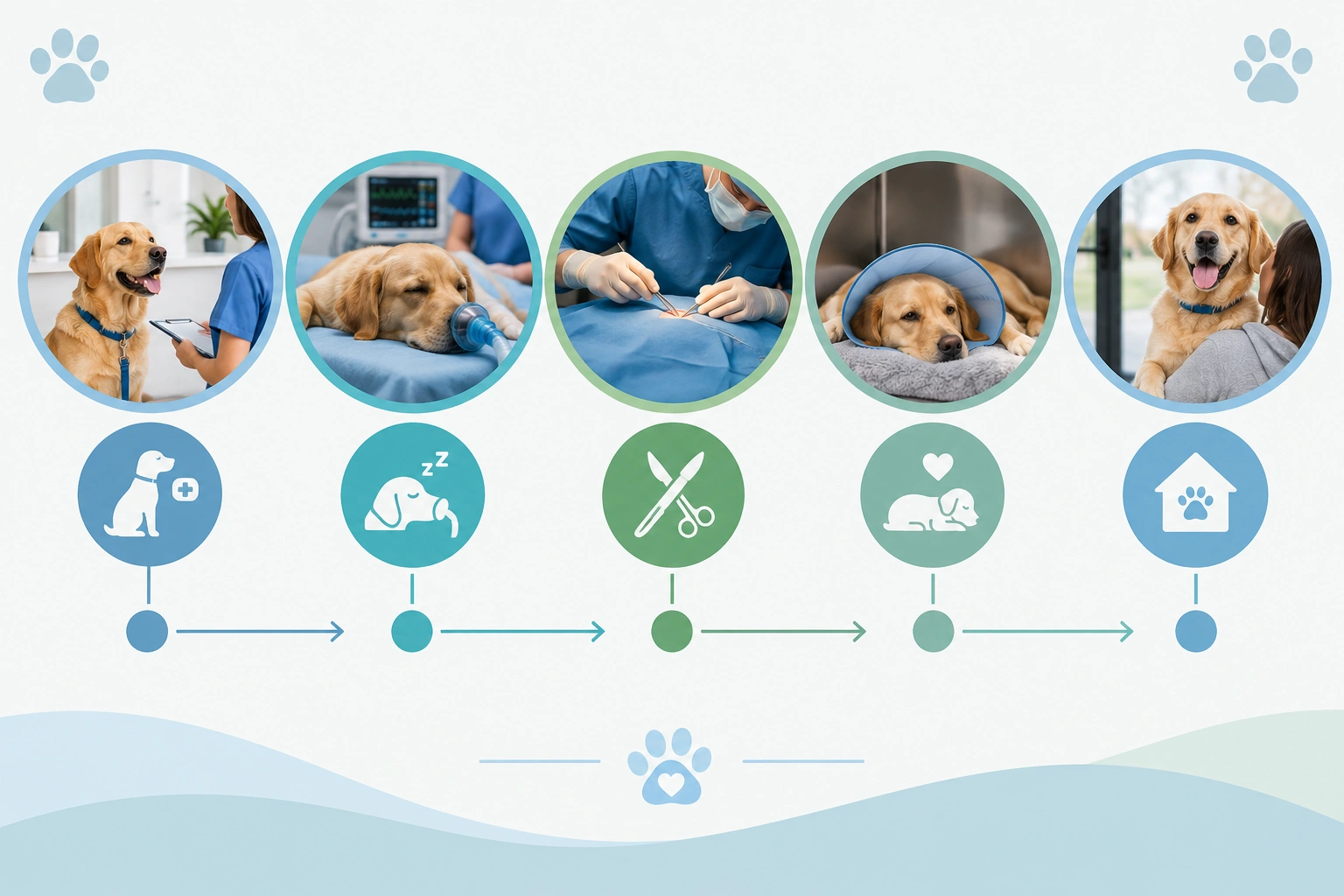
Here’s why the clock keeps running:
-
Check-in and paperwork
The clinic confirms fasting instructions, reviews the consent form, and checks your dog’s current health status. -
Pre-op exam
The team may listen to the heart, assess hydration, and confirm the dog is safe for anesthesia. -
Anesthesia preparation
Your dog is settled, monitored, and anesthetized. -
The surgery itself
This is the short part most people think of as “the neuter.” -
Recovery monitoring
Your dog has to wake up, stabilize, and show that breathing, temperature, and alertness are acceptable. -
Discharge
The clinic reviews home-care instructions and sends your dog home once it is safe.
That means the surgery might be over before lunch, but your dog may still be at the clinic for the rest of the afternoon.
A quick comparison at a glance
| Stage | Male neuter | Female spay |
|---|---|---|
| Actual surgery time | Often under 20 minutes | Often 30 to 90 minutes |
| Total time at clinic | Commonly several hours | Commonly several hours, often longer than a neuter |
| Anesthesia recovery | Usually longer than the surgery itself | Usually longer than the surgery itself |
| Home recovery | Days to weeks of restricted activity | Days to weeks of restricted activity |
Why male neuters are usually faster than female spays
The reason is anatomical and practical.
A male neuter removes the testicles through a small incision. A female spay involves entering the abdominal cavity and removing the ovaries, and sometimes the uterus as well depending on the procedure and the vet’s approach. That extra step makes the surgery more involved.
In real life, the difference may be smaller or larger depending on the dog. A healthy young male dog may be a straightforward case. A female dog that is older, in heat, overweight, or has other health concerns may need more time. So while the general rule is simple—female spays usually take longer—the exact difference is always vet-dependent.
If you are scheduling two dogs, the practical takeaway is this: assume the spay will take longer than the neuter, and plan your day around the slower of the two.
What can make the surgery faster or slower
Several factors influence timing, and most of them have nothing to do with the surgeon being “quick” or “slow.”
Age and size
Larger dogs can take longer because there is more tissue to work through and more anesthesia to monitor. Very small dogs may be quicker, but they can also need closer temperature and anesthesia management.
Sex
Male neuters are generally shorter than female spays for the reasons above.
Health status
If your dog has a heart murmur, respiratory issue, infection, or other concern, the veterinary team may take extra precautions before proceeding. Sometimes that means extra checks; sometimes it means delaying surgery.
Surgical complexity
A routine neuter is one thing. A medically indicated or complicated surgery is another. If the vet anticipates unusual anatomy, retained testicles, prior abdominal surgery, or another issue, the procedure may take longer.
The clinic’s protocol
Different clinics handle pre-op bloodwork, induction, monitoring, and discharge differently. That changes the total time at the clinic even if the surgery itself is similar.
What happens before, during, and after surgery
Understanding the sequence helps the timing make sense.
Before surgery
Your dog is checked in, the team reviews instructions, and the vet confirms the dog is fit for general anesthesia. This is where fasting matters. If the clinic told you not to feed breakfast, that instruction is there to reduce the risk of vomiting or aspiration under anesthesia. Follow it exactly.
During surgery
Your dog is anesthetized, monitored, and the procedure is performed. The actual operation is usually the shortest part of the day.
After surgery
Your dog wakes up in a monitored recovery area. This is where many owners are surprised: waking from anesthesia can take longer than the surgery itself, and the dog may still be groggy or unsteady after the operation is over.
That is normal. What matters is that the dog is waking safely, breathing well, and stable enough for discharge.
How long anesthesia and early recovery last
A pet may begin waking from anesthesia within about 30 minutes of surgery, but that is best understood as a general example rather than a universal expectation. It does not mean the dog is immediately back to normal. A dog can still be sleepy, wobbly, quiet, or slightly nauseous for several hours afterward.
That is why your clinic may not call right away after the procedure. They are not just waiting for the surgery to end; they are watching how your dog handles recovery.
A useful rule: the dog should be treated as if it is not fully “back” for the rest of the day, even if it can walk to the car and seems brighter by evening.
When your dog can go home
Many dogs go home the same day once they are awake enough and the veterinary team is satisfied with recovery. The discharge timing depends on the clinic’s protocol and your dog’s response to anesthesia.
Before pickup, the clinic usually wants to see that your dog:
– is waking appropriately,
– has stable vital signs,
– can stand or move safely enough,
– and does not need extended monitoring.
If your vet keeps your dog longer, that is usually a sign of caution rather than a problem. Extra observation can be the right call if recovery is slower than expected.
When you pick your dog up, ask one simple question: “What should be normal tonight, and what would make you concerned?” That keeps the discharge conversation practical instead of vague.
How to plan the day around the appointment
Do not schedule a busy workday, a long errand list, or a training session after pickup. Your dog will need supervision, and you will need time to listen carefully to discharge instructions.
A better plan looks like this:
- Drop your dog off in the morning.
- Expect to be available for pickup later in the day.
- Go straight home afterward.
- Keep the rest of the day quiet and low-stimulation.
- Use a leash for bathroom breaks.
- Prevent jumping, stairs, rough play, and off-leash excitement.
If you have an especially active dog, think of the first day as a management exercise, not a training exercise. Boredom is better than activity.
Recovery timeline after neutering
The operation may be quick, but healing is not.
In the first 24 hours, your dog may be sleepy, mildly sore, or less interested in food. By the next day, many dogs are brighter, but that does not mean the incision is ready for normal activity.
For routine cases, full activity restriction is often about 10 to 14 days, though your vet’s instructions may differ based on incision type and case complexity.
A practical recovery window looks like this:
– Day 1: rest, supervision, and limited movement
– First several days: protect the incision and prevent licking or chewing
– About 10 to 14 days: many dogs still need activity restriction until the vet clears them
One post-op guidance source says dogs may need to keep an e-collar on for 10 to 14 days after surgery to prevent licking or chewing at the incision. That lines up with the basic recovery principle: the skin may look fine before the tissue beneath it is fully healed. PRCKC post-operative guidance
The biggest mistake owners make is assuming a dog that looks comfortable is ready to resume normal life. Incisions can open, swell, or get infected if the dog is too active too soon.
How to prepare for the appointment
A little preparation removes a lot of stress.
Confirm fasting instructions
Ask the clinic exactly when food and water should be withheld. Do not guess.
Plan transport
Use a secure crate, seat belt harness, or other safe method so your dog does not bounce around in the car after surgery.
Set up the recovery area
Prepare a quiet room or pen with:
– a bed or blanket,
– a leash,
– water,
– and a way to block stairs or jumping.
Ask about discharge timing
Some clinics can give a tighter pickup window than others. Knowing this helps you avoid sitting around all day or arriving too early.
Prepare for supervision
If you cannot watch your dog closely after pickup, arrange help. The first evening matters more than most owners expect.
When to call the vet about delayed recovery or concerns
Some post-op grogginess is normal. Certain signs are not.
Call your veterinarian if you see:
– repeated vomiting,
– bleeding that does not stop,
– swelling that is getting worse,
– an incision that opens,
– extreme lethargy that does not improve,
– pale gums,
– trouble breathing,
– or a dog that seems increasingly painful instead of gradually better.
Also call if your dog will not settle, keeps trying to lick the incision despite the cone, or seems much worse the next day rather than a little better. A routine recovery should trend in the right direction.
For general post-surgery guidance, the ASPCA’s pet care resources and VCA Hospitals’ surgery information are useful places to review what normal recovery commonly looks like, but your own vet’s instructions should always take priority.
The practical answer for owners
If you want the simplest planning rule, use this:
- Actual neuter surgery: usually short, often under 20 minutes for a male dog
- Female spay: usually longer, often 30 to 90 minutes
- Total clinic time: often several hours, commonly around six hours or more
- Anesthesia recovery: longer than the surgery itself
- Home recovery: days to weeks of controlled activity
That is the schedule to plan around, not the surgery time alone.
The biggest challenge is rarely the procedure. It is the restraint afterward. A calm setup, a clear pickup plan, and disciplined rest at home make the whole process much easier.
Frequently asked questions
How long does neutering surgery take for a dog?
A routine male neuter is often under 20 minutes. A female spay usually takes longer, with Virginia Tech citing 30 to 90 minutes for dog spays.
How long will my dog be at the vet overall?
Often several hours. One veterinary source says the total time from check-in to going home is around six hours.
Is neutering faster for male dogs than female dogs?
Yes, usually. Male neuters are typically shorter because they are less invasive than female spays.
How long does anesthesia take to wear off?
Your dog may begin waking within about 30 minutes of surgery, but grogginess and unsteadiness can last much longer.
When can my dog go home?
Usually the same day, once the vet is satisfied with recovery and your dog is stable enough for discharge.
How long is recovery after neutering?
The first day is mostly rest and supervision, and many dogs need restricted activity for about 10 to 14 days or until the vet clears them.
What if my dog seems too sleepy after surgery?
Some sleepiness is normal. If the lethargy is extreme, worsening, or paired with vomiting, breathing trouble, bleeding, or swelling, call the vet.
Can an active dog recover differently because of temperament?
The healing process is the same, but active dogs often need stricter management because they are more likely to jump, run, or overdo it before the incision is ready.
Should I train my dog the day after surgery?
No. The first priority is rest and incision protection, not training, exercise, or stimulation.
What should I ask the vet before the appointment?
Ask about fasting, drop-off time, pickup time, pain control, cone use, and what signs would mean you should call back.
