
How Many Calories Does a Border Collie Need Each Day?

If you want the short answer first: most adult Border Collies need roughly 900 to 1,400 calories per day, with the lower end fitting calmer pet dogs and the higher end fitting very active dogs. A useful weight-based estimate is about 60 to 75 calories per kilogram of body weight per day for an average adult Border Collie, which puts an 18 kg dog around 1,080 to 1,350 calories daily. That range is a starting point, not a final answer, because activity level, body condition, age, and whether your dog is neutered or spayed all matter. Border Collies’ high activity levels mean that a well thought out diet is crucial for ensuring their mental and physical health is at its peak.
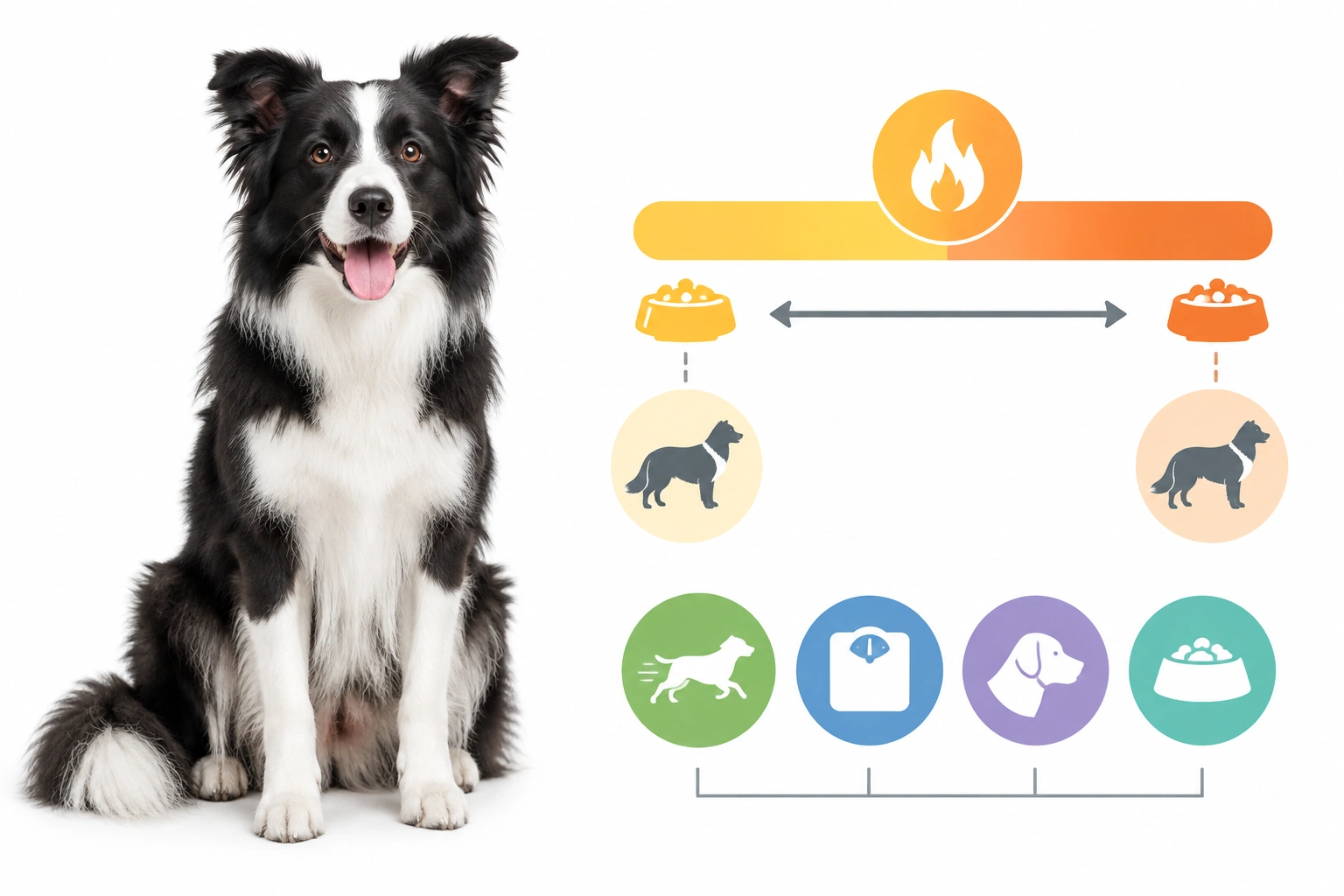
The practical goal is simple: feed enough to keep your Border Collie lean, energetic, and stable in weight. If your dog is gaining fat, the calorie target is too high. If ribs are becoming too prominent or weight is dropping, the target is too low. Breed alone does not decide the number.
What Changes a Border Collie’s Calorie Needs
A Border Collie’s daily calorie need is shaped by a few variables that matter more than breed reputation. If you want the simplest ranking, prioritize them like this:
- Body condition score and current weight trend
- Activity level
- Life stage
- Spay or neuter status
- Physiological status and health
Body weight
Heavier dogs usually need more calories than lighter dogs, but not in a perfectly straight line. A 14 kg Border Collie and a 25 kg Border Collie will not eat the same amount, even if they look equally active. Weight is the first number to check because calorie estimates are built from it.
Activity level
This is the biggest day-to-day driver. A dog that does two relaxed neighborhood walks will need less energy than a Border Collie doing agility, herding, long hikes, or daily ball sessions. A working dog can need significantly more than a family pet.
Life stage
Puppies burn energy for growth. Adults are usually fed for maintenance. Seniors may need fewer calories if they slow down, but not always less food if they start losing muscle or body weight.
Body condition
Two Border Collies of the same weight can need different calorie intakes if one is lean and muscled and the other is carrying extra fat. That is why body condition score matters more than the number on the scale alone.
Spay or neuter status
After spaying or neutering, some dogs become easier to overfeed because their energy needs may dip and their appetite may rise. That does not mean every altered dog needs a huge calorie cut, but it does mean the old portion may no longer fit.
Physiological status
Pregnancy and lactation are special cases. These dogs should not be fed a standard adult maintenance amount without adjustment, and they usually need a veterinary-specific feeding plan.
A useful rule of thumb: do not use breed averages alone if your dog’s body condition says otherwise. A lean, active Border Collie may need more than a breed chart suggests, while an overweight one may need less.
How to Estimate Calories Using RER and MER
If you want a more systematic method than guessing from a breed chart, use RER and MER.
RER: Resting Energy Requirement
RER is the energy a dog needs at rest to keep basic body functions running. A common formula is:
RER = 70 × body weight in kg^0.75
You do not need to calculate that by hand every time. Many veterinary calculators do it for you. The value is useful because it becomes the base for a more realistic daily target.
MER: Maintenance Energy Requirement
MER is the daily calorie target after you adjust RER for lifestyle, growth, reproduction, or weight goals. In plain language, MER is the number you actually feed.
Typical multipliers often used in practice include:
– Adult neutered dog: around 1.6 × RER
– Adult intact dog: around 1.8 × RER
– Active dog: often 2.0 to 3.0 × RER, depending on workload
– Weight loss: lower than maintenance, but ideally set with veterinary guidance
– Growth, pregnancy, lactation: higher than maintenance, sometimes much higher
The multiplier is only a starting point. If your Border Collie is gaining or losing weight unexpectedly, the real-world result matters more than the formula.
Worked example: RER and MER for one Border Collie
Let’s walk through a real example for an 18 kg adult Border Collie with moderate activity.
Step 1: Estimate RER
– Formula: RER = 70 × body weight in kg^0.75
– For an 18 kg dog, RER is approximately 606 kcal/day
Step 2: Choose an activity multiplier
– For a moderately active adult, a reasonable starting multiplier is about 1.8 × RER
Step 3: Calculate MER
– MER = 606 × 1.8
– MER = 1,090.8 kcal/day
Step 4: Round to a practical daily target
– A practical starting target is about 1,100 calories per day
Step 5: Monitor and adjust
– If the dog gains weight over 2 to 3 weeks, reduce the amount a little.
– If the dog loses weight or looks too thin, increase it slightly.
That example shows why calorie estimates are starting points, not fixed rules. Border Collies are active dogs, but some are far more athletic than others.
A simple decision rule
If you know your dog’s weight and body condition:
1. Estimate RER from weight.
2. Pick a multiplier that matches the dog’s lifestyle.
3. Feed that amount for 2 to 3 weeks.
4. Adjust based on body shape, energy, and weight trend.
Calorie Needs by Life Stage: Puppy, Adult, and Senior
| Life stage | Practical calorie guidance | Why it differs |
|---|---|---|
| Puppy | Higher than adults; often several meals per day | Growth, tissue development, and higher nutrient demand |
| Adult | Usually the baseline range for maintenance | Stable body size and predictable energy use |
| Senior | Often similar to adults if active, lower if activity drops | Less movement, but sometimes lower appetite or muscle loss |
Puppy
Border Collie puppies need more energy, protein, minerals, and vitamins than adults because they are building a body, not just maintaining one. The exact amount depends on age, size, and the food used.
A practical rule: feed a puppy food designed for growth and follow the puppy-feeding instructions for that specific food, then adjust by body condition. If ribs disappear under a thick layer of fat, the portion is too large even if the bag says it is “for puppies.”
Adult
For most healthy adult Border Collies, the best starting point is the 900 to 1,400 calories per day range, with smaller or calmer dogs near the low end and larger, more active dogs near the high end. An 18 kg adult often lands around 1,080 to 1,350 calories daily.
Senior
A senior Border Collie does not automatically need fewer calories. Some older dogs slow down and gain weight, so the portion should drop. Others stay lean but lose muscle or appetite, and they may need a more calorie-dense food rather than a smaller amount. Senior feeding should be based on body condition, not age alone.
How Activity Level Changes Border Collie Calorie Needs
Border Collies are known for high exercise needs, but “active” can mean very different things in real life.
| Activity level | Approximate daily calorie need for an adult Border Collie | Best fit |
|---|---|---|
| Low activity | About 900 to 1,050 kcal | Calm pet dog, short walks, little running |
| Moderate activity | About 1,050 to 1,250 kcal | Daily walks, play sessions, some training |
| High activity | About 1,250 to 1,500+ kcal | Long hikes, frequent fetch, agility, farm work |
| Working dog | Often above typical pet ranges | Herding, sustained sport, demanding daily work |
A calm Border Collie that looks “busy” around the house may still burn far fewer calories than a dog that runs hard for an hour every day. The difference shows up in body condition more than in personality.
The trade-off is easy to miss: if you increase food because your dog had a big exercise day, but the rest of the week is normal, the average intake can creep too high. For most pets, it is better to feed for the average week, then use treats or small add-ons only when activity is truly sustained.
How to Turn Calories Into Cups, Cans, or Grams of Food
Calories are the target. Cups and cans are just the delivery system.
Important: measure food by weight whenever possible, or use a standardized measuring cup if the label is given in cups. Eyeballing portions is one of the easiest ways to overfeed or underfeed.
For dry food
Check the bag for kcal per cup or kcal per kilogram. Then divide your daily calorie target by that number.
Example:
– Food provides 390 kcal per cup
– Your dog needs 1,170 kcal per day
– 1,170 ÷ 390 = 3 cups per day
If the food is 455 kcal per cup, the same dog would need only about 2.6 cups. That is why cup-for-cup comparisons between brands can be misleading.
For wet food
Use kcal per can or kcal per pouch.
Example:
– Food provides 350 kcal per can
– Your dog needs 1,050 kcal per day
– 1,050 ÷ 350 = 3 cans per day
Wet food often looks like a larger portion by volume, but the calorie count may be similar or even lower than kibble. Volume is not the same as energy.
For mixed feeding
Add the calories from both foods together. For example, if breakfast is kibble and dinner is canned food, the combined total still needs to match the day’s target.
Quick conversion examples
Here are a few approximate daily examples using common calorie densities:
- 18 kg adult at about 1,100 kcal/day
- At 390 kcal/cup kibble: about 2.8 cups/day
-
At 350 kcal/can wet food: about 3.1 cans/day
-
20 kg active adult at about 1,400 kcal/day
- At 390 kcal/cup kibble: about 3.6 cups/day
-
At 350 kcal/can wet food: about 4 cans/day
-
14 kg calmer adult at about 950 kcal/day
- At 390 kcal/cup kibble: about 2.4 cups/day
- At 350 kcal/can wet food: about 2.7 cans/day
These are only examples. Always use the calorie value on the specific food you buy.
How Treats, Chews, and Training Rewards Fit Into the Daily Budget
Treats are not free calories. They count.
A practical rule is to keep extras to a small part of the daily total, especially if your Border Collie is on a maintenance or weight-loss plan. Training treats, chew sticks, toppers, and table scraps all add up quickly because they are easy to underestimate.
Here is a realistic way to manage it:
– Set a daily calorie target.
– Reserve a portion for rewards.
– Reduce the main meal slightly if training is heavy that day.
For example, if your dog gets several training sessions, it is easier to use a bit of the regular kibble as rewards than to add separate treats on top of full meals. That keeps the total intake honest.
How to Tell If Your Border Collie Is Getting Too Many or Too Few Calories
Body condition is the most useful feedback tool you have.
A simple Body Condition Score (BCS) scale usually runs from 1 to 9, where:
– 1 to 3/9 = too thin
– 4 to 5/9 = ideal or healthy
– 6 to 9/9 = overweight to obese
A healthy 4 to 5/9 Border Collie typically has:
– A visible waist when viewed from above
– A gentle abdominal tuck from the side
– Ribs that can be felt with light pressure, but are not sharply visible
Signs calories may be too high
- Waist is hard to see
- Ribs are difficult to feel under a light fat layer
- Belly looks rounded rather than tucked
- Weight is slowly increasing over weeks
Signs calories may be too low
- Ribs, spine, or hip bones are too prominent
- Weight is dropping without a planned reason
- Coat may look dull if underfeeding is severe or prolonged
- Dog seems hungry all the time and never holds condition
A healthy Border Collie should usually have a visible waist from above and ribs that can be felt without pressing hard, but coat thickness and build can change how obvious that looks. Use the BCS score, not just appearance, to judge condition.
Special Adjustments: Spayed or Neutered Dogs, Weight Loss, Pregnancy, and Lactation
Spayed or neutered dogs
Many altered dogs do well on the same food, but with a smaller portion if their activity drops or weight starts creeping up. Watch the body condition score after surgery rather than making a permanent cut before you see the trend.
Weight loss
If your Border Collie needs to lose weight, do not slash calories aggressively. A practical starting reduction is often about 10% to 20% below current intake, then reassess after a couple of weeks. If weight loss is too slow, a veterinarian may recommend a more structured plan. The goal is steady loss while preserving muscle, not a crash diet.
Pregnancy
Pregnant dogs need more energy as pregnancy progresses, but the increase is not the same throughout the whole gestation. This is a case where veterinary guidance is worth it.
Lactation
Nursing dogs can need a lot more calories than usual, sometimes substantially more. Appetite, body condition, and litter size all matter here, so a one-size-fits-all number is not reliable. Pregnant and lactating dogs should have veterinary-specific feeding plans.
Worked Examples for Different Border Collies
Example 1: Typical adult, moderate activity
A 18 kg Border Collie who gets daily walks and some play may land around 1,100 to 1,250 calories per day. If the dog starts gaining weight, drop toward the lower end. If the dog is lean and very active, stay closer to the higher end.
Example 2: Highly active adult
A 20 kg Border Collie doing agility or long daily runs may need 1,300 to 1,500+ calories per day. If the dog is working hard several days a week, the maintenance target may sit above what a pet chart suggests.
Example 3: Border Collie puppy
A growing puppy needs more calories per pound than an adult, but the exact amount depends on age, size, and the food used. Use the puppy feeding guide on the food label, then adjust by body condition and growth rate.
Example 4: Senior dog
A senior Border Collie that still walks daily but has slowed down may need fewer calories than in middle age. If weight is stable and ribs are easy to feel, the current intake may already be right.
When to Ask Your Veterinarian
Ask your veterinarian for a personalized feeding plan if your Border Collie:
– Is losing or gaining weight without an obvious reason
– Has a poor appetite
– Seems unable to maintain condition despite eating enough
– Is pregnant or lactating
– Is a puppy with rapid growth concerns
– Has a medical issue that could affect appetite, digestion, or metabolism
If the numbers on the scale and the picture in the bowl do not match, the body condition score usually tells the truth. That is especially important for a breed as active and easy to overfeed as the Border Collie.
For more on how much daily exercise often goes hand in hand with calorie needs, see how much attention a Border Collie needs.
FAQs
How many calories does a Border Collie need per day?
Most adult Border Collies need about 900 to 1,400 calories per day, depending on size and activity level.
Do Border Collie puppies need more calories than adults?
Yes. Puppies need more energy and nutrients per pound because they are growing, and their immune system and body tissues are still developing.
How do I know if my Border Collie needs more or fewer calories?
Use body condition as the guide. If the dog is getting soft around the waist or losing a visible tuck, reduce calories. If ribs and hips are too prominent, increase them.
What does a healthy Border Collie body condition look like?
On a 1 to 9 BCS scale, a healthy dog is usually around 4 to 5/9. You should be able to feel the ribs with light pressure, and the dog should have a visible waist from above.
How do treats affect daily calories?
Treats count toward the total. If training rewards are frequent, reduce meal portions slightly so the day’s calories do not creep upward.
Should I feed fewer calories after spaying or neutering?
Often, yes, if your dog becomes less active or starts gaining weight. The best adjustment is based on body condition, not surgery alone.
Can I use the same calorie target for kibble and wet food?
Yes, but the portion size will look very different because calorie density varies. Always compare foods by kcal per cup or kcal per can, not by volume alone.
How much should I reduce calories for weight loss?
A cautious starting point is often about 10% to 20% less than current intake, then adjust based on weight trend and body condition. For a more precise plan, ask your vet.
When should I ask a vet about calories?
If your Border Collie is losing weight, gaining weight quickly, eating poorly, or has a special life stage like pregnancy, lactation, or rapid growth, a vet can help you fine-tune the plan.
