
How Much to Feed a Border Collie Puppy: A Practical Age-by-Age Guide

If you want the short answer, most Border Collie puppies do best with 3 to 4 meals a day, and the total daily amount should be based on age, current weight, food calories, and body condition, not just the number on the bag. How much a puppy needs can vary a lot depending on the calorie density of the food and the puppy’s growth stage, so the bag amount is only a starting point.
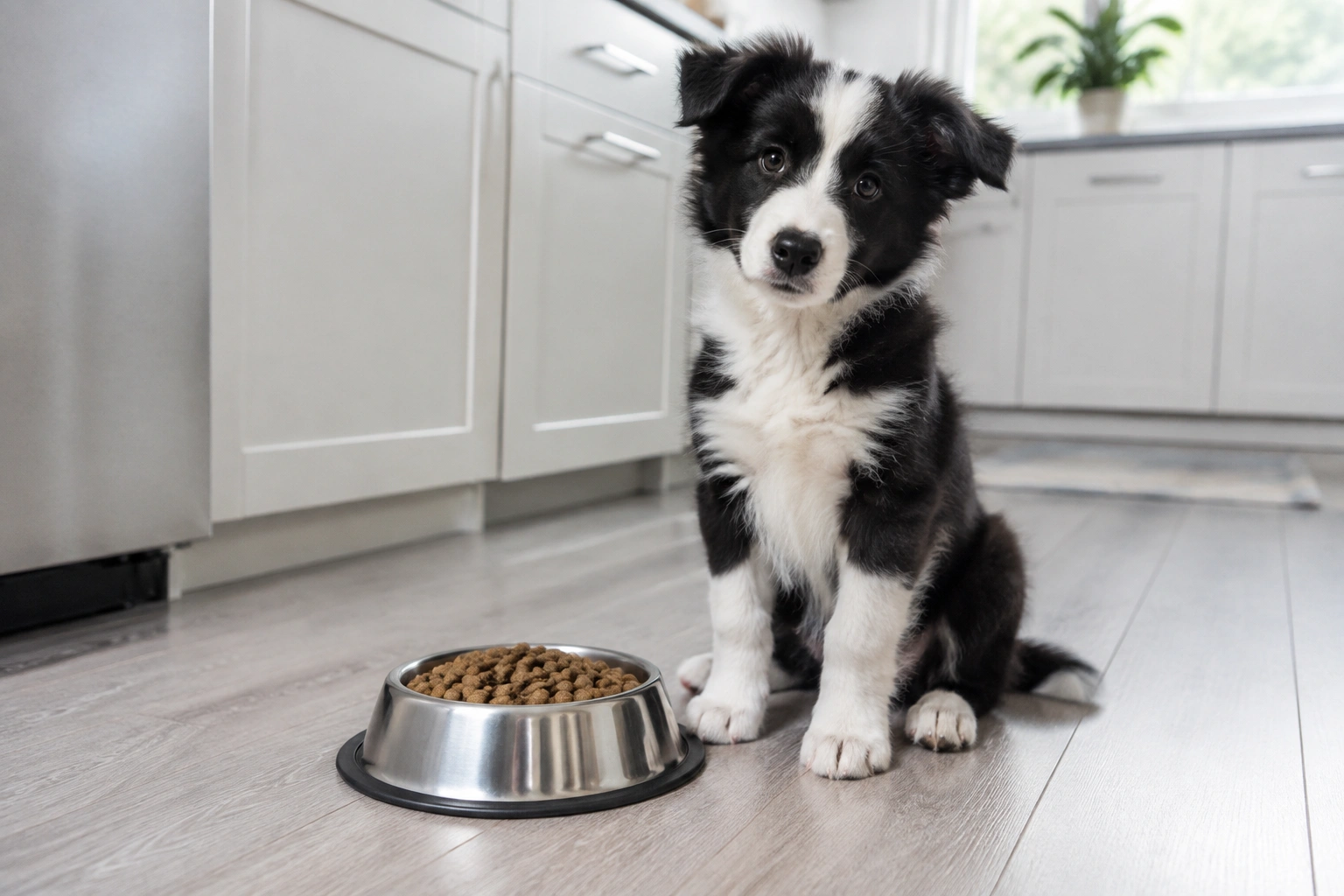
A sensible starting point is to use the feeding chart on the puppy food bag, then adjust based on your puppy’s body shape and weekly weight trend. If your puppy is growing steadily, has a visible waist, and you can feel ribs without pressing hard, you are usually in the right range. If the puppy is getting soft around the ribs or waist, reduce the daily amount a little. If the puppy is too thin or seems to be losing weight, increase the amount and call your vet if the change is more than minor.
Border Collie Puppy Feeding Basics: Why This Breed Needs a Different Approach
Border Collies are not a giant breed, but they are a high-energy herding breed with a lot of drive. That matters because many Border Collie puppies burn through calories quickly once they start moving, training, and exploring. At the same time, puppies still have small stomachs and need food split into several meals.
That combination creates a common mistake: owners either feed too little because the puppy looks small, or feed too much because the puppy seems constantly hungry. Both can be problems. A Border Collie puppy needs enough energy for growth, but not so much that the puppy gains excess body fat during a period when bones, joints, and muscles are still developing.
The most useful mindset is this: feed for steady growth, not for a full bowl. Puppies are often enthusiastic eaters. Enthusiasm is not the same as a real need for more calories.
For a complete and balanced puppy diet, look for food that meets recognized nutritional standards such as AAFCO growth guidance. AAFCO guidance is a nutritional adequacy statement, not a quality guarantee. The AAFCO consumer resources are a good place to understand what “complete and balanced” means on a label.
How Much to Feed by Age and Weight
There is no single amount that fits every Border Collie puppy, because the right portion changes with age, current weight, and the calorie density of the food. Still, it helps to have a simple framework:
- Find your puppy’s current weight.
- Check the puppy feeding chart on the bag for that weight and age.
- Note the calories per cup, per can, or per gram if the label gives them.
- Start with the chart amount for the current weight, then split it into meals.
- Recheck body condition and weight after 1 to 2 weeks and adjust a little if needed.
If your puppy is very active, you may end up closer to the upper end of the label range. If your puppy is calm or already carrying extra fat, you may need less than the chart suggests.
Border Collie puppy feeding guide: starting points
The examples below are practical starting points, not universal rules. They assume a typical puppy food around 350 to 400 calories per cup. If your food is more calorie-dense or less calorie-dense, the cup amount will change.
| Age / example weight | Approx. daily amount | Meals per day | Example meal size |
|---|---|---|---|
| 8 weeks / about 5 lb | about 1 to 1 1/4 cups per day, or roughly 350 to 450 calories | 4 | about 1/4 to 1/3 cup each meal |
| 10 weeks / about 10 lb | about 2 to 2 1/2 cups per day, or roughly 700 to 900 calories | 4 | about 1/2 to 5/8 cup each meal |
| 12 weeks / about 12 to 15 lb | about 2 1/2 to 3 cups per day, or roughly 875 to 1,050 calories | 3 to 4 | about 3/4 cup if 3 meals, or smaller if 4 meals |
| 16 weeks / about 18 to 20 lb | about 3 to 3 1/2 cups per day, or roughly 1,050 to 1,225 calories | 3 | about 1 cup to 1 1/4 cups each meal |
If you want a more concrete example, a 10-week-old Border Collie puppy that weighs around 10 pounds may be fed according to the food’s chart for that weight and age, then split into four meals. For example, if a label suggests 2 1/2 cups per day, that would equal about 1/2 cup four times a day. If the same food lists about 400 calories per cup, that daily amount would be about 1,000 calories total. That is not a universal target, but it shows how package guidance gets translated into real meals.
If your puppy is very small or very large for age, use the current body weight plus the food label rather than guessing by age alone.
How Many Meals a Day a Border Collie Puppy Should Eat
Young Border Collie puppies usually do best with three or four meals a day. That advice lines up with breed-feeding guidance that notes puppies have small stomachs and need several small meals rather than one or two large ones.
Here is the practical rule:
- 8 to 12 weeks: 4 meals is usually easiest on the stomach and easiest for energy stability.
- 3 to 5 months: 3 to 4 meals works well.
- Around 6 months and older: many puppies can move to 2 to 3 meals.
- Near adulthood: 2 meals a day is usually enough.
If your schedule only allows 2 meals a day while the puppy is still young, split the total daily amount as evenly as possible between morning and evening, and keep treats very small. That can work for some puppies, but very young puppies often do better with more frequent feeding, so age matters here.
How to Read a Puppy Food Feeding Chart Without Overfeeding
Feeding charts are useful, but they are starting points, not final answers. They are usually built around average activity and average growth. Border Collie puppies are often neither average in energy output nor average in appetite.
When you read a bag:
- Find the chart for puppy growth or all life stages.
- Match the puppy’s current weight, not projected adult weight unless the label specifically asks for it.
- Check whether the chart gives amounts in cups, grams, or calories.
- Divide the daily total into the number of meals you plan to feed.
- Recheck the puppy’s body condition after 1 to 2 weeks.
If the chart says more than your puppy seems to need, do not automatically follow it. If the puppy is already carrying extra fat over the ribs or waist, the chart may be too generous for that individual dog. If the puppy is lean but growing well, the chart may be appropriate or even a little low.
A useful habit is to keep the food bag or take a photo of the feeding chart. That makes it easier to compare the label amount with what you actually measure each day.
Calories vs Cups: How to Convert Food Labels Into Real Portions
Cups are convenient, but calories are more accurate. Two foods can both say “1 cup,” yet one may be much more calorie-dense than the other. That matters a lot when you switch brands or move from kibble to wet food.
Here’s the easier way to think about it:
- Calories tell you how much energy the puppy gets.
- Cups or grams tell you how much volume or weight of food you are serving.
- The same calorie target can look very different depending on the food.
If a food contains more calories per cup, your puppy needs fewer cups. If you switch to a less calorie-dense wet food, the portion may look larger even though the calorie total is similar.
This is why calorie-based feeding is more precise, especially for Border Collies that are very active or unusually easy to keep lean. If the bag lists calories per cup, use that number to compare foods. If it lists grams, a kitchen scale is more consistent than a measuring cup.
Choosing the Best Food for a Border Collie Puppy
The best food is one that is complete, balanced, age-appropriate, and easy for your puppy to digest consistently. For most owners, that means a puppy formula from a reputable brand that clearly states it is suitable for growth.
Dry kibble
Dry food is the easiest to measure and store. It is also the simplest option if you want consistency from day to day. The downside is that kibble can vary a lot in calorie density, so you still need to check the label.
Wet food
Wet food can be more palatable and sometimes helpful for puppies that are fussy or recovering from stress. It is usually less calorie-dense by volume, so portions can look large. That can help some puppies feel satisfied, but it also makes overfeeding easier if you rely on volume alone.
Mixed feeding
Some owners use kibble for meals and wet food as a topper or part of the ration. That can work well, but the calorie total has to include both parts. Mixed feeding is where people most often accidentally overfeed, because the topper feels “small” and gets added on top instead of replacing part of the meal.
If you want one decision rule, use this: pick the food format you can measure consistently and the puppy can digest reliably. Consistency matters more than chasing the “perfect” format.
How to Adjust Portions for Activity Level, Growth, and Body Condition
Border Collie puppies can have changing energy needs as they grow and become more active. That is why the same puppy may need different amounts over time.
A simple adjustment rule
- If your puppy’s weight or body condition changes over 1 to 2 weeks, adjust the daily amount by about 5% to 10%.
- Recheck again after another 1 to 2 weeks before making a second change.
- Keep the number of meals the same while you adjust the total daily amount, so you can see whether the portion change actually helped.
Increase food slightly if:
- the puppy is still growing but looking too narrow through the body,
- ribs and spine are becoming too prominent,
- weight is not increasing over 1 to 2 weeks,
- the puppy is unusually active and finishing meals quickly with no stool issues.
Decrease food slightly if:
- the waist disappears,
- ribs are hard to feel under a light touch,
- the puppy is getting soft over the back or tail base,
- weight is climbing faster than body shape suggests is healthy.
If your puppy is very active and still lean, it may need more calories than a calmer littermate. That is normal. The goal is not to keep every Border Collie puppy on the same chart number. The goal is to keep each puppy in a healthy body condition.
Border Collie Puppy Body Condition Checklist
A simple body-condition check is one of the best ways to tell whether portions are working.
Ideal condition
- You can feel the ribs with a light touch, but they are not sharp.
- There is a visible waist when viewed from above.
- The belly tucks up slightly from the side.
- The puppy looks lean and athletic, not bony.
Underfed condition
- Ribs, spine, or hip bones are too easy to see.
- There is very little body fat over the back or hips.
- The puppy looks narrow, thin, or tucked up too much.
- Weight is not increasing as expected.
Overfed condition
- Ribs are hard to feel under a light touch.
- There is little or no waist from above.
- The belly looks round or soft instead of tucked.
- There is padding over the chest, back, or tail base.
A puppy may act hungry even when it is already eating enough. That is especially common in smart, active breeds that learn meal routines quickly. Hunger behavior alone is not a reason to increase food. Body shape and weight trend matter more.
Signs Your Border Collie Puppy Is Getting Too Much or Too Little Food
A Border Collie puppy that is being fed well should look lean, athletic, and growing steadily. Here are the practical signs that the amount is off.
Possible overfeeding
- no visible waist,
- ribs difficult to feel,
- soft belly or thickening around the chest and rump,
- rapid weight gain,
- frequent loose stools after meals that are too large.
Possible underfeeding
- ribs, spine, or hip bones are too visible,
- puppy seems to be losing weight,
- poor growth over time,
- low energy that is not explained by normal puppy naps,
- constant food-seeking plus a thin body condition.
Treats, Training Rewards, and Other Extras: How They Affect Daily Intake
Treats count. Toppers count. Chews count. Even small extras can add up fast in a puppy with a small daily calorie budget.
The easiest way to manage this is to treat rewards as part of the day’s food, not a bonus on top of it. If you use a lot of training treats, reduce the meal portion a little so the total intake stays in range.
This matters more than many owners expect because Border Collie puppies are often training frequently. That is excellent for learning, but it can quietly push calories too high if every session uses several treats. Small, low-calorie rewards and pieces of kibble from the meal can solve that problem.
When to Switch From Puppy Food to Adult Food
Most Border Collie puppies should stay on puppy food until they are close to physical maturity, but the exact timing depends on size, growth rate, and your veterinarian’s advice. A practical window for many Border Collies is around 10 to 12 months, though some dogs may be ready a little earlier or later depending on body size and development.
A gradual switch is better than an abrupt change. Mix the new food in over about a week if the puppy’s stomach is sensitive, and watch stool quality and appetite. If the puppy is still growing fast, keep puppy food a little longer. If the puppy is nearing maturity and already carrying extra calories on a puppy formula, your vet may suggest moving sooner.
When to Ask Your Veterinarian
Call your veterinarian if your Border Collie puppy:
– is not gaining weight as expected,
– is losing weight,
– has a sudden drop in appetite,
– has persistent diarrhea or vomiting,
– seems hungry all the time but stays thin,
– or becomes overweight despite careful portion control.
This is especially important if you have already adjusted food and the puppy still does not look right. A vet can check growth, body condition, and whether a medical issue is affecting appetite or digestion.
For general feeding guidance on a high-energy working breed, the American Kennel Club’s Border Collie information is also a helpful reference point for understanding the breed’s activity profile.
FAQ: Border Collie Puppy Feeding Questions
How much should I feed my Border Collie puppy per day?
Use the food’s puppy feeding chart based on your puppy’s current weight, then adjust to body condition. Most young puppies need several small meals rather than one large daily portion.
How many meals a day should a Border Collie puppy eat?
Usually 3 to 4 meals when young, then 2 to 3 meals as the puppy gets older. Very young puppies often do best with 4.
Should I feed by cups or calories?
Calories are more accurate. Cups are easier. If you can, use the calorie information on the label and weigh or measure food consistently.
My puppy seems hungry all the time. Should I feed more?
Not necessarily. Border Collie puppies can act hungry even when they are eating enough. Check body condition first, then adjust only if the puppy is too thin or not growing well.
When should I reduce meals?
You can usually reduce meal frequency gradually as the puppy gets older, but keep the total daily food amount appropriate for growth and body condition.
Can I use wet food instead of kibble?
Yes, as long as it is complete and balanced for growth. Just remember that wet food often has fewer calories per volume, so the serving size will look larger.
When is my puppy ready for adult food?
Often around 10 to 12 months for many Border Collies, but the right time depends on maturity and body size. Transition gradually and confirm the timing with your veterinarian for your individual dog.
Should I ask a vet even if my puppy looks okay?
Yes, if you are unsure. A quick weight and body condition check can save you from feeding too much or too little for months.