
How Often Should a Dog Pee? A Practical Guide for Puppies, Adults, and Seniors

If you live with a Border Collie, you already know that “normal” can change fast. A day of hard exercise, hot weather, more water, or a new routine can all change how often your dog needs to go out. Normal pee frequency also depends on age, size, water intake, exercise, and health, so any “3–5 times a day” figure is only a general adult baseline. The goal is not to memorize one perfect number. It is to learn the normal range, then notice when your dog steps outside that range.
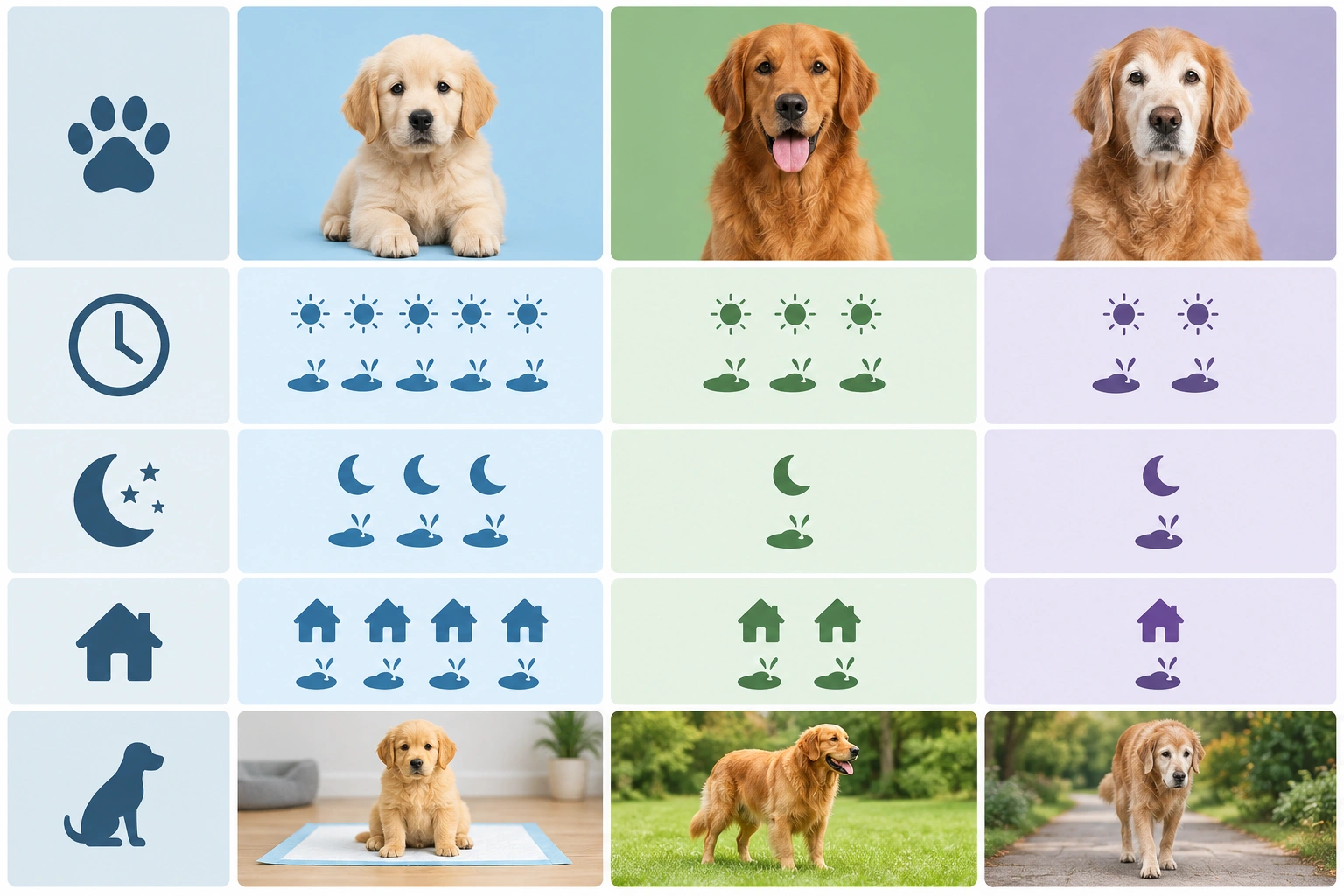
For a healthy adult dog, a useful baseline is three to five pees a day. That is only a rough rule of thumb, not a hard rule. Puppies usually need far more frequent breaks, and senior dogs often do too. Small dogs may also need to go more often than large dogs. If your dog suddenly starts peeing much more often than usual, or peeing only tiny amounts, that is a different question entirely.
A quick reality check helps here: if the schedule makes sense for your dog’s age, size, activity level, and water intake, it is probably normal. If the pattern changed suddenly, or comes with thirst, straining, blood, pain, or accidents in a previously house-trained dog, treat it as a possible health issue rather than a training issue.
The normal range: what most healthy dogs do
For many healthy adult dogs, peeing three to five times a day is typical. Some dogs will be a little below that, some a little above it. What matters most is the pattern you know for your own dog.
A dog that pees four times a day but empties a normal amount each time is usually less concerning than a dog that pees ten times a day in tiny spurts. Frequency alone does not tell the whole story. Volume, comfort, thirst, and whether the schedule changed matter just as much.
Here is the simplest way to judge it:
- Likely normal: your dog pees a normal amount, at predictable times, and acts comfortable.
- Worth watching: your dog pees more often than usual after heavy exercise, hot weather, or extra water.
- Vet concern: your dog suddenly pees much more often, pees tiny amounts repeatedly, strains, or starts having accidents after being reliably house-trained.
If you want a broader house-training and health context, this guide pairs well with our post on why your dog may be peeing so much.
What changes by age: puppies, adults, and seniors
Age changes bladder control more than most owners expect. A schedule that works for an adult dog can fail badly for a young puppy, and a senior dog may need a different rhythm again.
Puppies
Puppies have small bladders and immature bladder control. A common rule of thumb is that a puppy can hold urine for about one hour per month of age at most, and that is a maximum, not a target. A 2-month-old puppy may only manage about two hours. A 4-month-old may manage about four hours, but that does not mean you should test the limit.
In practice, young puppies usually need to go out:
- after waking up
- after play
- after meals
- after drinking
- before being crated
- before bed
- sometimes once overnight
For very young puppies, frequent trips are not overdoing it. They are how accidents are prevented and how house training actually sticks.
Adult dogs
Healthy adult dogs usually settle into a more predictable pattern. Three to five trips a day is a good general range, and many adults do well with breaks about every six to eight hours.
That said, “can hold it” and “should hold it” are not the same thing. For many healthy adult dogs, six to eight hours is a rough maximum capacity, not a routine to aim for. Regular bathroom breaks are usually better for comfort and urinary health.
Senior dogs
Older dogs often need more frequent opportunities to pee because bladder control can weaken with age. Some seniors also develop health problems that increase urination, including kidney disease, diabetes, or urinary tract issues. If an older dog starts asking out more often, don’t assume it is just age. Age may be part of the picture, but it is not the whole picture.
Size, breed, and activity level: why one schedule does not fit every dog
Small dogs often need more frequent bathroom breaks than large dogs. They have less bladder capacity, so the schedule that works for a Labrador may not work for a smaller dog. That does not mean small dogs are “bad at housetraining”; it means their bodies are different.
Border Collies add another layer. They are active, alert dogs that often drink more after training, long walks, fetch sessions, or warm weather. More water usually means more urine. If your Border Collie has had a hard run, a hike, or a long training session, expect extra potty breaks that day.
This is where owners sometimes make the wrong adjustment. They see more peeing and cut back on water. That is usually the wrong move. If your dog is drinking more because of exercise or heat, the safer response is to offer more bathroom breaks and keep an eye on whether the increase settles back down.
A practical rule:
- More exercise or heat = more water = more potty breaks
- Smaller dog = often shorter bladder intervals
- Sudden change without an obvious reason = check for a medical issue
For general guidance on bathroom timing, the American Kennel Club is a useful place to cross-check routine care advice.
How long can a dog hold its pee?
A healthy adult dog can often hold urine for 6 to 8 hours, but that is a rough capacity, not an ideal routine. Some dogs can manage longer in an emergency, but that should not become normal.
For daily life, a better question is: how long should a dog go between chances to pee? For most adult dogs, letting them out at least every six to eight hours is a reasonable baseline. Many dogs do better with more frequent opportunities, especially if they are small, older, active, or still in training.
The trade-off is simple:
- Longer gaps are convenient for people but can increase discomfort and accident risk.
- Shorter gaps take more supervision but usually reduce stress, especially for puppies and seniors.
If you are house training, use the dog’s ability as a ceiling, not a schedule. In other words, do not wait until the bladder is full and the dog is desperate. That is how accidents happen and habits get harder to fix.
When frequent peeing is normal vs. when it signals a problem
Frequent peeing is not automatically bad. The pattern tells you whether it is probably routine or potentially medical.
Usually normal
Frequent peeing is often normal when:
- your dog just drank a lot of water
- it is hot outside
- your dog exercised hard
- your puppy is still learning bladder control
- your senior dog has gradually needed more breaks over time
In these cases, the dog usually pees a normal amount each time and seems comfortable.
More concerning
Frequent peeing is more concerning when you see:
- repeated trips with only tiny amounts coming out
- straining or discomfort
- blood in the urine
- sudden house-training accidents in a previously reliable dog
- increased thirst along with increased urination
- urgency, whining, or restlessness before peeing
That pattern can point to irritation, infection, or a medical issue that needs attention.
A dog that pees often but only produces a few drops each time is not the same as a dog emptying a full bladder more often because it drank extra water. That difference matters.
Medical causes you should not ignore
Several health problems can change urination frequency. The ones most worth watching for are urinary tract infection, kidney disease, and diabetes.
Urinary tract infection or bladder irritation
UTIs can make a dog feel like it needs to pee constantly, even when little comes out. You may also see straining, licking at the genital area, accidents indoors, or discomfort. A dog that seems to “have to go” but cannot fully empty is a classic red flag.
Kidney disease
Kidney problems often show up as increased thirst and increased urination. The dog may drink more, pee more, and sometimes seem less energetic or less interested in food. Because kidney disease can develop gradually, owners sometimes notice the bathroom change before anything else.
Diabetes
Diabetes can also cause increased thirst and urination. If your dog is suddenly drinking much more and needing to go out much more often, that combination deserves a veterinary check.
If you need help collecting a sample for your vet, our guide on refrigerating a dog urine sample explains how to handle it safely.
For broader urinary-health context, VCA Hospitals has reliable veterinary information on common dog conditions and symptoms.
How water intake, heat, diet, and exercise affect urination
Water intake is the biggest everyday driver of pee frequency. A dog that drinks more will usually pee more. That is normal.
Heat and activity matter because they change hydration needs. A Border Collie after agility practice, a long hike, or a warm afternoon run may need extra water and extra bathroom breaks. The same dog on a cool, quiet day may go less often.
Diet can play a role too, especially if a food change alters how much your dog drinks. Some dogs also drink more after salty treats or after eating dry food compared with wetter food.
The useful habit here is to track the pattern, not just the count. Ask:
- Did my dog drink more today?
- Was it hotter than usual?
- Was exercise heavier than usual?
- Did the food change?
- Did the bathroom pattern return to normal afterward?
If the answer is yes to one of the first four and the pattern settles back down, that is usually reassuring.
Nighttime peeing: should you wake a dog up?
For a healthy adult dog, many can sleep through the night without a potty break. Puppies are different. Very young puppies often need an overnight outing, especially if they are still learning bladder control.
If your puppy is having repeated nighttime accidents, the answer is usually not “let them sleep longer and hope.” It is more often a sign that the schedule needs tightening. A late-night potty trip, a pre-bed water check, or a shorter stretch between bedtime and morning may help.
For adult dogs, waking them every night is usually unnecessary unless they are recovering from illness, still house training, or already showing signs of not being able to hold urine comfortably. If a previously reliable adult starts needing nighttime breaks out of nowhere, think medical first, not training first.
House-training and daily bathroom schedules that actually work
A schedule only works if it matches the dog in front of you.
For puppies
Use frequent, predictable trips. The best times are:
- first thing in the morning
- after naps
- after meals
- after play
- after drinking
- before crating
- before bed
For a very young puppy, that may mean every one to two hours during the day, plus extra trips around transitions. The exact timing depends on age and bladder control, but the principle is simple: prevent accidents before they happen.
For adult dogs
Most adults do well with a morning trip, a midday or afternoon trip, an evening trip, and a final trip before bed. Active dogs, small dogs, and dogs with urinary sensitivity may need more.
For seniors
Seniors often do best with shorter intervals and fewer long stretches. If accidents start happening at night or during long work blocks, increase the number of chances to go out before assuming the dog is “being difficult.”
The real decision rule is this: if accidents are happening, the schedule is too loose for that dog.
What to do right now if your dog suddenly starts peeing more
If the change is sudden, pause and gather information before making big changes.
- Track the pattern for a day. Note how often your dog pees, how much comes out, and whether there is straining or discomfort.
- Watch water intake. If your dog is drinking much more than usual, that matters.
- Do not cut water severely. Restricting water can make things worse.
- Give your dog more chances to go out temporarily. Extra potty opportunities help you see whether the pattern is just from water, heat, or exercise.
- Check for red flags. Blood, pain, repeated attempts, or accidents in a trained dog need veterinary attention.
If the dog is trying to pee repeatedly with little or no output, that is urgent. If your dog seems uncomfortable, lethargic, or unable to pass urine, do not wait.
When to see a veterinarian or certified trainer
See a veterinarian promptly if your dog:
- suddenly starts peeing much more often
- pees only tiny amounts repeatedly
- strains to urinate
- has blood in the urine
- drinks much more than usual
- starts having accidents after being house-trained
- seems painful, restless, or unwell
A certified trainer can help when the issue is clearly a routine or house-training problem, but a vet should come first when the change is sudden or paired with physical symptoms. Training can fix timing mistakes. It cannot fix a urinary infection, diabetes, or kidney disease.
For general urinary-health advice, The Kennel Club is another useful reference point for dog owners comparing normal care patterns.
FAQ
How many times a day should a dog pee?
A healthy adult dog often pees three to five times a day. Puppies and senior dogs may need more frequent breaks.
Is it normal for a dog to pee every hour?
For a young puppy, it can be normal during house training. For an adult dog, hourly peeing is not typical unless there is a lot of water intake, heat, exercise, or a medical problem.
How long can a dog hold its pee?
Many healthy adult dogs can hold urine for 6 to 8 hours, but that is not an ideal schedule for every dog. Puppies and seniors usually need more frequent breaks.
Should I wake my dog up to pee at night?
Young puppies may need overnight potty trips. Most healthy adult dogs do not need to be woken up routinely unless they are ill, recovering, or still struggling with bladder control.
When is frequent urination a vet issue?
If the change is sudden, if your dog is straining, if there is blood, if only tiny amounts come out, or if increased peeing comes with increased thirst, call your vet.
Does more water always mean something is wrong?
No. Hard exercise, hot weather, and dry food can all increase thirst and urination. The concern is when the change is sudden, extreme, or paired with other symptoms.
Why does my Border Collie pee more after exercise?
Active dogs often drink more, and more water usually means more urine. That is normal if the pattern settles back down after exercise and your dog seems comfortable.
What should I do if my puppy keeps having accidents?
Increase potty breaks, especially after sleep, play, meals, and drinking. If the puppy is also straining, peeing tiny amounts, or seems unwell, get veterinary advice.
Should I limit water if my dog is peeing a lot?
Not without veterinary guidance. Cutting water too much can cause problems. If the peeing increase is sudden or paired with other symptoms, have your dog checked.
Can a dog go too long without peeing?
Yes. Holding urine for too long is uncomfortable and can contribute to urinary problems. If your dog is regularly being forced to wait too long, the schedule needs to change.
