
How to Dry a Border Collie After Bathing Safely

Quick Answer
To dry a Border Collie after bathing, let your dog shake off excess water, gently press absorbent towels into the coat, and use a dog dryer with comfortable, low-heat or cool airflow if needed. Part the fur and check the undercoat near the skin, especially around the chest, belly, armpits, legs, and tail. Keep your dog indoors in a comfortable, draft-free area until the coat is dry.
Drying a Border Collie properly takes more than making the outer fur feel fluffy. Both rough-coated and smooth-coated Border Collies can have a dense double coat that holds moisture beneath the visible surface.
The most reliable approach is to remove as much water as possible with towels before finishing with gentle airflow when your dog tolerates it. The goal is to dry the coat thoroughly without tangling the longer hair, overheating the skin, or turning grooming into a stressful experience.
How Do You Dry a Border Collie After Bathing Step by Step?
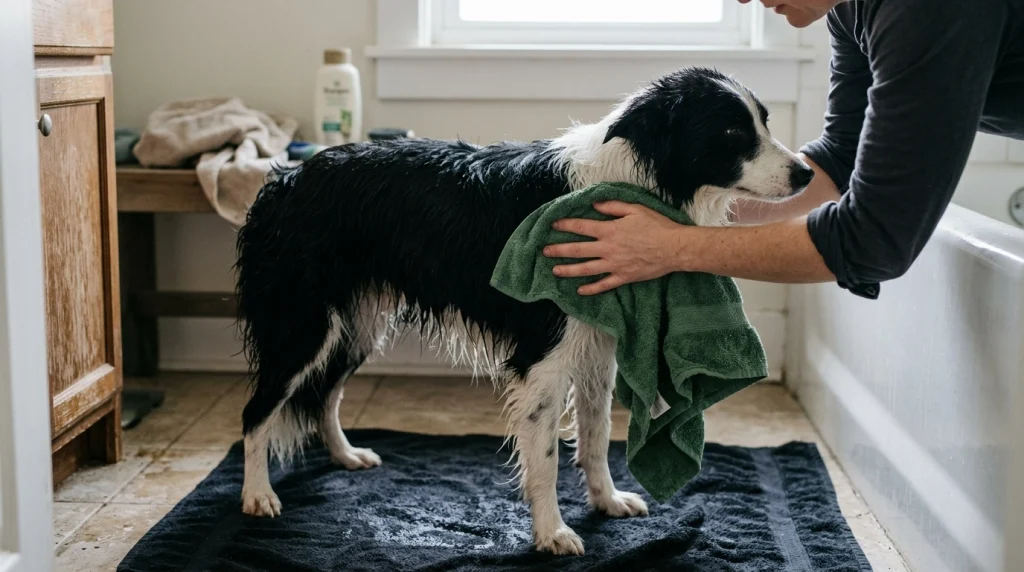
Start with towel drying, continue with controlled airflow if necessary, and finish by checking the coat close to the skin. Prepare your towels and drying area before the bath ends so your wet dog does not have to wait in a cold or slippery space.
- Let your dog shake. Once your Border Collie is standing securely, allow a natural full-body shake. This removes some loose surface water before you reach for the towels.
- Press out the water. Place an absorbent towel against the back, sides, chest, and belly. Press and lift the towel instead of rubbing rapidly back and forth.
- Change to a dry towel. Replace saturated towels as needed. Continue until the coat is no longer dripping and you have removed as much surface moisture as practical.
- Separate the thicker sections. Use your fingers to gently part the fur around the chest, rear legs, tail, and other feathered areas. This helps you locate moisture hidden underneath.
- Use gentle airflow if appropriate. Start with a dog dryer on a low airflow setting and little or no heat. Keep the nozzle moving and direct the air away from the face and ear canals.
- Check the roots of the coat. Part the hair in several places and feel close to the skin. Continue drying damp areas rather than relying on the appearance of the outer coat.
- Finish with a gentle brush. When the coat is dry enough to handle comfortably, separate the longer hair and check for small tangles without pulling on knots.
The American Kennel Club’s guidance on drying dogs completely also recommends pressing towels into the coat instead of rubbing vigorously and introducing dryers gradually when dogs are uncomfortable with their noise.
Why Can a Border Collie’s Coat Feel Dry While the Undercoat Is Still Wet?
A Border Collie’s double coat has a protective outer layer and a softer undercoat. Water can remain in the deeper hair after the outer layer begins to feel dry, so checking only the back or shoulders can give you a misleading impression.
This matters most when the coat is thick, the dog has substantial feathering, or the bath has soaked the entire coat. A rough-coated Border Collie often needs more attention around the chest, tail, belly, and backs of the legs. A smooth-coated dog may dry more quickly, but its undercoat still needs checking.
Where should you check for hidden moisture?
- Behind the ears: Check the hair gently without directing air into the ear canals.
- Chest and armpits: Separate the thicker hair and feel near the skin.
- Lower belly: Check underneath rather than judging from the visible surface.
- Rear legs: Inspect the longer feathering where hair can cling together.
- Tail base: Part the dense hair and check for dampness close to the body.
- Under the collar: Remove the collar if necessary and dry the covered fur before putting it back on.
Look for hair that feels wet or clammy near the roots. A slightly cool sensation alone is not a definitive test of whether the coat is wet, so use your fingers to assess the actual moisture in several areas.
Practical Tip
Check the same areas after towel drying and again after using the dryer. This makes it easier to spot places that repeatedly stay damp and need more careful attention next time.
Should You Use a Dog Dryer or a Human Hair Dryer?
A dog-specific dryer is generally the more suitable choice for a dense Border Collie coat because it can move moisture through the fur without relying on concentrated heat. A human hair dryer requires extra caution because its airflow may heat the skin quickly, especially when held close to one area.
Choose the method according to your dog’s coat, comfort, and the amount of moisture remaining.
| Method | Useful for | Main caution |
|---|---|---|
| Absorbent towels | Removing surface water and reducing dripping | May not dry a dense undercoat completely |
| Dog dryer | Finishing thick or feathered coats | Noise and strong airflow can frighten some dogs |
| Human hair dryer | Limited use when a genuinely cool setting is available | Concentrated heat can injure sensitive skin |
| Indoor air drying | Finishing a coat that is already mostly dry | Slow and unreliable for a heavily soaked undercoat |
These methods are not interchangeable in every situation. Towels are useful for almost every dog, while airflow is particularly helpful when water remains deep in a dense coat. Air drying is better treated as a finishing option than as a guaranteed way to dry a thoroughly soaked Border Collie.
How do you use a dryer safely?
- Begin with cool air or the lowest practical heat setting.
- Start at a distance and increase airflow only while your dog remains comfortable.
- Keep the nozzle moving instead of concentrating air on one patch of skin.
- Part the coat gently so air can reach damp areas without pulling the hair.
- Avoid directing air into the eyes, nose, or ear canals.
- Pause regularly to check skin temperature and your dog’s behavior.
Do not use a hot setting simply to speed up the process. If the airflow feels uncomfortably hot on your hand, move the dryer away or reduce the heat. Stop if your dog becomes distressed rather than forcing the session to continue.
How Do You Dry a Border Collie That Is Afraid of the Dryer?
Use towels and a comfortable indoor room first, then introduce the dryer gradually over separate, short training sessions. You do not need to make your dog tolerate strong airflow immediately after a bath.
Some dogs are more troubled by the sound and vibration than by the air itself. Trying to hold a frightened dog still can make future grooming harder and may create a risk of slipping or injury.
- Start with the dryer switched off. Let your dog approach and sniff it without pressure.
- Build a positive association. Offer praise or suitable treats when your dog stays relaxed near the equipment.
- Introduce the sound at a distance. Turn the dryer on briefly away from your dog, then switch it off before the dog becomes overwhelmed.
- Introduce airflow gradually. When the sound no longer causes concern, try low airflow directed away from the face and body at first.
- Keep sessions short. End while your dog is still coping comfortably, and build duration gradually over time.
For the current bath, keep using gentle towel blotting and allow your dog to rest indoors in a comfortable, draft-free space. If the coat remains substantially wet and your dog cannot tolerate home drying, a qualified groomer can help you determine a suitable approach.
Can You Let a Border Collie Air Dry After a Bath?
Yes, air drying can finish a coat that has already been towel dried thoroughly, particularly in a comfortable indoor environment. It is less dependable when the dog is soaked through, the undercoat is dense, or the room is cold.
After removing excess water, keep your dog on a clean, dry surface away from drafts and monitor the coat as it dries. Do not send a wet dog outdoors in cold or uncomfortable weather simply because the topcoat looks dry.
Consider using gentle airflow to finish the deeper sections if your dog tolerates it. If you rely on towels alone, check the undercoat again rather than assuming that time spent indoors guarantees complete drying.
Drying also gives you an opportunity to inspect the skin. If your dog repeatedly develops redness, soreness, persistent itching, or an unusual odor, seek veterinary advice instead of repeatedly bathing or aggressively drying the affected area.
What Drying Mistakes Should Border Collie Owners Avoid?
Most avoidable problems come from rushing, excessive friction, unsuitable heat, or overlooking areas where moisture remains trapped.
- Rubbing vigorously: Rough towel movements can tangle longer feathering and encourage mats. Press and blot instead.
- Using too much heat: Hot air held close to the skin can cause injury. Choose comfortable airflow and keep it moving.
- Drying only the topcoat: The outer hair can hide damp roots. Check several areas close to the skin.
- Pulling a comb through knots: Damp tangles can tighten when pulled. Separate them gently and seek grooming help for tight mats.
- Forcing a frightened dog: Stop and return to a calmer towel-based approach while you work on gradual dryer training.
- Leaving the dog in a cold, damp space: Move to a comfortable indoor area while drying is completed.
Watch your dog’s behavior throughout the process. Persistent attempts to escape, unusual panting, excessive drooling, or escalating distress are reasons to pause. Weakness, collapse, or breathing difficulty requires prompt veterinary attention.
When Should You Seek Grooming or Veterinary Help?
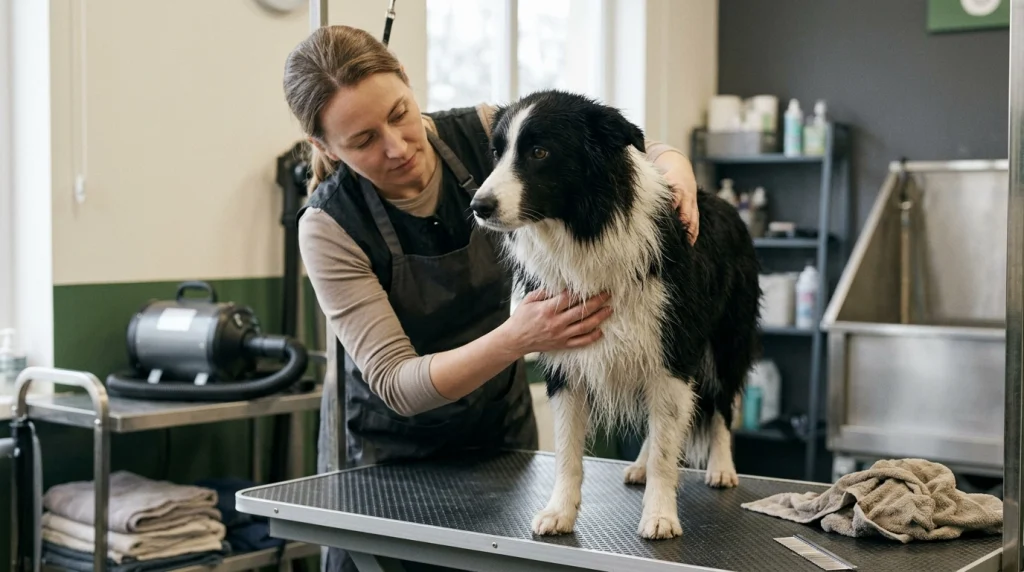
Routine drying should not cause pain, skin irritation, or prolonged distress. If your Border Collie has tight mats close to the skin, cannot tolerate necessary drying, or has a coat that remains persistently damp despite reasonable efforts, ask a qualified groomer about safe options.
Contact your veterinarian if you notice painful skin, open sores, persistent redness, significant itching, or an unusual odor that does not resolve. These signs can have causes unrelated to bathing technique, and repeated washing may not address the underlying problem.
Follow any individual instructions your veterinarian has given for skin conditions or medicated baths. A general drying routine should not override specific care advice for a dog with an existing health concern.
Related Product
Absorbent Microfiber Dog Towels
A dedicated absorbent towel can make the initial drying stage easier by removing surface water before you finish the coat with gentle airflow or indoor air drying.
As an Amazon Associate, we earn from qualifying purchases.
Frequently Asked Questions
How long does it take to dry a Border Collie after bathing?
Drying time varies with coat length, undercoat density, room conditions, towel absorption, and dryer use. Instead of relying on a fixed time, check several areas close to the skin and continue until the coat is dry.
Should I brush my Border Collie while drying?
You can gently separate longer hair once it is manageable, but avoid pulling a brush through wet knots. Finish with a careful brush and comb check when the coat is sufficiently dry.
Can I wrap my Border Collie in a towel after a bath?
You can drape a towel around your dog briefly to absorb water, provided the dog is comfortable and can move freely. Replace a saturated towel and avoid leaving a tight or heavy wrap in place unattended.
Is a dog drying coat useful for a Border Collie?
An absorbent dog drying coat may help wick away surface moisture while your dog rests indoors. It does not guarantee that the dense undercoat is dry, so check underneath and finish drying as needed.
Should I put my Border Collie outside to dry naturally?
It is safer to keep your dog indoors in a comfortable, draft-free area until the coat is dry. Outdoor conditions can be cold, wet, or otherwise unsuitable, and they do not ensure that moisture trapped in the undercoat will disappear promptly.
What if my Border Collie still smells after drying?
A persistent unusual odor, especially with itching, redness, greasy skin, or soreness, may indicate a skin or coat problem rather than ordinary post-bath dampness. Ask your veterinarian for advice instead of repeatedly bathing the dog to mask the smell.
Conclusion
The safest way to dry a Border Collie after bathing is to remove excess water with absorbent towels, use gentle airflow when appropriate, and check the undercoat instead of judging the coat by its appearance. Give extra attention to the chest, armpits, belly, legs, and tail, where moisture can be easy to miss.
Keep the drying area comfortable, avoid excessive heat and rough rubbing, and introduce a noisy dryer gradually if your dog is nervous. If the coat remains damp despite careful drying or you notice persistent skin irritation or unusual odor, seek appropriate grooming or veterinary guidance. A patient routine makes bath time more comfortable while helping you keep your Border Collie’s coat clean, dry, and manageable.