
How to Mentally Tire a Border Collie?

Quick Answer
To mentally tire a Border Collie, give them short tasks that require sniffing, problem-solving, learning, self-control, and decision-making instead of relying only on running. The AKC Border Collie breed profile describes the breed as an energetic working dog that needs to stay occupied, which is why purposeful brain work matters so much.
Quick ways to tire their brain
- Scent searches: Hide food or toys and let your Border Collie solve the search independently.
- Short training: Teach a new skill for five to ten focused minutes.
- Puzzle feeding: Replace an easy food bowl with a safe problem-solving activity.
- Toy-name games: Teach your dog to identify, find, and retrieve specific objects.
- Impulse control: Practice waiting, settling, disengaging, and responding around mild distractions.
- Sniff walks: Slow down and let your dog investigate scents instead of marching constantly.
The key
- Aim for useful engagement followed by calm recovery, not nonstop entertainment until your dog collapses.
Border Collies can finish a long walk and still stare at you as if the day has barely started. That doesn’t always mean they need another mile.
I get better results when I challenge the brain as well as the body. This guide explains how to mentally tire a Border Collie without accidentally creating a dog that expects constant high-speed entertainment.
In This Guide
- What Mentally Tires a Border Collie?
- What Are the Best Ways to Mentally Tire a Border Collie?
- Is Mental Exercise Better Than Physical Exercise?
- How Long Should Mental Stimulation Last?
- How Can You Tire a Border Collie Indoors?
- What Mental Stimulation Mistakes Should You Avoid?
- How Do You Know When Your Border Collie Is Mentally Tired?
- Frequently Asked Questions
- Build a Brain-and-Body Routine
What Mentally Tires a Border Collie?
A Border Collie becomes mentally tired when an activity requires concentration, choices, memory, problem-solving, or controlled responses. Repeating a familiar action with little thought usually provides less mental challenge.
Mental stimulation for a Border Collie is purposeful activity that makes the dog use their senses, memory, self-control, learning ability, or problem-solving skills.
That distinction matters because Border Collies developed as herding dogs. Working livestock involves much more than running across a field.
- Watching movement and predicting where livestock will go
- Responding to verbal cues and whistles
- Changing speed and direction
- Maintaining focus around distractions
- Making decisions while working at a distance
- Controlling natural chase and herding behavior
Modern pet Border Collies still benefit from activities that use those mental abilities. You don’t need sheep or a competition field to provide them.
Why doesn’t running always make a Border Collie settle?
Running burns physical energy, but repetitive running may not provide enough thinking. A fit Border Collie can also become more physically capable when high-speed exercise is constantly increased.
The better target is balance. I want a Border Collie to move, think, then understand how to switch off afterward.
PetMD’s guidance on mental stimulation for dogs also highlights training, games, food activities, and other inexpensive ways to engage a dog’s brain.
Section Takeaway: Mental tiredness comes from purposeful thinking, not simply accumulating more miles. Combine problem-solving, learning, sniffing, and self-control with appropriate physical activity.
What Are the Best Ways to Mentally Tire a Border Collie?
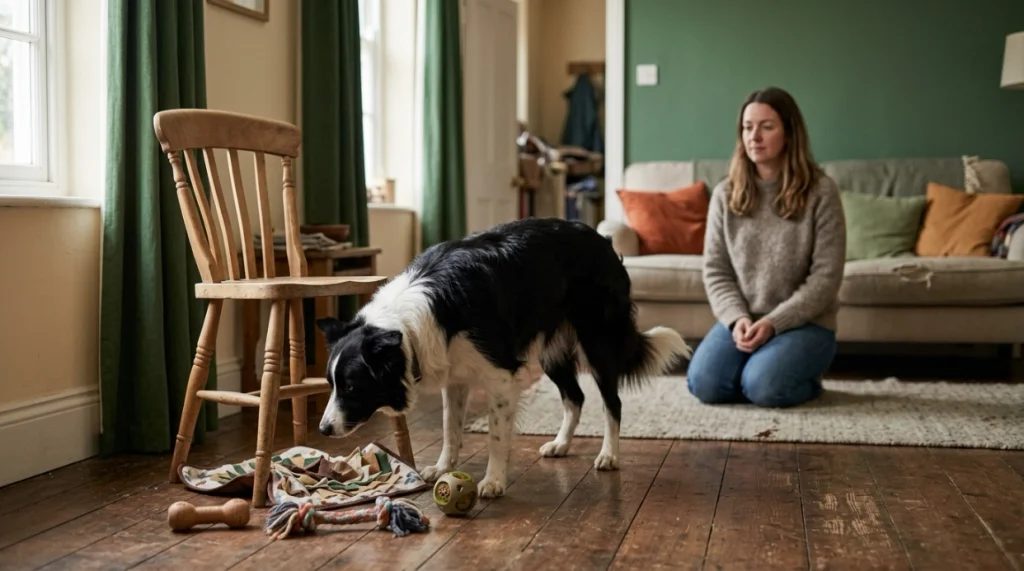
The most useful activities make your Border Collie solve something instead of waiting for you to provide constant excitement. Rotate several types so each remains interesting.
1. Play scent-search games
Scent work is one of my favorite choices because the dog controls much of the problem-solving. Start easy and make the search harder only after your dog understands the game.
- Let your Border Collie watch you place three treats around one room.
- Give a consistent search cue such as “find it.”
- Gradually place treats behind furniture or around safe corners.
- Later, hide treats while your dog waits outside the room.
- Use several rooms once simple searches become easy.
You can repeat the same idea with a favorite toy. This adds object recognition and memory to the search.
2. Teach one small new skill
New learning often requires more concentration than drilling twenty cues your dog already knows. Keep sessions short enough that your Border remains eager.
- Touch your palm with the nose
- Walk around a cone
- Put toys into a basket
- Back up three steps
- Place front feet on a platform
- Identify toys by name
- Go to a mat and settle
I prefer ending while the dog is still successful. Five sharp minutes can be more useful than twenty minutes of repetitive drilling.
3. Make meals require thought
A bowl lets many dogs finish dinner within seconds. Part of the same meal can instead become a safe searching or problem-solving task.
- Scatter kibble through clean grass.
- Use a snuffle mat.
- Place food in an appropriate puzzle feeder.
- Hide small portions around a room.
- Use kibble during reward-based training.
- Place food inside supervised, dog-safe enrichment items.
The ASPCA’s canine DIY enrichment guidance encourages opportunities for natural behaviors such as smelling, chewing, playing, chasing, and scavenging.
4. Teach toy names
Start with two toys that look different. Say the chosen name immediately before encouraging your dog to interact with that object.
Once the association is reliable, place both toys down and ask for one. Later, increase the distance or add another named object.
5. Add impulse-control work
Mental exercise isn’t always an exciting puzzle. Controlling an impulse can require serious concentration from a movement-sensitive Border Collie.
- Wait briefly before going through a door.
- Hold position while you move one step away.
- Disengage from a toy on cue.
- Settle on a mat while mild household activity occurs.
- Check in with you during a walk.
Section Takeaway: Use several kinds of brain work instead of depending on one favorite game. Scent work, new learning, food searches, object recognition, and self-control challenge different skills.
Is Mental Exercise Better Than Physical Exercise?
No. A healthy Border Collie generally needs both appropriate physical activity and mental stimulation.
Think of them as different needs rather than substitutes. Mental exercises shouldn’t be used to eliminate normal walks, movement, exploration, or play.
| Activity | Practical Starter Block | Main Challenge | Typical Arousal |
|---|---|---|---|
| Scent search | 5–10 minutes | Problem-solving and scent discrimination | Low to moderate |
| New trick training | 3–10 minutes | Learning and concentration | Moderate |
| Sniff walk | 15–30 minutes | Sensory exploration | Low to moderate |
| Structured fetch | 10–20 minutes | Movement plus cue control | High |
| Mat training | 5–10 minutes | Self-control and relaxation | Low |
These times are starting points, not medical or exercise prescriptions. Age, fitness, health, temperament, and previous training all change what is appropriate.
A useful pattern is movement followed by thinking, then recovery. For example, try a sniff walk, five minutes of training, then quiet rest.
As of 2026, the basic principle hasn’t changed: this working breed benefits from both activity and meaningful engagement. The AKC also recommends suitable exercise, practical skills, and purposeful jobs for energetic dogs in its guidance on helping highly active dogs settle.
Section Takeaway: Don’t choose between brain work and physical exercise. Build a routine where movement, thinking, and relaxation support each other.
How Long Should Mental Stimulation Last?
Many mental sessions can start at about three to ten minutes. Quality matters more than stretching a simple task into a marathon.
For a healthy adult Border Collie, you can spread brain work across the day rather than scheduling one huge session.
- Morning: Five minutes of obedience or trick practice during breakfast.
- Midday: Five to ten minutes of scent searching or puzzle feeding.
- Afternoon: A varied walk that includes sniffing and environmental exploration.
- Evening: Five to ten minutes of a new skill, followed by calm mat work.
Should puppies do the same routine?
No. Puppies need shorter sessions, age-appropriate movement, sleep, social learning, and simple successful exercises.
Don’t apply an adult working dog’s schedule to a growing puppy. A veterinarian can help you plan suitable physical activity during development.
What about senior Border Collies?
Seniors can still enjoy nose work, simple puzzles, familiar tricks, and gentle learning. Adjust physical demands for mobility, vision, hearing, and medical changes.
Vet note: Sudden restlessness, confusion, sleep changes, pain, exercise intolerance, or major behavior changes deserve veterinary attention rather than simply adding more stimulation.
How Can You Tire a Border Collie Indoors?
You don’t need a large yard to provide useful mental work. Indoor games can be excellent on hot, rainy, or otherwise unsuitable outdoor days.
Try a 30-minute indoor brain routine
- 5 minutes: Practice two familiar cues and one new behavior.
- 10 minutes: Run a treat or toy search through one or two rooms.
- 5 minutes: Practice toy names or putting toys into a basket.
- 5 minutes: Use a food puzzle, snuffle mat, or supervised food search.
- 5 minutes: Finish with quiet mat work and reward relaxed behavior.
Keep active indoor games controlled. Slippery flooring, furniture, stairs, and tight corners can turn energetic play into an injury risk.
Use household objects as training targets
Simple objects can become useful learning tools without creating complicated homemade equipment. A towel can mark a settle area, while a sturdy box can become a supervised search container.
- Walk around a chair.
- Touch a sticky-note target.
- Find food under one of several safe cups.
- Carry a toy to a basket.
- Search cardboard boxes for hidden food.
- Find a family member hiding in another room.
Supervise DIY enrichment closely. Remove anything your dog tries to shred and swallow.
What Mental Stimulation Mistakes Should You Avoid?
The biggest mistake is turning enrichment into nonstop excitement. Your Border Collie also needs to learn that quiet periods are normal.
Don’t make fetch the answer to every restless moment
Fetch combines speed, chasing, anticipation, and repetition. Some Border Collies become intensely focused on the game.
Use structured play with clear starts and finishes. Mix it with sniffing, training, and calmer tasks.
Don’t make puzzles impossibly difficult
A challenge should create thinking, not helpless frustration. Begin where your dog can succeed and increase difficulty gradually.
- Make the first scent hides obvious.
- Reward attempts during new training.
- Show your dog how a puzzle works.
- Reduce difficulty if frustration rises.
Don’t entertain your dog every waking minute
If every request for attention produces a game, your Border Collie can learn that pestering starts entertainment. Reinforce calm choices too.
Quietly reward lying down, disengaging from toys, resting after exercise, and watching household activity without reacting.
Don’t assume every restless behavior means boredom
Pacing, barking, destruction, or difficulty settling can have several causes. Fear, separation-related distress, pain, discomfort, and compulsive behavior can sometimes look like unused energy.
Vet note: Seek veterinary or qualified behavior help when behavior appears sudden, severe, compulsive, fear-driven, painful, or resistant to a sensible daily routine.
Section Takeaway: Good enrichment should create satisfaction and eventually support calm behavior. More excitement isn’t automatically better stimulation.
How Do You Know When Your Border Collie Is Mentally Tired?
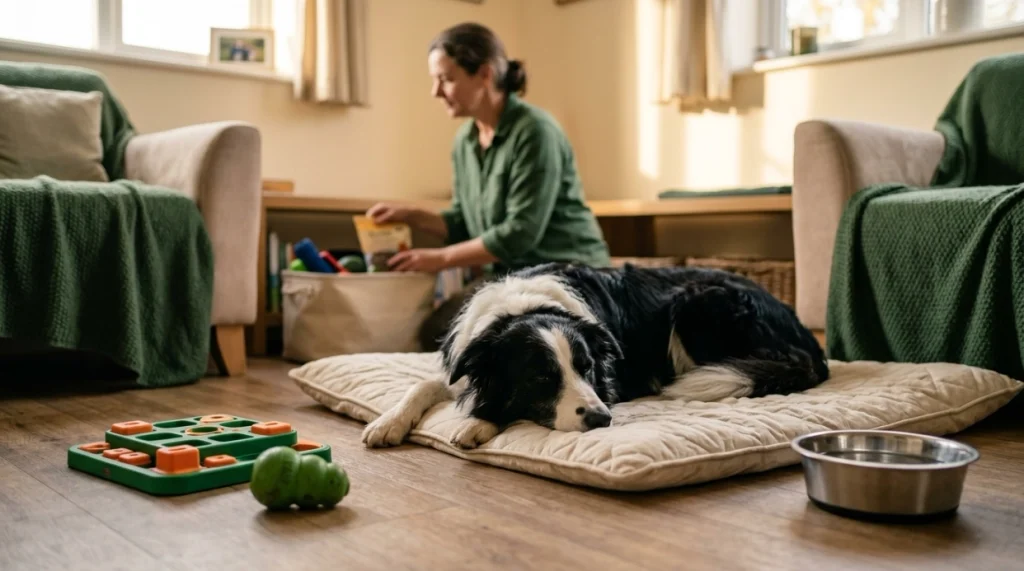
A mentally satisfied Border Collie often becomes easier to disengage and settle after an activity. You want relaxed recovery rather than complete physical exhaustion.
Healthy signs that the session can end
- Choosing to lie down afterward
- Relaxed facial expression and body posture
- Reduced demand for another immediate activity
- Drinking, chewing, or resting calmly
- Moving away from the puzzle or training area
- Losing some enthusiasm for repeated cues
Signs the activity may be too frustrating or intense
- Frantic scratching or biting at a puzzle
- Repeated barking from frustration
- Increasingly wild movement
- Difficulty taking food normally
- Ignoring previously easy cues
- Being unable to disengage after the game stops
If that happens, lower the difficulty and shorten the session next time. Mental stimulation should be challenging without becoming overwhelming.
I also like to finish with an obvious transition. Put equipment away, offer water, and move into a predictable quiet period.
Frequently Asked Questions
Can mental stimulation tire a Border Collie more than walking?
It can feel more tiring because learning, scent work, and problem-solving require sustained concentration. However, mental stimulation shouldn’t completely replace physical exercise. Most healthy Border Collies benefit from a daily combination of movement, exploration, training, play, and rest.
How many hours of mental stimulation does a Border Collie need?
You usually don’t need hours of formal brain games. Several short sessions spread through the day can provide meaningful mental work. Start with blocks of roughly three to ten minutes, then adjust the difficulty and frequency to your individual dog’s age, health, temperament, and response.
What is the fastest way to mentally tire a Border Collie?
A short scent-search session followed by new trick training often provides concentrated mental work. Hide several treats or a toy, let your dog search independently, then spend five minutes teaching one new behavior. Finish with a calm settling period instead of immediately starting another exciting game.
Are puzzle toys enough for a Border Collie?
No single toy covers every mental need. Puzzle feeders can be useful, but Border Collies also benefit from interaction, training, scent work, environmental exploration, natural behaviors, suitable physical exercise, and opportunities to relax. Rotate activities as familiar puzzles become easier.
Why is my Border Collie still hyper after exercise?
The exercise may have been physically intense but mentally repetitive, or your dog may still be highly aroused afterward. Add sniffing, simple problem-solving, controlled training, and deliberate relaxation. Persistent or sudden inability to settle should also be discussed with your veterinarian.
Does a Border Collie need a job?
A Border Collie doesn’t need livestock or a formal working role, but purposeful tasks often suit the breed extremely well. Scent work, obedience, agility foundations, toy retrieval, trick training, household search games, and other structured activities can provide a clear goal for that active brain.
Build a Brain-and-Body Routine
The goal isn’t to completely empty your Border Collie’s energy tank every day. That approach can become an endless race against a dog that keeps getting fitter.
Instead, give your Border Collie opportunities to move, sniff, solve problems, learn, practice self-control, and then recover. That combination is much closer to the varied mental demands this intelligent herding breed was built to handle.
- Use short, focused training sessions.
- Include scent work several times each week.
- Turn some meals into enrichment.
- Rotate puzzles before they become predictable.
- Allow sniffing and exploration on walks.
- Reward calm behavior as deliberately as active behavior.
- Adjust every activity for age, health, fitness, and personality.
Start with one ten-minute mental activity today. Watch what helps your Border Collie become focused during the task and relaxed afterward, then build your routine around those results.
