
How to Tell if Dogs Are Bonded: Clear Signs, Key Differences, and What to Do Next

If you live with two dogs, it can be hard to tell whether they truly care about each other or just share the same space. Some pairs act like they’ve known each other forever. Others look close on the surface, but the relationship is really built on habit, anxiety, or one dog shadowing the other for comfort.
The good news is that you usually do not need a dramatic “proof” moment to assess the relationship. In everyday life, bonded dogs tend to show a pattern: they seek each other out voluntarily, relax in each other’s presence, and recover well after routine separations. That pattern matters more than any single cute behavior.

For dog owners, foster homes, and rehoming decisions, this distinction is practical. A genuinely bonded pair may do better staying together. A pair that only coexists may be fine apart. And a pair that looks close but is actually dependent, guarded, or anxious may need a different plan.
What It Means for Two Dogs to Be Bonded
A bonded pair is best thought of as two dogs with a stable, repeated relationship that offers comfort, familiarity, and social ease. Shelter guidance from Maddie’s Fund notes that dogs may be considered bonded when they show closeness, continued physical contact, comfort each other, sleep together, and appear to rely on each other.
That does not mean they are inseparable every minute of the day. Bonding is not the same as constant contact. In fact, healthy bonds usually include flexibility. The dogs can be together without tension, but they can also settle separately when needed.
It also helps to separate bonding from other relationship labels that get used loosely:
- Simple familiarity: the dogs know each other and are comfortable sharing space, but there is no strong preference for each other. For example, two dogs may peacefully pass in the hallway and nap in the same room without seeking each other out.
- Dependency: one dog becomes distressed without the other and may have trouble functioning alone. For example, a dog may pace, whine, or refuse to settle when the other leaves the house.
- Dominance: a vague label people often use when they see tension, but it does not explain whether the dogs actually feel safe together.
- Coexisting: the dogs live together peacefully, but the relationship may be more practical than affectionate.
A real bond usually shows up in repeated behavior, not one-off moments. One cuddle session is nice. A consistent pattern of relaxed contact, mutual checking-in, and calm reunion tells you much more.
Clear Signs Two Dogs Are Truly Bonded
The most reliable signs are the ones that appear across ordinary routines, not just when the dogs are excited.
They choose each other voluntarily
Bonded dogs often seek proximity without being forced into it. One may follow the other from room to room, lie near the other’s bed, or settle in the same area even when there is plenty of space elsewhere.
The key detail is that the contact seems chosen, not clung to. A dog that calmly moves closer and then relaxes is showing something different from a dog that panics if the other leaves the room.
Their play looks reciprocal
Healthy bonded play tends to be back-and-forth. Both dogs take turns initiating, pausing, and re-engaging. You may see play bows, loose movement, bouncing, and brief check-ins that keep the game balanced.
What you do not want is one dog constantly chasing while the other repeatedly tries to escape. That can look active, but it is not necessarily affectionate. It may mean one dog is overwhelmed.
They rest together without tension
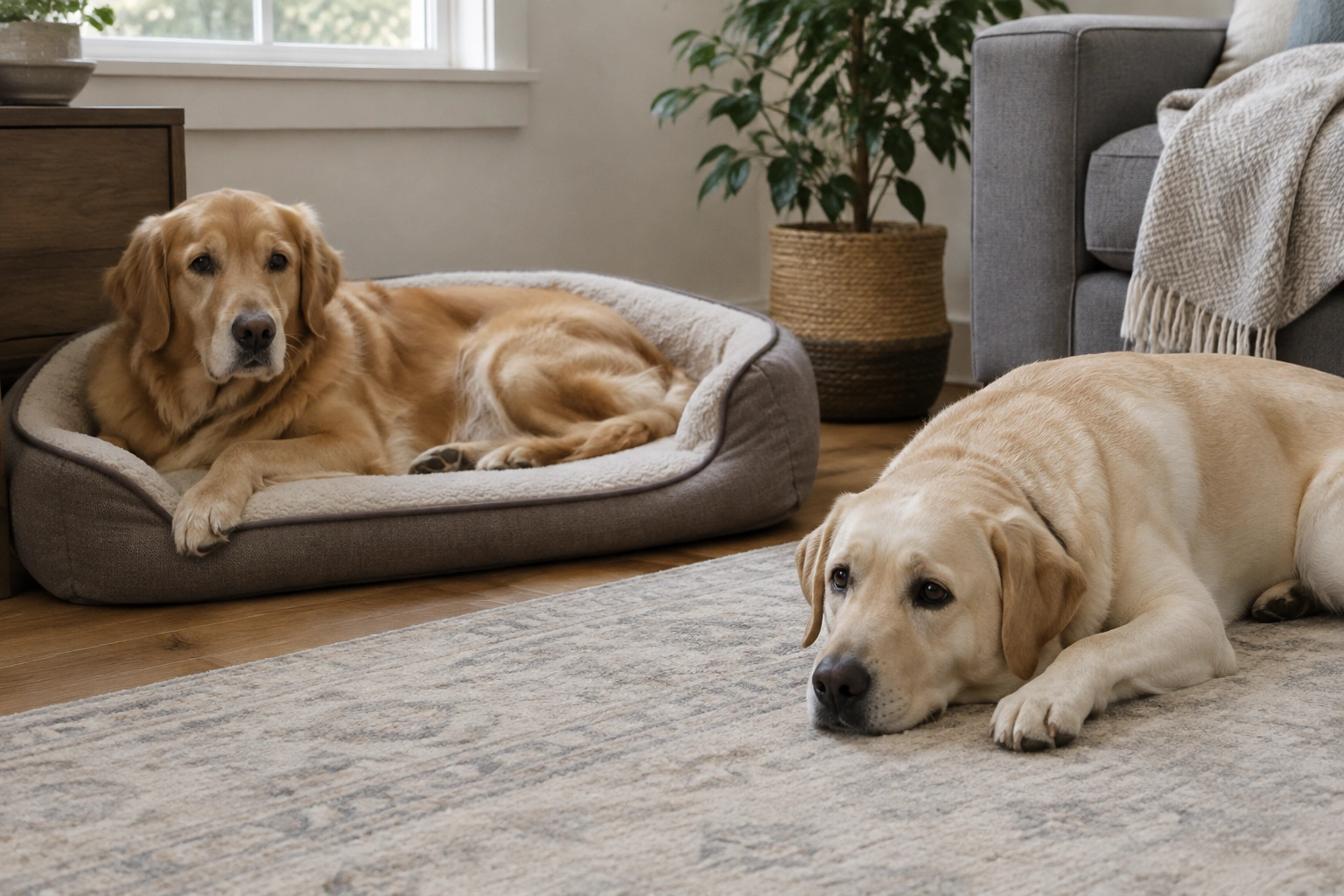
Sleeping near each other is one of the clearest everyday signs of comfort. Maddie’s Fund specifically includes dogs that “sleep together” as a sign they may be bonded. In practical terms, that can mean curled up together, touching sides, or simply choosing the same bed or room.
But sleep proximity alone is not enough. Two dogs may pile onto the same couch because it is the warmest or most convenient spot. What matters is whether they appear relaxed: loose limbs, soft faces, and no guarding of space.
They check in with each other
Bonded dogs often glance back at the other during walks, pause during play to make sure the other is still engaged, or settle more quickly when the other dog settles. This “social checking” is subtle, but it matters. It suggests the dogs are orienting to each other as a social reference point.
They recover calmly after brief separation
A short separation, like one dog going to the vet or out for a solo walk, can be revealing. A bonded dog may notice the absence and show mild concern, but should usually settle again once the routine changes. Persistent panic, refusal to eat, or destructive behavior points more toward distress than simple attachment.
Body Language That Shows Comfort and Trust
Reading dog body language is where many owners get the clearest answer.
Look for these signs of ease:
- Loose, wiggly movement rather than stiff, sharp motion
- Soft eyes and a relaxed facial expression
- Curved body posture instead of frozen or braced positioning
- Ears in a neutral, natural position
- Mouth loosely closed or gently open, not tight-lipped
- Easy disengagement when the interaction ends
The overall picture should look unforced. Bonded dogs typically do not need to “manage” each other constantly. They can lie near each other, rise, shift positions, and resettle without drama.
By contrast, tension often shows up as stiffness, hard staring, blocking, hovering, or one dog repeatedly licking the other’s face while the other turns away. In those cases, the interaction may be more about appeasement, uncertainty, or conflict avoidance than genuine comfort.
If you want a simple rule: relaxed bodies plus repeated voluntary closeness is much more meaningful than dramatic affection.
Bonded Dogs vs. Dogs That Just Live Together
This is where many owners get tripped up. Two dogs can share a home for years and still not be emotionally attached in a strong way.
| Behavior | Bonded dogs | Dogs that just live together |
|---|---|---|
| Seeking each other out | Repeated, voluntary, calm | Occasional or purely situational |
| Resting | Often choose to rest near each other | May rest together only because space is limited |
| Play | Reciprocal and balanced | Limited, brief, or one-sided |
| Separation | Mild concern or temporary adjustment | Little reaction, or independent coping |
| Reunion | Calm, easy, familiar | Neutral or mildly interested |
| Daily pattern | Consistent closeness with flexibility | Shared space without strong preference |
A useful question is: If the other dog were not available, would this dog still look emotionally steady? If yes, the relationship may be affectionate but not deeply dependent. If no, the pair may be too enmeshed.
That distinction matters because a close pair is not automatically a healthy pair. Sometimes “they can’t be apart” is a warning sign, not a compliment.
Bonding vs. Separation Anxiety, Resource Guarding, and Dependency
Some of the strongest-looking “bonding” behaviors are actually stress behaviors.
Separation anxiety can mimic attachment
A dog that panics when the other leaves may bark, pace, whine, refuse food, or destroy items. That can look like devotion, but it is more accurately distress. One dog may be fine alone while the other falls apart, which is a sign of overreliance rather than balanced bonding.
Resource guarding can look like protectiveness
If one dog stiffens, hovers over the other, blocks access to food, toys, doors, or resting spots, the issue may be guarding. Sometimes owners describe this as “they’re protective of each other,” but the body language tells a different story: tension, possession, and control.
Dependency is not the same as healthy closeness
Dependency shows up when one dog cannot settle, explore, or make decisions without the other. The relationship may be emotionally important, but it is not necessarily stable. A healthy bond should still leave room for each dog to function on its own.
If you are unsure which pattern you are seeing, ask yourself three questions:
- Do both dogs relax in each other’s presence?
- Can each dog settle alone for reasonable periods?
- Do their interactions look balanced, or does one dog always manage the other?
If the answer to the second question is no, think beyond “bonded pair” and consider anxiety.
How Bonded Dogs Behave When Separated
Brief separation is one of the best reality checks.
A bonded pair may notice the separation, look for each other, or be a little unsettled at first. That does not automatically mean something is wrong. Dogs are social animals, and routine changes can be mildly stressful.
What you want to see is recovery. A dog with a healthy attachment usually reorients, settles, eats, plays, or rests once the new routine becomes clear.
More concerning signs include:
- persistent vocalizing
- pacing or frantic searching
- refusal to eat or drink
- destructive behavior
- inability to rest
- repeated attempts to escape confinement
If the distress is strong, the issue may be more than bonding. It may be separation-related anxiety, and that deserves a different response.
A practical example: two dogs that nap together, then each settle with a chew in separate rooms for an hour, are probably comfortable and bonded. Two dogs that scream, scratch, and panic whenever one leaves the house are not simply “close.” They may be overdependent.
How to Support a Healthy Bond Without Creating Dependency
A healthy dog-to-dog bond should feel supportive, not fused. The goal is to build comfort together while still helping each dog stay confident alone.
Practical ways to do that include:
- Separate enrichment: give each dog its own chew, puzzle feeder, or sniffing activity so they can relax without competing.
- Separate short separations: practice brief, low-stakes time apart, such as one dog resting in another room while the other stays with you for a few minutes.
- Shared calm routines: reward quiet parallel time, like both dogs settling on their own beds after a walk.
- Individual attention: rotate training, handling, and one-on-one time so each dog learns to engage without relying on the other.
What to avoid is anything that rewards clinginess or conflict. For example, do not always let one dog follow the other everywhere, do not rush to reunite them after every small separation, and do not use joint excitement as the main source of interaction. Those habits can reinforce overdependence instead of resilience.
When a Strong Bond Is Healthy vs. When It Becomes a Problem
A healthy bond adds stability. The dogs are calmer together, not trapped together. They can share routines, enjoy each other’s company, and still tolerate ordinary independence.
A problematic bond starts to shrink each dog’s world.
Watch for these red flags:
- one dog cannot rest unless the other is present
- the pair becomes distressed during even short separations
- one dog controls access to beds, food, toys, or humans
- the dogs escalate each other’s arousal instead of settling each other
- one dog seems to lose confidence or curiosity when alone
The trade-off is real. Keeping a bonded pair together may reduce transition stress, but it can also preserve unhealthy dependence if the dogs never learn to cope separately. That is why “keep them together no matter what” is not always the right answer.
Can Dogs Bond Quickly, and What Helps the Bond Grow?
Yes, dogs can form a real bond faster than many people expect, especially if they are compatible in energy level, temperament, and daily routine. Shared history is not the only route to closeness. Dogs that come through a stressful experience together, or that spend a lot of time in calm, predictable contact, may attach relatively quickly.
What helps the relationship grow is not forced closeness. It is repeated low-pressure success:
- calm introductions
- predictable routines
- enough space to disengage
- shared positive experiences, like quiet rest or supervised play
- clear access to resources so the dogs do not have to compete
Healthy bonding behaviors to encourage include relaxed side-by-side resting, brief check-ins during walks, gentle play that stops and starts naturally, and easy settling after a routine interruption.
Interactions to avoid include rough play that keeps escalating, crowding one dog into contact, repeated face-to-face pressure, and situations where one dog is always “on” because the other never gets space. Those patterns can create stress, guarding, or dependency instead of trust.
The important part is that the bond forms in a setting where each dog can feel safe. If the relationship is built around competition or fear, the dogs may stay glued together without actually trusting each other.
Should Bonded Dogs Be Kept, Adopted, or Rehomed Together?
If two dogs are clearly bonded, keeping them together is often the least disruptive option. Shelter and rescue guidance commonly treats bonded pairs as candidates for joint placement when practical, because separation can create stress and adjustment problems.
Still, there are real-world trade-offs.
Keeping them together may help when:
- both dogs settle better in each other’s presence
- one dog shows distress when the other is absent
- they share a long history and rely on each other for emotional stability
- the household can safely manage two dogs with compatible needs
Separating them may be reasonable when:
- the relationship is mostly coexistence, not attachment
- one dog is clearly more independent
- the pair triggers each other’s anxiety or conflict
- one dog’s behavior is worsening because of the other’s presence
If you are deciding about rehoming, ask which option creates the most stability over the next several months, not just the next few days. A bonded pair may struggle at first if separated, but some pairs adapt well with gradual change and consistent support. Others do not.
Daily Management: When Bonded Dogs Should Be Handled Separately
Even truly bonded dogs should not always be treated as a single unit. Separate handling is especially important when there is guarding, overdependence, or tension around resources.
In daily life, consider separate management for:
- Feeding: use separate stations, and feed apart if one dog guards food or rushes the other.
- Resting: give each dog its own bed or crate space if one dog crowds, blocks, or controls access.
- Solo time: practice short separations if one dog becomes distressed without the other.
- Walks or training: separate sessions can help each dog focus and reduce competition for attention.
A simple rule is this: if the pair is calm and flexible, shared routines can work well. If one dog becomes possessive, anxious, or unable to settle, separate the dogs for that activity.
When to Call Your Veterinarian
Call your veterinarian if the relationship changes suddenly or if separation brings intense distress. A sudden shift can sometimes reflect pain, illness, or another medical issue that affects behavior.
You should also seek professional help if you see:
- panic that does not improve with routine
- guarding, snapping, or blocking access
- one dog becoming withdrawn or unusually clingy
- repeated fights or rising tension
- refusal to eat when the other dog is absent
- destructive behavior tied to separation
If the behavior is severe, a canine behaviorist or qualified behavior professional can help you sort out whether you are dealing with bonding, anxiety, guarding, or a combination of issues. The right plan depends on the actual pattern, not the label.
For general guidance on behavior and health concerns, the AVMA’s pet behavior resources are a helpful place to start.
FAQs
Do bonded dogs always sleep together?
No. Sleeping together can be a strong sign of comfort, but it is not required. Some bonded dogs prefer to rest nearby rather than touching, especially if the house is warm or space is limited.
Can dogs be bonded if they have only lived together a short time?
Yes, they can. A short shared history does not rule out a real bond. What matters more is whether the relationship is calm, repeated, and mutually comfortable.
Is it normal if one dog gets upset when the other leaves?
Some concern is normal. Panic, refusal to eat, or destructive behavior is not something to ignore. That pattern suggests distress and may need professional help.
Does following each other around mean the dogs are bonded?
Not by itself. Following can reflect affection, habit, insecurity, or separation anxiety. Look at the whole picture: body language, relaxation, and how each dog behaves when apart.
Should bonded dogs be adopted together?
Often, yes, if they are truly dependent on each other and do poorly when separated. But if the relationship is mostly habit or one dog is stressed by the other, separate placement may be better.
The clearest answer to how do you know if dogs are bonded is this: look for a calm, repeated pattern of voluntary closeness, relaxed body language, reciprocal interaction, and reasonable tolerance of short separations. One sweet moment does not prove much. A stable pattern over time does.
