
How to Tell If Dogs Like Each Other: A Practical Body-Language Guide

When two dogs meet, the biggest question is not “Are they touching?” It is “Are they both comfortable?”
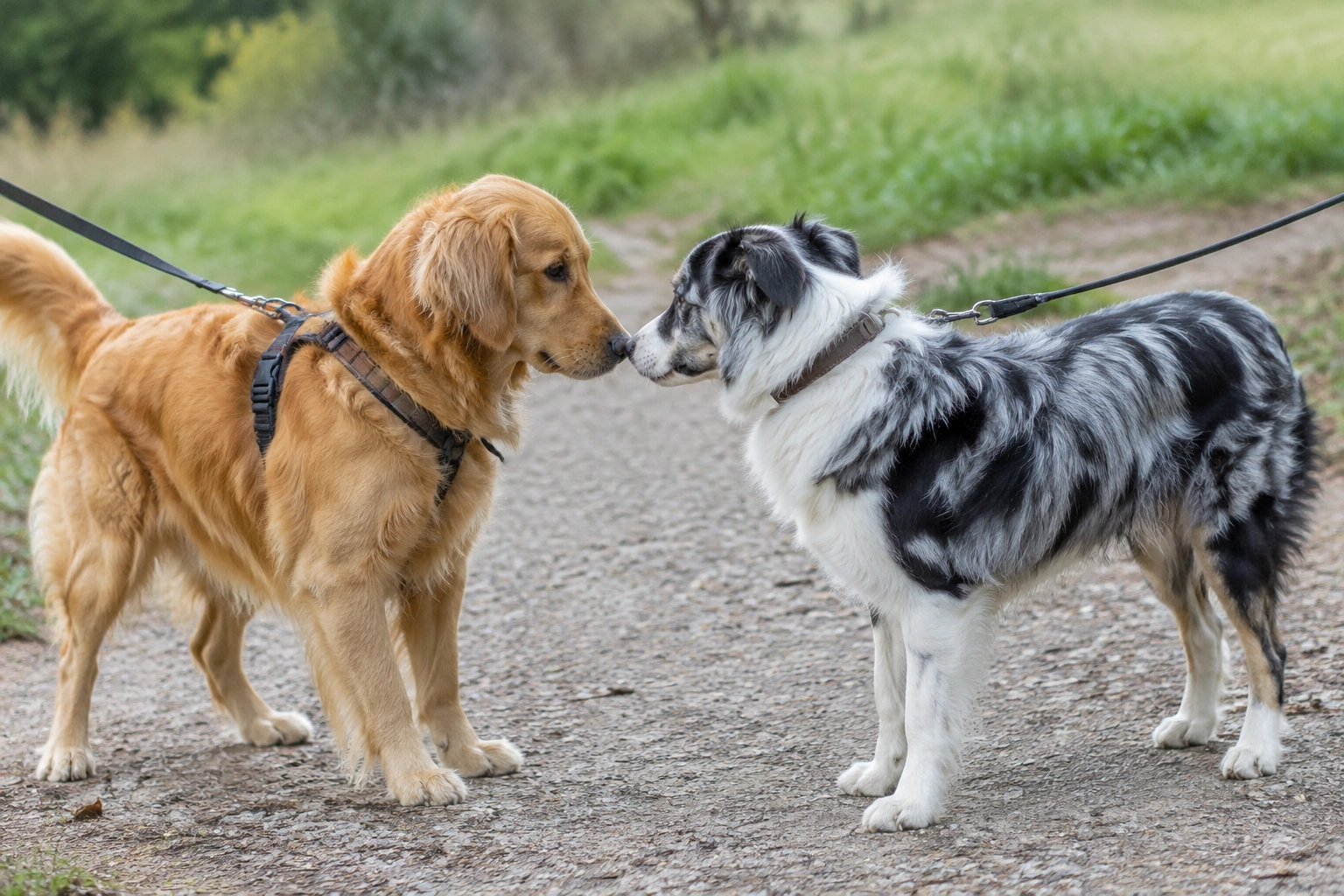
That distinction matters. Two dogs can be close, sniffing, or even playing and still not truly be at ease with each other. On the other hand, some dogs are quiet, polite, and a little distant at first, but still perfectly comfortable sharing space.
For Border Collie owners, this gets tricky fast. A Border Collie’s focus, stalking, circling, and intensity can look a lot like tension to another dog. Sometimes it is tension. Sometimes it is herding instinct. The job is to read the whole picture, not one dramatic moment.
The fast read: the clearest signs two dogs are comfortable
If you only get a few seconds to judge the interaction, look for this combination:
- loose, wiggly body posture
- soft eyes, not fixed staring
- curved or indirect approaches instead of a straight beeline
- brief sniffing, then easy disengagement
- play bows, pauses, and role reversals
- both dogs choosing to re-engage
That last point matters most. Mutual comfort is not just one dog acting friendly while the other tolerates it. It is both dogs showing they can move in, back off, and come back without tension.
A useful quick test is this: if one dog stops the interaction, does the other respect that pause? Dogs that like each other do not have to be glued together. They should be able to separate and rejoin without pressure.
What genuine friendliness looks like in dog body language
Friendly dogs usually look physically loose. Their movement is fluid rather than braced. Their mouths may be open and relaxed, their tails may move in a natural way, and their bodies tend to look curved rather than squared off.
You may also see a play bow: front end down, rear end up. That is one of the clearest “this is play” signals dogs offer. It is not a guarantee that everything is perfect, but it usually means the dog is inviting interaction rather than threatening it.
Indirect approaches are another good sign. Dogs often greet each other at an angle rather than marching straight face-to-face. That gentler approach is easier for both dogs to process and less likely to trigger defensiveness.
The most useful thing to watch is whether the body stays soft during the greeting and after it. A dog can sniff politely and then stiffen a moment later. That shift tells you more than the sniff itself.
If you want a broader reference point on dog social behavior, the AKC’s guidance on reading canine body language is a solid starting place.
Friendly play, polite tolerance, or real social bonding?
Not every peaceful interaction means the dogs are close friends.
Friendly play
This is the easiest category to spot. The dogs actively seek each other out, exchange roles, and keep the energy balanced. One chases, then the other chases. One bows, then the other responds. There are pauses, resets, and plenty of room for both dogs to opt out.
Polite tolerance
These dogs are fine together, but not especially interested in each other. They may share a room, sniff briefly, or walk past one another without issue. There is no drama, but also not much social spark. That is still a successful relationship if both dogs stay relaxed.
Real social bonding
Bonded dogs often show a little more ease around each other. They may rest near each other, seek each other out, or settle together without fuss. Some bonded pairs lean on each other, lay head to tail, or drape a paw over the other’s back. Dogs that cuddle or sleep together may feel safe and comfortable with one another, but that should be read as one sign among many, not as proof on its own.
The important trade-off here is this: if you expect every good relationship to look affectionate, you may miss a perfectly healthy, quiet bond. If you assume every calm interaction is friendship, you may miss a dog that is merely enduring the situation.
How to read whether play is mutual or one-sided
Balanced play has rhythm. One dog does not spend the whole time chasing, pinning, cornering, or controlling the other.
Look for these signs of mutual play:
- turn-taking
- pauses that both dogs accept
- role reversals
- both dogs returning voluntarily after a break
- neither dog repeatedly trying to escape
One-sided play usually has a different feel. One dog keeps pushing, and the other keeps yielding. The pressured dog may hide behind you, drift away, freeze, or stop offering play signals. That is not “rough play.” That is a dog trying to manage pressure.
This is where owners often get fooled by enthusiasm. A dog can look very excited and still be making the other dog uncomfortable. Excitement is not the same as consent.
A practical rule: if the interaction only works when one dog keeps accommodating the other, the relationship is not balanced enough to leave unsupervised.
Stress signals owners miss
Dogs often show discomfort before they show obvious conflict. The early signs are easy to overlook because they are small and brief.
Watch for:
- lip licking
- yawning when the dog is not tired
- whale eye, where the whites of the eyes show
- head turns away from the other dog
- freezing or slowing suddenly
- tucked posture
- repeated attempts to move off
- sniffing the ground to create distance
- stepping behind a person or object
These are not always dramatic, but they matter. A dog does not need to growl to say “I want space.”
That is why avoidance should be taken seriously. If one dog keeps moving away and the other keeps following, the issue is no longer simple curiosity. It is pressure.
When you see several stress signals together, treat them as a pattern, not a coincidence.
When growling, barking, mounting, or herding is normal—and when it is not
Growling is one of the most misunderstood signals in dog-dog interactions. In some cases, it is part of normal social communication or even rough play. In other cases, it is the first clear warning before conflict.
Normal-ish play growling
This usually shows up with loose bodies, pauses, role reversals, and willing re-entry. The sound may be dramatic, but the dogs keep self-regulating. No one is freezing, cornered, or trying to escape.
Conflict growling
This is different. The body looks stiff. The stare gets hard. The dog may guard space, a toy, or a person. The growl is not part of a back-and-forth game; it is a warning attached to tension.
Mounting is similar. In some dogs, it is over-arousal, not dominance. In others, it is a pressure behavior that starts to irritate the other dog quickly. If the mounted dog stiffens, snaps, or tries repeatedly to leave, the mounting is no longer harmless.
Border Collie herding behavior needs special attention. Stalking, circling, intense eye contact, and body-blocking can be instinctive and not aggressive in themselves. But if the other dog looks uneasy, keeps moving away, or stops engaging, the Border Collie’s behavior is too much for that dog in that moment.
The question is not “Is my Border Collie being a Border Collie?” The question is “Is the other dog comfortable with this?”
When to intervene, redirect, or separate the dogs
Intervene sooner when the pattern is getting tighter, not looser.
Separate or step in if you see:
- repeated stiffening
- hard staring
- freezing
- snapping
- repeated escape attempts
- one dog consistently bullying the other
- escalating arousal with no pauses
If both dogs are still loose and reciprocal, you may be able to let the interaction continue under supervision. If the energy keeps climbing and neither dog is recovering, end the session before it tips into conflict.
A good practical standard is this: if you are asking yourself whether one dog is “putting up with it,” you are probably already close enough to intervene.
For general safety guidance on introductions and warning signs, Best Friends Animal Society’s dog introduction advice is worth reading.
How to judge compatibility over multiple meetings
One meeting is not enough.
Dogs have off days, and the context matters. A dog that seems awkward on leash may be relaxed in a larger space. A dog that looks friendly for five minutes may become pushy once arousal rises. What matters is the repeated pattern.
Look for these signs across several meetings:
- do both dogs recover quickly after a pause?
- can they disengage without conflict?
- does one dog keep pressuring the other every time?
- does the same dog always end up doing the accommodating?
- do they settle more easily over time, or less?
A cautious judgment is usually more reliable after several short, calm meetings over a few days or weeks than after a single session. If the relationship improves with structure and short sessions, that is a promising sign. If each meeting produces the same tension, the dogs may simply not be a good fit.
That does not always mean they cannot live in the same home or be managed safely. It does mean you should stop expecting a naturally easy friendship.
Border Collie-specific considerations: intensity, stalking, and herding behavior
Border Collies often read other dogs very closely. That can be useful, but it can also create pressure.
A Border Collie may:
- lock eyes on another dog
- circle or stalk
- move in fast, then stop abruptly
- try to control movement
- herd a running dog into more motion
To another dog, that can feel intense even when no aggression is intended.
The key trade-off is this: if you dismiss every intense Border Collie interaction as “just herding,” you may ignore a dog that is genuinely uncomfortable. If you label every focused Border Collie move as aggression, you may overcorrect and interrupt harmless social behavior.
Use the other dog as your gauge. If the other dog stays loose, re-engages, and does not keep trying to leave, the intensity may be manageable. If the other dog gets tight, avoids, or repeatedly disengages, the herding style is too much.
How to introduce and supervise dogs while you assess their relationship
The safest introductions are usually controlled, not chaotic. Dogs often greet more comfortably at a gentle angle rather than face-to-face, and direct approaches can be intimidating. That matters because the first few seconds often shape the whole interaction.
A practical structure is:
- let the dogs observe each other without pressure
- allow brief, indirect greeting
- watch for looseness and willingness to re-engage
- break the interaction before either dog gets overwhelmed
- repeat in short sessions rather than one long meeting
If you want a more structured starting point, PetMD’s introduction guidance discusses parallel walking and keeping dogs at a safe distance during early stages.
The goal is not to force instant friendliness. It is to create enough calm that you can read the dogs accurately.
When repeated awkward interactions mean the dogs may be incompatible
Some dogs are simply not a good match.
Warning signs include:
- one dog always trying to avoid the other
- repeated tension every time they meet
- guarding of toys, food, space, or people
- bullying that does not improve
- inability to settle after excitement
- one dog looking chronically stressed around the other
A single awkward greeting can be managed. A repeating pattern is more meaningful.
If the dogs can only be together when tightly controlled, or if one dog seems to spend most of the time managing the other, the relationship may need long-term structure rather than more “practice.”
That is a hard conclusion for some owners, but it is often the kindest one.
When to see a veterinarian or certified trainer
Get professional help if:
- the dogs keep escalating despite careful management
- one dog is consistently targeted or cornered
- there has been snapping, lunging, or biting
- the dogs cannot settle in the same space
- you feel you are guessing instead of reading clear body language
A certified trainer or behavior professional can help you decide whether the issue is poor introductions, over-arousal, resource guarding, fear, or plain incompatibility. Veterinary help is most important if the behavior changes suddenly, pain is suspected, or the aggression seems out of character. If the behavior is recurring, do not wait for a bigger incident to make the decision for you.
Quick comparison: friendly play, polite tolerance, stress, and conflict
| Interaction type | Body posture | Eye contact | Movement | Vocalization | What it usually means | What to do |
|---|---|---|---|---|---|---|
| Friendly play | Loose, bouncy, curved | Soft, brief | Back-and-forth, pauses, role reversals | Play growls may appear, but body stays loose | Mutual enjoyment | Continue with supervision |
| Polite tolerance | Neutral, calm | Minimal or brief | Parallel, low-key, little interest | Usually quiet | Comfortable coexistence | Let them share space if both relax |
| Stress/unease | Stiff, tucked, freezing, turning away | Hard stare or whale eye | Avoidance, retreat, repeated escape attempts | Lip licking, yawning, sometimes whining | One dog wants more space | Interrupt and give space |
| Conflict | Very stiff, braced, tense | Fixed stare | Blocking, pinning, lunging, chasing without relief | Growling, barking, snapping | Pressure is building | Separate calmly and reassess |
FAQs
Do dogs have to play together to like each other?
No. Some dogs like each other and still prefer calm coexistence over rough play. Quiet comfort can be just as meaningful as active play.
Is growling always bad?
No. Growling can be part of normal communication or play, but context matters. If it comes with stiffness, hard staring, or repeated avoidance, treat it as a warning.
What if one dog keeps following the other?
That is often pressure, not friendship. If the other dog keeps moving away or freezing, intervene and create space.
Can a Border Collie be too intense for another dog?
Yes. Border Collies can bring a lot of focus and motion into an interaction. If the other dog looks uneasy, the intensity is too much for that pairing.
How long should I watch before deciding they get along?
There is no magic timer. Watch for repeated patterns across several short, calm interactions rather than making the call from one brief meeting.
If the dogs stay loose, recover quickly, and respect each other’s pauses, you have a good sign to work with. If one dog keeps managing the other, step back and shorten the sessions before the pattern hardens.