
Kibble vs Fresh Food for Border Collies: Which Diet Fits Your Dog Best?

Border Collies are not average house dogs with average calorie needs. They are lean, driven, and often busy from morning to night, even when “busy” means a mix of training, herding instinct, fetch, hiking, or simply shadowing you from room to room. That activity level changes how you should think about food.

For this breed, the best diet is not the fanciest one. It is the one that keeps your dog in good body condition, supports steady energy, produces healthy stools, and fits your real-life routine. That is why the kibble vs fresh food border collie question is worth asking carefully rather than treating it like a trend debate.
Border Collie Nutrition Needs: Why This Breed Is Different
A Border Collie usually does best on a diet that is complete and balanced, easy to portion, and appropriate for its life stage and activity level. That sounds simple, but it matters because this breed can swing from underfed-looking to overfed very quickly if portions are guessed instead of measured.
A working or highly active Border Collie may need more calories than a sedentary companion dog of the same weight. But “more food” is not the same as “better food.” If the diet is too calorie-dense, the dog can gain weight even while staying active. If it is too low in digestible energy, you may see hunger, weight loss, or poor recovery after exercise.
For this breed, feeding priorities usually include:
– maintaining lean muscle without overfeeding
– supporting long training or work sessions without stomach upset
– keeping energy steady rather than spiking and crashing
– avoiding excess weight on a dog that may still look naturally slim
– making portions precise enough to match changing activity levels
Protein and fat matter here, but not in a vacuum. Protein supports tissue maintenance and recovery. Fat is a concentrated energy source that can help active dogs maintain stamina. The practical question is whether the food delivers those nutrients in a form your dog can actually use, without upsetting digestion or making portion control a guessing game.
Kibble vs Fresh Food for Border Collies: The Core Differences
Here is the simplest way to compare the two.
| Factor | Kibble | Fresh food |
|---|---|---|
| Moisture | Low | Higher |
| Convenience | Very high | Moderate to low |
| Storage | Easy, shelf-stable | Usually needs refrigeration/freezing |
| Cost | Usually lowest | Usually higher |
| Portioning | Easy and consistent | Can be easy if pre-portioned, but varies by product |
| Nutritional completeness | Often complete and balanced when labeled appropriately | Can be complete and balanced if commercially formulated; homemade versions vary widely |
| Palatability | Good for many dogs | Often very appealing |
| Digestive tolerance | Often predictable | Can be excellent, but not automatically better |
| Safety handling | Simple | More handling, especially if raw or frozen |
| Best fit | Owners who want practicality, travel ease, and lower cost | Owners who want higher moisture, strong palatability, or a different feeding format |
The most important takeaway is this: kibble and fresh food are both capable of being nutritionally adequate if they are complete and balanced. The difference is usually less about “good versus bad” and more about trade-offs in moisture, convenience, cost, and how well the dog handles the diet.
Pros and Cons of Kibble for an Active Border Collie
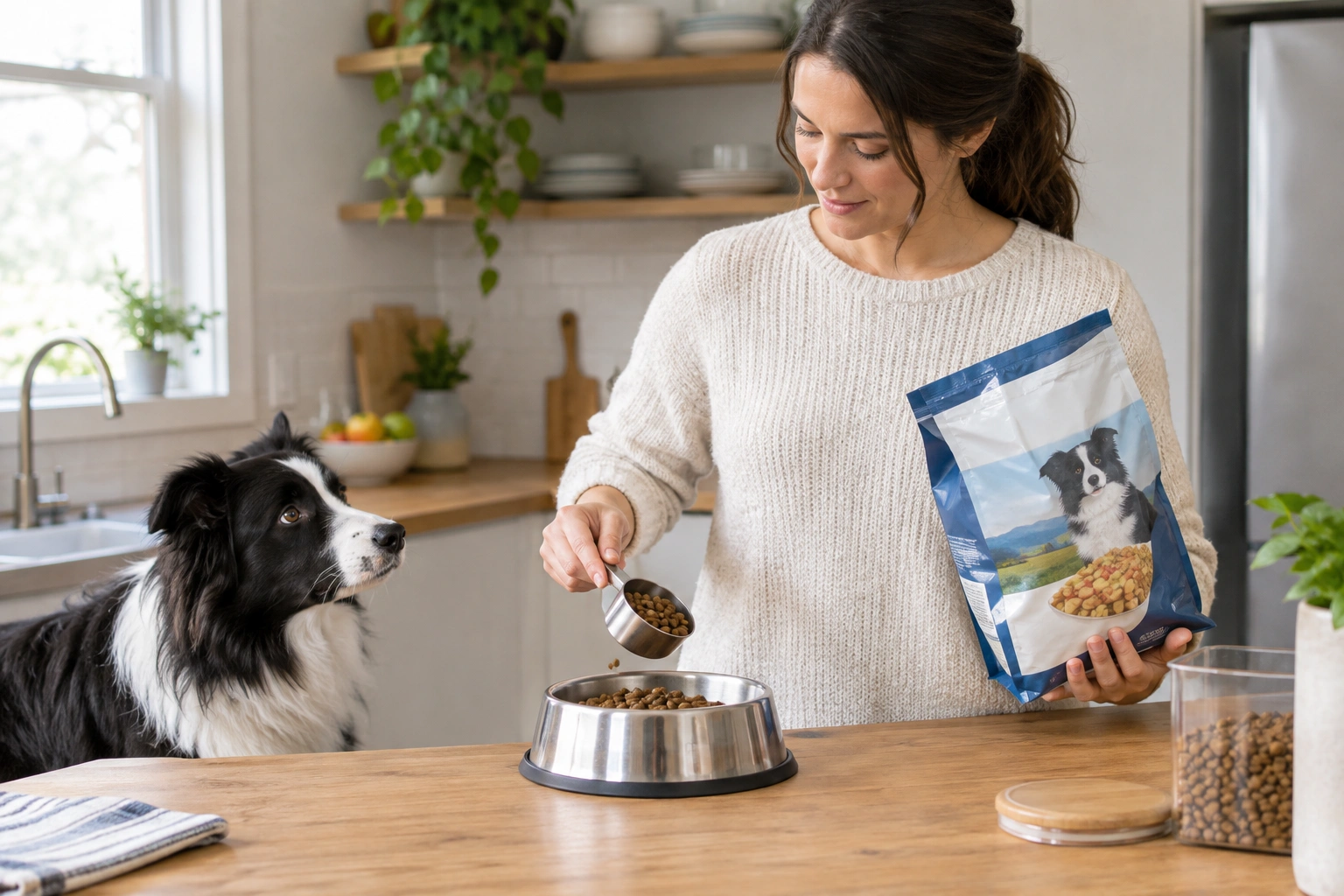
Kibble is still the default choice for a lot of Border Collie owners for good reason. It is easy to store, easy to measure, and usually the most budget-friendly way to feed a dog that burns through calories. For people who train, travel, or hike often, that matters.
A quality kibble can work very well for a Border Collie that needs consistent fuel without fuss. It is also easier to split into multiple meals, use in training routines, or leave with a sitter. If your dog does well on kibble, there is no nutritional requirement to switch away from it just because fresh food is popular.
There are trade-offs. Some kibble-fed dogs seem less excited at mealtime, which can matter for picky eaters. Dry food also contains less moisture than fresh food, so it does not contribute as much water to the diet. That does not mean kibble causes dehydration by itself, but dogs that eat mostly dry food should still have reliable access to water.
One point that is often misunderstood: kibble is not automatically “lower quality” because it is dry. The real question is whether the food is complete and balanced, appropriate for your dog’s life stage, and made by a company that provides clear nutritional information.
Pros and Cons of Fresh Food for a Border Collie
Fresh food has a strong appeal for Border Collie owners because many dogs eat it eagerly. For a picky eater, that can be a practical advantage rather than a luxury. Commercial fresh diets are also often gently cooked, which is generally considered lower risk than raw feeding because cooking reduces harmful pathogens while keeping the food more moist and aromatic than kibble.
That higher moisture content can be useful for dogs that do not drink much or for owners who like a softer texture. Some dogs also produce firmer, smaller stools on certain fresh diets, though that is not guaranteed. Stool quality is a useful clue, but it is not proof that one format is universally superior.
Fresh food has real downsides too. It usually costs more. It often needs refrigeration or freezer space. It may require more planning if the meals arrive frozen and need thawing. And if you choose homemade fresh food, the nutritional risk rises sharply unless the recipe is professionally formulated.
It also helps to separate the options clearly:
– Commercial fresh food: professionally formulated, usually cooked, and can be complete and balanced when made by a reputable company.
– Homemade fresh food: cooked meals you prepare yourself, which can be very hard to balance correctly without a veterinary nutrition plan.
– Raw food: uncooked diets that carry more food-safety concerns and also need careful formulation to avoid nutrient gaps.
A useful caution: “fresh” does not automatically mean “balanced.” A dog can eat a very appealing fresh diet that still misses key nutrients if it is not properly formulated.
Which Diet Supports Energy, Performance, and Recovery Best?
For a Border Collie that works hard, the best diet is the one that delivers energy consistently and keeps the dog in good body condition over time. That may be kibble, fresh food, or a mix.
In practical terms, performance-supportive feeding looks like this:
– enough calories to maintain a lean, athletic body
– a diet that is digestible enough to avoid bloating, loose stools, or urgency
– meal timing that does not interfere with exercise
– food that the dog will reliably eat, even on busy training days
Kibble often has the edge for owners who want predictable calories and easy portion control. That can matter for dogs in agility, herding, or long training sessions, where too many calories can creep in unnoticed. A well-made kibble can also be a practical choice for dogs that need a reliable routine day after day.
Fresh food may have an edge for dogs that eat poorly on dry food or for owners who want a more palatable meal after exercise. Some dogs are simply more eager to eat fresh food, which can help if you are trying to keep intake steady in a high-drive dog that burns a lot of energy.
For any active Border Collie, a few practical rules help:
– avoid a large meal right before hard exercise
– use smaller meals if your dog is prone to GI upset
– keep treats and toppers in the calorie total
– watch body condition, not just appetite
– choose the format your dog digests consistently
The key point is that performance is not just about ingredient glamour. A dog that eats a balanced kibble consistently and stays lean, energized, and interested in work is doing better than a dog on a trendy diet that causes loose stools or inconsistent intake.
Digestion, Stool Quality, and Sensitive Stomachs
Stool quality is one of the most practical ways to judge a diet. If your Border Collie has firm, easy-to-pick-up stools, normal appetite, and steady energy, that is a good sign. If stools are loose, frequent, or unusually large, the diet may not be a great fit or the transition may have been too fast.
Fresh food does not automatically improve digestion, but some dogs do better on it, especially if they are sensitive to a particular kibble formula or simply prefer a more moist meal. Others do just as well on a well-chosen kibble. The real answer is individual.
If your Border Collie has a sensitive stomach, the most useful move is usually not to chase the most “natural” label. It is to choose a diet with a clear formulation, then change slowly and track stool quality for several days at a time. Fast switches are a common reason dogs get diarrhea and owners blame the new food itself.
Weight Control, Portioning, and Body Condition in Border Collies
Border Collies can look deceptively lean even when they are carrying too much weight, especially if they are muscular and active. That is why body condition matters more than the marketing on the bag.
A dog at a healthy weight should have a visible waist from above and a tucked abdomen from the side, with ribs that are easy to feel but not sharply visible. If your dog is always acting hungry, that may mean the food is not satisfying enough, but it may also mean portions are too small or activity has increased.
Kibble usually makes portioning easier because the calorie content is printed clearly and the food is simple to measure. Fresh food can be just as workable if it is pre-portioned and calorie-labeled. What matters is that you know the calories per serving and can adjust based on your dog’s actual body condition.
For mixed feeding, the same rule applies: count all calories, not just the main meal. Training treats, chews, toppers, and table scraps can push a Border Collie over maintenance calories faster than many owners expect.
How to Choose a High-Quality Kibble or Fresh Diet
Whether you choose kibble or fresh food, look first for a complete and balanced diet for your dog’s life stage. That phrase matters more than protein hype, grain-free marketing, or “human-grade” language.
Here is a more actionable label-reading checklist.
What to check on kibble labels
- Complete and balanced statement for the correct life stage
- AAFCO nutritional adequacy statement or equivalent life-stage adequacy language
- Feeding trial or formulation statement if available
- Calorie content per cup or per kilogram
- Guaranteed analysis for protein, fat, fiber, and moisture
- Ingredient list for obvious issues your dog does not tolerate
- Company transparency: who formulates the food, whether a nutrition team is involved, and how to contact the company
What to check on fresh food labels
- Complete and balanced statement for the correct life stage
- Calories per package or per meal
- Whether the diet is commercially formulated or homemade
- Handling and storage instructions
- Protein, fat, and moisture information
- Whether the company provides feeding guidance based on weight and activity
- Quality-control information if the company makes it available
A few useful warnings:
– “Natural” does not mean nutritionally complete.
– “Fresh” does not mean safer if the diet is raw or poorly handled.
– “High protein” does not automatically mean better for an active dog.
– Homemade recipes need professional formulation if you want them to be balanced long term.
If you want a deeper framework for choosing among food types, our guide on the best food for a Border Collie can help you narrow the field by age, activity, and digestion.
For fresh diets, the quality question is especially important because some fresh services are professionally formulated while homemade versions are not. Fresh can be excellent, but only if the recipe is built to meet nutritional needs over time.
Fresh Food, Raw Food, and Homemade Diets: Safety and Completeness
Fresh food is not the same thing as raw food, and that difference matters. Commercial fresh food is usually cooked, which generally lowers pathogen risk compared with raw diets while still offering a moist, highly palatable meal. That makes commercial fresh food a different risk category from raw feeding.
Raw diets can be appealing to some owners, but they come with more safety concerns for both dogs and people handling the food. They also require careful formulation to avoid nutrient imbalance. Homemade cooked diets have a similar issue: they can be excellent in theory, but only if they are properly designed.
If you are considering homemade feeding, do not wing it with internet recipes. A Border Collie that looks healthy for a few weeks can still be missing important nutrients over time. This is one area where professional formulation is worth the effort.
Can You Mix Kibble and Fresh Food Safely?
Yes, mixed feeding can work well for a Border Collie. It can be a smart compromise if you want the convenience and affordability of kibble but also want to improve palatability or add moisture with some fresh food.
The downside is that mixed feeding makes calorie tracking harder. It is easy to add a scoop of fresh food on top of kibble and accidentally overfeed. That is especially relevant for Border Collies, because they are active enough to mask small weight gain until it becomes obvious.
A practical approach is to decide in advance what role each food plays. For example, kibble can provide the base diet, and fresh food can make up a smaller portion of the meal or serve as a topper. That keeps the diet simpler to manage than trying to build every meal from scratch.
When Kibble, Fresh Food, or Mixed Feeding Makes the Most Sense
Here is a simple decision framework for Border Collie owners:
- Choose kibble if: you want the lowest cost, the easiest storage, simple travel feeding, and reliable portion control.
- Choose commercial fresh food if: your dog is picky, you want higher moisture, or you are willing to pay more for convenience and palatability.
- Choose mixed feeding if: you want a middle ground between cost and appeal, or you want to keep kibble as the base while improving mealtime enthusiasm.
- Avoid DIY homemade or raw as a casual choice if: you want the lowest risk and least complexity. Those options can work, but they need more planning and more caution.
A few scenario-based examples:
– Very active working dog: kibble or commercial fresh food can both work; choose the one that maintains weight and stools reliably.
– Sensitive stomach: start with the most consistent, well-formulated diet you can find and transition slowly.
– Picky eater: commercial fresh food or mixed feeding may improve intake.
– Travel-heavy lifestyle: kibble is usually easier.
– Tight budget: kibble usually wins.
– Owner wants more moisture but not a full switch: mixed feeding may make the most sense.
Cost Comparison: What to Expect
Cost is one of the biggest differences between these diets, and it is usually the deciding factor for many Border Collie households.
In general, the expected cost ranking is:
1. Kibble — usually the most affordable
2. Commercial fresh food — usually several times more expensive than kibble
3. Raw food — often similar to or higher than commercial fresh food, depending on sourcing and handling
4. Homemade fresh food — can vary widely, but often becomes expensive once you factor in quality ingredients and formulation support
A few practical notes:
– Kibble is usually the easiest way to feed a large-volume eater on a budget.
– Commercial fresh food often costs more because of ingredient handling, packaging, and cold-chain logistics.
– Raw diets may add freezer space, storage, and handling costs.
– Homemade diets can look cheaper at first, but that can change if you use premium ingredients or work with a veterinary nutritionist.
If cost is your top priority, kibble is usually the clear winner. If cost is not the main issue and your dog truly does better on fresh food, the higher price may be worth it.
How to Transition a Border Collie from Kibble to Fresh Food
A slow transition is the safest way to change diets, especially if your dog has a sensitive stomach. A gradual schedule helps reduce digestive upset and gives you time to see whether the new food actually agrees with your Border Collie.
Sample 7- to 10-day transition schedule
Use the schedule below as a starting point. If your dog has a sensitive stomach, stretch it to 10 days or longer.
Days 1–2: 75% old food, 25% new food
Days 3–4: 50% old food, 50% new food
Days 5–6: 25% old food, 75% new food
Days 7–10: 100% new food
Practical transition tips
- Keep meal times consistent.
- Measure portions carefully so total calories do not jump.
- Watch stool quality daily.
- If stools soften, hold at the current ratio for a few more days instead of increasing the new food.
- If your dog refuses the new food, mix a smaller amount in and increase more slowly.
- If vomiting, persistent diarrhea, or obvious discomfort occurs, pause the transition and speak with your veterinarian.
Fresh meals that arrive frozen also need practical planning. Make sure you have enough refrigerator or freezer space and follow storage instructions closely.
How to Tell Whether Your Dog’s Diet Is Working
A good diet shows up in daily life. Watch for:
– steady energy without mid-day crashes
– normal, manageable stools
– a healthy waist and body shape
– a coat that looks clean and feels normal for your dog
– a stable appetite without constant scavenging
– good recovery after exercise
Those are the signs that matter most, whether you feed kibble, fresh food, raw, or a mixed plan.
If your Border Collie is losing weight unintentionally, producing loose stools, scratching more, or seeming less energetic, the diet may need adjustment. Sometimes the fix is a different formula. Sometimes it is simply a more careful portion plan.
When to Ask Your Veterinarian
Ask your veterinarian or a canine nutrition professional if you are considering homemade food, raw feeding, or a major diet change for a dog with ongoing digestive issues. That guidance matters even more if your Border Collie is a puppy, senior, highly active working dog, or has a history of picky eating that makes feeding inconsistent.
It is also worth asking for help if your dog’s weight changes unexpectedly, stools stay abnormal after a slow transition, or you are unsure whether your current diet is truly complete and balanced. A good diet should make feeding simpler, not more confusing.
Bottom Line: Which Is Better for a Border Collie?
There is no universal winner in the kibble vs fresh food border collie debate. Kibble usually wins on convenience, cost, and easy portion control. Fresh food often wins on palatability and moisture, and some dogs simply do better on it. The best choice is the one that keeps your Border Collie lean, energized, comfortable, and easy to feed consistently.
If you want the simplest path, choose a complete and balanced kibble that fits your dog’s life stage and activity level. If your dog is a picky eater or you want a more moisture-rich meal and can manage the cost and storage, a commercial fresh diet may be worth it. If you mix the two, keep calories under control and track how your dog actually responds.
FAQ
Is kibble nutritionally complete for an active Border Collie?
Yes, it can be. A well-formulated kibble labeled complete and balanced for the correct life stage can meet the needs of an active Border Collie when portions are appropriate.
Is fresh food better for Border Collies than kibble?
Not automatically. Fresh food may help with palatability or moisture, but kibble can work just as well if it is complete, balanced, and well tolerated.
Is raw food the same as fresh food?
No. Fresh food is usually cooked and generally lower risk than raw food. Raw food has more food-safety concerns and also needs careful formulation.
Can I mix kibble and fresh food?
Yes. Mixed feeding can be a practical middle ground, but you need to count calories carefully so you do not overfeed.
What is the best diet for a picky Border Collie?
A commercial fresh diet or a mixed-feeding plan may help, but the diet still needs to be complete and balanced.
