
What Are Border Collie Guard Hairs?

Quick Answer
Border Collie guard hairs are the longer, tougher hairs that form the outer layer of the breed’s double coat. They protect the softer undercoat and skin from moisture, dirt, sunlight, and everyday outdoor wear, which is why proper double-coat care matters.
How to recognize guard hairs
- Longer hairs: Guard hairs usually extend above the softer undercoat.
- Coarser texture: They feel firmer and less fluffy than undercoat hairs.
- Outer protection: They help shield the skin from dirt, moisture, sunlight, and vegetation.
- Visible color: Much of the Border Collie’s obvious coat color and pattern appears in the outer coat.
- Slower shedding: Guard hairs generally remain longer than the softer undercoat hairs that shed heavily during seasonal coat changes.
One important care tip
- Brush through the coat instead of routinely shaving it, because removing the protective outer layer can interfere with normal double-coat function.
If you part a Border Collie’s coat with your fingers, you’ll usually notice two different textures. The soft layer close to the skin is the undercoat, while the firmer hairs over it are the guard hairs.
I’ve found that understanding this difference makes grooming much easier. It helps you remove loose undercoat without treating every long hair as something that needs trimming.
In This Guide
- What Exactly Are Border Collie Guard Hairs?
- Guard Hairs vs. Undercoat: What’s the Difference?
- What Do Guard Hairs Do for a Border Collie?
- Do Rough and Smooth Border Collies Both Have Guard Hairs?
- Do Border Collie Guard Hairs Shed?
- How Should You Groom Border Collie Guard Hairs?
- How Can You Tell if the Outer Coat Is Damaged?
- Frequently Asked Questions
- The Takeaway
What Exactly Are Border Collie Guard Hairs?
A Border Collie’s guard hairs are the longer, stronger hairs forming the visible outer coat. They sit over a shorter, softer, denser layer called the undercoat.
Together, these layers create the Border Collie’s double coat. The American Kennel Club describes both rough and smooth Border Collies as having dense, weather-resistant double coats.
You may also hear guard hairs called primary hairs, outer-coat hairs, or simply the topcoat. Those terms describe the tougher protective hairs rather than the fluffy insulation underneath.
- Position: Guard hairs form the outside of the coat.
- Texture: They tend to feel straighter, firmer, or coarser.
- Length: They normally extend farther than undercoat hairs.
- Strength: Their hair shafts are more durable than the soft undercoat.
- Appearance: They contribute strongly to visible coat color and pattern.
What do they feel like?
Run your fingers gently along an adult Border Collie’s back. The hairs you feel first usually have more structure than the fluffy fur beneath them.
Then part the coat and look closer to the skin. That softer material is largely undercoat rather than guard hair.
The contrast is easiest to notice during a heavy seasonal shed. Loose undercoat can come away like soft fluff while many longer outer hairs remain in place.
Guard Hairs vs. Undercoat: What’s the Difference?
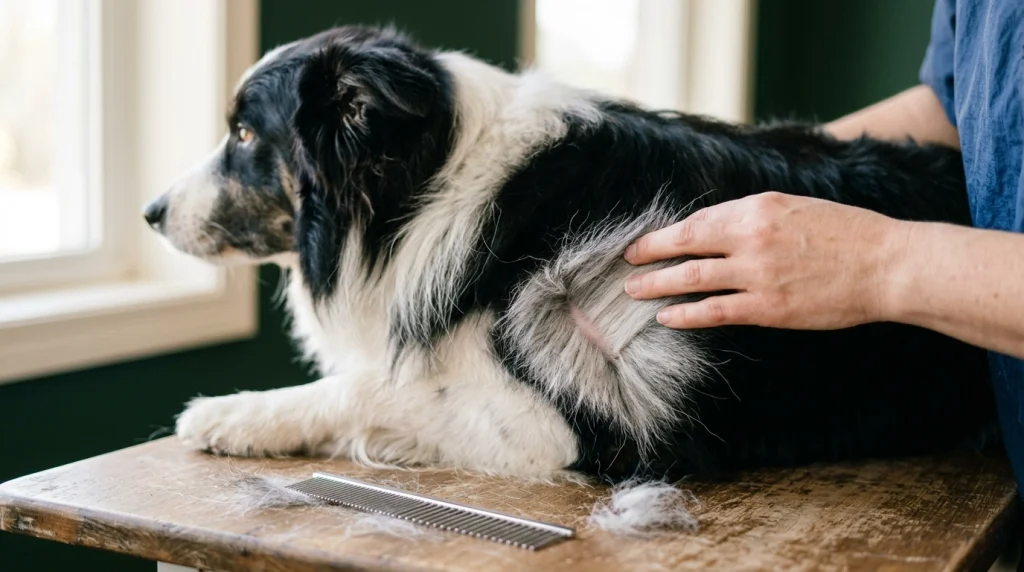
Guard hairs provide much of the Border Collie’s outer protection, while the undercoat mainly supplies insulation. Both are important, but they differ in texture, growth, and shedding behavior.
| Feature | Guard Hairs | Undercoat |
|---|---|---|
| Location | Outer layer | Close to the skin |
| Texture | Firmer and coarser | Soft and fluffy |
| Typical length | Longer | Shorter |
| Main role | Environmental protection | Insulation |
| Seasonal shedding | Usually less dramatic | Often heavy during coat changes |
| Visible color | Major contributor | Often less visually dominant |
This distinction explains why a Border Collie can look almost unchanged while producing an astonishing pile of fur during brushing. Much of that loose material can be undercoat.
The outer coat remains more visible. That helps preserve the dog’s familiar shape, color, and protective surface.
Why do Border Collies need two coat layers?
Border Collies developed as working herding dogs exposed to changing outdoor conditions. A layered coat offers more useful protection than one uniform layer of hair.
The AKC’s Border Collie information describes the breed’s coat as dense and weather-resistant. Both recognized coat types need regular grooming.
What Do Guard Hairs Do for a Border Collie?
Guard hairs create the first barrier between your Border Collie’s skin and the outside world. They’re useful whether your dog works livestock or spends weekends running through wet grass.
- Deflect moisture: The outer layer helps keep light moisture from immediately reaching the dense undercoat.
- Block debris: Grass fragments, dust, and small bits of vegetation often contact guard hairs first.
- Protect skin: The coat places a physical barrier between skin and everyday environmental exposure.
- Preserve insulation: Guard hairs work with the undercoat rather than replacing it.
- Create coat appearance: The outer hairs help produce the dog’s recognizable color, markings, and texture.
Are guard hairs waterproof?
I wouldn’t call a Border Collie waterproof. A soaked dog is still going to become wet down to the skin eventually.
“Weather-resistant” is a better description. Healthy outer hairs can help delay moisture penetration and keep minor dirt away from the softer layers underneath.
Do guard hairs help in warm weather?
The whole double coat works as a system, rather than the guard hairs acting alone. That’s one reason routine summer shaving isn’t considered normal coat maintenance for a healthy double-coated dog.
The AKC’s double-coat grooming guidance recommends brushing and coat maintenance instead of automatically shaving the coat.
Section Takeaway: Guard hairs aren’t decorative excess. They form a functional outer layer that works with the undercoat to protect a Border Collie’s skin and coat.
Do Rough and Smooth Border Collies Both Have Guard Hairs?
Yes. Both rough-coated and smooth-coated Border Collies have double coats, so both can have an outer layer of guard hairs and a softer undercoat.
The biggest visible difference is coat length and feathering. It isn’t the presence versus absence of a double coat.
Rough-coated Border Collies
Rough coats look fuller and longer. Feathering can be especially noticeable around the chest, underside, legs, and tail.
The longer coat makes individual outer hairs easier to notice. It can also make tangles and trapped plant material more obvious.
Smooth-coated Border Collies
Smooth Border Collies have shorter coats that lie closer to the body. Their guard hairs may therefore be less dramatic to the eye.
Don’t mistake short for single-coated. The smooth variety still has the breed’s characteristic double-coat structure.
What about puppies?
Border Collie puppies usually feel softer than mature adults because their adult coat hasn’t fully developed. The texture can change noticeably as the mature outer coat grows in.
I wouldn’t judge an adult coat from an eight-week-old puppy’s fluff. Coat density, length, and texture become clearer as the dog matures.
Do Border Collie Guard Hairs Shed?
Yes, guard hairs eventually shed because individual hairs naturally move through growth and replacement cycles. However, the softer undercoat often creates the most noticeable seasonal shedding.
That difference matters when you find piles of fluff around your home. Heavy shedding doesn’t automatically mean your Border Collie is losing its protective outer coat.
- Normal coat turnover: Individual outer hairs can fall out throughout the year.
- Seasonal coat changes: Double-coated dogs may release much more undercoat during seasonal changes.
- Indoor living: Artificial lighting and indoor temperatures can make shedding patterns less sharply seasonal.
- Individual variation: Coat density, genetics, age, health, and environment influence what you see.
PetMD’s guidance on dog shedding notes that breed, season, environment, and health can influence how much a dog sheds. Double-coated dogs commonly show stronger seasonal undercoat shedding.
When is shedding a health concern?
Loose hair by itself can be normal. Sudden bald patches, intense itching, sores, inflamed skin, or a major unexplained change deserves more attention.
The VCA guide to healthy skin and coat explains that coat condition can reflect both grooming and overall health. A healthy coat should not suddenly become brittle, patchy, or accompanied by unhealthy skin.
Vet note: If your Border Collie develops unexplained hair loss, persistent itching, skin lesions, or a major coat change, contact your veterinarian rather than assuming it’s normal shedding.
Section Takeaway: Guard hairs do shed, but dramatic seasonal fluff is often dominated by undercoat. Watch the skin and overall coat pattern rather than judging health by loose hair alone.
How Should You Groom Border Collie Guard Hairs?
The goal isn’t to remove guard hairs. Good grooming removes loose hair, debris, and tangles while preserving the healthy outer coat.
I normally approach a Border Collie coat in layers. I check the surface first, then make sure my comb or brush can reach through the dense coat without scraping the skin.
A simple Border Collie brushing routine
- Check the coat first: Feel for burrs, knots, damp areas, or packed fur.
- Start gently: Brush in the direction the coat naturally lies.
- Work in sections: Part thicker areas so you can reach loose undercoat.
- Pay attention to friction areas: Check behind the ears, around the collar, feathering, legs, and tail.
- Finish with a comb: A comb can reveal small tangles a surface brushing missed.
For many Border Collies, brushing once or twice weekly is a useful baseline. During heavier shedding, you may need more frequent sessions.
Short sessions usually work better than aggressive marathon grooming. Ten calm minutes several times a week can be easier on both the coat and the dog.
Should you use an undercoat rake?
An appropriate undercoat tool can help during heavy shedding. Use it gently and stop if it pulls healthy coat, scratches skin, or makes your dog uncomfortable.
More pressure isn’t better. A grooming tool should remove loose hair without repeatedly cutting or stripping healthy guard hairs.
Should you shave a Border Collie?
Routine shaving isn’t the normal way to control a Border Collie’s shedding. Cutting off the outer coat also removes the guard hairs you’re trying to preserve.
There are situations where clipping may be necessary for veterinary treatment or severe coat problems. Those cases are different from shaving a healthy dog simply because summer is warm.
Section Takeaway: Groom through a Border Collie’s double coat instead of trying to eliminate it. Gentle brushing preserves guard hairs while removing the loose undercoat that causes much of the shedding.
How Can You Tell if the Outer Coat Is Damaged?
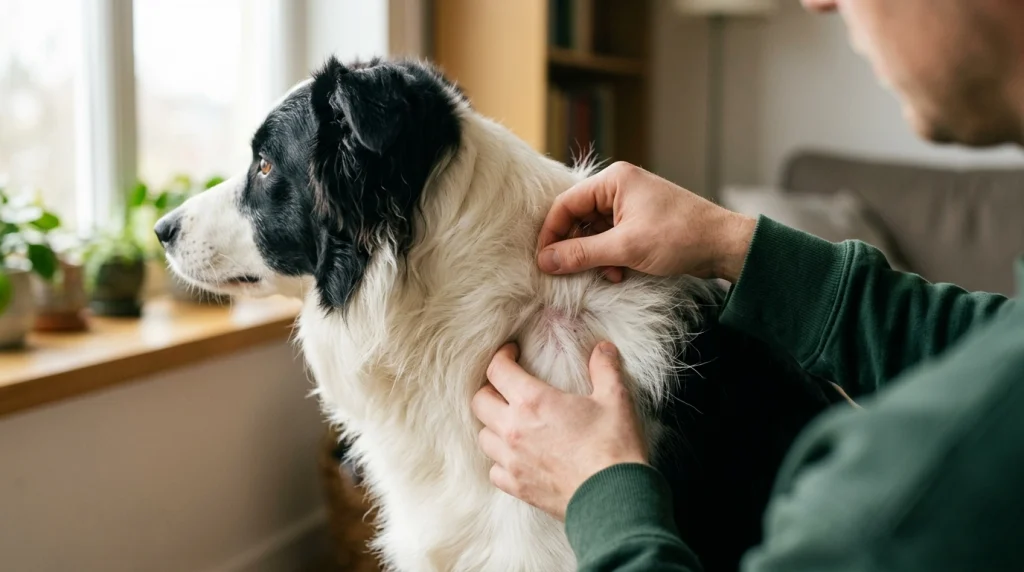
A healthy Border Collie outer coat should generally look clean, resilient, and appropriate for that individual dog. Damage can show up as a noticeable change in texture, coverage, or appearance.
- Persistent breakage: Outer hairs snap rather than simply shedding naturally.
- Patchy coverage: Some areas lose normal coat density.
- Unusual texture: The coat becomes noticeably dry, brittle, or rough compared with its normal condition.
- Skin changes: Redness, scaling, sores, odor, or strong itching appear beneath the hair.
- Poor regrowth: A previously clipped area remains noticeably different for an extended period.
Grooming technique is only one possible factor. Nutrition, parasites, allergies, skin disease, hormonal problems, and other medical issues can also affect coat quality.
That’s why I focus on changes from the dog’s normal baseline. One Border Collie may naturally have a sleek coat while another carries a thick, flowing rough coat.
Vet note: Persistent hair loss, skin irritation, painful grooming, or an unexplained change in coat quality should be evaluated by your veterinarian.
Frequently Asked Questions
Are guard hairs the same as a Border Collie’s topcoat?
Yes, in everyday grooming language, guard hairs make up the protective outer coat or topcoat. They’re generally longer and firmer than the soft undercoat beneath them.
Are Border Collie guard hairs supposed to feel coarse?
They can feel noticeably firmer than the undercoat, although “coarse” doesn’t mean unhealthy or wiry. Coat texture varies between individual dogs and between rough and smooth Border Collies.
Do smooth Border Collies have guard hairs?
Yes. Smooth Border Collies still have a weather-resistant double coat. Their outer hairs are simply shorter and lie closer to the body than those of many rough-coated Border Collies.
Why is my Border Collie shedding soft fluffy hair?
That soft fluff is often loose undercoat, especially during seasonal shedding. Guard hairs are usually longer and stronger, so they may remain visible even while large amounts of undercoat come out during brushing.
Will Border Collie guard hairs grow back after shaving?
Hair can regrow after clipping, but double-coat regrowth may not happen uniformly because the outer coat and undercoat have different growth patterns. Avoid routine shaving unless there’s a medical or coat-care reason for it.
Can I trim long guard hairs on my Border Collie?
Small cosmetic tidying around areas such as feet may be appropriate, depending on the dog. Avoid cutting large areas of healthy outer coat simply to reduce shedding, because trimming doesn’t address loose undercoat.
How often should I brush a Border Collie’s double coat?
A useful starting point is once or twice weekly, with more frequent brushing during heavy seasonal shedding. Adjust the schedule for your dog’s coat length, activity, environment, and tendency to develop tangles.
The Takeaway
Border Collie guard hairs are the longer, stronger hairs forming the outside of the breed’s double coat. They work with the softer undercoat to protect the skin and help the coat handle everyday outdoor conditions.
Once you learn to tell the two layers apart, grooming becomes much more logical. Remove loose undercoat and tangles, but preserve healthy guard hairs whenever possible.
Make coat checks part of your normal routine in 2026 and beyond. A few minutes with your hands, brush, and comb can tell you a surprising amount about your Border Collie’s coat condition.
