
What Are the Bumps on My Dog? A Practical Guide to Dog Lumps, Bumps, and When to Worry

Noticing a new bump on your dog can be unsettling. Some are minor skin changes. Others need a vet to look at them sooner rather than later. The hard part is that bumps can look similar from the outside while meaning very different things underneath.
For Border Collie owners, this may come up during grooming, after a hike, or when you’re running your hands over a dog that seems perfectly healthy otherwise. That’s exactly when a careful check matters most: not because every bump is dangerous, but because appearance alone cannot tell you enough.
What a bump on your dog could be
A bump can be anything from a tiny surface papule to a larger lump under the skin. Common possibilities include warts, cysts, lipomas, histiocytomas, abscesses, ticks, calluses, and skin tumors. Banfield also lists pustules, abscesses, cysts, calluses, tumors, and ticks among common skin lumps and bumps in pets.
Some are more likely to be harmless or lower risk. For example, lipomas are often soft, movable fatty masses under the skin and are typically harmless, though they still deserve monitoring. Cysts can be fluid-filled and may appear suddenly. Histiocytomas are often described as red, raised, button-like lumps in young dogs and usually resolve on their own. Papules are tiny bumps near a hair follicle and can happen because of an allergy or a small infection; once the underlying allergy is addressed, they usually disappear.
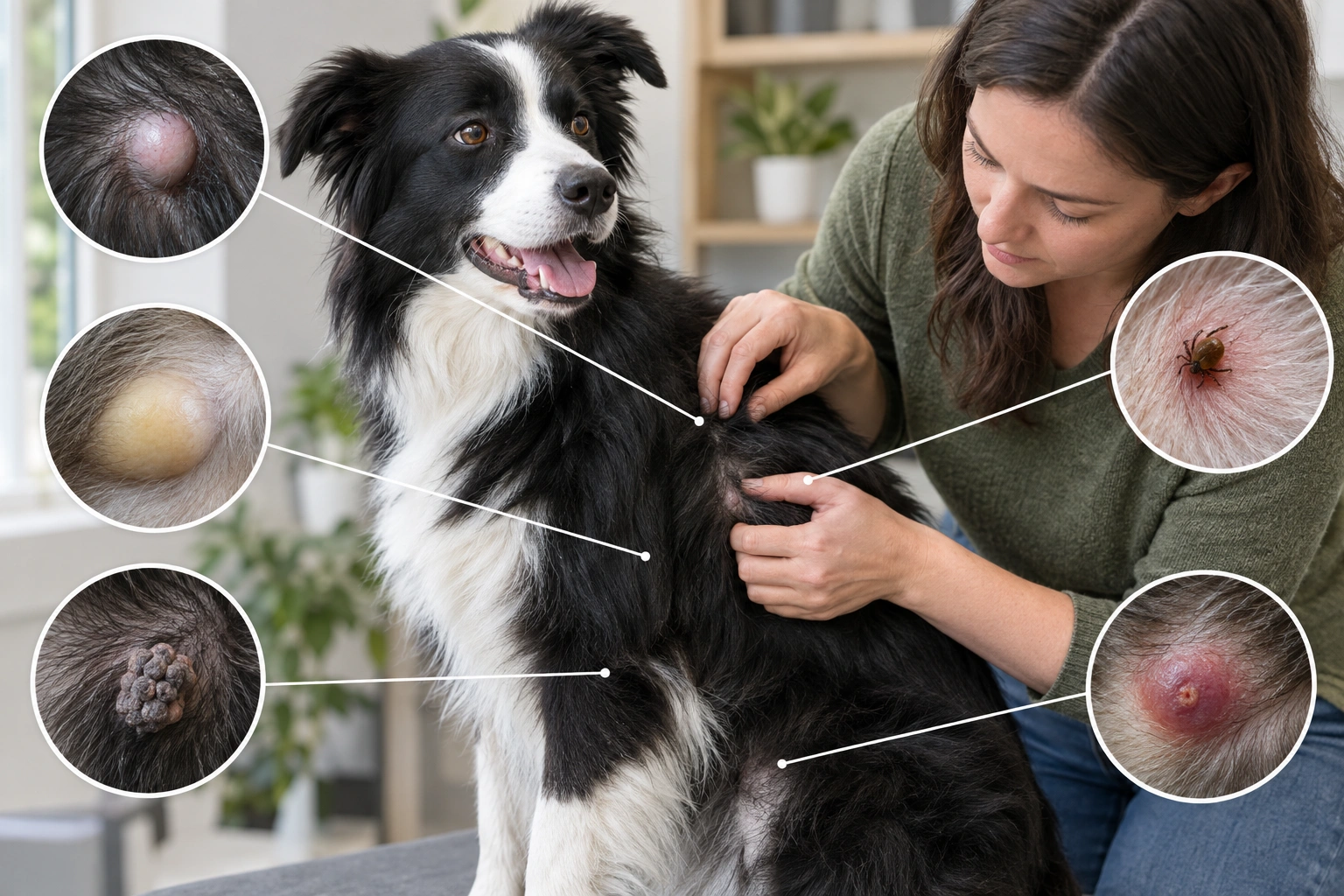
It is also worth separating short-lived swelling from a true lump. Insect bites and allergic reactions can cause sudden, puffy swellings that may look alarming but often improve within a day or two as the irritation settles. If the swelling is shrinking, your dog seems comfortable, and the area is not getting hotter, redder, or more painful, it is more likely to be a temporary reaction. A persistent lump, by contrast, stays in place, changes slowly or not at all, or keeps growing and should be checked if it does not resolve.
Others need more caution. Abscesses are swollen, painful lumps caused by infection or injury. Tumors can be benign or malignant, and you cannot sort that out reliably just by looking.
The safest mindset is simple: treat the bump as “unknown” until you’ve checked how it behaves.
First-pass triage: monitor, book a vet visit, or treat it as urgent
Use this rule of thumb:
- Monitor at home if the bump is small, stable, not painful, not bleeding, and your dog is acting normal.
- Book a routine vet visit if it is new and you can’t identify it, if it is growing slowly, or if it keeps getting irritated.
- Seek prompt care if it is rapidly enlarging, painful, hot, bleeding, ulcerated, oozing, or clearly affecting comfort or function.
That last category matters more than people realize. A bump that is “just a lump” on the side of the body may be less urgent than a smaller one on the eyelid, paw, mouth, or near the anus, where it can interfere with blinking, walking, eating, or toileting.
A useful trade-off: waiting can be reasonable for a stable lump, but waiting becomes risky once the bump changes. Change is often the clue that tells you the body is no longer treating it like a quiet, stable issue.
If the dog seems unwell too — lethargic, feverish, or off food — don’t keep watching the bump in isolation. The whole picture matters.
For a general pet-health reference on skin masses, Banfield’s overview of skin lumps, bumps, and masses is a practical starting point.
How to assess the bump like a clinician
You do not need to diagnose it at home. You do need to describe it well.
1) Size
Measure it. A ruler or tape measure is enough. Even a bump that seems “small” may be important if it is growing. The first measurement becomes your baseline.
2) Feel
Ask three questions:
- Is it soft or firm?
- Is it movable under the skin or fixed in place?
- Does it seem painful when touched?
Soft, movable lumps are often less alarming than firm, fixed ones, but that is not a guarantee. A firm or attached mass deserves more attention, especially if it is changing.
3) Surface
Look for redness, scabbing, discharge, ulceration, or a shiny swollen surface. An irritated surface does not automatically mean infection, and a calm surface does not automatically mean harmless.
4) Behavior over time
This is one of the most useful clues. A bump that appears and stays the same for months is different from one that doubles in size over a couple of weeks. Growth rate matters because fast change usually lowers the threshold for a vet exam.
5) Dog’s response
Watch whether your dog is licking, scratching, rubbing, or guarding the area. Itchiness can point toward irritation, allergy, or surface inflammation. Pain raises the concern level because pain often means deeper inflammation, infection, or pressure.
A practical way to think about it: the more a bump behaves like a stable, quiet skin change, the more reasonable watchful waiting becomes. The more it behaves like an actively changing lesion, the more you should have it examined.
Common harmless or lower-risk causes of dog bumps
Lipomas
Lipomas are soft, fatty lumps often found in older dogs. They are usually harmless, but they should still be monitored. A lipoma that stays the same may simply be tracked over time. One that grows large enough to interfere with movement is different and may need a vet’s input.
Cysts and sebaceous cysts
Cysts are fluid-filled sacs that may appear suddenly and are often benign. Sebaceous cysts are linked to blocked oil glands and may resolve on their own, but they can rupture or become infected. If a cyst starts draining, becomes red, or becomes painful, it no longer belongs in the “ignore it” category.
Histiocytomas
These are often red, raised, button-like lumps in young dogs and are usually benign and self-resolving. They can look dramatic, which is why they worry owners, but the appearance alone does not tell the whole story. If you are unsure whether a bump is a histiocytoma or something else, a vet exam is the sensible move.
Warts
Warts can look rough or cauliflower-like. They may be harmless, but they can be confused with other growths. If a “wart” is bleeding, rapidly growing, or changing color, it should not be assumed to be a simple wart.
Papules and small surface irritation
Papules are tiny bumps near hair follicles and can happen because of allergy or a small infection. Once the trigger is addressed, they often settle down. If the bumps are numerous, itchy, or spreading, that points more toward a skin problem than a single isolated lump.
Potentially serious causes: abscesses, infected lesions, and skin tumors
Abscesses
An abscess is a painful, swollen lump caused by infection or injury. These often feel warm, tender, and inflamed. They may develop after a bite, scratch, or puncture wound. Because infection can worsen quickly, an abscess usually deserves a vet visit rather than home experimentation.
Infected bumps
A bump that was once quiet can become a problem if it gets scratched, licked, or ruptures. Drainage, smell, redness, and heat all push the concern level higher.
Skin tumors
Tumors can be benign or malignant, and you cannot tell which from appearance alone. Some malignant growths can be dangerous and aggressive. That is why a new or changing mass is worth checking rather than guessing.
A key caution: inflammation does not prove a bump is harmless. Some serious masses can look irritated, and some benign ones can look ugly. The job is not to label it from a photo; the job is to decide whether it needs a vet’s hands and a sample.
Wart, tick, cyst, or tumor: how to tell them apart
This is where owners get stuck, because several bumps can look alike at a glance.
| What it may be | How it often feels | How it may look | Growth pattern | Pain/itch | Typical urgency |
|---|---|---|---|---|---|
| Tick | Attached to skin, may feel like a small bead | Dark or grayish, often with visible body parts on close look | Stays attached until removed | May be irritating | Prompt removal or vet help if unsure |
| Wart | Rough or cauliflower-like | Surface growth, sometimes skin-colored | Slow | Often not painful unless irritated | Routine vet check if uncertain |
| Cyst / sebaceous cyst | May feel round, soft to firm | Dome-shaped lump under or in skin | Can appear suddenly, may change if ruptured | Usually not painful unless infected | Routine unless red, painful, or draining |
| Lipoma | Soft, movable | Smooth lump under skin | Often slow | Usually painless | Routine monitoring, especially if growing |
| Abscess | Warm, tender, swollen | Red, inflamed, sometimes draining | Can worsen quickly | Often painful | Prompt vet visit |
| Suspicious tumor | Firm or fixed, sometimes irregular | Any look; may ulcerate or bleed | May grow, shrink, then grow again, or change quickly | May or may not hurt | Vet evaluation soon |
The biggest confusion is often tick versus wart versus skin tag. If the bump seems attached to the skin surface and you can see a body-like shape, think tick first. If you are not sure, do not dig at it. A careful removal or vet check is safer than guessing.
If you do find a tick or think a bump might be one, safe removal is appropriate only when you can clearly see it, your dog will stay still, and you can grasp the tick close to the skin with fine-tipped tweezers or a tick tool and pull straight out with steady pressure. If the tick is embedded in a sensitive area, your dog is too painful or reactive, or you are not sure it is a tick at all, let a vet handle it instead of trying to scrape or squeeze it.
Another useful distinction is soft movable lump versus firm fixed mass. Soft and movable leans more benign, but not always. Firm and fixed is more concerning, especially if it is growing or altering the skin.
Red flags that mean the bump should be checked promptly
Do not wait if any of these are true:
- It is growing quickly
- It bleeds easily
- It is ulcerated or open
- It is hot, red, or painful
- It is oozing or smells bad
- Your dog is licking, scratching, or chewing it nonstop
- It is affecting walking, blinking, eating, or toileting
- Your dog seems tired, feverish, or not interested in food
- The bump changed after a bite, puncture, or injury and is worsening
These signs do not automatically mean cancer. They do mean the bump has moved out of the “watch and wait quietly” category.
What a veterinarian may do to diagnose the lump
A vet usually starts with a physical exam and a history: when you noticed it, whether it changed, and whether it bothers your dog. That information matters more than owners often realize.
The next common step is a fine-needle aspirate, where a small needle is used to collect cells from the lump. That can help a vet sort out whether the mass looks like fat, inflammation, infection, or something that needs more investigation. It is often a helpful first sample, but it does not always give a complete or final answer.
Sometimes the vet may recommend a biopsy, especially if the lump’s appearance or sample is not clear enough. For oral growths such as epulis, diagnosis is made by recognizing the appearance and confirming it with a biopsy. Imaging, such as dental radiographs or other head imaging, may be one part of the workup in some cases, but it is not a universal or definitive step for every oral growth.
The point of testing is not to “do every test.” It is to get enough information to know whether monitoring is reasonable or whether treatment should move forward.
For a broader veterinary perspective on what can be found in skin masses, VCA Hospitals’ pet health resources are a useful reference point.
How to monitor a stable bump at home without making it worse
If the bump seems stable and your vet has not told you to come in urgently, monitor it the same way every time.
Use this simple system:
- Take a clear photo in good light.
- Place a ruler or coin beside it for scale.
- Note the date.
- Record the location on the body.
- Write down how it feels: soft, firm, movable, fixed, painful, itchy, warm, or dry.
Repeat the same check weekly. If the bump seems to be changing sooner than that, remeasure it sooner rather than waiting for the next weekly check. A new photo or measurement every few days can be useful if you are trying to confirm whether it is truly stable.
What you are looking for is not perfection. You are looking for change: larger, redder, firmer, more painful, more irritated, or more bothersome to your dog. If it changes, your notes become the most useful thing you can bring to the vet.
What not to do
Do not squeeze, pop, lance, or cut into a bump at home. That can spread infection, cause bleeding, and make diagnosis harder.
Do not apply human creams, acne treatments, or leftover antibiotics unless a veterinarian has told you they are safe. Human products can irritate skin or mask the real problem.
Do not assume a bump that drains is “better.” Drainage can mean rupture, infection, or a lesion that still needs treatment.
Special cases that deserve a lower threshold for veterinary evaluation
Some locations deserve quicker attention because they affect function or are easy to miss.
- Eyelid: can interfere with blinking and irritate the eye
- Mouth or gums: can affect eating and may need biopsy or imaging
- Paw: can be painful, hard to keep clean, and prone to licking
- Neck: can be mistaken for swelling or a deeper mass
- Near the anus: can affect comfort, toileting, and hygiene
If a bump is in one of these places and your dog is bothered by it, do not wait for it to become dramatic before acting.
When a bump can wait versus when it should not
A bump can usually wait when it is small, soft, movable, not painful, not red, not draining, and unchanged over time. That is the profile of a stable lesion that can be discussed at a routine appointment.
It should not wait when it is growing, firm, fixed, bleeding, ulcerated, painful, hot, or interfering with normal life. It also should not wait if your dog seems unwell or if you simply cannot tell whether it is a bump, a tick, or an irritated lesion.
If you are on the fence, take the photo, measure it, and book the exam. That is often the best balance between overreacting and missing something important.
For more general guidance on skin issues in dogs, the ASPCA’s pet care resources are worth bookmarking.
FAQs
Can a bump on my dog be cancer?
Yes, some bumps are tumors, and some tumors are malignant. Appearance alone cannot confirm that. A vet exam and, in many cases, a sample are needed.
Should I pop a bump on my dog?
No. Popping or squeezing can worsen infection, cause bleeding, and hide the real problem.
How fast is too fast for a bump to grow?
If it is noticeably larger over days or a couple of weeks, that is enough to justify a vet visit. Rapid change matters more than exact size.
My dog’s bump is painless. Does that mean it is harmless?
Not necessarily. Some benign bumps are painless, but some serious ones can be too. Pain helps with triage, but it does not rule things out.
What if I think it is a tick?
Treat it carefully and remove it properly, or have a vet remove it if you are unsure. A tick can be mistaken for a skin growth, especially when it is small.
Can dog bumps go away on their own?
Some can, including certain papules, histiocytomas, and some cysts. But “might go away” is not the same as “safe to ignore,” especially if the bump changes.
How often should I recheck a stable lump?
Weekly photos and measurements are a practical home approach. If the bump seems to change sooner, remeasure it sooner rather than waiting for the weekly check. If your vet is monitoring a small benign mass, they may recommend periodic rechecks and measurements in the clinic.
When should I call the vet today?
Call today if the bump is painful, bleeding, ulcerated, hot, rapidly growing, draining, or affecting eating, walking, blinking, or toileting.
How do insect bites or allergic swellings differ from a real lump?
Bites and allergic swellings usually come on quickly and then improve as the irritation settles, often within a day or two. A persistent lump tends to stay in one place or keep changing over time, so if swelling does not start to resolve or it gets worse, it should be checked.
