
What Is Border Collie Syndrome? Border Collie Collapse Explained

Quick Answer
“Border Collie syndrome” usually refers to Border Collie collapse, or BCC. It is an episodic disorder in which a healthy-looking Border Collie can become confused, unsteady, weak, or unable to walk after strenuous exercise. The University of Minnesota Border Collie collapse research describes BCC as an exercise-triggered nervous system disorder.
Common clues owners notice
- Exercise trigger: Signs often appear after several minutes of hard running, herding, agility, or retrieving.
- Wobbly movement: The dog may sway, stumble, scuff the feet, or cross the legs while turning.
- Mental changes: Some dogs look dazed, confused, unfocused, or slow to respond.
- Short episodes: Many affected dogs return toward normal within roughly 5–30 minutes.
- Normal between episodes: A dog with BCC can appear completely healthy when resting.
What should you do?
- Stop exercise immediately and contact your veterinarian, especially after a first collapse or any severe episode.
I’ve seen how easy it is to underestimate a Border Collie when the dog looks perfect again ten minutes later. That quick recovery can make an episode seem less serious than it deserves.
This guide explains what owners usually mean by “Border Collie syndrome,” what BCC looks like, and what should happen next.
In This Guide
- What Does Border Collie Syndrome Mean?
- What Are the Signs of Border Collie Collapse?
- What Triggers Border Collie Collapse?
- How Is BCC Different From Other Causes of Collapse?
- How Do Vets Diagnose Border Collie Collapse?
- What Should You Do During a Collapse Episode?
- Can a Border Collie Live Normally With BCC?
- Frequently Asked Questions
- Final Takeaway
What Does Border Collie Syndrome Mean?
When people search for Border Collie syndrome, they usually mean Border Collie collapse, shortened to BCC. You may also hear owners call it “the wobbles.”
BCC is linked with strenuous exercise. Affected dogs appear normal between episodes.
Definition: Border Collie collapse is an episodic disorder in which intense exercise can trigger temporary problems with coordination, gait, awareness, or the ability to remain standing.
BCC is not simply a tired Border Collie
A normal tired dog slows down, pants, rests, and may lose enthusiasm for play. BCC looks different.
The dog may lose coordination even while still mentally driven to continue working. That contrast is one reason experienced handlers notice something is wrong.
- Normal fatigue: The dog slows down in a coordinated way.
- BCC episode: The dog may wobble, scuff its feet, stagger, or become confused.
- Normal recovery: Rest gradually restores energy.
- BCC recovery: Neurologic-looking signs can disappear within minutes.
Why Border Collies may show it during work
Border Collies were developed as intense herding dogs. The American Kennel Club Border Collie profile describes the breed as an energetic working dog that thrives when given a job.
That matters because many BCC triggers are exactly the activities Borders love most.
- Herding livestock
- Repeated ball or disc retrieving
- Agility
- Flyball
- Fast running
- Highly exciting training sessions
I never treat a Border Collie’s willingness to continue as proof the dog is physically fine. This breed can stay intensely focused even when its body needs a break.
Vet note: Any unexplained collapse, weakness, loss of coordination, or altered awareness deserves veterinary assessment. BCC cannot be confirmed safely from an internet description alone.
What Are the Signs of Border Collie Collapse?
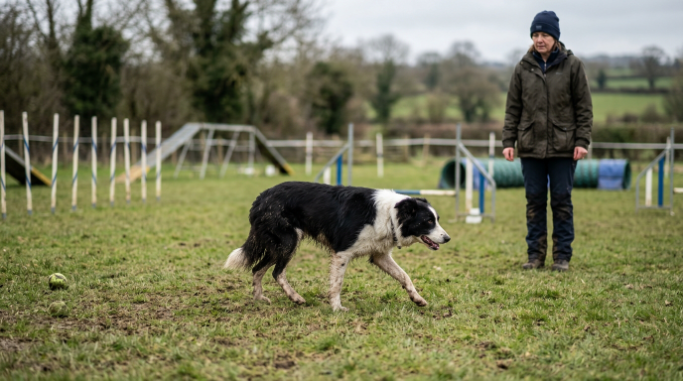
BCC usually causes a noticeable change in movement, awareness, or both. Episodes often develop after about 5–15 minutes of strenuous activity.
Some dogs show signs while exercising. Others look abnormal shortly after they stop.
Changes in movement
- Swaying: The body moves from side to side.
- Staggering: The dog looks almost drunk while walking.
- Toe scuffing: The feet drag or scrape the ground.
- Choppy steps: Strides become short, stiff, or exaggerated.
- Leg crossing: The limbs may cross when the dog turns.
- Falling: Some dogs stumble sideways or cannot remain standing.
Changes in awareness
Not every affected Border Collie loses consciousness. In fact, many remain awake throughout an episode.
What owners often notice is a change in focus.
- Dazed appearance
- Confusion
- Reduced response to commands
- Loss of normal focus
- Unusual dullness
How long does an episode last?
Typical BCC abnormalities may last about 5–30 minutes. The dog can then appear normal again.
That fast recovery is important, but it doesn’t prove BCC is harmless. Other serious problems can also cause temporary weakness or collapse.
A video can be valuable if recording is safe. Movement patterns that disappear before the veterinary appointment are much easier to discuss when your veterinarian can see the episode.
Vet note: Do not delay emergency care to record a video. Breathing difficulty, seizures, persistent collapse, severe overheating, pale or blue gums, or reduced responsiveness need immediate veterinary attention.
What Triggers Border Collie Collapse?
Strenuous exercise is the main trigger associated with BCC. Heat, excitement, and exercise intensity may increase the likelihood of an episode.
The exact combination differs between dogs.
High-intensity exercise matters more than simple movement
A calm leash walk and twenty frantic ball retrieves are not the same workload. Intensity changes what the dog’s nervous system and body must handle.
I pay attention to excitement as much as distance. A Border can cover surprisingly little ground yet work at maximum intensity.
- Repeated sprinting after a ball
- Fast sheep work
- Agility sequences
- Flyball runs
- Disc chasing
- Hard running during hot weather
Does hot weather cause BCC?
Warm conditions can make episodes more likely, but BCC is not considered simply another name for overheating. Research has found affected dogs can become extremely hot during exercise without being hotter than unaffected Border Collies doing comparable work.
This distinction matters. It also means an owner should never assume a hot, collapsing dog “only has BCC.”
As of 2026, the underlying biology is still not explained by one simple mutation or one simple heat problem. The Merck Veterinary Manual discussion of exercise-induced collapse notes that a similar syndrome occurs in Border Collies without an identified single genetic mutation.
Vet note: Exercise in hot or humid weather can also cause true heat-related illness. Treat collapse during heat exposure seriously until a veterinarian determines the cause.
How Is BCC Different From Other Causes of Collapse?
BCC is only one possible explanation for a Border Collie that suddenly becomes weak or falls. Heatstroke, seizures, heart disease, low blood sugar, toxins, and other neurologic problems can produce overlapping signs.
This is why diagnosis should focus on ruling out dangerous alternatives.
| Problem | Typical Clues | Recovery Pattern | Owner Response |
|---|---|---|---|
| Border Collie collapse | Triggered by hard exercise; wobbling, scuffing, confusion, abnormal gait | Often improves within about 5–30 minutes | Stop exercise and arrange veterinary assessment |
| Heatstroke | Heavy panting, overheating, weakness, abnormal gums, vomiting, diarrhea, confusion | May worsen without treatment | Emergency veterinary care |
| Seizure | May include stiffening, paddling, uncontrolled movements, loss of awareness, or post-event confusion | Post-seizure behavior may remain abnormal | Protect the dog from injury and contact a veterinarian |
| Cardiac syncope | Sudden fainting or loss of posture, sometimes with rapid recovery | Can recover quickly | Prompt veterinary investigation |
BCC versus Labrador-type exercise-induced collapse
Border Collie collapse is also different from the better-defined DNM1-associated exercise-induced collapse found in some retriever breeds. Affected Border Collies studied for BCC have not shown that condition as the explanation for their episodes.
That means a DNA result designed for Labrador-type EIC does not automatically diagnose or exclude Border Collie collapse.
BCC versus heatstroke
This is one of the most important distinctions for an owner to understand. Both problems may occur around exercise and hot weather.
Heatstroke can cause organ damage and death. PetMD’s veterinary heatstroke guidance lists weakness, collapse, disorientation, vomiting, diarrhea, heavy panting, and abnormal body temperature among important warning signs.
If you cannot confidently tell the difference, treat the situation as potentially urgent.
Vet note: Never use a previous BCC diagnosis as a reason to dismiss new or unusually severe symptoms. A dog can have BCC and still develop an unrelated emergency.
How Do Vets Diagnose Border Collie Collapse?
There is no simple test that says, “Yes, this is BCC.” Diagnosis is generally based on the history, the characteristic episode, and ruling out other causes.
Your veterinarian may start with the story of exactly what happened.
Details worth bringing to the appointment
- What activity the dog was doing
- How many minutes the dog had exercised
- Weather and temperature
- Whether excitement was unusually high
- What the gait looked like
- Whether the dog remained conscious
- How long signs lasted
- How quickly normal behavior returned
- Whether similar episodes happened before
- Any safe video of the event
Why other diseases must be ruled out
Collapse is a symptom, not a diagnosis. Your vet may consider heart disease, metabolic problems, neurologic disease, heat illness, toxins, pain, or other causes depending on the dog.
Testing may include a physical examination and blood work. Some dogs need cardiac or neurologic testing based on their history.
The fact that a Border Collie recovers rapidly does not remove the need for that workup. A first unexplained collapse deserves attention.
Vet note: The right tests depend on your individual dog. A veterinarian who has examined the dog is better placed to decide what needs to be ruled out.
What Should You Do During a Collapse Episode?
Stop strenuous activity immediately. Move the dog away from the trigger and keep the environment calm.
Do not encourage the dog to “walk it off.” Coordination may be poor.
- End exercise. Do not throw another ball or restart the activity to test the dog.
- Move to safety. Keep the dog away from roads, livestock, jumps, stairs, and water hazards.
- Check breathing and awareness. Severe breathing difficulty or reduced responsiveness needs emergency care.
- Help the dog cool safely. Move into shade or a cooler environment and follow veterinary advice.
- Offer water if appropriate. Do not force water into a confused dog’s mouth.
- Contact your veterinarian. A first episode should be investigated even if recovery seems complete.
When is collapse an emergency?
Some signs should push you toward emergency veterinary care rather than home observation.
- Difficulty breathing
- Blue, gray, extremely pale, or abnormal-looking gums
- Repeated vomiting or diarrhea
- Seizure activity
- Loss of consciousness
- Failure to recover normally
- Extreme lethargy
- Severe overheating
- Repeated collapse in a short period
I would rather interrupt a training day too early than push a Border Collie through one more run. Their enthusiasm can hide the point where enough became too much.
Vet note: First aid does not replace veterinary care. Call your veterinarian or emergency hospital for instructions when your Border Collie collapses unexpectedly.
Can a Border Collie Live Normally With BCC?

Many affected dogs can still enjoy daily life, but the trigger activity may need to change. Management focuses on preventing another collapse rather than trying to build tolerance through harder exercise.
There is currently no specific medication proven to prevent BCC.
Learn the dog’s threshold
Owners often become good at spotting the situations that raise risk. The challenge is stopping before symptoms begin.
- Reduce repeated all-out sprinting.
- Build frequent rest breaks into active sessions.
- Avoid hard exercise in hot conditions.
- Lower excitement before intense work.
- Watch gait and focus, not just enthusiasm.
- Stop immediately at the first suspicious change.
Mental work can replace some physical intensity
A Border Collie still needs a job. That job does not have to involve endless high-speed retrieving.
I like short training tasks because they engage the Border brain without turning every session into a sprint test.
- Obedience exercises
- Scent games
- Trick training
- Object discrimination
- Low-intensity problem solving
- Controlled walking and exploration
Is Border Collie collapse genetic?
Current research supports a genetic contribution. BCC appears to be a complex, polygenic condition rather than a disorder explained by one known mutation.
That distinction matters for breeders. As of 2026, there is no simple BCC DNA test comparable with the DNM1 test used for certain other forms of exercise-induced collapse.
Breeding decisions involving an affected dog deserve discussion with a veterinarian and knowledgeable breed-health professionals. A health problem does not become simple just because one commercial test cannot detect it.
Section Takeaway: Living with BCC usually means controlling exercise intensity and recognizing early warning signs. More exercise is not the treatment.
Vet note: Ask your veterinarian for an exercise plan based on your Border Collie’s health, age, previous episodes, and normal activities.
Frequently Asked Questions
Is Border Collie syndrome a real disease?
“Border Collie syndrome” is not the usual medical name. People commonly use the phrase when referring to Border Collie collapse, an exercise-triggered episodic disorder associated with abnormal gait, coordination, and sometimes awareness.
What age does Border Collie collapse start?
BCC has been reported in young dogs and adults, with many cases beginning in young adulthood. Age alone cannot diagnose the disorder, so a first episode of exercise intolerance or collapse should still be assessed by a veterinarian.
Can a Border Collie collapse from playing fetch?
Yes. Repeated retrieving is one activity associated with BCC episodes because it combines sprinting, repetition, and high excitement. Stop play immediately if your dog begins wobbling, scuffing its feet, losing focus, or moving abnormally.
Is Border Collie collapse the same as heatstroke?
No. Heat can increase the chance of a BCC episode, but BCC and heatstroke are not the same condition. Heatstroke is a medical emergency that can damage multiple organs, so never assume a hot, collapsing Border Collie simply has BCC.
Is there a DNA test for Border Collie collapse?
As of 2026, there is no single diagnostic DNA test for BCC. Research indicates a complex genetic component involving many variants rather than the known DNM1 mutation associated with exercise-induced collapse in some retriever breeds.
Can Border Collie collapse be cured?
There is no specific cure or preventive medication currently established for BCC. Management usually involves avoiding known triggers, limiting high-intensity activity, using sensible rest periods, and stopping exercise as soon as suspicious signs appear.
Final Takeaway
If someone says “Border Collie syndrome,” they are usually talking about Border Collie collapse. The classic pattern involves a healthy-looking Border becoming unsteady, confused, weak, or unable to walk after strenuous exercise.
What makes BCC tricky is how normal the dog may look again after resting. That recovery should not replace a veterinary evaluation.
Stop activity when something looks wrong, record useful details, and have unexplained collapse investigated. With a sensible plan, many affected Border Collies can still have rich lives without being pushed into the activities that trigger their episodes.
