
What Noises Do Dogs Hate? A Practical Guide for Border Collie Owners

If you live with a Border Collie, you’ve probably seen how quickly a sound can change the mood in the room. A dog that was relaxed a moment ago may suddenly freeze, pace, bolt, or try to hide when a firework goes off or the vacuum starts. That reaction can be mild, or it can be the first sign of a bigger noise problem.

The short answer to what noises do dogs hate is this: dogs most often struggle with sounds that are loud, sudden, unpredictable, high-pitched, or repeated without warning. Fireworks, thunderstorms, sirens, vacuum cleaners, smoke alarms, and sharp bangs are common examples. But the more useful answer is that dogs do not all react the same way. One dog may only dislike a sound. Another may panic.
For Border Collie owners, that difference matters. Border Collies are often alert, quick to notice changes, and highly responsive to stimulation. That does not mean they are doomed to noise fear, but it does mean you should pay attention early and manage problems before they grow.
The noises dogs most often dislike or fear
Some sounds are reported again and again because they combine the qualities dogs find hardest to ignore: volume, unpredictability, and lack of control.
Here are the most common triggers:
- Fireworks – loud, sudden, and impossible for the dog to predict
- Thunderstorms – booming noise, pressure changes, and often flashing light
- Sirens – high-pitched, persistent, and difficult to escape
- Vacuum cleaners – loud motor noise plus movement toward the dog
- Smoke alarms – sharp, piercing, and often startling even for people
- Construction bangs and metallic crashes – abrupt, jarring, and irregular
- Loud household appliances – some dogs also react to blenders, hair dryers, or washing machines
Noise phobia in dogs is a serious condition, and common triggers often include thunderstorms, fireworks, alarms, and vacuums. It also helps to distinguish phobia from aversion: a dog with aversion may dislike a sound, while a dog with phobia panics and overreacts.
Not every dog hates the same sound. A dog that ignores thunder may panic at a smoke alarm test. Another may be fine with the vacuum but howl at sirens. That’s why it helps to think in categories rather than a single “worst noise” list.
Which sounds are most likely to be a problem?
As a practical rule, prioritize the sounds that are:
- Sudden
- Very loud
- Unpredictable
- Repeated
- Hard to escape
That combination is often more upsetting than loudness alone. A steady fan may be louder than a distant siren, yet many dogs cope better with the fan because it is predictable and easy to ignore.
Why certain sounds bother dogs more than others
Dogs usually react to the pattern of a sound, not just the volume.
Sudden sounds feel more threatening
A noise that appears without warning gives the dog no time to prepare. That’s why a dropped pan or firework bang can trigger a bigger reaction than a machine that hums steadily in the background.
Unpredictable sounds are harder to settle around
Dogs do better when they can predict what happens next. A vacuum cleaner that turns on, moves toward them, and changes pitch is much harder to ignore than a constant sound source.
High-pitched or sharp sounds can be especially irritating
Many dogs seem more bothered by sharp, high-frequency noises than by low, steady ones. That does not mean every dog hates them, but it does help explain why sirens, alarms, and some electronic sounds can be so upsetting.
Past experiences matter
A single frightening event can create a lasting association. If a dog heard thunder while alone and panicked, future storms may trigger fear faster. The dog is not being stubborn; it has learned that the sound predicts something bad.
Temperament changes the picture
Some dogs are naturally cautious. Others are bold and recover quickly. Border Collies often notice environmental changes fast, which can make sound reactions more noticeable. That does not mean they are inherently noise-phobic; it means their alertness and arousal can make them quicker to react when something changes.
Normal startle response vs. noise phobia
Not every reaction to sound is a disorder. A brief startle can be normal. Noise phobia is different.
A normal startle response usually looks like this
- The dog flinches or looks toward the sound
- The reaction is brief
- The dog recovers quickly
- Eating, playing, or resting resumes within moments
Noise aversion usually looks like discomfort
- The dog leaves the room
- The dog stays alert or uneasy
- The dog may not like the sound, but does not panic
- Recovery is still fairly quick
Noise phobia looks like panic
- Intense fear
- Repeated attempts to escape
- Inability to settle
- Dramatic stress signals such as trembling, drooling, or hiding
- Fear that can spread beyond the original sound
I would treat reports that noise phobia may affect up to 50% of dogs as a reminder that this is common enough to take seriously, not as a reason to assume every nervous reaction is phobia.
Quick decision rule
If your dog only startles once and then moves on, you are probably seeing a normal response.
If your dog repeatedly avoids the sound but still functions, you may be dealing with aversion.
If your dog panics, cannot recover, or seems to expect the next sound with dread, that’s when noise phobia becomes a real concern.
Warning signs your dog is reacting badly to sound
The earlier you spot stress, the easier it is to manage.
Watch for:
- Hiding or trying to get under furniture
- Trembling
- Panting when it is not hot
- Drooling
- Pacing
- Whining, barking, or howling
- Refusing food or treats
- Dilated pupils or a fixed stare
- Trying to escape through doors, windows, or fences
- Clinging to you or, in some dogs, shutting down and becoming unusually still
Some dogs show active panic. Others go quiet and disappear. A Border Collie that normally stays engaged but suddenly won’t take food during fireworks is telling you the environment is too much.
If the dog is still eating, playing, and recovering normally after the sound ends, the situation is less urgent. If the dog cannot settle, the reaction is more serious.
Are Border Collies more sensitive to noise?
Border Collies are not automatically noise-sensitive, but they often come with traits that can make sound reactions more noticeable.
They tend to be:
- Highly aware of movement and environmental changes
- Quick to react
- Responsive to stimulation
- Sometimes more difficult to “switch off” after arousal rises
That does not mean the breed is the problem. Individual temperament matters more than breed label. A calm Border Collie may shrug off sirens, while another dog from a different breed may panic at the same sound.
What the breed tendency does change is how early you should intervene. If your Border Collie already shows strong alertness, don’t wait for the fear to become a full-blown pattern.
What to do during fireworks, thunder, sirens, or other loud events
When the noise is happening right now, the goal is not training. The goal is keeping your dog safe and reducing panic.
1. Move the dog to the safest available space
Choose the room where your dog already relaxes best. Many dogs do well in a covered crate, a quiet bedroom, or a corner away from windows. If your dog naturally seeks a den-like space, let that work in your favor.
2. Close doors, curtains, and access points
You are not trying to make the house soundproof. You are trying to reduce visual and auditory intensity and prevent escape.
3. Add background sound if it helps
A fan, soft music, or white noise may reduce the contrast between the scary sound and the environment. This works best when the masking sound is calm and familiar, not loud enough to create a second problem.
4. Let the dog choose contact
Some dogs want to lean on you. Others want space. Offer comfort without forcing it. For example, sit nearby, speak normally, and let your dog choose whether to stay close or move away. If your dog comes close, stay steady and calm. If the dog retreats, let that happen.
5. Prevent escape
This is not the time to test a loose gate, open front door, or unsecured fence. Panicked dogs can make dangerous decisions fast.
6. Skip punishment
Do not scold barking, pacing, or hiding. The dog is not being difficult. Punishment adds stress to a dog that already feels trapped.
How to set up a safe room and reduce noise impact at home
A good safe room is simple, familiar, and easy to access.
What helps most
- A room your dog already likes
- A bed, crate, or blanket the dog uses regularly
- Curtains or blinds closed
- Background sound that is steady and not harsh
- Water available
- No pressure to interact
If your dog prefers a crate, keep it open and comfortable long before a storm arrives. If your dog likes under-desk spaces or a hallway nook, use that. The best safe space is the one your dog already chooses.
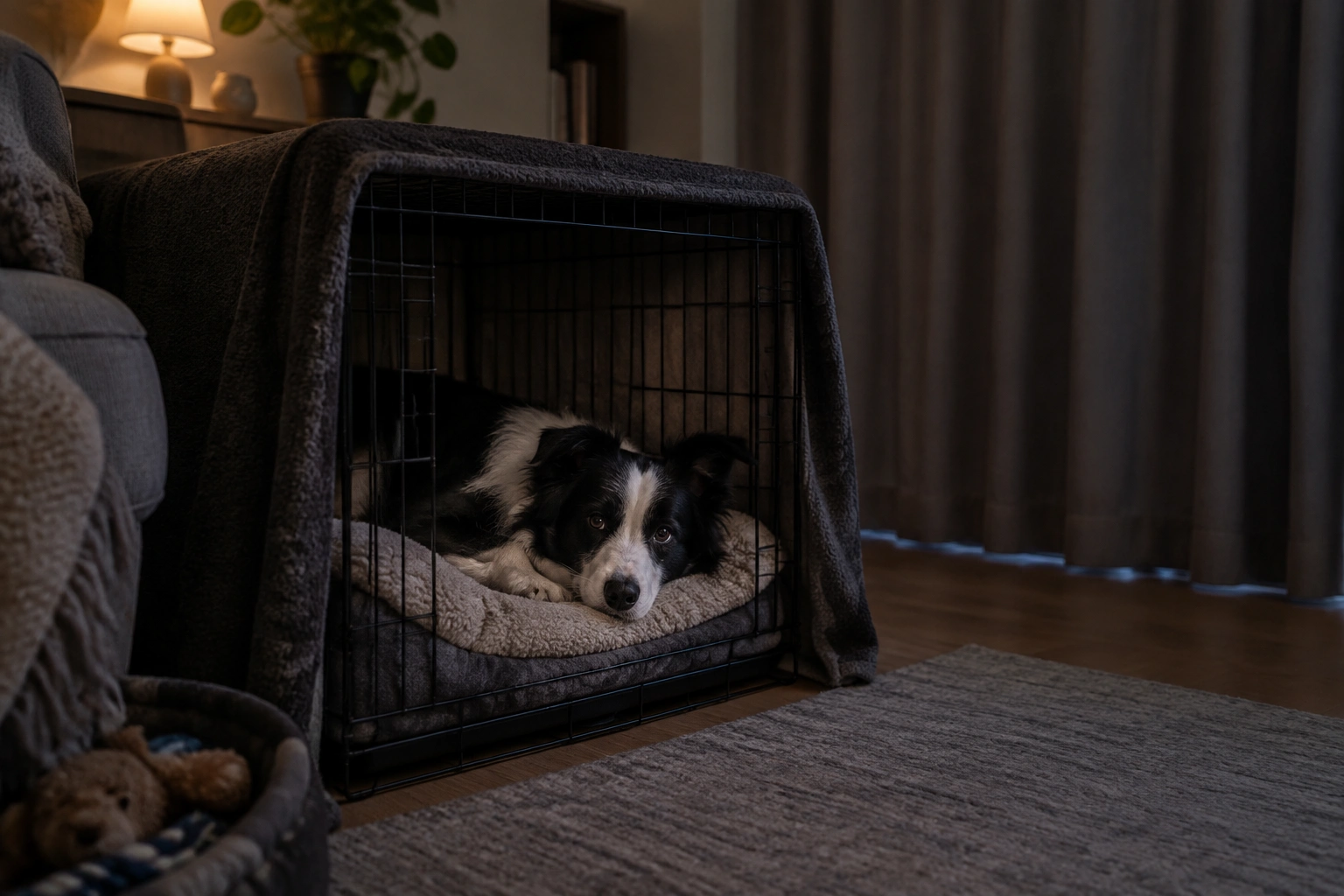
Trade-off: hiding space vs. “confidence building”
Some owners worry that letting a dog hide will reinforce fear. In the middle of a noise event, that concern is usually misplaced. Hiding can be a coping strategy, not a bad habit. The bigger risk is forcing the dog to stay exposed and making the fear worse.
Long-term confidence work is separate. In the moment, give the dog a place to feel secure.
Desensitization and counterconditioning: how to train tolerance safely
If your dog has repeatable but manageable fear, structured training can help over time.
Desensitization means starting below the dog’s fear threshold
The sound is played so quietly, or at such a distance, that the dog notices it but does not panic. If the dog reacts strongly, the setup is too intense.
Counterconditioning means changing the emotional association
The scary sound predicts something good, such as high-value food or a favorite toy. Over time, the dog starts to connect the sound with safety and reward instead of danger.
A safe starting example
If your dog fears fireworks recordings, don’t begin with a loud clip. Begin with a very low-volume version where the dog stays relaxed. Pair it with something the dog genuinely loves. Stop before the dog shows stress.
The main rule
Progress only while the dog is calm.
If you move too fast, you can make the fear stronger. That’s the trade-off: slower work is safer, but it takes patience. Faster work may feel efficient, but it carries a real risk of worsening the problem.
For general training principles and positive reinforcement guidance, the American Kennel Club has useful owner education resources.
Common mistakes that make noise fear worse
A lot of well-meant advice backfires.
Flooding the dog
Flooding means exposing the dog to a scary sound at full intensity and hoping it “gets used to it.” For noise fear, that often does the opposite.
Accidentally rewarding panic
If your dog is frantic and you suddenly start a huge, dramatic comfort routine, you may increase arousal. Calm support is fine. High-energy reassurance can make the event feel bigger.
Waiting until the dog is already in crisis
A dog that has rehearsed panic for months is harder to help than a dog that gets early management. Early action is easier than repair.
Using the wrong training intensity
If the sound is too loud, too close, or too long, the dog is no longer learning. The dog is coping. That distinction matters.
When to see a veterinarian or certified trainer
Seek professional help if any of these apply:
- The fear is getting worse over time
- Your dog cannot recover after the sound ends
- There are escape attempts, broken teeth, injured paws, or damaged doors/windows
- Your dog refuses food, water, or rest during events
- The dog has panic reactions to multiple sounds
- Your management plan is not enough to keep the dog safe
A veterinarian can help rule out medical contributors and discuss whether medication or supplements are appropriate. A certified dog behaviorist can help build a structured plan if the fear is entrenched.
If your dog’s reaction is severe, don’t wait for the next storm season to act.
Practical decision guide: manage, train, or get help?
Use this simple framework.
Choose home management if:
- The dog startles but recovers quickly
- Reactions are mild and predictable
- The issue happens only occasionally
Choose desensitization and counterconditioning if:
- The dog reacts to specific sounds in a repeatable way
- The fear is moderate, but the dog can still stay under threshold
- You can work slowly and consistently
Choose veterinary or behaviorist support if:
- Panic is intense
- The dog cannot settle
- The fear is escalating
- Safety is becoming a problem
A lot of dogs need more than one approach. A safe room helps now. Training helps later. Professional support becomes important when the problem is bigger than a home plan can handle.
FAQ: what dog owners ask most often
Do dogs hate fireworks more than thunder?
Many dogs react strongly to both. Fireworks are often more startling because they are sudden and unpredictable, while storms can add thunder, wind, and flashes of light.
Why does my dog bark at sirens?
Some dogs howl or bark in response to high-pitched, persistent sounds. That can be normal for a dog that is alerting or joining in, but it can also be a stress response if the dog looks tense or cannot settle afterward.
Should I comfort my dog during a noise event?
Yes, if your comfort is calm and steady. The goal is not to “ignore” fear. The goal is to avoid turning the moment into a bigger emotional event.
Can a puppy grow out of noise fear?
Sometimes mild startles improve with age and good experiences. But if fear keeps repeating, it can become a learned pattern. Early management is the safer bet.
Are ultrasonic sounds safe for dogs?
Be cautious with any device that uses high-frequency sound. Claims about comfort or safety vary by product, and if a dog finds a sound aversive, it can still create stress. Avoid using sound-based deterrents around a fearful dog unless you know exactly why you are using them and have checked the product guidance.
For a broader look at sound sensitivity and common trigger noises, see the ASPCA’s pet behavior resources. For veterinary guidance on behavior concerns, VCA Hospitals is also a solid reference point.
Final takeaway
If you’re wondering what noises dogs hate, the best answer is not a single sound. It’s a pattern: loud, sudden, unpredictable, and hard-to-escape noises are the ones most likely to upset dogs. Fireworks, thunderstorms, sirens, vacuums, smoke alarms, and sharp bangs are the usual suspects.
For Border Collies, the key is to notice the early signs, manage the environment quickly, and treat worsening fear as a real behavior issue rather than a quirk. If your dog only startles, manage it. If your dog starts avoiding, train carefully. If your dog panics or can’t recover, get professional help sooner rather than later.
