
What to Do If Your Dog Attacks Another Dog: A Practical Owner’s Guide

If your dog has just attacked another dog, your job is simple in theory and messy in practice: create distance, prevent a second clash, and then deal with injuries, information, and the behavior behind it.
With Border Collies, this can be especially confusing. A fast, intense dog may look “fine” one moment and then explode when arousal, fear, frustration, or herding instinct tips over the edge. That does not mean the dog is hopeless. It does mean you need a plan before the next walk, park visit, or chance encounter.
The first 5 minutes: stop the incident without making it worse
Your first goal is not to “win” the situation. It is to end it safely.
First 5 minutes checklist
1. Get the dogs apart if you can do so safely. Use a barrier, a leash from behind, a gate, a car door, or a closed door. If they are still latched, do not reach in with your hands.
2. Move your dog to a secure spot. Clip the leash, step behind a barrier, get into a car, or go through a door so there is no second lunge.
3. Do a quick injury check. Look for bleeding, punctures, limping, swelling, shaking, or trouble breathing.
4. Contain the scene. Keep both dogs separated and calm while you assess what happened.
5. Start collecting details. Get names, numbers, and basic facts before everyone leaves.
If the dogs are still engaged, avoid reaching into the fight with your hands or stepping between them. Dogs in a fight can redirect onto the nearest moving thing, and that is often a person. Premier Veterinary Group also cautions against standing between fighting dogs.
Instead, use the safest interruption you have available:
- Create distance with a leash if your dog is already attached and you can do so from behind or at a safe angle.
- Use a barrier such as a gate, fence, car, or even a closed door if one is nearby.
- Use a loud interruption or water only if it is safe and available. Some veterinary guidance notes that a loud noise, water, or barrier may help break the dogs apart, but none of these should put you within bite range.
If you can move your dog away, do it calmly and quickly. PDSA advises walking away calmly but quickly when another dog is showing aggression, and not letting your dog approach because that can make the situation worse.
A useful rule in the moment: speed matters, but personal safety matters more. A few extra seconds spent creating a barrier is better than grabbing a collar and ending up in the emergency room yourself.
How to separate dogs safely without getting bitten
A live dog fight is not the time for cleverness. It is the time for distance and restraint.
Safer options
- Barrier first: car door, fence, gate, baby gate, trash bin, board, or anything solid that blocks access.
- Leash pull from distance: if your dog is leashed and you can pull back without leaning over the dogs, use the leash to move your dog away.
- Water or loud sound: may interrupt enough to create a gap, but only if you can do it without stepping into the fight.
What not to do
- Do not put your hands between the dogs.
- Do not grab collars if your face is close to the action.
- Do not kneel beside them to “get leverage.”
- Do not assume one dog will stop just because the other does.
Premier Veterinary Group specifically warns against standing between fighting dogs because the other dog can turn on you and seriously injure you. Airway Veterinary Hospital gives the same core advice: separate carefully, but do not put your hands or body between them.
If the dogs are already locked and you cannot safely interrupt them, your best move may be to back off, call for help, and use barriers rather than forcing a dangerous hands-on breakup.
Check both dogs for injuries, shock, and hidden punctures
Once the dogs are apart, do not relax too quickly. The visible chaos may be over while the injury problem is just beginning.
Airway Veterinary Hospital recommends looking for bleeding, swelling, and puncture wounds after separation. That matters because bite wounds are often smaller on the surface than they are underneath. A puncture can seal over while deeper tissue is damaged.
Check for:
- bleeding
- limping
- swelling
- puncture holes, especially around the neck, chest, face, legs, or flank
- tenderness when the dog moves
- unusual quietness, shaking, or hiding
- rapid breathing or obvious distress
Speak calmly and move slowly. A dog in pain may react defensively, even if it is normally friendly. If your dog is tense or growling while you inspect them, do not force the issue. Get the dog contained and seek veterinary help.
A minor-looking scuffle can still deserve a vet visit. That is especially true if you cannot clearly see the full body, if the dog was shaken hard, or if the other dog’s teeth may have contacted the skin.
When the situation is an emergency vet case
Some cases can wait for a regular appointment. Others should go to an emergency veterinary clinic.
Treat it as urgent or emergency-level if you see any of the following:
- heavy bleeding
- deep puncture wounds
- swelling that is increasing
- limping or refusal to bear weight
- wounds near the eyes, neck, chest, or abdomen
- breathing changes
- collapse, extreme lethargy, or signs of shock
- your dog acting painful, stiff, or unusually withdrawn
- you cannot tell how deep the wound is
Even if the skin looks intact, a dog that was bitten hard may have bruising, muscle damage, or deeper trauma. If you are unsure, call the vet and describe what happened. It is better to be told to monitor than to miss a wound that needs treatment.
If your dog was bitten, clean the wound only if that can be done safely and without delaying care. Prompt cleaning is not a substitute for veterinary assessment when the wound is more than trivial.
What to say and exchange with the other dog owner
This is the moment when emotions can make things worse. Keep the conversation short, factual, and focused on safety.
Try to exchange:
- name
- phone number
- address if appropriate
- email if available
- dog’s name, breed, color, and description
- vaccination status, especially rabies and other core vaccines, if available
- proof of vaccination if the other owner can show it
- the location, time, and basic sequence of events
- witness names and contact details if anyone saw it
- whether either dog has a history of bites or reactivity, if the other owner is willing to share
Airway Veterinary Hospital recommends exchanging contact information if possible after a dog bite incident. A practical script helps:
“I’m sorry this happened. I want to make sure both dogs are okay. Can we exchange contact details and vaccination information?”
That sentence does two useful things. It shows concern without turning into an argument, and it avoids making a detailed legal admission in the heat of the moment.
If the other owner is angry, refuses to cooperate, or tries to leave, stay calm and do not escalate. Take what details you can, photograph the dog and the scene if safe, note the license plate if appropriate, and contact local animal control or non-emergency authorities as soon as you can.
How to document the incident for your records and insurance
Document early. People remember less than they think, and details blur fast after a stressful incident.
Quick documentation checklist
Take photos of:
– your dog’s injuries
– the other dog’s injuries, if the owner agrees
– torn harnesses, broken leads, or damaged gates
– the exact location
– the route, gate, trail, or parking area
– anything that shows how the dogs met
Write down:
– date and time
– weather and lighting
– whether either dog was leashed
– what happened just before the contact
– who said what, in brief
– witness names and numbers
– whether the other dog rushed up, was loose, or was behind a barrier
– whether you exchanged vaccination or contact information
Keep the notes factual and brief while the incident is fresh. Even if you never end up in a formal dispute, those notes are useful for your vet, trainer, insurer, or landlord.
If you have liability insurance, notify the provider promptly if the other dog or person was injured, if you expect a claim, or if your policy requires early notice. If the incident is minor and no one was hurt, you can often wait until you know whether local reporting rules apply. If local rules require reporting, do that first or at the same time.
Was this aggression, reactivity, fear, frustration, or herding behavior?
This distinction matters because the next step is different depending on the cause.
Here is a practical comparison:
| Behavior pattern | What it often looks like | What usually drives it | Best next step |
|---|---|---|---|
| Fear-based reaction | barking, lunging, snapping when another dog gets too close | the dog feels trapped or unsafe | distance, calm handling, behavior plan |
| Reactivity | explosive response on leash or at close range | arousal plus poor coping skills | management, training, trigger work |
| Frustration | overexcited pulling, vocalizing, then snapping | blocked access or high arousal | increase distance, reduce trigger intensity |
| Herding-style nipping/chasing | fast pursuit, circling, heel or flank nips | motion triggers, instinct, overstimulation | strict supervision, impulse control, redirection |
| True aggression | serious intent to drive off, bite, or hold | can be fear, pain, conflict, or other causes | vet check, behavior assessment, safety plan |
With Border Collies, “aggression” is not always the right first label. Some dogs are overaroused, frustrated, or trying to control motion. That does not make the behavior safe, but it does change the training plan.
A dog that only reacts when cornered by an off-leash dog is different from a dog that seeks conflict. The first case often improves with better management and structured training. The second may need a more cautious, specialist-led plan.
When sudden aggression may be caused by pain or a medical issue
If the behavior came out of nowhere, do not assume it is purely behavioral.
NYC Health notes that a dog may bite if it is unwell, sick, or injured. That does not prove the attack was medical, but it is a strong reason to rule out pain. Dogs with arthritis, ear pain, dental pain, spinal discomfort, or other hidden problems can become less tolerant around other dogs.
Look closely at whether the behavior is new, whether your dog has been moving stiffly, or whether handling has become harder. If there was a sudden personality change, a veterinary exam should come before any serious training work.
A good question to ask is: Did the dog choose conflict, or did the dog react more sharply because something hurt or felt wrong? If pain is part of the picture, training alone will not solve it.
What to do before your dog is around other dogs again
Do not “test” your dog by putting them back into the same kind of setup that just failed.
For the short term:
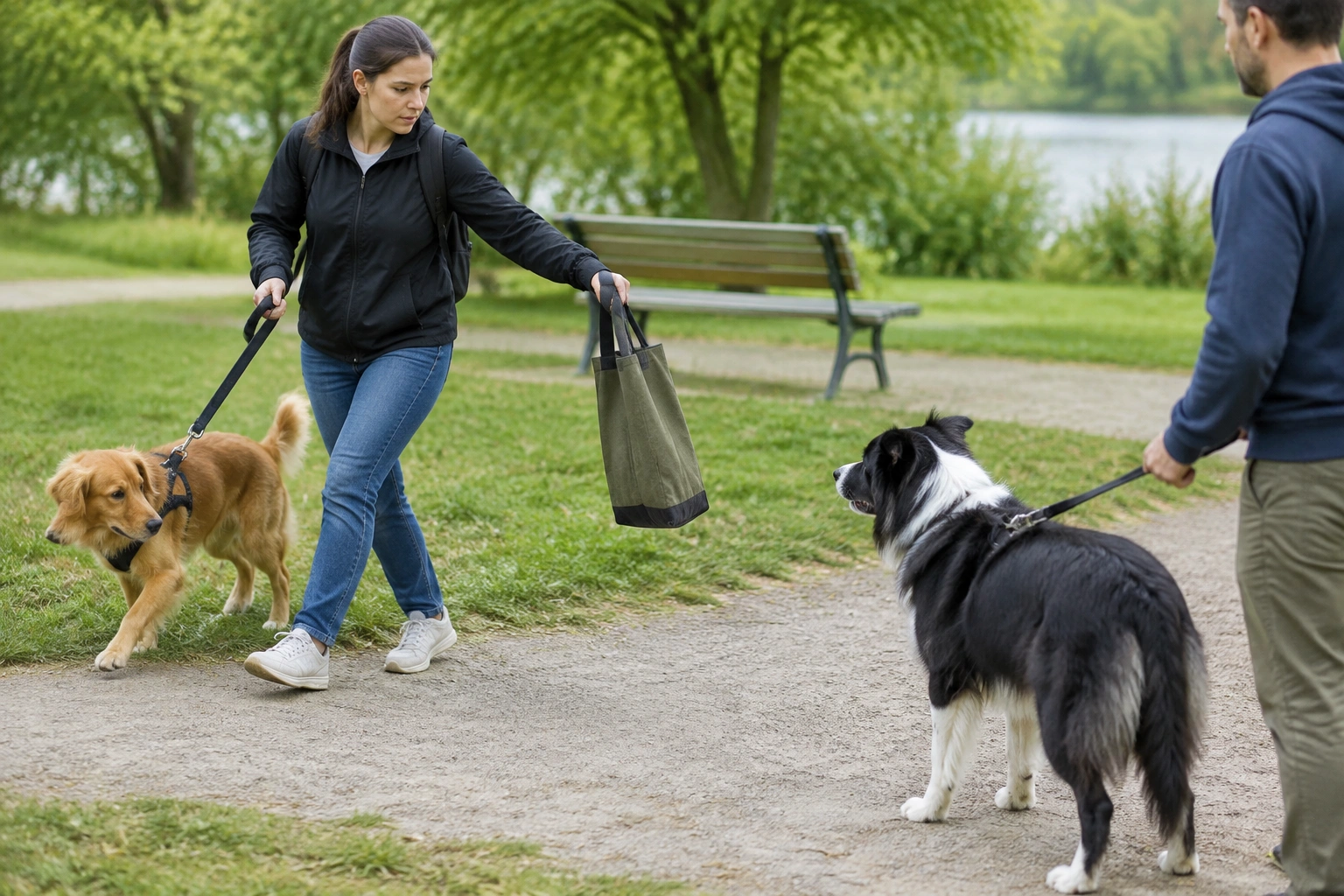
- keep the dog on leash in public
- avoid dog parks and off-leash greetings
- create more distance than you think you need
- use barriers where possible
- prevent surprise encounters on narrow paths
- feed separately if you have more than one dog
- give the dog a quiet retreat space if the household is noisy or overstimulating
Animal Emergency Service recommends feeding dogs separately and limiting access to shared food or toys, and it also suggests giving dogs a quiet space to retreat to if the environment is overstimulating. That advice is practical after an attack because arousal is often already high.
For a Border Collie, this usually means fewer chaotic social situations, not more. A dog that is already wound tight does not learn better in a crowded, noisy setting. It learns worse.
Muzzles, leashes, barriers, and other management tools: when to use each
Management is not a failure. It is how you keep everyone safe while you figure out what is going on.
Leash
Use it when the dog needs controlled movement, especially in public or near triggers. A leash is your first line of prevention, but it only helps if you keep enough distance from other dogs.
Barrier
Use it whenever you can. A fence, car, gate, or door can stop a problem before it becomes a bite.
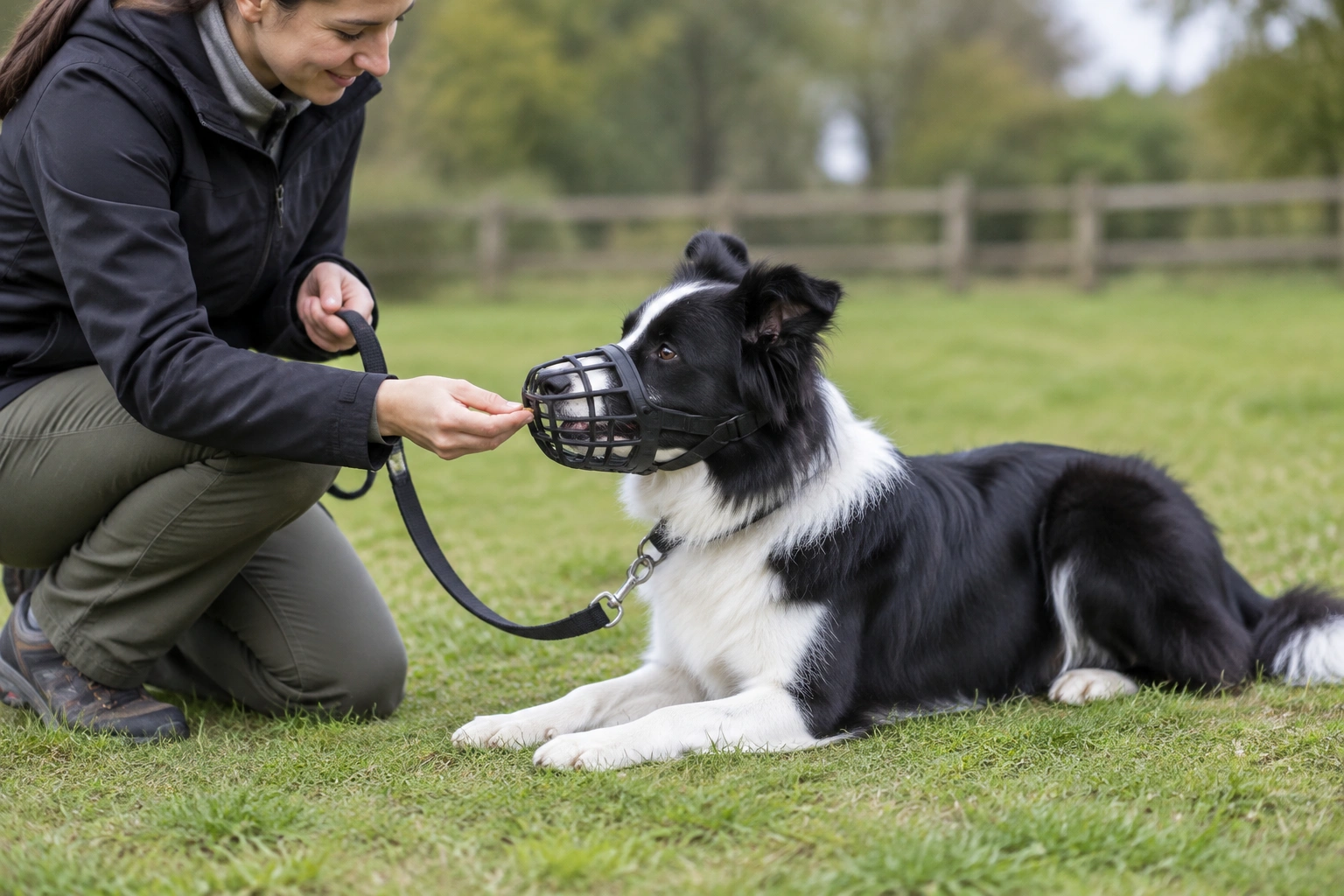
Muzzle
A muzzle is useful when there is a real bite risk and you have trained the dog to wear it calmly before the emergency. It is not a quick fix you slap on five minutes before a walk. Poorly introduced muzzles can add stress and make the dog harder to handle.
Crate or separate room
Useful at home if the dog needs decompression, if there are multiple dogs, or if excitement around visitors is part of the problem.
The trade-off is straightforward: more equipment can increase safety, but only if the dog is conditioned to accept it. A muzzle on an untrained dog can create panic. A leash on a reactive dog can create tension if you let the dog reach the trigger. The tool matters less than the way it is used.
How to prevent this from happening again
Prevention has two parts: reduce exposure to the trigger, and teach the dog a better response.
Step 1: identify the trigger
Ask what was happening right before the incident:
– Was the other dog too close?
– Was your dog on leash?
– Was there a narrow path or corner?
– Was the dog guarding a toy, food, person, or space?
– Was the dog already overexcited?
Step 2: manage the environment
Before training even begins, reduce the chance of another incident:
– avoid crowded dog areas
– use distance as a tool
– don’t allow rushed greetings
– keep sessions short
– stop before the dog tips over threshold
For a high-drive Border Collie, that means watching for early warning signs like hard staring, stalking posture, vocalizing, tight body movement, spinning, or fixating on motion. If your dog is already pulling hard, ignoring food, or unable to disengage, that is usually past the point where learning is useful. Increase distance immediately.
Helpful high-arousal management can include:
– decompression walks in quiet areas with no dog greetings
– predictable routines before and after outings
– sniffing and calm movement instead of constant social exposure
– structured rest periods after exciting events
– avoiding repeated “close call” encounters that rehearse the behavior
Step 3: retrain the response
A good behavior plan usually includes:
– desensitization to the trigger at a safe distance
– counterconditioning so the trigger predicts something good
– calm, repeatable handling routines
– reward-based reinforcement for disengaging, checking in, or moving away
A staged return-to-dog exposure plan is safer than jumping back into normal walks:
1. Start at a distance where your dog can notice another dog and still eat, think, and respond.
2. Reward calm behavior and voluntary disengagement.
3. Gradually decrease distance only if the dog stays loose and recoverable.
4. Add motion and real-world distractions slowly.
5. Pause or increase distance again if the dog crosses threshold.
This is not about forcing the dog to “get used to it” by exposure alone. Repeated uncontrolled exposure can rehearse the very behavior you are trying to stop.
For a high-drive Border Collie, the biggest mistake is often giving the dog too much freedom too soon. Structure first. Freedom later.
When to see a veterinarian or certified trainer
If the dog was injured, start with the vet. If pain, illness, or sudden change is part of the picture, that comes first.
A veterinarian is the right first call when:
– there may be wounds or hidden injury
– the behavior changed suddenly
– the dog is limping, sore, or lethargic
– you suspect pain or illness
A certified trainer can help when:
– the dog is physically okay
– the problem is mostly management, arousal, or poor leash manners
– you need a practical training plan for daily life
A veterinary behaviorist is the better choice when:
– the dog has a bite history
– the aggression is severe or escalating
– fear, anxiety, or medical issues may be part of the problem
– previous training has not moved the needle
If you are unsure, that usually means the case is complex enough to justify the more experienced route.
Legal, landlord, HOA, and leash-law considerations
This part varies by location, so keep it practical rather than theoretical.
Do this first:
– check your local animal control or city website for reporting rules
– confirm whether your area requires a bite report, quarantine, or proof of rabies vaccination
– save photos, notes, and witness details in case a report is needed
– keep copies of vet records and vaccination proof
– avoid altering the scene if there is a chance of an official report
You may also need to:
– notify a landlord or HOA if the rules require it
– provide vaccination records
– follow leash-law or dangerous-dog procedures if your area has them
If you are uncertain, check the local animal control website or municipality page as soon as possible. Waiting rarely helps.
Common mistakes that make the situation worse
These are the errors I see most often:
- reaching into the fight with bare hands
- assuming no blood means no injury
- leaving without exchanging details
- arguing instead of documenting
- letting the dog meet others again too soon
- skipping the vet because the wound “doesn’t look bad”
- using punishment without addressing fear or arousal
- buying a muzzle but never training it
- treating one incident as proof the dog is permanently bad
The biggest one is this: a single attack is information, not a final verdict. It tells you the current setup failed. Your next job is to figure out why.
A calm plan for the next walk
Before you take your dog out again, make three decisions:
- How will I create distance quickly?
- What management tool do I need right now?
- Who will help me assess the behavior and health side of this?
If you answer those three questions before the next outing, you are already ahead of most owners after a dog-on-dog incident.
Frequently asked questions
Should I apologize if my dog attacked another dog?
Yes, a brief apology is usually appropriate, but keep it focused on concern and next steps. Avoid long explanations or statements that sound like you are assigning legal fault in the moment.
Do I need to take my dog to the vet if the wound looks small?
Often, yes. Small punctures can hide deeper damage, and swelling or infection may show up later.
Can I use a muzzle right away?
Only if the dog has already been conditioned to wear one calmly. A muzzle is a safety tool, not an emergency shortcut.
Is my Border Collie being aggressive or just reactive?
It depends on the trigger, body language, and context. Border Collies often react to arousal, motion, pressure, or frustration rather than simple hostility, but any bite-level incident deserves a careful assessment.
When can my dog see other dogs again?
Not until you have a clear plan. In the short term, keep distance, avoid off-leash contact, and work through the trigger and safety setup first.
Should I call animal control?
If local law, the severity of the injury, or the other owner’s report suggests it, yes. If you are unsure, check your local rules quickly rather than guessing.
For broader dog-bite prevention guidance, the AVMA’s dog bite prevention resource is a useful reference, and the ASPCA’s dog care and behavior guidance can help you think through management and behavior support. If you want a practical reminder to keep your distance during fights, the PDSA dog attack advice is worth reading.
