
What to Do When Your Dog Has a Seizure: A Calm, Practical Owner’s Guide

If your dog suddenly stiffens, falls over, paddles, drools, or seems “not there,” the first job is not to diagnose it in the moment. The first job is to keep the dog safe, avoid getting hurt yourself, and gather enough information to help a veterinarian decide what comes next.
That sounds simple until it happens in real life. A seizure is loud, chaotic, and deeply unsettling. Border Collie owners often describe the same feeling: the mind races, the body freezes, and every instinct says to grab the dog and stop it. That instinct is understandable. It is also usually the wrong move.
What follows is the practical version of seizure first aid: what to do in the first few minutes, what not to do, how to tell whether it was really a seizure, and when the situation becomes an emergency.
What to do in the first 5 minutes
Your priorities are safety, timing, and calm.
1) Move hazards out of the way
If your dog is on the floor, clear the area around them. Slide furniture, shoes, lamps, cords, and anything sharp or heavy out of reach. If the dog is near stairs, a pool, a fireplace, or an edge, block access if you can do so without putting your hands near the dog’s mouth or body.
If the dog is on a couch or bed, gently lower the risk of a fall by creating space around them. Do not try to carry a seizing dog unless they are in immediate danger and you can do it without being bitten or injured.
2) Keep hands away from the mouth

Do not put your fingers in the dog’s mouth. Do not try to pull the tongue out. Do not hold the jaw open. Cornell’s veterinary guidance is blunt on this point: avoid the mouth so you do not get bitten. A dog having a seizure is not choosing its movements, and it may clamp down reflexively.
3) Do not restrain the body
Resisting the seizure does not help. Holding the dog down can increase panic, cause injury, and make you the target of involuntary movements. Let the seizure run its course while you protect the area around the dog.
4) Dim the environment
Turn off bright lights, reduce noise, and keep children and other pets away. A quiet room helps prevent extra stimulation once the seizure ends and makes recovery smoother. If the dog is in a busy household space, asking everyone else to back away is one of the most useful things you can do.
5) Start timing immediately
Use your phone stopwatch. Write down the start time if you can. This is more important than trying to estimate later, because a seizure that feels like “a couple of minutes” can actually be longer.
Most seizures last one to three minutes, but the exact duration is worth recording because it changes the next step. A seizure lasting longer than five minutes is treated as a medical emergency.
6) Watch the pattern, not just the drama
Notice whether the dog loses consciousness, stiffens, paddles, chomps, drools, urinates, or defecates. Those details matter more than the noise level. If you can safely do it without getting close, a short video can help your veterinarian later.
What not to do during a dog seizure
The mistakes people make during a seizure are usually driven by panic, not negligence. Still, some of them make the situation worse.
Do not put anything in the mouth
A dog does not swallow its tongue during a seizure. That is a human-seizure myth that does not apply here. Putting a hand, spoon, leash handle, or any object in the mouth can lead to a serious bite or broken teeth.
Do not shake, pin, or hug the dog tightly
A tight hold can interfere with the dog’s movements and make you both more likely to get injured. A brief, loose touch to move the dog away from danger may be necessary in rare cases, but active restraint is not the goal.
Do not assume the dog is choking
Seizures can include gulping, jaw movements, drooling, and odd breathing sounds. Those signs can look alarming, but they are not the same as choking. Reaching into the mouth is usually more dangerous than helpful.
Do not feed or offer a full bowl of water during the seizure
The dog is not coordinated enough to eat or drink safely while the seizure is ongoing. Wait until the seizure stops and the dog is more coordinated before offering anything.
Do not punish or scold
A dog is not misbehaving. It is neurologically impaired during the event and often confused afterward. Punishment adds stress and solves nothing.
How to time the seizure and observe it accurately
If you want your veterinarian to make sense of the episode, the details matter.
Record these facts
Write down:
- the exact time it started
- how long it lasted
- what the dog did physically
- whether the dog seemed conscious or unresponsive
- whether there was drooling, urination, or defecation
- how quickly the dog recovered
- whether anything unusual happened beforehand
That “beforehand” piece is easy to miss, but it can matter. A new food, a missed medication dose, access to trash, a walk in a yard treated with chemicals, or unusual stress may be relevant.
Video is useful, but safety comes first
A 10- to 20-second clip can be enough for a veterinarian to see whether the event looks like a seizure, a fainting episode, or something else. Do not chase the perfect video if doing so means crowding the dog or moving closer than is safe.
Keep a seizure log
A simple note in your phone works fine. Include the date, time, duration, and what it looked like. If this happens again, patterns become much easier to see.
Seizure or fainting? A practical comparison
Not every collapse is a seizure. That distinction matters because fainting and seizure can point to different problems.
| Feature | More like a seizure | More like fainting/collapse |
|---|---|---|
| Body movement | Paddling, stiffening, rhythmic jerking | Often limp or briefly weak |
| Awareness | Usually absent or altered | May stay partly responsive |
| Recovery | Confusion, pacing, disorientation, restlessness | Often faster return to normal |
| After-effect | Post-seizure confusion may last minutes to hours | May bounce back more quickly |
| Drooling/urination | Can happen | Less typical, though not impossible |
A dog that suddenly drops, goes limp, and then gets up quickly may be fainting rather than seizing. A dog that falls, paddles, chomps, and then spends 20 minutes staring into space is more consistent with a seizure and deserves veterinary follow-up.
If you are unsure, treat it as a possible seizure and document it carefully. The practical first aid is similar: protect the dog, time the event, and call your vet.
What normal recovery looks like after a seizure
The period after the seizure is called the postictal phase. In plain language, it is the brain’s recovery window.
During this phase, a dog may seem confused, restless, wobbly, temporarily blind, clingy, hungry, thirsty, or even a little reactive. Some dogs pace. Some stare. Some seem to not recognize familiar people for a short time. Cornell notes that this can last minutes to hours, and sometimes it includes aggressive behavior simply because the dog is disoriented.
The best response is usually quiet and low-pressure:
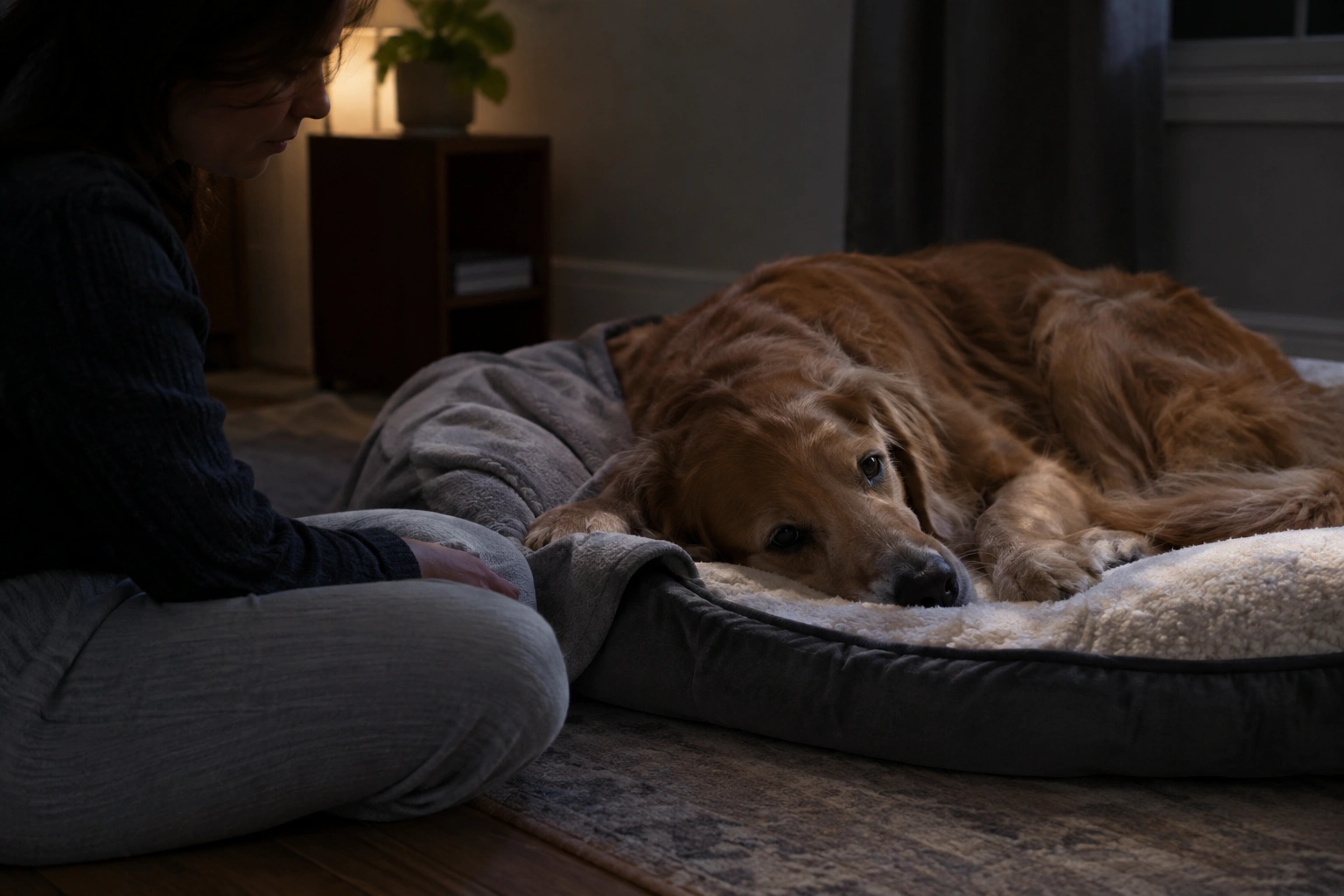
- keep the lights dim
- keep noise low
- keep other pets away
- let the dog recover in a safe, enclosed space
- offer small sips of water once the dog is coordinated enough to drink safely
Do not crowd the dog with excitement or a lot of touching. A calm voice and space are usually better than fussing.
If the dog does not steadily improve, or if the behavior seems more severe than a typical recovery period, that is not something to “wait out” casually.
When a dog seizure is an emergency
Some seizures are urgent, some are emergency-level, and some are both. The difference usually comes down to time, repetition, and recovery.
Go to an emergency veterinarian now if:
- the seizure lasts longer than five minutes
- the dog has repeated seizures close together
- the dog does not begin recovering normally after the seizure
- the dog may have been exposed to a toxin
- the dog had head trauma
- the dog is having trouble breathing
- the dog seems unable to stand, remains severely altered, or worsens after the event
These are the red flags to keep in mind whenever a seizure happens. A seizure longer than five minutes is especially important because prolonged seizure activity can become dangerous quickly. Repeated seizures in a short period are also a red flag.
Call your regular vet the same day if:
- this is the first seizure
- the seizure was brief but clearly abnormal
- the dog seems back to normal but the event was unexplained
- you suspect a missed medication dose or a possible trigger
- the dog is a Border Collie and you want to discuss inherited epilepsy risk
Border Collie-specific caution
Border Collies can be among the breeds where inherited epilepsy is part of the conversation, but breed alone does not confirm the cause. A seizure in a Border Collie still needs proper veterinary evaluation, because toxin exposure, blood sugar problems, illness, and structural brain disease can all look similar at the surface.
According to current ACVIM guidance summarized by MedVet, long-term antiseizure medication may be considered by a veterinarian in dogs with certain seizure patterns or underlying disease. That is a treatment decision for the veterinarian, not something owners should decide on the spot.
Should you call your regular vet or go to an emergency clinic?
Use this simple decision rule:
- Emergency clinic now if the seizure is ongoing, lasts over five minutes, repeats, or the dog is not recovering normally.
- Call your regular vet promptly if the dog had a first seizure, but is stable and fully recovering.
- Watch at home only briefly if your vet has already advised that plan for a known seizure disorder and the episode fits the dog’s usual pattern.
The trade-off is straightforward. Waiting at home can be reasonable only when the dog is clearly improving and there are no red flags. The risk of waiting is missing toxin exposure, cluster seizures, or a prolonged event that needs immediate treatment.
If you are torn between “maybe it was nothing” and “this feels wrong,” lean toward the veterinarian. Seizures are one of those problems where a cautious call is usually the smarter one.
If your clinic or emergency hospital asks you to call before arriving, do it. That gives the team time to prepare and can save minutes that matter.
What can cause seizures in dogs
A seizure is a symptom, not a diagnosis. Several different problems can trigger it.
Common possibilities include:
- Primary epilepsy: often suspected when no other cause is found and the pattern fits recurrent seizures
- Toxin exposure: this is an emergency possibility, especially if the dog may have eaten something unusual
- Low blood glucose: blood sugar problems can trigger seizure activity
- Illness or metabolic disease: liver, kidney, electrolyte, or infectious issues can sometimes play a role
- Head trauma: even if the injury seemed minor at first
- Structural brain disease: a problem in the brain itself that needs veterinary workup
You do not need to diagnose the cause at home. What you can do is identify anything that makes a toxin or trauma more likely and tell the vet immediately.
What to record or video for the veterinarian
Bring useful facts, not just worry.
A strong seizure note includes:
- date and time
- how long it lasted
- what the dog did during it
- whether the dog lost awareness
- whether there was drooling, paddling, urination, or defecation
- how long the recovery phase lasted
- whether the dog returned fully to normal
- any possible trigger or exposure
- any recent illness, missed medication, or unusual stress
- a short video if you got one safely
If your dog has had more than one episode, write down whether the seizures were close together or separated by hours or days. That helps the vet distinguish a single isolated event from a cluster pattern.
What the veterinarian may need to rule out next
After a first seizure, the vet may recommend a physical exam, bloodwork, and sometimes additional testing based on age, breed, history, and recovery. The point is not to “label” the event too quickly. It is to sort out whether this was epilepsy, a toxin problem, a metabolic issue, or something else that needs treatment.
That is why even a short seizure can still matter. A brief episode may look small from the couch, but it can be the first visible sign of a bigger issue.
For broader dog-health context on seizure signs and emergency care, the AKC’s seizure overview and VCA’s pet health resources are helpful starting points, and Cornell’s Managing Seizures guide is especially useful for the mouth-safety and recovery-phase details.
FAQs
How long do dog seizures usually last?
Most last one to three minutes, but timing still matters because anything over five minutes is an emergency.
Should I give water after a seizure?
Small sips may be offered once the dog is awake enough and coordinated enough to drink safely. Do not force it.
Can a dog seem normal after a seizure?
Yes, some dogs recover quickly. Others stay confused, restless, or wobbly for minutes to hours.
Is one seizure enough to call the vet?
Yes. A first seizure should be reported, even if it stops quickly and the dog seems fine afterward.
What if it happens again the same day?
Repeated seizures in a short period are a red flag and usually warrant urgent veterinary care.
Could my Border Collie have epilepsy?
Possibly, but breed alone does not confirm it. Your vet still needs to rule out other causes first.
What if I am not sure it was a seizure?
Treat it as a seizure-like event, keep the dog safe, and document everything you can. A video and timeline help your vet sort it out.
If you want, I can also turn this into a Border Collie-specific seizure action checklist you can save on your phone or print for your fridge.
