

Quick Answer
Start your Border Collie with practical tricks that build focus, self-control, body awareness, and communication. Sit, down, stay, touch, spin, place, find it, toy names, left and right, and tidy-up are excellent choices before harder skills. The American Kennel Club’s trick-training guidance also notes that dogs of different ages can enjoy learning tricks for mental and physical enrichment.
A smart order to follow
- Build focus first: Teach name response, sit, down, stay, come, and touch before flashy tricks.
- Add body skills: Spin, bow, back up, paws up, and leg weaves improve coordination.
- Challenge the brain: Try toy names, find it, hide-and-seek, and object sorting.
- Use working instincts: Direction cues, targeted retrieves, and carrying tasks give a Border Collie purposeful work.
- Teach calm too: Place, settle, chin rest, and wait are as valuable as energetic tricks.
Training tip
- Keep sessions short, reward successful attempts, and stop before your Border Collie loses interest.
Border Collies, sometimes called Borders or BCs, are unusually quick learners with a strong working heritage. That makes trick training one of my favorite ways to give them useful mental work without simply trying to exhaust them.
As of 2026, I still prefer a balanced approach. I teach practical control, calm behaviors, problem-solving games, and fun tricks rather than chasing an endless list of party skills.
In This Guide
- What Tricks Should I Teach My Border Collie First?
- Which Foundation Cues Should Come Before Tricks?
- What Are the Best Beginner Border Collie Tricks?
- Which Tricks Give a Border Collie the Most Mental Stimulation?
- What Advanced and Working-Style Tricks Can I Teach?
- How Do I Teach a Border Collie Tricks Effectively?
- Which Tricks Suit Puppies, Adults, and Senior Border Collies?
- What Trick-Training Mistakes Should I Avoid?
- Frequently Asked Questions
What Tricks Should I Teach My Border Collie First?
Start with tricks that make everyday communication easier. A clever trick is useful, but reliable focus and self-control give you a much stronger training foundation.
I usually build a Border Collie’s trick vocabulary in four layers:
- Safety skills: Come, wait, stay, leave it, and drop it.
- Communication skills: Touch, look at me, place, and heel position.
- Fun movement: Spin, bow, paws up, back up, and weave.
- Thinking work: Find it, retrieve named objects, directions, and tidy-up.
This sequence matters because Border Collies learn patterns fast. If I establish clear communication first, more complex tricks become easier to shape later.
Definition: A Border Collie’s trick is a trained behavior performed in response to a cue, rather than simply an amusing action. Good trick training can build communication, confidence, self-control, and mental engagement.
The breed’s working history helps explain why purposeful learning suits it so well. Border Collies were developed to cooperate with handlers while making decisions around livestock.
The American Kennel Club describes Border Collies as active dogs that benefit from continued obedience work and mental stimulation throughout life. That same drive can make a five-minute learning game surprisingly satisfying.
Section Takeaway: Build useful communication first, then add complexity. A Border Collie doesn’t need the flashiest trick first; it needs a clear learning system.
Which Foundation Cues Should Come Before Tricks?
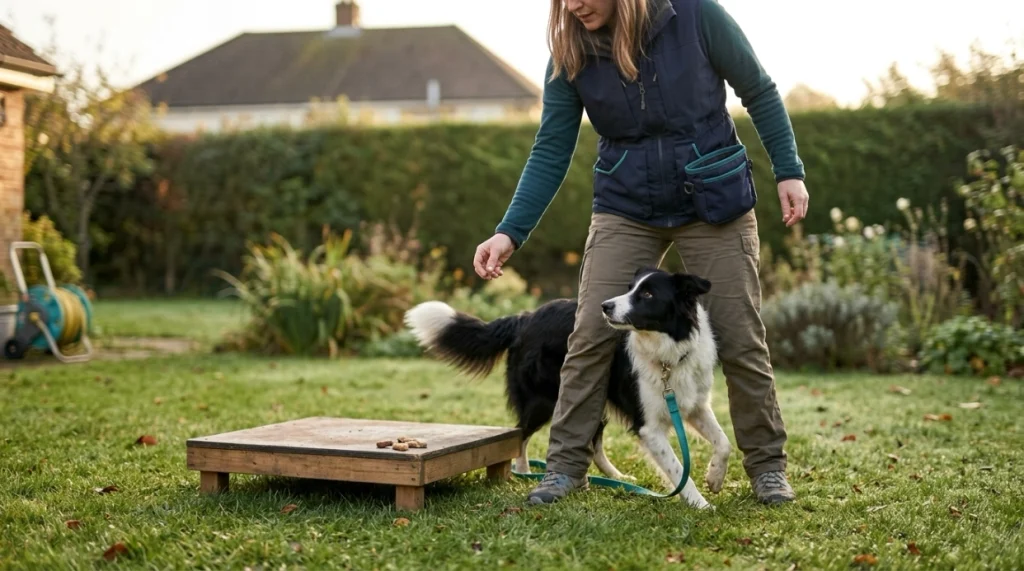
Teach a few reliable foundation behaviors before moving into complicated sequences. These cues become building blocks you can reuse in dozens of tricks.
Name response and eye contact
Say your dog’s name once. Reward the moment your Border turns toward you.
This creates a simple pattern: hearing the name means checking in. It becomes invaluable when distractions appear.
Touch
Present an open palm near your dog’s nose. When the nose touches your hand, mark the behavior and reward it.
A hand target later helps with spins, position changes, recalls, leg weaves, heel work, and directing your dog around objects.
Stay and release
Teach the release word at the same time as the stay. I want the dog to understand both when to remain still and when the exercise ends.
- Start with one or two seconds.
- Increase duration gradually.
- Add distance separately.
- Add distractions only after the basic behavior is clear.
Place or mat
Teaching a Border Collie to go to a bed or mat may not look impressive, but I consider it one of the best tricks in the house.
It gives an energetic dog a clear job during meals, visitors, cleaning, or quiet family time. It also teaches that successful training doesn’t always involve speed.
What Are the Best Beginner Border Collie Tricks?
Beginner tricks should be easy to reward and simple to repeat. Success builds enthusiasm without creating frustration.
- Shake: Teach your dog to place one paw in your hand.
- Spin: Lure or target your dog through a comfortable circle.
- Bow: Reward the front end lowering while the rear remains standing.
- Paws up: Ask for two front paws on a stable low platform.
- Back up: Reward one backward step, then slowly build distance.
- Middle: Teach your dog to stand between your legs and look forward.
- Leg weave: Guide the dog in a figure-eight pattern around your legs.
- Peekaboo: Ask the dog to place its head between your legs while facing forward.
I often teach spin on both sides. Using separate cues for clockwise and counterclockwise turns makes the trick more mentally challenging.
Back up is another favorite because it asks the dog to think about rear-foot movement. Many dogs naturally pay much more attention to their front feet.
Don’t rush the finished cue
Early in training, concentrate on getting the behavior rather than repeating the verbal command. Add the word once the dog is predictably offering the action.
That prevents the cue from becoming background noise. One clear word should eventually predict one clear behavior.
Which Tricks Give a Border Collie the Most Mental Stimulation?
The most mentally demanding tricks require your Border Collie to solve a problem, discriminate between choices, or remember specific information. These often satisfy a clever dog better than endless repetition.
Veterinarian-reviewed PetMD guidance on canine mental stimulation includes short training sessions, scent work, hide-and-seek, food activities, and toy rotation among useful enrichment options.
Teach toy names
Start with one toy. Say its name before presenting it, playing with it, or rewarding interaction.
Once your dog reliably selects that object, introduce a clearly different toy. Ask for one item while both are visible.
You can gradually create a vocabulary of several objects. The challenge is discrimination, not simply retrieving whatever is closest.
Find it
Hide a treat or familiar toy somewhere easy. Give your search cue and allow the dog’s nose to do the work.
Increase difficulty slowly by changing rooms, hiding objects behind furniture, or asking for a named toy.
Tidy up toys
This trick combines retrieving, carrying, targeting, and releasing an object into a container.
- Teach a reliable retrieve.
- Reward carrying the toy toward the box.
- Teach the dog to release above the box.
- Add distance from the container.
- Introduce the tidy-up cue.
I like this exercise because one apparently simple trick contains several separate decisions. That’s exactly the kind of layered challenge many Border Collies enjoy.
Section Takeaway: For serious mental work, choose tricks involving memory, scent, discrimination, and multi-step problem solving rather than repeating one physical behavior.
What Advanced and Working-Style Tricks Can I Teach?
Once the foundations are strong, advanced tricks can borrow ideas from a Border Collie’s herding heritage. You don’t need sheep to teach thoughtful directional and task-based skills.
Left and right
Teach separate directional cues by sending your dog around a cone, tree, chair, or other safe object from each direction.
Keep the cue consistent. Gradually increase the distance after the dog understands the difference.
Targeted retrieves
Instead of asking for any toy, request a specific object. Later, place several known objects together and ask for one by name.
This combines language discrimination, impulse control, searching, retrieving, and delivery.
Carry an object
Teach your dog to hold a light, safe object without chewing it. Then add a few steps of movement before asking for the release.
A controlled carry can later become part of a household routine, retrieval exercise, or more elaborate trick chain.
Send around an object
Place a cone a few feet away and send your dog around it before returning to you. Increase the distance in small steps.
This is one of my favorite ways to practice listening at a distance without turning every session into frantic running.
The breed’s history matters here. The American Kennel Club’s Border Collie history describes a working dog developed around livestock handling, stamina, responsiveness, and independent decision-making.
How Do I Teach a Border Collie Tricks Effectively?
Use short sessions, precise rewards, and small training steps. A smart dog can learn mistakes as quickly as correct behavior.
Break every trick into pieces
Don’t wait for the complete behavior before rewarding. Reinforce small movements that take your dog toward the final goal.
For example, teaching a dog to put toys away may begin with simply looking at the box. The next reward might come for approaching it while holding a toy.
Use a clear marker
A marker can be a clicker or a short word such as “yes.” It tells the dog exactly which moment earned the reward.
Timing matters. Mark the correct action, then deliver the treat.
Keep sessions short
I usually prefer several focused sessions over one long drill. Five to ten minutes is plenty for many adult Borders when the exercise demands concentration.
End while the dog still wants another turn. That keeps enthusiasm high for the next session.
Raise one difficulty at a time
- Increase duration without adding distance.
- Add distance without adding major distractions.
- Introduce distractions only after the basic behavior is reliable.
- Practice in new locations once your dog understands the cue at home.
Positive, consistent training also fits broader ASPCA dog-care and behavior guidance, which provides resources on training, enrichment, and common canine behavior concerns.
Section Takeaway: Make the correct answer easy to discover, reward it clearly, then increase difficulty gradually. Fast learners still need fair steps.
Which Tricks Suit Puppies, Adults, and Senior Border Collies?
Choose tricks according to the individual dog’s age, physical condition, confidence, and training history. Mental difficulty and physical difficulty are not the same thing.
| Life stage | Good starting tricks | Typical session target | Main priority |
|---|---|---|---|
| Young puppy | Name response, touch, sit, recall games, place | About 2–5 minutes | Confidence and communication |
| Adolescent | Stay, find it, directions, retrieve, settle | About 5–8 minutes | Focus around distractions |
| Healthy adult | Toy names, tidy-up, chains, directions, scent games | About 5–10 minutes | Variety and problem solving |
| Senior | Scent searches, chin rest, touch, object choice | About 3–7 minutes | Low-impact mental engagement |
These times are practical starting targets, not medical rules. Watch the individual dog rather than a stopwatch.
A puppy who stops engaging needs a break. A focused adult may happily work longer when rewards and difficulty remain appropriate.
For older dogs, I often shift toward scent work and stationary cognitive games. They can provide challenge without demanding repeated jumping, sharp turns, or high-speed movement.
Vet note: If your Border Collie has pain, stiffness, an injury, a medical condition, or a sudden change in willingness to perform familiar movements, ask your veterinarian before continuing physically demanding tricks.
What Trick-Training Mistakes Should I Avoid?
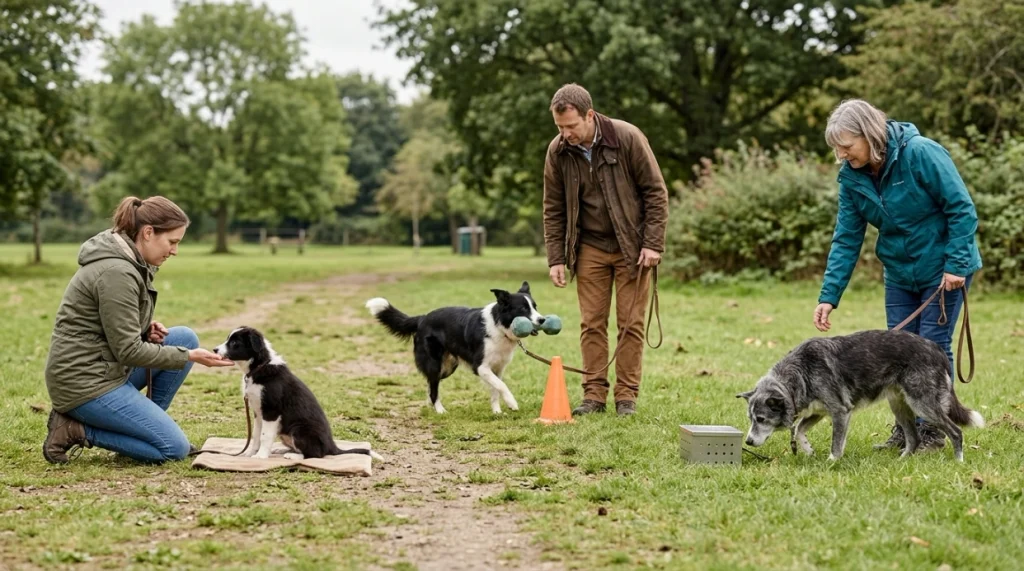
The biggest mistake is assuming that intelligence removes the need for patience. Border Collies can learn quickly, but unclear training can make them confused or frustrated just as quickly.
- Repeating cues: Saying “sit, sit, sit” can teach the dog that the first cue is optional.
- Training too long: Stop before concentration collapses.
- Moving too fast: Don’t add distance, duration, and distractions together.
- Using harsh corrections: Show the dog what earns reinforcement instead of punishing confusion.
- Only teaching high-energy tricks: Include settle, place, wait, and stationary scent work.
- Making every session identical: Rotate skills so your dog learns to think rather than predict a fixed routine.
- Ignoring physical comfort: Avoid repetitive jumping, spinning, or impact work when it doesn’t suit the individual dog.
Another mistake is trying to solve every restless moment with harder exercise. The American Kennel Club notes that active breeds can benefit from jobs combining mental and physical work, including obedience, agility, and related activities.
I’ve found calm skills especially important with driven Border Collies. A dog that can race through ten tricks but cannot lie quietly after training is missing an important part of the picture.
The goal isn’t to create a dog that demands entertainment all day. It’s to create a dog that can learn, work, communicate, and relax.
Section Takeaway: Balance exciting tricks with calm behaviors. Good training should build flexibility, not create a dog that expects nonstop stimulation.
Frequently Asked Questions
How many tricks can a Border Collie learn?
There is no useful fixed limit. Border Collies can build large cue vocabularies when behaviors are taught clearly and practiced consistently. Focus on reliability and enjoyment instead of collecting tricks as fast as possible.
What is the easiest trick to teach a Border Collie?
Touch, sit, shake, and spin are often easy starting tricks because the behavior is simple to capture or guide. I especially like touch because hand targeting becomes useful in many later exercises.
What is the hardest trick for a Border Collie?
The hardest tricks usually involve several skills at once. Identifying named objects, selecting the correct item from a group, following distant directional cues, or performing a long behavior chain requires more thinking than a simple spin.
Should I teach my Border Collie tricks every day?
Short daily practice can work well if your dog remains enthusiastic. You don’t need a marathon session. A few minutes of focused training can fit naturally around walks, meals, play, and quiet time.
Are tricks enough mental stimulation for a Border Collie?
Trick training is valuable, but it should be only one part of enrichment. Include sniffing, exploration, appropriate exercise, social interaction, food puzzles, rest, and activities that suit your individual dog’s interests.
Can an old Border Collie still learn new tricks?
Yes. Senior dogs can continue learning when tasks match their comfort and abilities. Choose low-impact skills such as scent searches, object discrimination, touch, chin rests, and simple stationary behaviors.
What should I do if my Border Collie loses interest during training?
Stop and consider the cause. The session may be too long, the reward may be weak, the environment may be distracting, or the task may have become too difficult. Make the next repetition easier and finish after a successful attempt.
Teaching tricks to a Border Collie works best when you stop thinking about tricks as entertainment alone. Each lesson can develop communication, confidence, impulse control, body awareness, or problem-solving ability.
Start with touch, stay, place, spin, find it, and a reliable retrieve. Then build toward directions, named objects, tidy-up, scent searches, and multi-step behaviors as your dog’s skills grow.
Most importantly, teach an off-switch alongside the clever stuff. A Border Collie that knows when to think, when to move, and when to relax is far more enjoyable to live with than one trained only to go faster.
