
When a Dog Has a Seizure: What to Do Right Away, What Not to Do, and When It’s an Emergency

If your dog is having a seizure, your job is not to “stop” it. Your job is to keep the dog safe, stay calm, and use the next few minutes to gather the information your vet will need.
That sounds simple, but in the moment it’s easy to panic. Border Collies are often active, alert dogs, which can make any sudden episode feel even more alarming. The good news is that the first-aid steps are straightforward. Most of them are about removing danger, not physically intervening.
Emergency decision box
If the seizure lasts over 5 minutes, repeats in 24 hours, or follows toxin/heat exposure, go to an emergency vet now; otherwise, call your regular vet the same day for a first seizure.
What to do in the first 1–5 minutes
If your dog is on the floor and seizing, think safety first:
- Move hazards away if you can do it safely. Slide chairs, lamps, toys, and sharp objects out of reach.
- Keep the dog away from stairs, furniture edges, pools, or roads. If the dog is near a drop-off, create space around them.
- Dim the room and reduce noise. Turn off the TV, ask people to step back, and keep the environment calm.
- Start a timer immediately. Use your phone. Duration matters more than almost anything else in the first decision.
- Watch closely without touching the mouth or restraining the body. Look for paddling, stiffening, drooling, urination, or repeated episodes.
- Take a short video only if it does not distract you from safety. A few seconds can help your vet a lot.
If the dog is in a safe spot, leave them there. If they are near stairs, a pool, the road, or a hard edge, it is usually safer to move the hazard out of the way than to move the dog. Only move the dog if that is the only way to prevent immediate harm, and do it as gently as possible.
The single most important thing to avoid is trying to physically control the seizure. A dog cannot reason through that moment, and restraint can create injury risk for both of you.
A useful mental rule: if the environment is safe, leave the dog where it is. If the environment is unsafe, change the environment, not the dog, unless moving the dog is the only way to prevent immediate harm.
That distinction matters. Picking up a seizuring dog can increase the chance of being bitten involuntarily, and it can make the dog more unstable if the seizure is already causing stiff limbs or paddling.
What not to do during a dog seizure
There are a few common mistakes that make a frightening situation worse:
- Do not put your hands near the mouth.
- Do not try to hold the tongue.
- Do not place a spoon, fingers, or any object in the mouth.
- Do not pin the dog down.
- Do not shake, slap, or force the dog to “snap out of it.”
A seizuring dog is not “choosing” the behavior, and the mouth is not a safe place to intervene. Even a dog that is normally gentle may bite reflexively.
Another mistake is assuming that gentle holding is always comforting. Some dogs do seem reassured by a calm voice or a hand resting nearby, but only if you can do that without restraining them. If your touch changes the dog’s position or puts your hand near the head, skip it.
How to tell whether it is a seizure or something else
Not every collapse is a seizure. That matters because fainting, heatstroke, toxin exposure, and other emergencies can look similar at first glance.
Here’s a practical comparison:
| Episode type | What you may see | What it often means | What to do |
|---|---|---|---|
| Typical seizure | Stiffening, paddling, drooling, loss of awareness, possible urination/defecation | Abnormal brain electrical activity | Protect from injury, time it, call vet |
| Fainting/collapse | Sudden limp drop, body goes slack, quicker recovery, usually less paddling or stiffening | Heart, blood pressure, or other systemic issue | Treat as urgent; call vet promptly |
| Brief seizure | Lasts under a few minutes, then dog is confused but recovering | May still need veterinary follow-up | Monitor closely and contact vet |
| Prolonged seizure | Continues for several minutes or recovery is not happening normally | Emergency | Go to emergency vet now |
| Cluster seizures | More than one seizure in a short period | Higher-risk neurologic emergency | Emergency vet immediately |
In plain terms: fainting often looks like a sudden limp drop and a faster return to normal, while seizures more often involve stiffening, paddling, or confusion afterward. If the dog collapses without those seizure-like movements and seems to bounce back quickly, fainting or another collapse problem may be more likely.
If you’re unsure, treat it seriously. You do not need to diagnose the exact cause at home before seeking help.
How long the seizure lasted and why timing matters
Timing is one of the most useful things you can do.
Use your phone timer from the moment the episode starts. If the dog has a second episode later the same day, time that one too. Write down:
- start time
- end time
- how long it lasted
- whether the dog was aware before it started
- what the body did during the event
- how the dog behaved afterward
That information helps your vet separate a one-off event from a pattern that needs faster intervention.
A seizure lasting more than five minutes is a standard emergency threshold. That matters because prolonged seizures can become harder to stop and may increase the risk of complications. GSVS advises calling an emergency clinic immediately if a seizure lasts more than five minutes or if a dog has multiple seizures in 24 hours.
If you only remember one number, remember that one. Five minutes is not a “wait and see” point.
What to do right after the seizure stops
The seizure ending does not mean the dog is back to normal.
The recovery period, often called the postictal phase, can include:
- confusion
- wobbliness
- pacing
- temporary blindness or poor vision
- thirst
- hunger
- clinginess or agitation
Veterinary Specialty Center notes that dogs may seem disoriented, tired, or temporarily unable to see clearly after a seizure. That is common enough that you should plan for it.
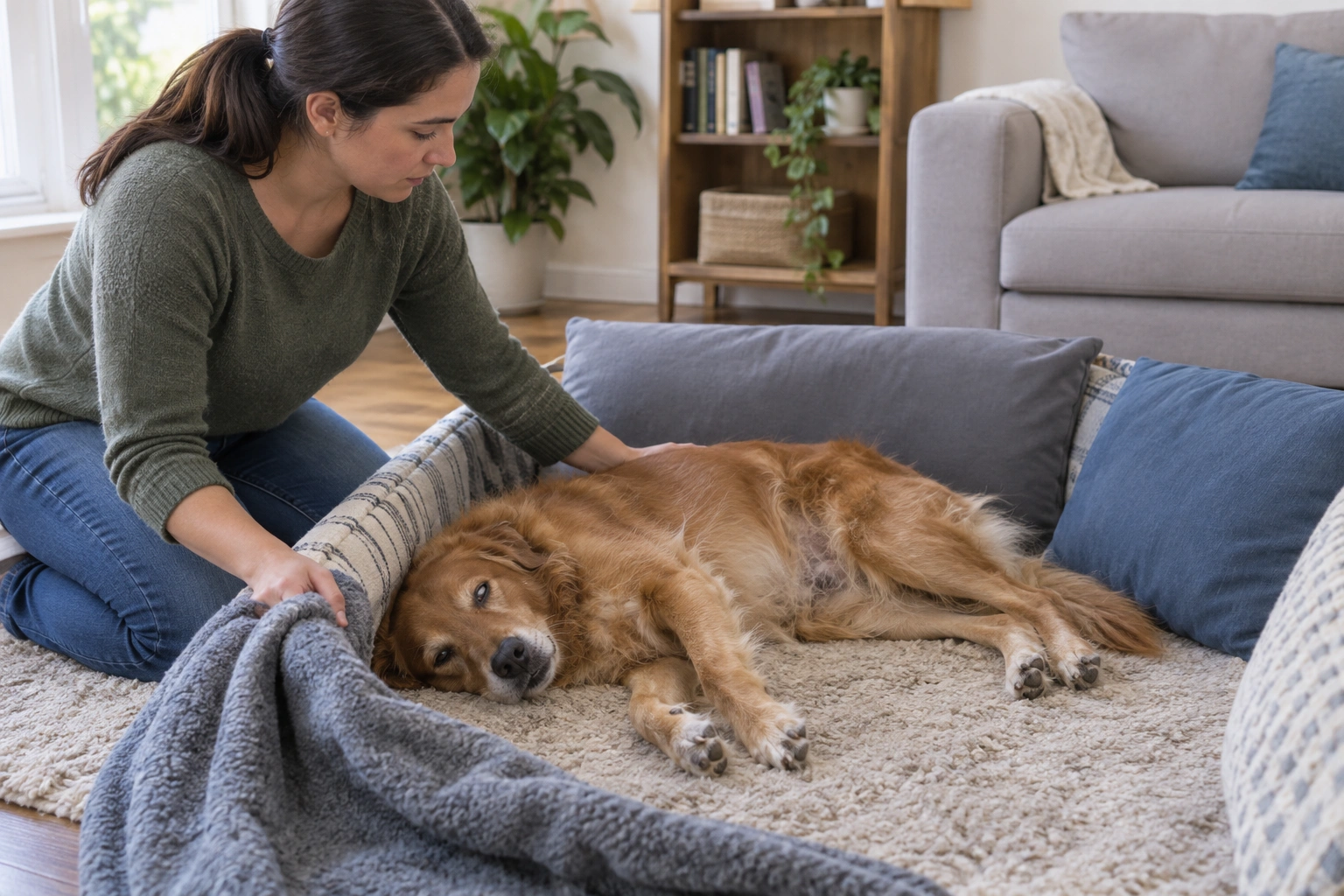
Your job after the seizure is to keep the dog from getting hurt while the brain resets.
Practical recovery steps
- Keep the dog in a quiet, dim room.
- Block stairs and jump points if possible.
- Limit the dog to one small, safe area if they are wandering or bumping into things.
- If the dog seems blind, wobbly, or confused, keep furniture and hazards out of the way.
- Offer water only when the dog is coordinated enough to drink safely.
- Wait before offering food if the dog is still dazed or unsteady.
- Stay close, but do not crowd the dog.
If your dog seems blind or deeply confused, reduce the space they can move through. A small room or blocked-off area is safer than letting a disoriented dog wander the house. If stairs are nearby, block access until coordination is clearly improving.
If the dog is pacing, do not force them to lie down. Just keep the area clear and let the recovery phase pass.
When a seizure is an emergency
Some seizure patterns need emergency care right away, not later that day.
Go to an emergency vet immediately if:
- the seizure lasts more than five minutes
- your dog has multiple seizures in 24 hours
- the dog is not recovering normally afterward
- breathing looks abnormal
- the dog has a known or suspected toxin exposure
- the episode followed possible heatstroke or overheating
- the dog is weak, unresponsive, or collapsing repeatedly
The toxin point matters. If your dog may have gotten into chocolate, xylitol, cannabis, rodent bait, human medication, or another poison, do not wait to see whether the seizure passes and the dog “seems okay.” Call an emergency vet or poison resource immediately.
If toxin exposure is suspected, tell the emergency clinic what the dog may have eaten, when it happened, how much might be missing, the dog’s weight, and any symptoms you have seen. Even partial information can help them triage faster.
Heat exposure is another urgent possibility. A dog that seizes after being in extreme heat may be dealing with a body-wide emergency, not just a neurologic event.
Should you call your regular vet or an emergency vet?
Use this decision rule:
- Emergency vet now if the seizure is prolonged, repeated, severe, linked to a toxin, or followed by poor recovery.
- Regular vet the same day or next available appointment if it was a first seizure, the dog recovered, and there are no emergency red flags.
Even if your dog seems normal afterward, a first seizure should still be reported to a veterinarian. The reason is simple: the episode could be epilepsy, but it could also be something urgent like poisoning, low blood sugar, head trauma, or another internal problem.
Cornell notes that seizure frequency influences treatment decisions, and MedVet summarizes ACVIM guidance indicating that long-term antiseizure medication is generally considered when seizures become recurrent, cluster, prolonged, or especially severe. That is not a home decision, but it shows why your vet will want a clear record of what happened.
What information to record for the veterinarian
If you can do it safely, write down or record:
- exact time the seizure started
- how long it lasted
- whether it was the first seizure
- what the dog was doing right before it started
- whether the dog collapsed suddenly or stiffened first
- whether there was paddling, drooling, urination, or defecation
- whether the dog seemed confused, blind, or weak afterward
- any possible toxin exposure
- recent heat exposure, trauma, vomiting, or illness
A short video can be especially helpful. Southeast Veterinary Neurology specifically recommends noting the duration and taking a video if possible.
This is one of those moments where a 20-second clip can save a lot of guesswork later.
Possible causes of seizures in dogs
A seizure is a sign, not a diagnosis.
Common causes include:
- Epilepsy
- Toxins or poisoning
- Low blood sugar
- Heatstroke
- Head trauma
- Structural brain disease
- Metabolic illness
For an owner, the immediate priority is not to identify every possible cause. It is to rule out the dangerous ones first.
That is why toxin exposure, overheating, trauma, and abnormal recovery push an episode into the emergency category. A dog that had a single seizure while otherwise healthy may still need a workup, but a dog that seized after getting into medication or after overheating needs faster action.
First seizure vs recurring or cluster seizures
A single seizure and repeated seizures are not the same problem.
A single brief seizure may still end with a dog walking around later as if nothing happened. That can be misleading. The episode still deserves veterinary follow-up because the next step depends on the cause.
Cluster seizures mean more than one seizure in a short period. MedVet’s summary of ACVIM guidance notes that cluster seizures are one of the situations where long-term antiseizure medication is commonly considered. In practical terms, clusters raise the stakes because the brain has shown it can enter that unstable pattern more than once.
Think of it this way:
- One brief event = important, needs follow-up
- Repeated events in the same day = urgent
- Prolonged event = emergency
That’s the decision ladder most owners need.
Border Collie seizure risk: what matters and what does not
Border Collies are not the breed most people first think of when they hear “seizure,” but breed alone should never be your deciding factor.
What matters more is:
- the dog’s age
- whether it was a first event
- how long it lasted
- whether recovery was normal
- whether there was possible toxin, heat, or trauma exposure
One practical breed-specific point: if a Border Collie has a first seizure as a puppy or young adult, epilepsy is often on the list of possibilities, but it is still important not to assume that is the cause without a veterinary exam. Other causes can look the same at home.
If you own a Border Collie and your dog has a seizure, don’t talk yourself out of action because the breed “usually” seems healthy. A fit, athletic dog can still have epilepsy or a serious secondary cause.
Breed context is useful only in a narrow way: it may shape your concern and your vet’s differential diagnosis, but it does not change the first-aid steps. Safe environment, timing, and prompt veterinary contact still come first.
When to seek longer-term veterinary follow-up
Even if the seizure stops and your dog looks normal later, it is still worth arranging a veterinary evaluation soon. Your vet may want to review the video, ask about possible exposures, and decide whether the episode fits a pattern that needs further workup.
This is especially true if:
- the dog is young or middle-aged and has a first seizure
- there are repeated episodes
- the post-seizure phase was unusually long
- there were changes in appetite, behavior, or coordination beforehand
- the dog has access to toxins, medications, or unsafe foods
You do not need to solve the diagnosis at home. You do need to give the vet a clear, accurate account of what happened.
FAQs
Should I put my dog in my lap during a seizure?
No. Holding or restraining the dog can increase injury risk and does not stop the seizure. Keep the area safe instead.
Are dog seizures painful?
Dogs may not seem to experience pain during the seizure itself, but the event can still be frightening and the recovery period can be uncomfortable or disorienting.
Can I give water after the seizure?
Only once the dog is coordinated enough to drink safely. If the dog is still wobbly, blind, or disoriented, wait and monitor.
How long is too long for a seizure?
More than five minutes is a common emergency threshold. Repeated seizures in a short period are also urgent.
What if my dog seems fine afterward?
Still call your veterinarian. A normal-looking recovery does not rule out a serious cause.
Could this be epilepsy?
Yes, but epilepsy is only one possible cause. Poisoning, low blood sugar, heatstroke, head trauma, and other illnesses can also cause seizures.
The calmest useful response is the safest one
If your dog has a seizure, the best response is practical, not dramatic: protect the body, time the event, avoid the mouth, and know when to escalate. That simple framework keeps most owners from making the mistakes that turn a frightening episode into a worse one.
