
When Does a Golden Retriever Go Into Heat? A Practical Owner’s Guide

If you live with an intact female Golden Retriever, the first question is usually simple: is this timing normal, or is something off? The short answer is that most Golden Retrievers go into heat for the first time somewhere around 10 to 14 months of age, although some start earlier and some later. After that, cycles often repeat about every 9 to 10 months, but individual dogs can vary. Crystal Creek Kennels notes that reproductive cycling generally continues unless the dog is pregnant or spayed, though timing can change with age and health.
That variation matters because owners often expect a neat schedule. Dogs do not always cooperate. A first heat can be subtle, irregular, or easy to miss if you are only looking for heavy bleeding. The goal here is to help you judge what is normal, what is not, and how to manage the cycle safely without guessing.
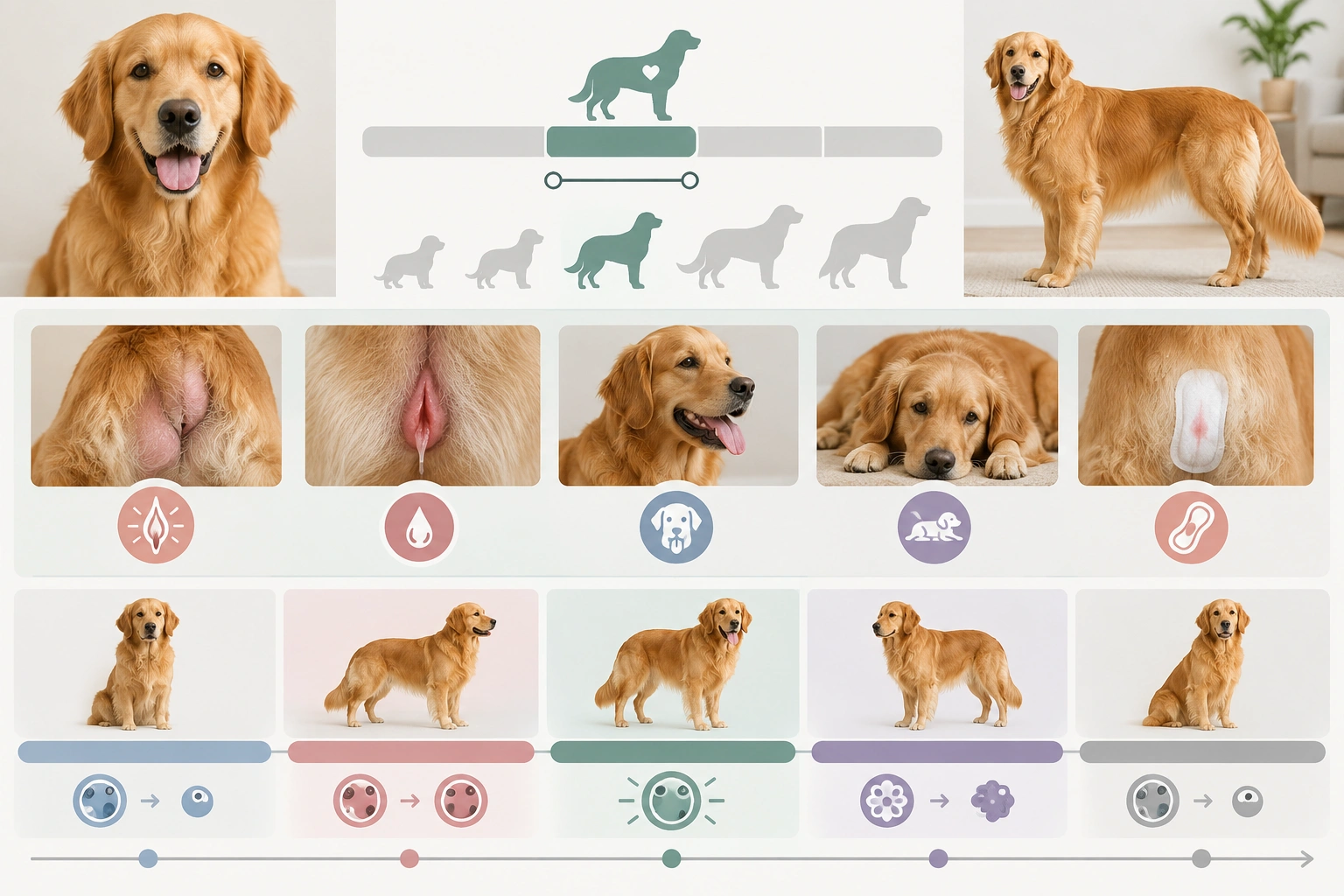
When a Golden Retriever Usually Goes Into Heat
For most female Golden Retrievers, the first heat shows up in the late puppy-to-young-adult window rather than right at six months like some smaller breeds. A practical expectation is around 10 to 14 months, with a wider possible range of roughly 6 to 15 months depending on the dog. Veterinary guidance also places large-breed first heats later than those of smaller dogs; the AKC’s heat-cycle guidance notes that large breeds may not cycle until 12 to 16 months, and some dogs may start later than that.
That range gives you a decision rule:
- Under 6 months: unusual for a Golden Retriever, and worth a vet call if you see bleeding or swelling.
- Around 10 to 14 months: the most typical window.
- After 18 months without any heat signs: not automatically an emergency, but it deserves a veterinary conversation.
A first heat is also not the same thing as “fully mature.” Puberty begins with that first cycle, but the dog may still be physically and behaviorally immature. That is one reason accidental breeding can happen when owners assume “she still seems like a puppy, so she can’t be fertile yet.” She can.
How to Tell Heat From Other Causes of Bleeding or Behavior Changes
The earliest signs are usually more useful than waiting for obvious bleeding. Many owners notice subtle changes first: a swollen vulva, more licking of the rear end, a slight change in odor, or male dogs suddenly showing strong interest. Some females also become clingier, restless, distracted, or a little more inclined to mark territory.
Here is the practical distinction to keep in mind:
- Heat signs tend to include swelling, discharge that may start light or bloody, attraction from males, and behavior changes that come and go.
- Illness or injury is more likely if there is strong pain, foul odor, lethargy, fever, vomiting, or discharge that looks pus-like rather than typical heat discharge.
Do not rely on bleeding alone. A dog can be in heat before the bleeding becomes obvious, and some dogs bleed very lightly. Others have enough discharge that it is obvious from across the room.
If the picture is unclear, treat the dog as though she is in heat until a veterinarian says otherwise. That is the safer assumption because a fertile female can attract males before an owner realizes the cycle has started.
Heat Cycle Stages and What to Expect
A dog’s heat cycle is usually described in stages. You do not need to memorize the Latin terms, but the stages help explain why the dog’s behavior changes over time.
Proestrus: the “starting” phase
This is the phase most owners notice first. Signs often include:
- swollen vulva
- bloody or pink-tinged discharge
- increased licking
- attraction from male dogs
- possible moodiness or restlessness
During proestrus, males are interested, but many females are not yet ready to accept mating. That does not mean the risk is low. It only means fertility is not yet at its peak.
Estrus: the fertile phase
Estrus is the stage when the dog is receptive to mating and pregnancy can occur. In real life, this is the phase that matters most for prevention. The discharge may become lighter or change in appearance, and some dogs seem friendlier, more distractible, or eager to roam.
This is where owners get caught out: bleeding may decrease, and they assume the cycle is ending. It may not be. Fertility can still be active.
Diestrus and the post-heat phase
After estrus, the body moves into the post-heat phase. Interest from males drops, swelling gradually resolves, and behavior usually settles. For some dogs, the tail end of the cycle is easy to miss because the dramatic signs fade before the body is fully back to baseline.
If your dog’s first cycle seems odd or hard to read, that is not unusual. First heats are often less predictable than later ones.
How Long Heat Lasts and How Often It Repeats
A Golden Retriever heat cycle commonly lasts about three weeks, though the visible signs do not always look the same for all three weeks. My Golden Retriever Puppies reports that heat cycles typically last about three weeks and that dogs usually experience two heat cycles per year, although this varies. Other breed-focused sources note that Golden Retrievers often cycle every 9 to 10 months.
That means a practical expectation is:
- Cycle length: about 3 weeks
- Repeat interval: about 9 to 10 months
- Range: roughly 6 to 10 months between cycles, with individual variation
The first heat is the one most likely to confuse owners. A young female may show only mild swelling, a small amount of discharge, or a short-lived change in behavior. Later cycles tend to become easier to recognize.
Comparison Table: Normal Timing, Possible Concerns, and Vet Triggers
| Situation | What may be normal | When to call the vet |
|---|---|---|
| First heat at 10–14 months | Typical for many Golden Retrievers | Not needed unless signs are unusual |
| First heat at 6–9 months | Can happen, especially in some dogs | Worth discussing if very early or paired with pain, odor, or heavy bleeding |
| First heat after 18 months | Can still happen in larger dogs | Call for advice, especially if there are no signs at all by 2 years |
| Light bleeding and vulva swelling | Common early heat signs | Call if bleeding is heavy, prolonged, or foul-smelling |
| Restlessness, clinginess, male interest | Often normal during proestrus/estrus | Call if the dog seems sick, painful, or extremely lethargic |
| Bleeding stops but males still swarm her | She may still be fertile | Continue strict separation; do not assume heat is over |
| Discharge with odor, fever, vomiting, or pain | Not typical heat | Vet visit promptly |
How to Prevent Unwanted Pregnancy During Heat
The safest approach is boring but effective: assume pregnancy is possible from the moment you suspect heat until the cycle is clearly over.
That means:
- Leash every outdoor trip. Even a fenced yard is not enough if a determined male dog can get in or if your dog can slip out.
- Separate her from intact males completely. Visual contact, shared gates, and “they only sniff through the fence” are not enough.
- Supervise bathroom breaks. Heat is not the time for unattended yard time.
- Avoid dog parks, daycare, and off-leash play. One lapse is all it takes.
- Use extra caution around visiting dogs. A male dog may become persistent fast.
The key trade-off is convenience versus certainty. It is easier to let a dog out into the yard alone. It is also how many accidental matings happen. If you cannot supervise, she should be confined in a secure area separate from male dogs.
Because the fertile period usually falls within the middle of the overall three-week cycle, keep strict separation in place until all discharge and swelling have clearly resolved and your veterinarian says the cycle is over if you are unsure.
Home Management: Hygiene, Confinement, and Daily Routine
A dog in heat usually does best with a predictable routine. Big changes can make her more restless, and restlessness makes management harder.
A few practical steps help:
- Put washable covers on bedding and sofas.
- Use dog diapers only as a cleanup aid, not as pregnancy prevention.
- Keep a cleaning kit ready for discharge spots.
- Walk at quieter times and avoid places where intact males are common.
- Maintain normal exercise, but keep it controlled and on leash.
If your dog is used to off-leash freedom, this phase can feel restrictive. That is intentional. The goal is not to entertain her endlessly; the goal is to keep her safe and prevent mating. Short, calm leash walks are usually better than trying to “burn off energy” in uncontrolled settings.
When First Heat Timing Is Early, Late, or Absent
Some variation is normal, but there are limits.
Early heat can happen. The AKC notes that some dogs may cycle as early as 4 months, but that is not typical for a Golden Retriever. If a young Golden shows heat signs very early, a vet visit is sensible to confirm what you are seeing.
Late heat is also possible. Large breeds may not start until 12 to 16 months, and some dogs may start later than that. That said, if your Golden is well past the usual range and has shown nothing at all, it is worth asking your veterinarian whether there is an underlying issue.
Absent heat means no cycle by the age you would reasonably expect it. If your dog is approaching 18 to 24 months with no signs, do not wait indefinitely. A veterinary exam can help rule out hormonal or developmental causes.
Red Flags That Need a Veterinarian
A normal heat cycle should not make your dog look sick.
Call your veterinarian if you notice:
- heavy bleeding
- discharge with a foul smell
- obvious pain or straining
- lethargy
- fever
- vomiting
- refusal to eat
- symptoms lasting far longer than expected
- bleeding when the timing does not fit a heat cycle
One useful way to think about it: heat changes behavior and discharge; illness changes the whole dog. If she seems unwell, do not assume it is just hormones.
Heat Management vs Spaying: How to Decide
This decision is less about theory and more about what you can realistically manage.
Continuing to manage heat cycles
This makes sense if you want to keep the dog intact for now, whether for breeding plans or because you are still deciding. The upside is flexibility. The downside is ongoing management: repeated cycles, constant supervision, and the risk of accidental mating every time she cycles.
Spaying
Spaying removes the heat cycle entirely, which ends the cycle-management problem. For many owners, that is the cleanest long-term solution. The trade-off is that it is a surgical decision, so timing should be discussed with your veterinarian rather than rushed.
A practical way to decide is to ask:
- Can I reliably prevent mating every time she cycles?
- Do I have a clear reason to keep her intact?
- Am I prepared for the repeat schedule and household disruption?
- Have I discussed spay timing with my vet for my dog’s age and health?
If the honest answer to the first question is no, spaying deserves serious consideration.
When to See a Veterinarian or Certified Trainer
For heat-cycle questions, the veterinarian is the right professional. A certified trainer can help with management routines if your dog becomes anxious, vocal, or difficult to confine during heat, but medical concerns belong with the vet.
Book a veterinary appointment if:
- the first heat comes very early or very late
- there are no signs by the upper end of the expected range
- bleeding is heavy, prolonged, or smelly
- the dog seems painful, weak, or ill
- you are unsure whether the signs are heat or something else
- you want help deciding when to spay
For broader reproductive-health basics, the ASPCA’s pet care resources and VCA Hospitals’ veterinary articles are useful starting points, especially when you want a second reliable source before making a decision.
FAQ
How long is a Golden Retriever in heat?
Most are in heat for about three weeks, although the most fertile period is usually only part of that cycle.
How often do Golden Retrievers go into heat?
A common pattern is about every 9 to 10 months, though some dogs vary and may cycle a bit sooner or later.
What are the first signs of heat in a Golden Retriever?
Swollen vulva, light discharge, increased licking, restlessness, and male dog interest are common early signs.
Can a Golden Retriever get pregnant during her first heat?
Yes. The first heat can be fertile, so prevention matters right away.
When should I call the vet?
Call if the timing seems very early or late, if bleeding is heavy or foul-smelling, or if your dog seems sick or painful.
Quick Takeaway
Most female Golden Retrievers go into heat for the first time around 10 to 14 months, though the range can be wider. Heat usually lasts about three weeks, often repeats every 9 to 10 months, and the first cycle may be less obvious than later ones. If you see swelling, discharge, or male interest, assume she is fertile enough to need strict supervision right away. If the timing, odor, bleeding, or behavior seems off, call your veterinarian instead of waiting it out.
